
Introduction Welcome Block
At Free Documents Hub, we specialize in providing high-quality, field-ready documentation, safety guides, and operational standards tailored for the oil and gas, manufacturing, and heavy industrial sectors.
1. Introduction: The Foundation of Industrial Control Architecture
When designing an industrial automation system, selecting the right Programmable Logic Controller (PLC) hardware is one of the most critical decisions an automation engineer will make. The control system acts as the central nervous system of any modern manufacturing plant, water treatment facility, or oil and gas installation. Within this ecosystem, the choice typically narrows down to two primary hardware architectures: Compact PLCs and Modular PLCs.
While both hardware types execute the same core function—reading inputs, executing user control logic via IEC 61131-3 programming languages, and driving physical outputs—their physical layout, expansion capabilities, cost structures, and application sweet spots are vastly different. Choosing incorrectly can lead to bloated project budgets, physical space constraints in control panels, or severe limitations when future plant expansions are required.
This comprehensive guide explores the structural nuances, performance characteristics, advantages, and limitations of modular and compact PLCs, giving you a definitive framework to select the ideal hardware architecture for your next engineering project.
2. Understanding Compact PLCs (Fixed Architecture)
What is a Compact PLC?
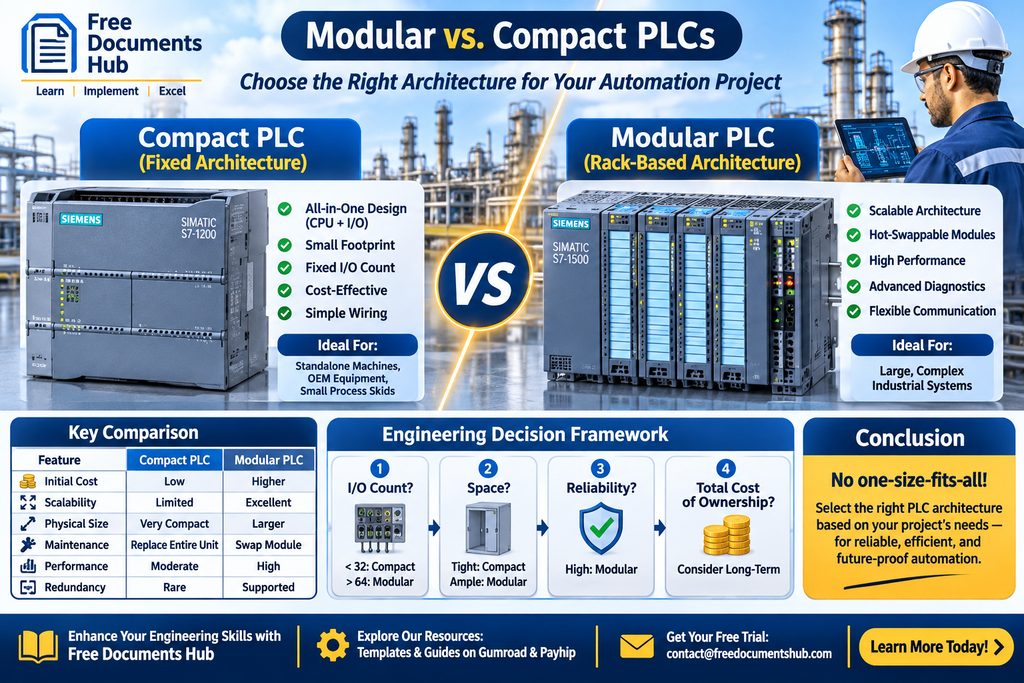
A Compact PLC, often referred to as a “brick,” “fixed,” or “packaged” PLC, integrates the central processing unit (CPU), power supply, and a fixed number of digital and analog input/output (I/O) points into a single, unified housing.
Unlike modular systems where components are separate entities slotted onto a backplane, the compact PLC is built as a cohesive, all-in-one unit. While some advanced compact models allow for limited expansion through a small number of specialized snap-on communication modules or expansion cards, their core I/O capacity is predetermined at the point of purchase.
Key Characteristics of Compact PLCs
- All-in-One Design: CPU, memory, power supply, and local I/O reside in a single enclosure.
- Small Physical Footprint: Highly optimized for space-constrained electrical enclosures and machine-mounted control boxes.
- Fixed I/O Count: Typically available in standard configurations (e.g., 14, 24, 40, or 60 I/O points).
- Cost-Effective Entry Point: Lower upfront material costs for small-scale, standalone applications.
- Simplified Wiring: Straightforward terminal blocks directly connected to the main chassis.
Ideal Applications for Compact PLCs
Compact PLCs shine in standalone machines, OEM equipment, and localized process skids where the I/O count is known, stable, and unlikely to change over the asset’s lifecycle. Common use cases include:
- Packaging and bottling machines.
- HVAC skid package units.
- Small conveyor systems.
- Generator sets and compressor control panels.
- Single-axis motion or simple pump lift stations.
3. Understanding Modular PLCs (Rack-Based Architecture)
What is a Modular PLC?
A Modular PLC utilizes a rack-based or DIN-rail backplane system where individual hardware components—such as the CPU, power supply module, communication processors, and discrete or analog I/O cards—exist as separate, interchangeable modules.
In a modular setup, the system is completely customizable. If a project requires fifty thermocouple inputs and zero high-speed counter channels, the engineer simply selects and inserts the exact matching I/O modules onto the rack. If the plant later expands and requires fifty additional control points, new I/O modules are simply snapped onto the existing backplane without replacing the core processor.
Key Characteristics of Modular PLCs
- Scalable Architecture: Easily expandable by adding I/O cards, specialty function modules, or remote rack drops.
- Hot-Swappable Components: Many modular systems allow technicians to replace failed I/O modules or power supplies without shutting down the entire PLC rack or cutting main power (depending on safety ratings).
- High Processing Power & Memory: Designed to handle complex, multi-tasking automation routines, massive tag databases, and advanced mathematical computations.
- Robust Diagnostics: Advanced channel-level diagnostic LEDs and software-level fault reporting for troubleshooting individual field connections.
- Flexible Communication: Seamless integration of multiple industrial networking protocols (PROFINET, EtherNet/IP, Modbus TCP, PROFIBUS) via dedicated communication processors.
Ideal Applications for Modular PLCs
Modular PLCs are engineered for large-scale, complex, and highly integrated industrial environments where system flexibility and high availability are mandatory. Common use cases include:
- Continuous process plants (chemical, petrochemical, and refineries).
- Large automotive manufacturing lines.
- City-wide municipal water and wastewater treatment facilities.
- High-speed automated distribution and logistics sorting centers.
- Distributed Control Systems (DCS) and hybrid automation networks.
4. Head-to-Head Comparison: Modular vs. Compact PLCs
To make an informed engineering decision, let us evaluate both hardware architectures across key technical and financial dimensions:
| Evaluation Criteria | Compact PLCs | Modular PLCs |
| Initial Capital Cost | Low; ideal for tight budgets on small projects. | Higher upfront cost due to backplanes, racks, and discrete modules. |
| Scalability & Expansion | Very limited; restricted to few expansion slots or none. | Extremely high; scale effortlessly by adding rack cards or remote drops. |
| Physical Footprint | Compact, slim, and space-saving in small panels. | Requires larger control cabinets to accommodate racks and wiring troughs. |
| Maintenance & Repair | Unit failure usually requires replacing the entire brick controller. | Modular replacement; swap only the failed I/O card or power supply. |
| Processing Performance | Moderate; optimized for straightforward control logic and smaller tag counts. | High to industrial-grade power; handles complex algorithms and motion control. |
| Redundancy Options | Rarely supports CPU or power supply redundancy. | Full support for hot-standby CPU redundancy and dual power supplies. |
5. Engineering Decision Framework: How to Choose for Your Project
Selecting the right architecture requires balancing immediate project specifications against long-term operational goals. Ask yourself and your project team the following four key questions:
1. What is the Current and Future I/O Count?
Calculate your hardwired digital inputs, digital outputs, analog inputs, and analog outputs.
- If your total I/O is small (e.g., under 32 points) and guaranteed never to expand, a Compact PLC is your most economical choice.
- If your I/O exceeds 64 points, or if plant stakeholders indicate potential future expansions, invest in a Modular PLC to avoid costly retrofits later.
2. What are the Environmental and Physical Constraints?
Look at the physical space available inside your electrical control panel.
- If you are retrofitting a tight machine-mounted enclosure where panel real estate is at a premium, a compact brick PLC saves critical space.
- If you have ample room and require structured wire management troughs alongside high-density terminal blocks, a modular rack layout provides superior organization.
3. What Level of System Reliability and Downtime Tolerance is Required?
Consider the cost of unexpected plant downtime.
- For a standalone machine where a 2-hour stoppage has minimal financial impact, a compact PLC is sufficient.
- For a critical continuous process plant where downtime costs thousands of dollars per minute, the hot-swappable capabilities, diagnostics, and redundancy of a Modular PLC are essential.
4. What is the Total Cost of Ownership (TCO)?
Look beyond the initial purchase order price. While compact units are cheaper initially, replacing an entire brick controller due to a single damaged output channel can prove more expensive over a 10-year lifecycle than simply swapping a single modular I/O card.
6. Conclusion: Striking the Right Balance
Neither modular nor compact PLCs are universally “better”—each architecture serves a distinct purpose in the vast landscape of industrial automation. Compact PLCs deliver unbeatable value, simplicity, and a small footprint for standalone machines and OEM equipment. Modular PLCs provide the scalability, robust processing power, and maintenance flexibility required to command large, complex industrial facilities.
By carefully evaluating your project’s I/O requirements, expansion potential, physical space constraints, and lifecycle maintenance goals, you can select the ideal hardware architecture to ensure reliable, efficient, and future-proof plant operations.
🎓 Elevate Your Engineering Capabilities with Free Documents Hub
Knowing how to select hardware architecture is only half the battle; mastering modern industrial documentation, code compliance, and smart control frameworks is what sets top-tier engineers apart.
At Free Documents Hub, we offer specialized remote training programs covering industrial engineering design, PLC programming workflows, and technical documentation. Our programs are specifically designed to bridge the gap between academic theory and real-world shop-floor execution.
🛠️ Ready to elevate your technical credentials?