
Introduction
Every fire alarm system installed on an industrial project — whether a process plant in Jubail, a high-rise in Dubai, or a warehouse in Germany — must comply with one standard above all others. That standard is NFPA 72, the National Fire Alarm and Signaling Code.
Yet on project sites across the Gulf and globally, fire alarm system drawings are rejected, installations fail inspection, and commissioning is delayed — all because engineers, inspectors, and technicians do not have a solid working knowledge of what NFPA 72 actually requires.
This guide was written to fix that.
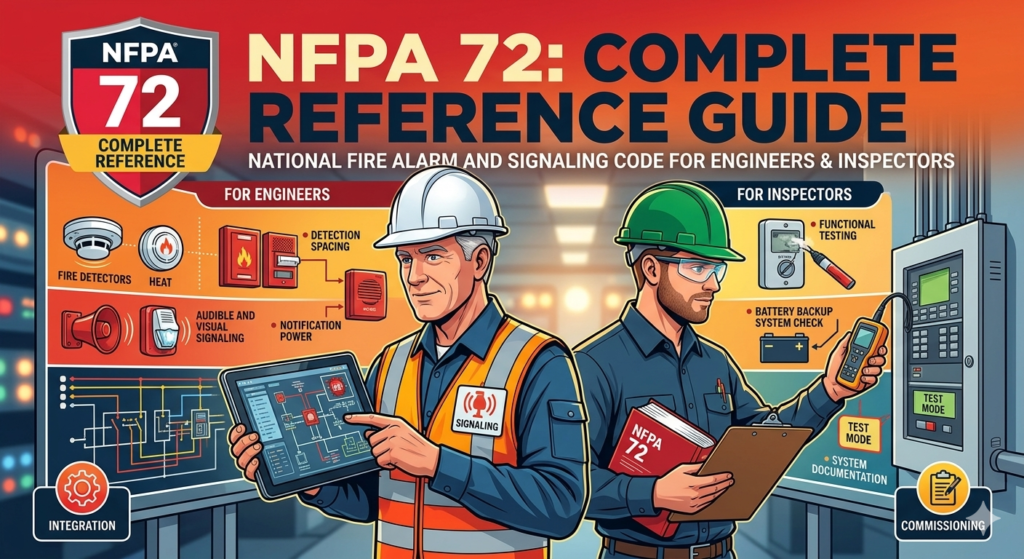
The NFPA 72 Complete Reference Guide from FreeDocumentsHub.com covers everything a working engineer or inspector needs — system types, the Fire Alarm Control Unit, initiating device selection and spacing, notification appliance requirements, wiring classes, inspection and testing frequencies, documentation obligations, hazardous area applications, and the ten most common compliance failures found on industrial projects.
Download it . Keep it on your desk.
What is NFPA 72?
NFPA 72 is published by the National Fire Protection Association and is updated on a three-year revision cycle — the current edition is 2022. It governs the design, installation, inspection, testing, and maintenance of fire alarm systems and emergency communications systems in the United States and is referenced globally as the primary fire alarm standard.
On Saudi Aramco projects, NFPA 72 is the design reference for all fire alarm and detection systems. Engineers preparing fire alarm drawings for Aramco approval must demonstrate compliance with NFPA 72 requirements. Inspectors and safety officers are tested on NFPA 72 in the Aramco CBT. It is not background knowledge — it is a daily working requirement.
NFPA 72 does not stand alone. It works together with NFPA 70 (National Electrical Code), NFPA 101 (Life Safety Code), and local building codes to form the complete fire protection and life safety framework for any facility.
What the Guide Covers — 11 Sections
Section 1 — What is NFPA 72 covers the purpose, scope, and why this standard matters specifically on industrial and Aramco projects. It establishes the foundation before moving into technical requirements.
Section 2 — System Types and Classifications covers every type of system NFPA 72 governs — protected premises systems, central station and proprietary supervising stations, and the full range of Emergency Communications Systems including wide-area mass notification, in-building mass notification, and distributed recipient systems.
Section 3 — Fire Alarm Control Unit covers the FACU in full — its functions, the dedicated power circuit requirement, the critical 24-hour standby plus 5-minute full alarm battery requirement, battery charger specifications, supervision of both primary and secondary power, and mounting and location rules.
Section 4 — Initiating Devices is the largest technical section. It covers all nine types of automatic fire detectors — ionisation smoke, photoelectric smoke, combination detectors, fixed temperature heat, rate-of-rise heat, combination heat, flame detectors, gas detectors, and multi-sensor detectors — with the operating principle and correct application for each. It covers manual pull station requirements including mounting height, maximum travel distance, and colour identification. And it covers detector spacing rules including the critical high-ceiling spacing reduction that is the most common drawing rejection reason on Aramco and Gulf industrial projects.
Section 5 — Notification Appliances covers audible devices including the minimum 15 dB above ambient rule, the 75 dB sleeping area requirement, and the mandatory Temporal-3 evacuation pattern. It covers visible devices — strobe candela ratings, mounting heights, and the mandatory synchronization requirement that prevents seizure risk when multiple strobes are visible simultaneously. It covers voice evacuation systems and the minimum STI-PA 0.45 intelligibility requirement.
Section 6 — Wiring and Installation covers Class B, Class A, and Class X circuit styles and their survivability characteristics, when each is required, cable listing requirements (FPLP and FPLR), separation from power wiring, conduit requirements in hazardous areas, circuit supervision requirements, and the differences between conventional, addressable, analogue addressable, and hybrid systems.
Section 7 — Inspection, Testing and Maintenance covers the full ITM schedule from quarterly FACU inspection through annual detector sensitivity testing and five-year battery replacement, the complete 10-step acceptance testing procedure for new systems, and detector sensitivity testing methods.
Section 8 — Documentation and Records covers every document required by NFPA 72 — system design drawings, equipment lists, battery calculations, voltage drop calculations, acceptance test reports, as-built drawings, ITM records, impairment records, and the mandatory Record of Completion form that must be produced for every installation.
Section 9 — Special Applications covers high-rise building requirements, hazardous location equipment selection for Class I Division 1 and Division 2 and Zone 0, 1, and 2 areas, intrinsically safe barrier requirements for classified area wiring, duct smoke detector installation and testing requirements, and suppression system interface requirements.
Section 10 — Common Deficiencies is one of the most practically useful sections in the guide. It lists the ten most common NFPA 72 compliance failures found on industrial and Aramco projects — missing battery calculations, unadjusted detector spacing for high ceilings, unsynchronized strobes, Class B wiring in critical areas, missing duct detectors, no voltage drop calculation, missing IS barriers in classified areas, incorrectly located manual stations, incomplete acceptance testing, and no Record of Completion. Understanding these deficiencies at the design stage eliminates the drawing rejection comments that delay project approval.
Section 11 — Abbreviation Reference provides a complete reference for all NFPA 72 abbreviations including AHJ, FACU, ECS, IS, ITM, MNS, STI-PA, T-3, and all wiring designations.
Who Should Download This Guide
This guide is for fire alarm system design engineers preparing drawings for AHJ or Aramco approval. It is for electrical engineers who need to understand NFPA 72 requirements when reviewing contractor submittals. It is for site inspectors conducting fire alarm system acceptance testing. It is for safety officers preparing for the Aramco CBT where NFPA 72 requirements are tested. It is for project managers who need to understand why fire alarm drawings are rejected and what is required to resolve the comments.
If you work on any industrial, commercial, or process plant project where a fire alarm system is installed, this guide belongs in your reference library.
The NFPA 72 Complete Reference Guide is available now as a free Word document download from FreeDocumentsHub.com.
👉 www.freedocumentshub.com 📧 Custom fire alarm documentation for your project: contact@freedocumentshub.com
FreeDocumentsHub.com — Free Industrial Documents and Training. Available 24 hours, 7 days a week.