
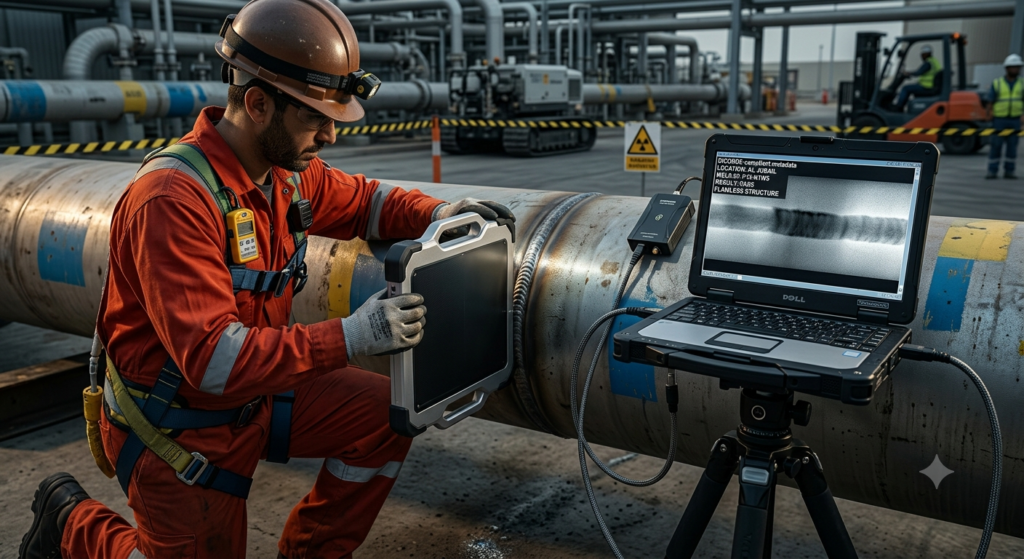
For nearly a century, industrial radiography has served as the bedrock of structural safety and non-destructive testing (NDT). From verifying the integrity of high-pressure pipelines to checking critical aerospace components for sub-surface flaws, radiographic testing (RT) has saved countless lives by identifying hidden structural defects before they lead to catastrophic failure.
Historically, this meant relying heavily on industrial X-ray film. However, the industrial inspection landscape is experiencing a massive paradigm shift. Propelled by rapid advancements in sensor technology and digital imaging, Digital Radiography (DR) systems are aggressively replacing traditional film-based techniques across UK industrial sectors and global engineering landscapes.
If you are an NDT technician, a quality assurance manager, or an asset integrity engineer, understanding the shift from Film RT to DR is no longer optional—it is a modern operational necessity. This comprehensive guide breaks down the mechanisms of both technologies, compares their core metrics head-to-head, and explains why digital systems are taking over the industry.
1. The Legacy Framework: Understanding Traditional Film RT
To appreciate where industrial radiography is going, we must first look at where it started. Traditional Film Radiographic Testing (Film RT) operates on a concept very similar to old-school analog photography.
How Film RT Works
An industrial X-ray or gamma-ray source is positioned on one side of the test object (such as a structural steel weld or a valve casting), while a flexible cassette containing radiographic film is placed on the opposite side. When the radiation source is activated, the rays penetrate the object.
Denser areas of the material (like a thick steel wall) absorb more radiation, allowing fewer rays to pass through. Conversely, volumetric defects—such as internal gas porosity, slag inclusions, or cracks—absorb less radiation, letting more rays reach the film. The radiation interacts with the silver halide crystals in the film emulsion, creating a latent image.
The Drawbacks of the Analog Process
While Film RT provides exceptional spatial resolution and a permanent physical record, it is burdened by significant operational bottlenecks:
- Chemical Processing Consumables: Developing the latent image requires a dedicated darkroom, automatic film processors, and a hazardous cocktail of developing and fixing chemicals.
- Time Delays: Technicians must wait anywhere from 15 minutes to an hour for the film to develop, wash, and dry before anyone can interpret the results. If the exposure settings were incorrect, the entire process must be repeated.
- Physical Storage and Degradation: Industrial codes often require radiographic records to be kept for decades. Storing thousands of physical film sheets requires immense climate-controlled warehouse space, and the film itself can degrade over time.
- Environmental Concerns: The disposal of toxic chemical waste and silver byproducts creates heavy environmental compliance costs for industrial facilities.
2. The Digital Frontier: What is Digital Radiography (DR)?
Digital Radiography eliminates the need for chemical film entirely, replacing it with electronic sensors that capture radiation and instantly convert it into a digital image file displayed on a computer monitor.
Within the industrial NDT sector, digital radiography generally branches into two major modalities:
Computed Radiography (CR)
Computed Radiography is considered the transitional step between film and pure digital. Instead of a chemical film, CR utilizes a flexible Photostimulable Phosphor (PSP) plate.
The PSP plate is exposed to radiation exactly like traditional film. However, instead of entering a darkroom, the plate is run through a laser scanner. The laser stimulates the phosphor crystals, releasing light that is converted into a high-resolution digital image. The plate is then erased by a bright light source and can be reused thousands of times.
Direct Digital Radiography (DR)
Direct Digital Radiography (or simply DR) represents the absolute cutting edge of modern NDT. DR utilizes a rigid or semi-flexible Flat Panel Detector (FPD).
These detectors contain a matrix of electronic pixels. When radiation strikes the detector, it is immediately converted into an electrical charge (either directly via an amorphous selenium sensor or indirectly using a scintillator coupled with an amorphous silicon sensor). Within fractions of a second, a highly detailed digital image appears on the technician’s laptop screen or tablet. There is zero intermediate scanning step.
3. Head-to-Head Comparison: DR vs. Film RT
When evaluated across real-world industrial key performance indicators (KPIs), the advantages of transitioning to new DR systems become undeniably clear.
| Feature / Metric | Traditional Film RT | Modern Digital Radiography (DR) |
| Image Acquisition Time | 15 to 60+ minutes (due to chemical developing) | Near-instantaneous (under 10 seconds) |
| Consumable Costs | High (ongoing costs for film, chemistry, disposal) | Extremely Low (reusable digital detectors) |
| Dynamic Range & Latitude | Narrow (requires highly precise exposure settings) | Very Wide (software can adjust contrast post-exposure) |
| Environmental Footprint | Large (hazardous chemical waste stream) | Eco-Friendly (zero chemicals or heavy metals) |
| Radiation Dose Requirements | High exposure times needed to react with film | Up to 70-90% lower exposure times |
| Data Mobility & Storage | Physical archive boxes, manual scanning needed | Cloud-ready, secure servers, instant digital sharing |
Dynamic Range and Image Manipulation
One of the greatest engineering advantages of DR over Film RT is its massive dynamic range. Film has a narrow latitude; if an object varies significantly in thickness, the thin sections will appear completely black (overexposed) while the thick sections will remain completely white (underexposed) on the same film.
DR flat panel detectors possess incredible contrast sensitivity. Advanced NDT image processing software allows inspectors to apply digital filters, zoom in on microscopic regions, alter contrast, and measure defect dimensions accurately directly on screen. A single digital exposure can capture multiple material thicknesses simultaneously, completely eliminating the need for multi-film setups or time-consuming re-shots.
Enhanced Radiation Safety
Because digital sensors are significantly more sensitive to radiation than industrial film, they require far less radiation exposure to produce a high-contrast image. This allows field inspection teams to utilize lower-output X-ray tubes or smaller radioactive sources, drastically reducing the safety exclusion zone on a worksite. In bustling manufacturing yards or UK shipyards, minimizing the radiation boundary means surrounding trades can continue working safely without costly down-time.
4. Driving Force in UK Industrial Applications
The adoption of industrial digital radiography across the UK is skyrocketing, fueled by modern quality control demands and safety regulations.
- Aerospace and Defense: Aerospace components, such as turbine blades and composite wings, require flawless structural reliability. DR allows precision inspection of intricate geometries with microscopic defect detection capabilities.
- Oil, Gas, and Process Piping: For offshore North Sea installations or onshore refineries, mapping internal corrosion and examining pipe girth welds is a round-the-clock requirement. DR systems allow inspection crews to move rapidly down a pipeline, capturing and logging hundreds of weld profiles per day directly into asset management databases.
- Pressure Vessel Fabrication: Heavy manufacturing facilities constructing vessels under international standards use DR to instantly verify the integrity of longitudinal and circumferential shell seams, accelerating production throughput.
5. Overcoming the Hurdles of the Digital Transition
Despite its immense benefits, moving away from traditional film does present a few challenges that organizations must carefully navigate:
- Initial Capital Investment: Purchasing premium industrial FPDs, specialized NDT software, and ruggedized fieldwork laptops requires a significant up-front financial commitment compared to basic film equipment. However, most companies realize a complete return on investment (ROI) within 12 to 18 months due to the elimination of film consumables and massive time savings.
- Code Compliance and Standards: Industrial sectors operate under strict codes like ASME Section V, ASTM, and ISO standards. Historically, these documents were written around film terminology. Fortunately, modern code updates have established comprehensive frameworks for qualifying digital radiography procedures.
- Personnel Upskilling: Technicians accustomed to evaluating physical film sheets require proper training to handle digital image manipulation software, manage digital data storage compliance, and correctly identify digital image artifacts.
Summary: The Digital Future is Now
The transition from traditional Film RT to modern Digital Radiography is a natural evolutionary step for industrial quality control. By replacing chemical darkrooms with instant digital acquisition, DR systems provide manufacturing and asset maintenance sectors with unprecedented speed, reduced operational overhead, enhanced radiation safety, and superior defect visibility. As industries continue to undergo digital transformations, the reliance on film will continue to fade, solidifying DR as the definitive gold standard for industrial X-ray inspection.
Advance Your Engineering Career with Free Training
Mastering the complexities of international inspection codes, digital NDE procedure development, and asset documentation takes time—but you do not have to learn it alone.
At Free Documents Hub, we provide expert remote training specializing in all types of engineering, design, and technical documentation. Whether you are looking to master pressure vessel design formulas, perfect your fabrication blueprints, or understand international compliance and inspection standards, our remote programs are built to bridge the gap between academic theory and real-world industrial application.
Ready to elevate your technical skills? Contact us today at contact@freedocumentshub.com to claim your free trial and kickstart your training journey!