
Safety Requirements Explained
| Need a Confined Space Gas Detection & Alarm System That Actually Passes Audit? Shammari Smart Systems designs, installs, and certifies confined space entry safety systems for oil & gas facilities — Aramco Approved Vendor No. 10109302. WhatsApp Us: +966-XXXXXXXXX | www.freedocumentshub.com/contact |
Confined space entry remains one of the leading causes of multiple-fatality incidents in the oil and gas industry. A worker overcome by toxic or oxygen-deficient atmosphere inside a tank, vessel, or pit frequently triggers a second and third fatality when untrained colleagues attempt an unprotected rescue. A disciplined, permit-based confined space entry procedure is not paperwork — it is the control that keeps entrants alive and keeps a facility inspection-ready.
This guide walks through what qualifies as a confined space in an upstream, midstream, or downstream facility, the regulatory frameworks that govern entry, and the step-by-step procedure — from hazard assessment through rescue planning — that a compliant entry permit must document.
What Counts as a Confined Space?
OSHA 29 CFR 1910.146 defines a confined space as an area that is large enough for a worker to enter and perform work, has limited or restricted means of entry or exit, and is not designed for continuous occupancy. In oil and gas facilities, this typically includes:
- Storage tanks, pressure vessels, and separators
- Process columns, reactors, and heat exchangers
- Pipeline sections, manifolds, and pig launcher/receiver barrels
- Sumps, pits, trenches, and below-grade vaults
- Sewers, drainage systems, and cellars on drilling rigs
A confined space becomes a permit-required confined space (PRCS) when it contains, or has the potential to contain, a hazardous atmosphere, engulfment hazard, an internal configuration that could trap or asphyxiate an entrant, or any other recognized serious safety or health hazard. Nearly every process vessel in an oil and gas facility falls into this category.
Governing Standards
Confined space entry programs in oil and gas are typically built around a combination of the following references:
- OSHA 29 CFR 1910.146 — Permit-Required Confined Spaces (general industry)
- API RP 2217A — Guidelines for Confined Space Work in the Petroleum and Petrochemical Industries
- API RP 2016 — Guidelines for Confined Space Work in Petroleum Storage Tanks
- ISO 45001 — Occupational Health and Safety Management Systems (procedural and risk-assessment requirements)
- Facility-specific procedures, including Saudi Aramco’s General Instruction (GI) 6.021 for confined space entry on Aramco-operated sites
Vendors and contractors working on Aramco-operated facilities are expected to align their internal confined space procedures with the operator’s GI requirements as a condition of site access and AVL standing.
Entry Roles and Responsibilities
| Role | Core Responsibility |
| Entry Supervisor | Authorizes the permit, verifies pre-entry conditions, and can terminate entry at any time |
| Attendant | Remains outside the space, monitors entrants continuously, and initiates rescue procedures if needed |
| Authorized Entrant | Performs the work, wears required PPE, and evacuates immediately when ordered or when hazards are detected |
| Rescue Team | Standby or facility-based team trained and equipped to retrieve entrants without entering an unprotected atmosphere |
Step-by-Step Entry Procedure
1. Hazard Assessment and Isolation
Before any permit is issued, the space must be evaluated for atmospheric, mechanical, and physical hazards. All energy sources — electrical, mechanical, pneumatic, and hydraulic — are isolated using lockout-tagout (LOTO). Piping connections are blinded or physically disconnected rather than relying on closed valves alone, since valve leakage is a recurring root cause in incident investigations.
2. Atmospheric Testing
A calibrated multi-gas detector tests the atmosphere before entry and continuously during occupancy. Testing sequence matters: oxygen first, then combustibles, then toxics. Results are logged on the permit at the required interval, typically every 2-4 hours or continuously with a fixed monitor for higher-risk spaces.
| Parameter | Acceptable Range | Action if Exceeded |
| Oxygen (O2) | 19.5% – 23.5% | Ventilate and retest before entry |
| Lower Explosive Limit (LEL) | Below 10% LEL | Evacuate, ventilate, identify source |
| Hydrogen Sulfide (H2S) | Below 10 ppm (8-hr TWA) | Evacuate immediately, do not enter |
| Carbon Monoxide (CO) | Below 35 ppm (8-hr TWA) | Ventilate and retest before entry |
3. Ventilation
Forced-air ventilation is established before entry and maintained throughout the work. Where natural ventilation cannot maintain safe atmospheric limits, continuous mechanical ventilation combined with a fixed-point or personal gas monitor is required for the duration of occupancy.
4. Permit Issuance
The confined space entry permit consolidates the hazard assessment, isolation record, atmospheric test results, required PPE, communication method, and rescue plan into a single authorized document. The permit is time-limited — typically valid for a single shift — and must be re-issued if conditions change or work is suspended and resumed.
5. Rescue Planning
OSHA requires that a rescue capability be arranged before entry begins, not improvised after an incident. Non-entry retrieval — a harness and mechanical retrieval line operated from outside the space — is the preferred method wherever the internal configuration allows it. Where entry rescue is unavoidable, the standby rescue team must be trained, equipped with supplied-air respiratory protection, and able to respond within the time the atmosphere or engulfment hazard allows.
| Common Findings in Confined Space Audits and NCRs • Atmospheric testing logged but not repeated at the required interval • Attendant leaves the entry point unattended, even briefly • Rescue plan references a team that is not actually on-site or on standby • Blinding not verified — isolation relies on a closed valve alone • Permit not closed out or re-validated after a shift change |
PPE and Equipment Checklist
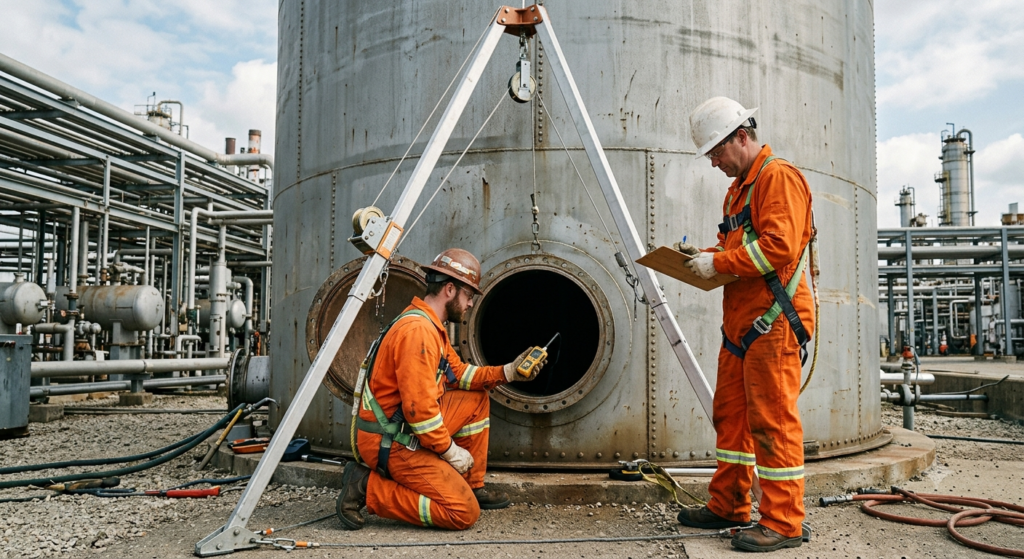
- Calibrated four-gas (or multi-gas) detector, bump-tested before each use
- Full-body harness with retrieval line for non-entry rescue
- Tripod or davit arm anchor system positioned at the entry point
- Continuous or two-way radio communication between entrant and attendant
- Supplied-air or SCBA respiratory protection where atmosphere cannot be maintained safely
- Explosion-proof lighting and forced-air ventilation blower
- Fire-resistant coveralls and appropriate hand/eye/head protection for the specific task
Why This Matters Beyond Compliance
A confined space entry procedure that exists only as a template, without a fixed gas detection system, tested alarm thresholds, and a rescue plan matched to the actual layout of the vessel, will not hold up under either an incident investigation or an Aramco AVL audit. The procedure and the hardware behind it — detectors, alarms, ventilation, and retrieval systems — have to be engineered together for the specific space, not assembled from a generic checklist.
| Need a Confined Space Gas Detection & Alarm System That Actually Passes Audit? Shammari Smart Systems designs, installs, and certifies confined space entry safety systems for oil & gas facilities — Aramco Approved Vendor No. 10109302. WhatsApp Us: +966-XXXXXXXXX | www.freedocumentshub.com/contact |