
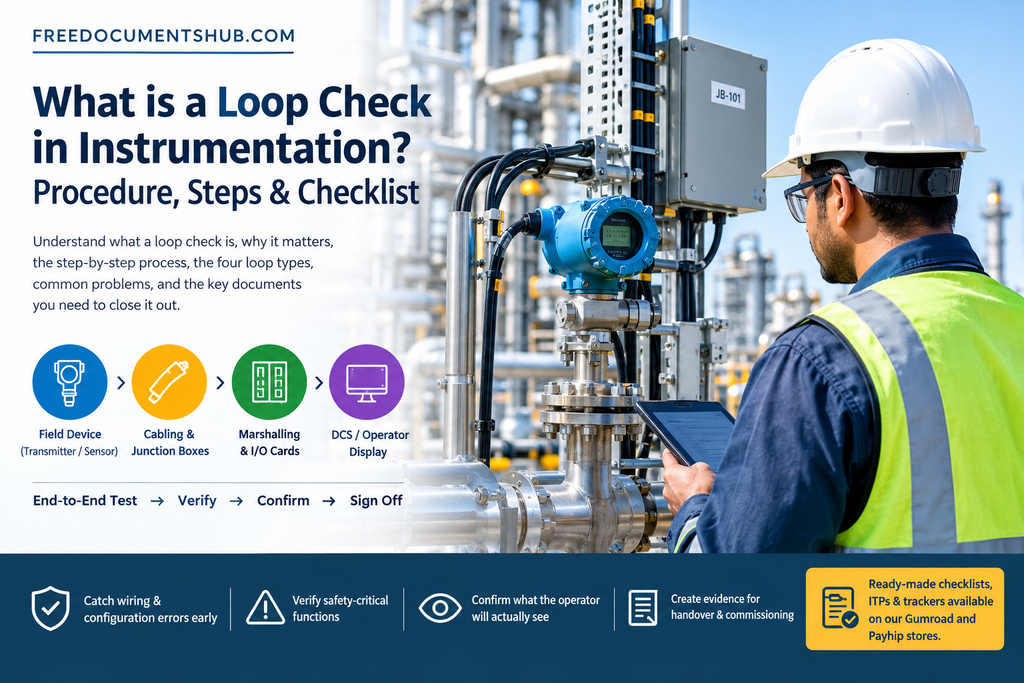
| In this article: What a loop check is, where it fits in the project sequence, the four loop types you’ll test, a step-by-step loop check procedure, the problems it most often uncovers, how it differs from point-to-point checks and calibration, and the documents needed to close it out. Ready-made commissioning checklists, ITPs, and trackers are available on our Gumroad and Payhip stores, or built custom to your project — available 24/7. |
On every instrumentation project there’s a moment where the cables are pulled, the instruments are mounted, and the control system is programmed — and nobody yet knows whether any of it actually works together. A transmitter can be perfectly calibrated and a DCS card perfectly healthy, and the operator can still be looking at the wrong tag, the wrong range, or a valve that moves the opposite way to the command. The loop check exists to find those problems before the plant is started up, when they are cheap to fix, rather than after, when they are not.
What Is a Loop Check?
A loop check is a documented, end-to-end functional test of a single instrument loop — from the field device, through the cabling, junction boxes, and marshalling cabinets, into the I/O card, and up to the operator display (and back out again for control outputs). It proves that the signal path works as a complete chain and that the right tag, range, units, scaling, alarm, and action appear at the other end.
The international reference is IEC 62382, Electrical and instrumentation loop check. The current edition (2024) defines the loop check as the activities between completion of loop construction — including installation and point-to-point checks — and the start of cold commissioning, and it applies to new plants as well as expansions and retrofits covering PLC, DCS, panel-mounted, and field instrumentation. It describes what should be tested rather than how, since the methods vary with the technology, and it’s intended to be adapted to your project’s own requirements. Most operators and EPC contractors layer their own loop check procedure and forms on top of it.
Why Loop Checks Matter
- They catch wiring and configuration errors early — swapped tags, reversed polarity, wrong I/O channel assignments, and wrong ranges are far cheaper to fix before start-up.
- They prove safety-critical functions work end to end — a gas detector or shutdown switch that was never loop-tested is an assumption, not a verified protection layer.
- They confirm what the operator will actually see — the right tag, engineering units, scaling, alarm limits, and valve action, rather than what the drawing says should be there.
- They create the evidence that systems were verified — signed loop check records are a core part of the handover documentation and the commissioning data book.
Where the Loop Check Fits in the Project Sequence
Loop checking sits in the middle of the E&I completion sequence. Cables are installed and terminated, point-to-point checks confirm every conductor is connected to the right place, and instruments are calibrated. The loop check then proves the whole chain functions together. Only after that does cold commissioning (testing with the process not yet live) and then hot commissioning begin. Skipping or rushing this stage pushes loop-level faults into commissioning, where they delay start-up and are far harder to isolate.
The Four Types of Loops You’ll Test
Every loop falls into one of four signal categories, and the test method differs slightly for each:
| Loop Type | Typical Example | What You Verify |
| Analog Input (AI) | 4–20 mA pressure, temperature, level, or flow transmitter | Field signal is simulated or injected at several points across the range; the DCS/PLC reading, units, and scaling must match at each point. |
| Analog Output (AO) | Control valve positioner, variable speed drive reference | Output is commanded from the control system at several points; the final element’s actual position or speed and its feedback must follow. |
| Digital Input (DI) | Limit switch, pressure switch, valve status, push button | Contact is physically operated or simulated; the correct tag changes state on the operator screen and any alarm or trip action is confirmed. |
| Digital Output (DO) | Solenoid valve, motor start command, alarm horn, beacon | Command is issued from the control system; the field device operates and the status feedback returns correctly. |
Smart (HART), fieldbus, and safety-system loops follow the same principle, with added checks for device communication, diagnostics, and — for fire & gas and emergency shutdown loops — the correct alarm, trip, and shutdown action as defined in the cause & effect matrix.
Loop Check Procedure — Step by Step
1. Confirm the Prerequisites
Before any loop is tested, the supporting information must be in place: current P&IDs and loop diagrams, the instrument index and I/O list, calibration certificates for the instruments, completed point-to-point records, and a clear punch list for that system. Testing against outdated drawings only produces rework.
2. Obtain Permits and Confirm Safety
Work in operating or hazardous areas requires the correct work permit, isolation of any process or actuated equipment that could move unexpectedly, and notice to operations. Control valves and shutdown devices must be made safe before any output is commanded.
3. Prepare the Loop Check Sheet
Each loop gets its own loop check sheet listing the tag number, description, I/O address, range and units, alarm and trip settings, and the expected action. The sheet is the record of the test, so it must match the current I/O list and loop diagram.
4. Test Input Loops
For analog inputs, a simulated signal is applied at the field device or transmitter and the reading is checked at the control system. A five-point check at 0, 25, 50, 75, and 100 percent of range is commonly used. For digital inputs, the field contact is operated and the state change is confirmed at the control system. Engineering units, scaling, and any associated alarm or trip are verified at the same time.
5. Test Output Loops
For analog outputs, the control system commands the output at several points and the field device — typically a control valve positioner — is observed to move correctly, with position feedback matching the command. For digital outputs, the command is issued and the field device operation and status feedback are confirmed. Valve fail-safe action (air-to-open versus air-to-close) is also checked.
6. Verify Alarms, Trips, and Interlocks
Alarm and trip setpoints are checked against the approved settings, and the resulting action — alarm annunciation, interlock, shutdown — is confirmed to operate as designed, in line with the cause & effect documentation.
7. Record, Witness, and Sign Off
Results are recorded on the loop check sheet and signed by the person performing the test and the witnessing party — QC inspector, and where required, the client, operations representative, or third-party inspector. Any deficiency is logged on the punch list, corrected, and the loop retested.
8. Close Out and Update Records
Once the loop passes, it is marked complete in the loop check tracker and the as-built loop diagram and I/O list are updated to reflect any changes made during testing. Completed sheets go into the handover documentation package.
Problems Loop Checks Commonly Uncover
- Wrong tag or I/O channel — a signal that reaches the control system but is mapped to the wrong point.
- Reversed polarity or missing loop power — a transmitter that reads zero or fails because of a wiring or power issue.
- Incorrect range or scaling — the instrument and the control system are configured with different ranges, so the displayed value is wrong.
- Reversed valve action — the valve moves opposite to the command, or fails in the wrong direction.
- Alarm and trip mismatches — setpoints in the system that don’t match the approved settings.
- Intrinsically safe barrier or isolator faults — signals lost or distorted in hazardous-area interface equipment.
- Grounding and shielding issues — noisy or unstable readings caused by incorrect shield termination.
Loop Check vs Point-to-Point Check vs Calibration
These three activities are often confused because they happen close together, but each answers a different question:
| Activity | What It Confirms | When It Happens |
| Point-to-Point Check | Confirms each cable and wire is connected to the correct terminal at both ends (continuity and identification). | Before the loop check — it’s a construction activity. |
| Instrument Calibration | Confirms the instrument itself measures accurately across its range against a known reference. | Before or alongside the loop check, with certificates on file. |
| Loop Check | Confirms the complete signal path works end to end — field device, cabling, junction boxes, marshalling, I/O card, and the operator screen — with correct tag, range, scaling, and action. | After installation and point-to-point checks, before cold commissioning. |
Documents Required to Close Out a Loop Check
Loop Check Sheet — one per loop, recording the test results, signatures, and any deficiencies.
Loop Diagrams — the as-built drawings the test is performed against and updated from.
Instrument Index and I/O List — the master reference for tag numbers, ranges, and I/O addresses.
Calibration Certificates — evidence the instruments were calibrated with traceable equipment before testing.
Point-to-Point Test Records — evidence that cabling and termination were verified before the loop check began.
Cause & Effect Matrix — the reference for verifying alarm, trip, and shutdown actions.
Punch List — tracks open items found during testing until each is corrected and retested.
Loop Check Tracker / Summary — shows the status of every loop across the project at a glance, used to demonstrate completion.
ITP Reference — ties the loop check hold and witness points back to the project’s Inspection and Test Plan.
Get the Documents
Ready-made commissioning checklists, Inspection and Test Plans, and completion trackers are available on our Gumroad and Payhip stores, in editable Word and Excel formats ready for instant download and project customization.
If you need a loop check form matched to your project’s tag numbering, I/O list structure, or client format, we prepare custom documentation remotely. Email contact@freedocumentshub.com — we’re available 24/7, and your first correction or trial document is free.
This article is general technical background on loop checking and does not replace the project specification, the client’s commissioning procedures, or the current edition of IEC 62382. Always follow the requirements in your contract documents.