
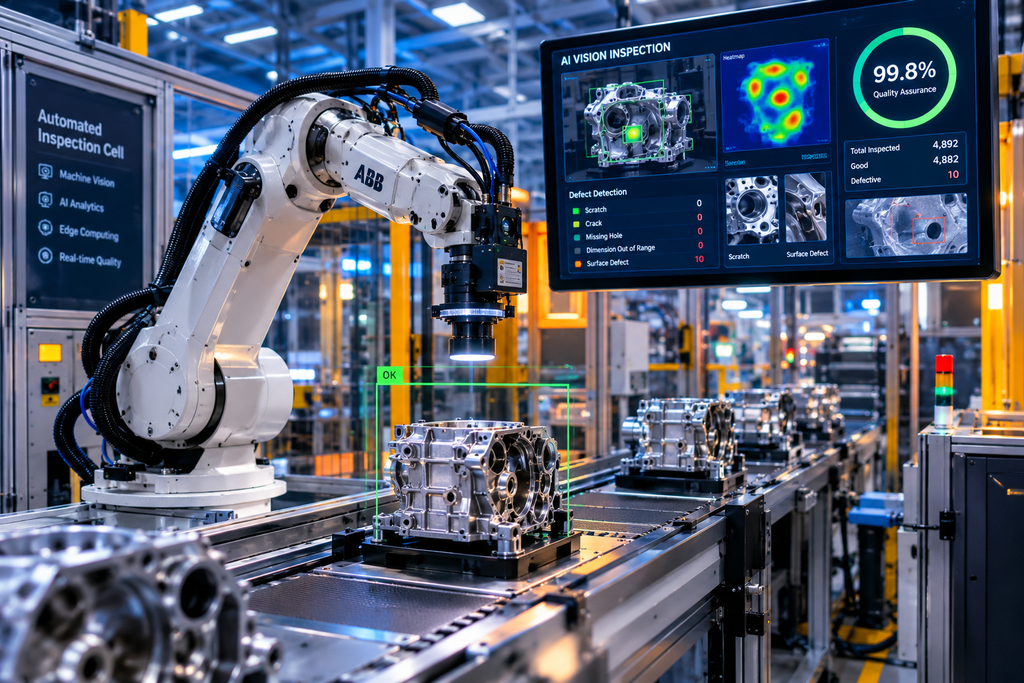
Introduction: The Modern Quality Control Revolution
For decades, industrial quality control relied heavily on two methods: manual visual inspection by human operators or rigid, rule-based machine vision systems. While traditional machine vision worked well in highly controlled environments with predictable parts, it struggled immensely with natural product variations, shifting lighting, and complex defects. Human inspection, on the other hand, suffers from fatigue, subjectivity, and severe slowdowns on high-speed production lines.
Today, the integration of Artificial Intelligence (AI) and deep learning into machine vision is revolutionizing smart manufacturing. AI-powered vision systems are shifting quality control from a reactive, end-of-line bottleneck into a proactive, real-time pillar of Industry 4.0 automation. This comprehensive guide explores how AI machine vision works, why it outperforms legacy systems, its primary industrial applications, and the structural advantages it delivers.
1. Traditional Rule-Based Vision vs. AI-Powered Vision
To understand why modern plants are rapidly upgrading, it helps to look at the architectural differences between traditional systems and deep learning approaches:
| Feature | Traditional Rule-Based Vision | AI-Powered Deep Learning Vision |
| Handling Variations | Rigid; struggles with natural part-to-part texture or color changes. | Highly adaptive; learns what “good” looks like across natural variations. |
| Programming & Setup | Complex; requires vision engineers to manually code geometric rules and thresholds. | Fast training; neural networks learn from a small set of image examples (good vs. defective). |
| False Positive Rate | High; minor changes often trigger unnecessary rejections (overkill). | Low; distinguishes cosmetic anomalies from true functional defects. |
| Defect Scope | Limited to explicit mathematical or geometric definitions. | Capable of identifying complex, subtle, or unstructured anomalies (micro-cracks, texture flaws). |
2. How AI-Powered Quality Inspection Works
Modern AI vision architectures combine high-speed optical hardware with edge computing and convolutional neural networks (CNNs). The inspection workflow operates in milliseconds at full production speed:
- High-Speed Image Capture: Industrial cameras coupled with precision lighting (polarized, backlighting, or multi-angle lighting) capture high-resolution imagery of every component passing down the line.
- Preprocessing & Edge Inference: Local edge GPUs normalize and enhance images instantly, passing them through deep learning models to identify deviations.
- Classification & Segmentation: Neural networks categorize defects by type and severity (e.g., classifying a scratch as cosmetic vs. structural).
- Closed-Loop Action: The system executes pass/fail sorting, triggers mechanical rejection gates, or signals SCADA/PLC systems to adjust upstream manufacturing parameters (such as welding current or CNC tool positioning) before future parts are compromised.
3. Core Manufacturing Applications
AI vision systems inspect a vast array of production sectors with micron-level precision:
- Automotive: Inspecting stamped metal panels for micro-cracks, verifying complex multi-part assemblies, checking weld seam integrity, and verifying adhesive dispense volumes.
- Electronics & SMT: Performing printed circuit board (PCB) inspection, verifying tiny solder joints, and checking component placement alignment.
- Food, Beverage & Pharma: Checking fill levels, ensuring packaging and label integrity, identifying seal contamination, and detecting foreign object debris (FOD) at high throughput speeds.
4. Key Operational Advantages of AI Vision Systems
- 99%+ Detection Accuracy: Consistently outperforms human inspectors and legacy systems, eliminating human fatigue and shift-to-shift variance.
- Reduced Scrap and False Rejects: By accurately separating harmless cosmetic blemishes from true structural failures, AI cuts waste and lowers expensive material scrap rates.
- Rapid ROI Payback: Most manufacturing facilities achieve complete return on investment within 6 to 12 months through reduced labor overhead, higher throughput, and lower defect escape rates.
- Continuous Self-Improvement: Deep learning frameworks continuously refine their models based on new operational data, becoming more resilient and accurate over time.
🎓 Advance Your Engineering Career with Free Training
Mastering the complexities of automation, industrial quality assurance (QA/QC), and smart factory integration takes specialized knowledge. At Free Documents Hub, we offer expert-led remote training programs designed to bridge the gap between traditional engineering and modern industrial demands.
Whether you want to master quality control frameworks, upgrade your technical documentation skills, or understand industrial IoT and AI integration, we have the resources to help you succeed.
🛠️ Explore Our Digital Resource Libraries:
- Gumroad Store: https://iftakhar.gumroad.com/
- Payhip Store: https://payhip.com/b/pLP7W
📩 Claim Your Free Trial: Ready to future-proof your career and elevate your plant’s operational capabilities? Contact our training team today at contact@freedocumentshub.com to claim your FREE trial sample!