
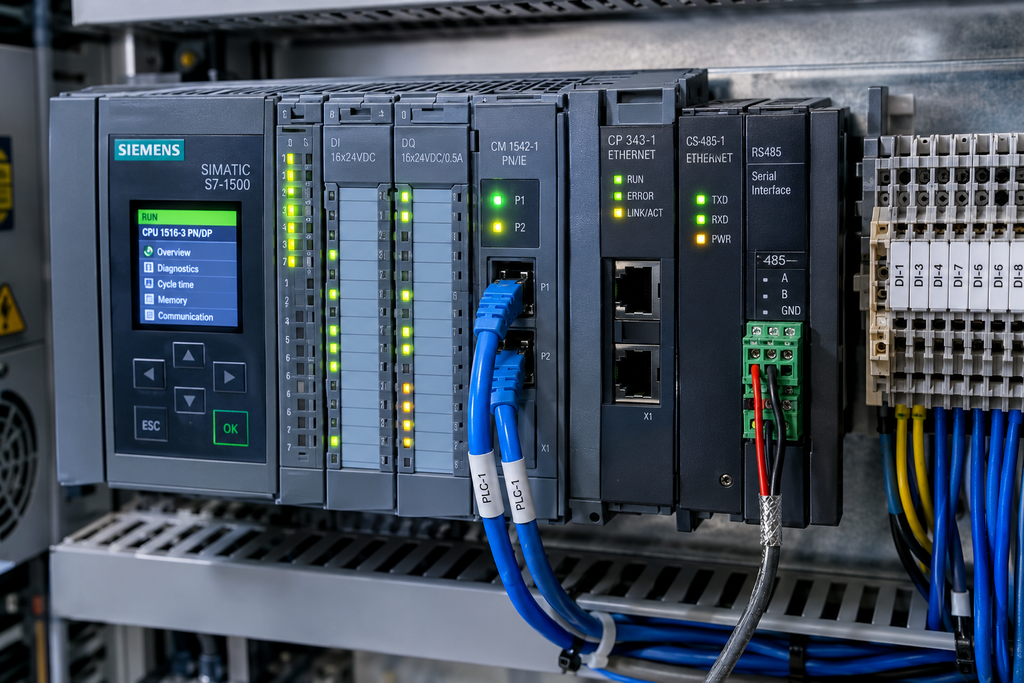
In the modern industrial automation ecosystem, a Programmable Logic Controller (PLC) acts as the brain of the facility. However, even the most advanced CPU and control logic are useless if the controller cannot communicate reliably with field devices, human-machine interfaces (HMIs), SCADA systems, and enterprise networks.
Choosing and troubleshooting the correct PLC communication ports and physical layers is a foundational skill for automation and control engineers. Whether you are retrofitting a legacy plant with serial lines or designing a high-speed smart factory utilizing Industrial Ethernet, understanding the physical layer is critical to preventing packet loss, noise interference, and catastrophic communication dropouts.
In this comprehensive guide, we break down the three primary physical layers used in industrial PLCs today: RS-232, RS-485, and Industrial Ethernet.
1. The Role of the Physical Layer in Industrial Automation
In the OSI network model, the Physical Layer (Layer 1) is responsible for the actual transmission of raw bit streams over a physical medium (copper wires, fiber optics, etc.). In industrial automation, this layer operates under harsh conditions: electromagnetic interference (EMI) from heavy variable frequency drives (VFDs), long cable runs across massive manufacturing floors, and extreme temperature fluctuations.
A failure in the physical layer can manifest as intermittent polling errors, frozen HMI screens, or complete network timeouts. Therefore, selecting the correct physical standard is just as important as choosing the right communication protocol (such as Modbus RTU, Modbus TCP, Profinet, or EtherNet/IP).
2. RS-232: The Classic Point-to-Point Serial Standard
Overview and Architecture
RS-232 (Recommended Standard 232) is one of the oldest and most widely recognized serial communication interfaces. Historically found on almost every computer and legacy PLC, RS-232 is designed for point-to-point communication between two devices (e.g., programming a PLC using a laptop or connecting a single barcode scanner).
Key Technical Specifications
- Topology: Point-to-Point (strictly 1 transmitter to 1 receiver).
- Maximum Cable Length: Typically limited to 15 meters (50 feet) at standard baud rates.
- Voltage Levels: Uses single-ended signaling. Logic “1” is -3V to -25V; Logic “0” is +3V to +25V.
- Noise Immunity: Low. Because it uses single-ended signaling referenced to a common ground, it is highly susceptible to electrical noise over long distances.
Industrial Applications and Limitations
While RS-232 is largely obsolete for multi-drop industrial floor networks, it remains useful for local configuration tasks, legacy device commissioning, and connecting standalone laboratory or weighing instruments directly to a controller.
3. RS-485: The Workhorse of Multi-Drop Industrial Networks
Overview and Architecture
When industrial plants required multiple devices—such as dozens of temperature controllers, power meters, and drives—to talk to a single PLC over a shared pair of wires, RS-485 became the definitive solution. Unlike RS-232, RS-485 supports multi-drop network topologies.
Key Technical Specifications
- Topology: Multi-drop bus (typically wired in a daisy-chain configuration).
- Maximum Cable Length: Up to 1,200 meters (4,000 feet) at lower baud rates.
- Signaling: Differential signaling (using a twisted pair: Data+ and Data-). Voltage differences determine the logic state, neutralizing common-mode electrical noise.
- Node Capacity: Typically up to 32 unit loads on a single standard segment (though modern transceiver chips allow 128 or even 256 nodes).
Best Practices for RS-485 Implementation
- Termination Resistors: Always use $120\,\Omega$ terminating resistors at both extreme ends of the cable run to prevent signal reflections.
- Polarity and Shielding: Maintain consistent polarity across all devices (Data+ to Data+, Data- to Data-) and ground the cable shield at one end only to eliminate ground loops.
4. Industrial Ethernet: High-Speed Networking for Industry 4.0
Overview and Architecture
As data demands skyrocket with the advent of the Industrial Internet of Things (IIoT) and smart manufacturing, standard office-grade Ethernet has been hardened for factory floors into Industrial Ethernet. Unlike traditional serial networks, Industrial Ethernet handles massive data bandwidth, integrating enterprise ERP systems directly down to the sensor level.
Key Technical Specifications
- Topology: Star, Ring, or Line configurations utilizing managed/unmanaged industrial switches.
- Speed: 100 Mbps (Fast Ethernet) to 1 Gbps and beyond.
- Distance: 100 meters per copper segment (Cat5e/Cat6 cable), expandable to kilometers using fiber optics.
- Determinism: Industrial protocols (like PROFINET IRT, EtherNet/IP, and EtherCAT) add specialized MAC layer scheduling to guarantee real-time, deterministic packet delivery for motion control and safety systems.
Ruggedized Hardware Requirements
Industrial Ethernet components are built differently than office IT gear. They feature:
- Ruggedized RJ45 or locking M12 connectors.
- DIN-rail mountable enclosures.
- Wide operating temperature ranges (-40°C to +70°C).
- Redundant DC power inputs (typically 24VDC).
5. Comparative Matrix: RS-232 vs. RS-485 vs. Industrial Ethernet
| Feature | RS-232 | RS-485 | Industrial Ethernet |
| Max Distance | ~15 meters | ~1,200 meters | 100m (copper) / km (fiber) |
| Topology | Point-to-Point | Multi-drop (Daisy-Chain) | Star, Ring, Line |
| Max Nodes | 2 devices | 32+ devices | Thousands (via switches) |
| Noise Immunity | Poor | High (Differential) | Very High (Shielded/Optic) |
| Bandwidth | Very Low (Kbps) | Low to Medium (Kbps-Mbps) | High to Very High (Mbps-Gbps) |
| Primary Use | Local programming / legacy | Modbus RTU / Field instruments | SCADA, PLC-to-PLC, IIoT |
Conclusion
Understanding PLC communication physical layers is essential for designing resilient control systems. While RS-232 is restricted to local configuration and RS-485 remains a cost-effective champion for long-distance multi-drop serial instruments, Industrial Ethernet is the undeniable backbone of modern high-speed automation and Industry 4.0 integration.
🎓 Elevate Your Engineering Capabilities with Free Documents Hub
Mastering industrial networking, automation standards, and plant documentation takes hands-on guidance[cite: 1]. At Free Documents Hub, we provide expert remote training specializing in industrial engineering design and quality control[cite: 1, 2].
🛠️ Access Our Digital Libraries:
- Gumroad Store: https://iftakhar.gumroad.com/[cite: 2]
- Payhip Store: https://payhip.com/b/pLP7W[cite: 2]
📩 Ready to upgrade your facility’s operational documentation or claim a FREE trial sample? Email us today at contact@freedocumentshub.com[cite: