
Two documents. One misunderstanding. Significant consequences on site.
Most engineers use the terms deviation and concession interchangeably. They are not the same document. They do not describe the same situation. Submitting the wrong one to your client is a professional error that signals you do not understand basic quality management principles.
This post explains exactly what each one is, when to use each, what must be included, and how to write one that gets approved quickly. A free professional template is available for download at the bottom.
The Single Most Important Difference
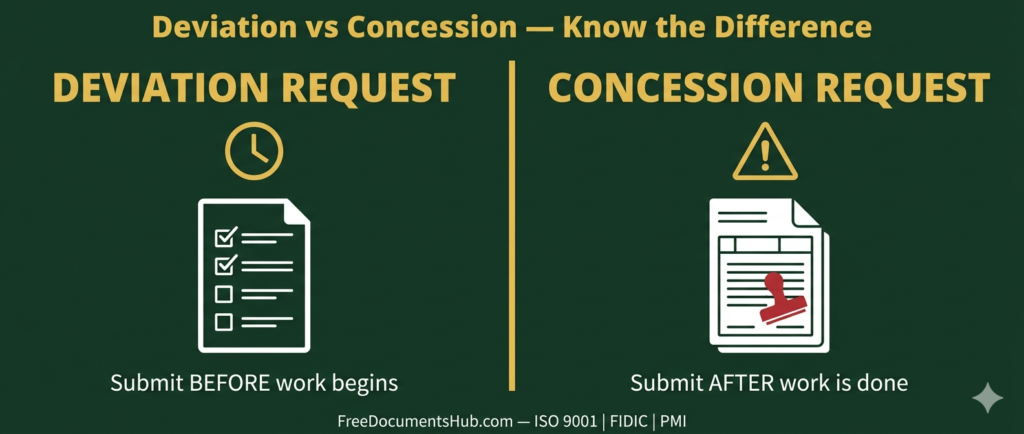
The difference between a deviation and a concession comes down to one thing — timing.
Deviation — you are asking for permission to depart from the specification before the work is done.
Concession — you are asking for acceptance of work that has already been done and does not fully comply with the specification.
That is the entire difference. Same paperwork structure. Same technical justification required. Completely different timing and completely different implications.
What Is a Deviation Request?
A deviation request is a formal document submitted to the client or engineer before work begins, requesting approval to use a different material, method, or specification than what was originally stated in the contract documents.
Common situations where a deviation is needed:
— The specified material is out of stock and an equivalent alternative is available — The specified equipment model has been discontinued — a replacement model is proposed — Site conditions make the specified installation method impractical — an alternative method is proposed — A technical development since the specification was written means a better option now exists — Cost saving is identified through an alternative that meets the same technical requirement
Key point: A deviation is proactive. You identify the issue before work starts. You present the alternative. You get written approval. Then you proceed.
This is the correct professional approach. It protects you, it protects the client, and it keeps the project compliant with ISO 9001 Section 8.7 — Control of Nonconforming Outputs.
What Is a Concession Request?
A concession request is a formal document submitted to the client or engineer after work has been completed, requesting acceptance of work that does not fully comply with the specified requirement.
Common situations where a concession is needed:
— Material was installed before the specification mismatch was identified — A dimension is slightly outside tolerance after fabrication — A test result is marginally outside the specified range but the item is still functional — Installation was completed to a different standard than specified — both standards are valid
Key point: A concession is reactive. The work is done. You cannot undo it without significant cost or delay. You are asking the client to accept it as-is, with full technical justification that it is still fit for purpose.
A concession is not an excuse for poor quality. It is a formal quality management mechanism for situations where non-compliance occurred but the item remains technically acceptable.
Why This Difference Matters Professionally
Submitting a concession when you should have submitted a deviation tells the client one thing — you knew about the issue, you proceeded without approval, and now you are asking them to accept the result.
This damages trust. It creates contractual risk. In some contracts it gives the client the right to reject the work entirely — even if it is technically acceptable.
Submitting a deviation before proceeding tells the client something completely different — you identified a potential issue, you analysed it technically, you presented an alternative, and you asked for approval before spending money or time on the wrong approach.
This builds trust. It demonstrates professional competence. It shows you understand quality management.
The timing of your submission is a professional statement about how you manage your work.
What Must a Deviation or Concession Request Include?
Both documents follow the same structure. Every section is mandatory. A submission missing any section will be returned without approval.
Section 1 — Request Identification
Every submission needs document control information:
— Request number — your internal reference — Type — clearly state DEVIATION or CONCESSION — Project name and number — Date of submission — Submitted by — your company name — Submitted to — client company and representative name — Specification or drawing reference — the exact document you are departing from — Response required by date — give the client a reasonable deadline
Section 2 — Description of the Deviation or Concession
Describe exactly what is being requested in clear, simple technical language.
For a deviation: “Request to use Schneider NSX100N circuit breaker in place of NSX100F as specified in Clause 14.3 of the Electrical Specification.”
For a concession: “Request acceptance of installed 16mm² cable on circuit DB-01-C12 where 25mm² was specified. Cable was installed before specification mismatch was identified during document review on 20/04/2026.”
Be specific. State the specification clause. State the proposed or installed alternative. Do not write vague descriptions.
Section 3 — Specification Requirement
Quote the exact specification requirement being departed from. Include the clause number, the drawing number and revision, what the specification says exactly, and what was proposed or installed instead.
This section proves you have read and understood the specification. It shows the client precisely where the departure occurs.
Section 4 — Technical Justification
This is the most important section. It is where most submissions fail.
Your technical justification must prove that the proposed alternative or installed item is still fit for purpose and meets the intent of the specification.
A strong technical justification includes:
— Technical comparison between specified item and proposed/installed item — Relevant standard references for both options — Calculation references if applicable — fault level calculations, load calculations, structural calculations — Statement of equivalence — why the alternative meets the same functional requirement — Statement of any difference — be honest about differences — minimising them is not the same as hiding them
Example of a strong justification:
“The proposed Schneider NSX100N has an Ics of 25kA at 400V. The maximum prospective short circuit current at SDB-01 per calculation CALC-001 Rev A is 18kA. The NSX100N provides adequate fault protection at this location. Both NSX100N and NSX100F are compliant with IEC 60947-2. External dimensions are identical — no installation modification required. The NSX100N saves SAR 450 per unit — total saving SAR 2,700 for 6 units.”
This justification is approved because it is specific, technical, honest, referenced, and shows clear benefit without hiding any difference.
Section 5 — Impact Assessment
Assess and state the impact of the deviation or concession on four areas:
Safety impact — does the alternative affect any safety function? If yes — explain fully. If no — state clearly: “No safety impact.”
Quality impact — does the alternative affect the quality or performance of the installed system? If yes — explain. If no — state clearly.
Programme impact — does submitting the deviation save time or does the concession require rework that causes delay? State clearly.
Cost impact — is there a saving or additional cost? State the amount. Clients appreciate financial transparency.
Also state whether the departure is permanent or temporary, and how many units or what length or area is affected.
Section 6 — Client Decision
This section is completed by the client or engineer after review.
Three possible decisions:
Approved — the deviation or concession is accepted as submitted. Proceed or accept as-is.
Approved with conditions — accepted subject to specific conditions stated by the client. You must comply with every condition before proceeding or before the item is accepted.
Rejected — the alternative is not acceptable. For a deviation — proceed with the specified item. For a concession — rework or replacement is required.
Never assume approval if you have not received a signed response. Verbal approval does not exist in professional project management.
Section 7 — Sign-Off
Three signatures required:
— Prepared by — the person who wrote the submission — Reviewed by — your internal QC or project manager — Approved by — the client or engineer representative
Work proceeds or acceptance is granted only after the client signature is obtained and dated.
The Most Common Mistakes
Submitting a concession when a deviation was possible If you knew about the issue before starting work and proceeded without approval — you have created a concession situation that could have been a deviation situation. Always check specifications before starting work.
Vague technical justification “Both items are similar and meet the required standard” is not a technical justification. Clients reject these immediately. Be specific. Reference standards. Reference calculations.
No specification clause reference If you do not quote the exact clause you are departing from — the reviewer does not know what to check. Always include clause number, document title, and revision.
Missing impact assessment Leaving safety impact blank or writing “N/A” without explanation signals that you have not considered it. Even if there is no impact — state it clearly and briefly explain why.
Submitting without a response deadline If you do not state when you need a response — the client has no urgency. State the date clearly. Explain the programme impact if approval is delayed.
When to Submit — Timing Rules
Deviation — submit as early as possible. As soon as you identify that the specified item or method is unavailable, discontinued, or not suitable — raise the deviation immediately. Do not order materials or start work while waiting. The earlier you submit — the more time the client has to review — the faster you get approval.
Concession — submit immediately after discovering the non-compliance. The moment you identify that installed work does not comply — stop work on that item and raise the concession. Do not continue work assuming it will be approved. Submit first. Continue only after approval.
Free Template Download
The complete Deviation and Concession Request template is available for free download below.
What you get: — All 7 sections structured and ready to fill — Guidance notes in every section — Worked example text showing exactly what a strong justification looks like — ISO 9001, FIDIC, and PMI referenced — Professional FreeDocumentsHub branded format
Download the template — fill your project details — submit with confidence.
Need a complete project documentation package for your current project?
We provide professional technical documentation for engineering and construction projects — deviation requests, concession requests, NCRs, RFIs, method statements, ITPs, commissioning reports — delivered remotely to any location in the world.
🆓 Free — templates, guides, and general advice always available here 📄 Paid — custom documentation written for your specific project
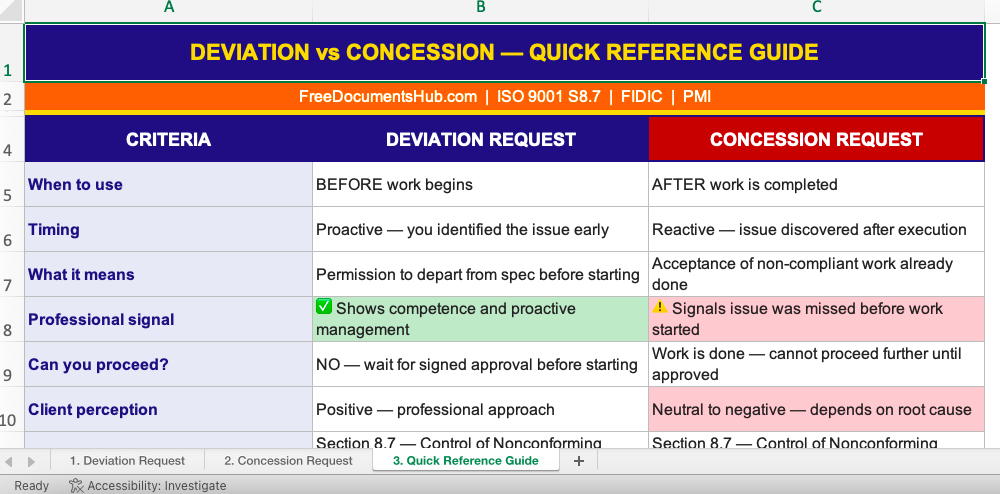
Free Download
Deviation & Concession Request Template
3 Sheets · Deviation Form · Concession Form · Quick Reference Guide · ISO 9001 · FIDIC · PMI
⬇ Download Free NowNo sign-up required · Instant download · Excel format
📩 contact@freedocumentshub.com 🌐 FreeDocumentsHub.com — Available 24 hours, 7 days a week