
Fire Protection
Engineering —
Complete Series
30 topics. 30 blog posts. Professional documents every week. Free for our connection list and email subscribers. This is the most complete fire protection content series for Gulf engineers.
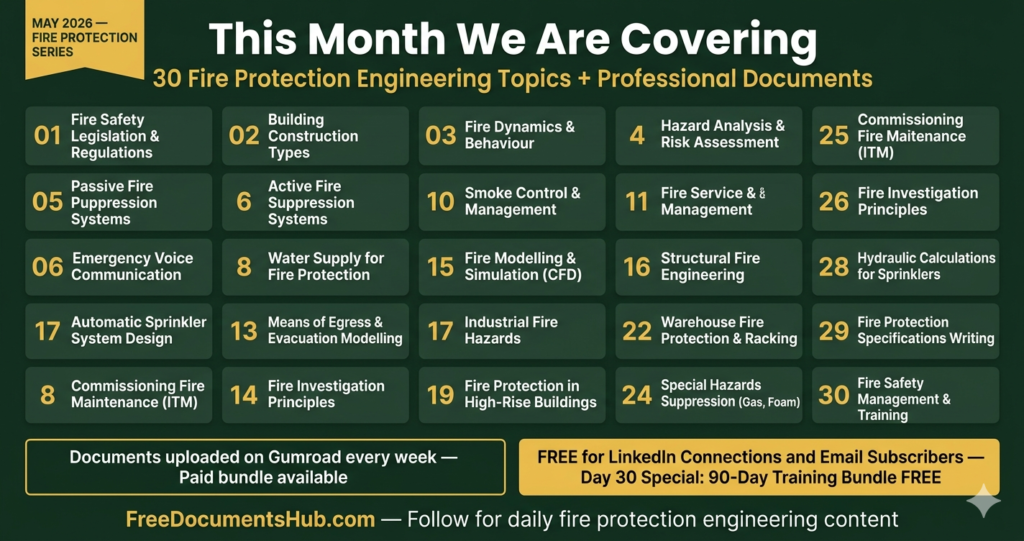
What We Are Covering in May
Every day in May we publish one fire protection engineering topic — blog post, professional document, and LinkedIn post. Whether you are a fire alarm engineer, MEP project manager, or systems integrator — this series is built for you.
I have spent 19 years working on fire protection systems across Saudi Aramco, SABIC, and SAIPEM projects in the Gulf. Everything in this series comes from real site experience — not textbooks.
Paid Bundle
Professional documents available on Gumroad. Download instantly. Use on every project.
Free for Connections
Already in my LinkedIn connection list? Message me — I send you any document completely free.
Day 30 Special
Complete 90-Day Training Bundle — given FREE to all subscribers and connections on Day 30.
Subscribe at freedocumentshub.com/subscribe to receive free documents every week directly in your inbox.
Every Topic We Will Cover
One blog post per day. One professional document per week. All month long.
Introduction to Fire Protection Systems
Types, Standards, and What Every Engineer Must Know Before Starting a Fire Protection Project
In 19 years of Gulf industrial project work — Saudi Aramco, SABIC, SAIPEM — fire protection has been on every single project I have ever worked on. Not because it is mandated. Because fire is the one risk that can end everything in minutes.
Yet I have seen fire alarm systems installed without a single approved document. Panels commissioned without a checklist. Detectors placed in wrong locations because nobody read the standard. Handover packages rejected because the cause and effect matrix was missing.
This series fixes that. One topic per day. Real knowledge from real projects. Let us start from the beginning.
What is a Fire Protection System?
A fire protection system is a combination of detection, alarm, suppression, and escape systems designed to detect fire early, alert occupants, suppress or control the fire, and allow safe evacuation.
In industrial facilities — refineries, petrochemical plants, offshore platforms, and camps — fire protection is not optional. It is a life safety requirement enforced by Saudi Aramco, SABIC, and international codes including NFPA and IBC.
Types of Fire Protection Systems
Fire Detection & Alarm System (FDAS): Detects fire through smoke, heat, or flame detectors and activates alarms to alert occupants and trigger automatic responses. The Fire Alarm Control Panel (FACP) is the brain of the system.
Gas Detection System: Detects combustible or toxic gas leaks — LPG, H2S, methane — before ignition. Critical in oil and gas facilities.
Fire Suppression System: Automatically suppresses fire using water (sprinklers), clean agent (FM200, CO2), or foam. Activates on signal from FACP or standalone.
Fire Fighting System: Active fire fighting — hydrants, hose reels, monitors — operated manually by trained personnel or fire brigade.
Passive Fire Protection: Fire-rated walls, fire dampers, intumescent seals, structural fireproofing — contains fire spread without active systems.
How a Fire Alarm System Works — Step by Step
Step 1 — Detection: A detector (smoke, heat, or flame) senses abnormal conditions and sends a signal to the FACP via the Signalling Line Circuit (SLC).
Step 2 — Processing: FACP receives the signal, verifies it against programmed cause and effect matrix, and determines the response.
Step 3 — Alarm: FACP activates audible and visual alarms — sounders, beacons, voice evacuation — in the affected zone.
Step 4 — Automatic Action: FACP sends output signals — gas valve closes, HVAC shuts down, suppression releases, fire doors close, elevators recall.
Step 5 — Monitoring: FACP transmits alarm signal to monitoring station, BMS, or remote fire alarm panel for response coordination.
Key International Standards — Every Engineer Must Know
NFPA 72: National Fire Alarm and Signaling Code — the most referenced standard for fire alarm system design, installation, testing, and maintenance worldwide.
NFPA 13: Installation of Sprinkler Systems — covers automatic sprinkler system design and installation requirements.
NFPA 2001: Clean Agent Fire Extinguishing Systems — FM200, Novec 1230, CO2 suppression system requirements.
IEC 62368-1: International standard for fire alarm equipment used on many Gulf projects.
SAES-B-058: Saudi Aramco Engineering Standard for fire and gas systems — mandatory on all Aramco facilities. Supplements NFPA requirements with Aramco-specific rules.
SASO: Saudi Standards, Metrology and Quality Organization — local Saudi code requirements for all projects inside the Kingdom.
Top 5 Mistakes Engineers Make on Fire Protection Projects
Mistake 1 — No ITP before installation starts: Work begins without an approved Inspection and Test Plan. Client rejects installation. All work re-inspected from zero.
Mistake 2 — Detector spacing not calculated: Smoke and heat detectors placed by guesswork instead of NFPA 72 spacing calculations. Failed inspection.
Mistake 3 — No cause and effect matrix: System is commissioned but nobody has documented what happens when each detector activates. Handover rejected.
Mistake 4 — SLC wiring not supervised: Open and short circuit faults not detected by the system. FACP does not comply with NFPA 72 Class A or Class B wiring requirements.
Mistake 5 — No commissioning record: System is running but no signed commissioning report exists. Client withholds final payment indefinitely.
Fire Protection Standards — At a Glance
| Standard | Issuing Body | Scope | Applies To |
|---|---|---|---|
| NFPA 72 | NFPA USA | Fire alarm system design, installation, testing, and maintenance | All fire alarm projects |
| NFPA 13 | NFPA USA | Automatic sprinkler system installation requirements | Sprinkler systems |
| NFPA 2001 | NFPA USA | Clean agent suppression systems — FM200, CO2, Novec | Suppression systems |
| NFPA 30 | NFPA USA | Flammable and combustible liquids storage — fire protection requirements | Tank farms, refineries |
| NFPA 11 | NFPA USA | Low, medium, high expansion foam systems for flammable liquids | Foam suppression |
| SAES-B-058 | Saudi Aramco | Fire and gas system requirements for all Aramco facilities | Aramco projects |
| SAES-B-067 | Saudi Aramco | Safety requirements for firewater systems at Aramco facilities | Aramco firewater |
| IEC 62368-1 | IEC | International standard for fire alarm equipment and components | Equipment specification |
FOLLOW THIS SERIES — GET FREE DOCUMENTS
30 topics. 30 blog posts. Professional fire protection documents every week. Free for our connection list and email subscribers.
LinkedIn Connections
Message me on LinkedIn — I send you any document completely free. No cost. No condition.
Email Subscribers
Subscribe at freedocumentshub.com/subscribe — receive free documents every week in your inbox.