
Gas Detection Systems —
Fixed and Portable:
The Complete Professional Guide
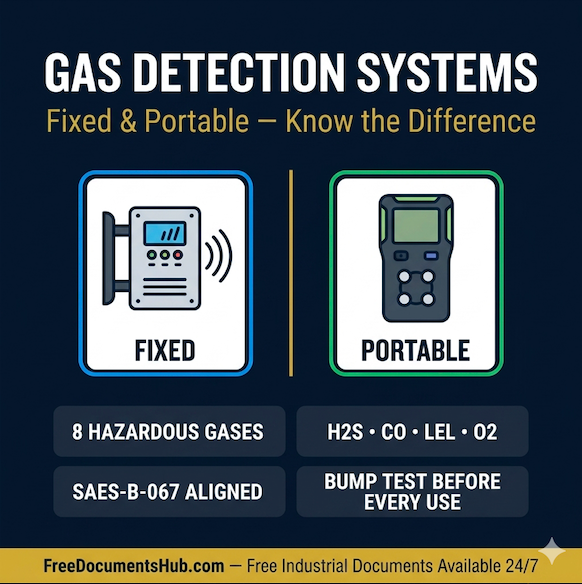
Fixed systems, portable detectors, hazardous gas properties, alarm setpoints, bump testing, calibration, common problems and solutions — everything a safety officer, engineer, or technician needs to know. SAES-B-067 and IEC 60079 aligned. Free Excel template included.
Table of Contents
- Gas Detection — The First Line of Defence
- The Four Primary Hazardous Gases
- Fixed Gas Detection Systems
- Portable Gas Detectors
- Fixed vs Portable — When to Use Which
- Alarm Setpoints — The Critical Numbers
- Bump Testing vs Full Calibration
- Common Problems and Solutions
- Standards Alignment
- Free Download — Excel Template
- Conclusion
Gas Detection — The First Line of Defence
In the hierarchy of controls, Personal Protective Equipment sits at the bottom — it is the last resort, not the first response. Gas detection systems sit near the top. They are the engineering control that identifies the hazard before it reaches the worker — giving the warning that allows evacuation, shutdown, or intervention before an incident occurs.
On Saudi Aramco projects, this is not a philosophical position. It is a design requirement. SAES-B-067 mandates fixed gas detection in all classified hazardous areas — compressor stations, pump rooms, process areas, wellheads, and any facility where flammable or toxic gases may accumulate. The gas detection system is not optional equipment. It is part of the facility’s life-safety infrastructure — as fundamental as the fire alarm system or the emergency escape routes.
“A gas detector that has not been bump tested today is not a gas detector. It is a false assurance — an object that creates confidence in protection that may no longer exist.”
This guide covers the two primary types of gas detection — fixed and portable — their technologies, their applications, their alarm setpoints, their maintenance requirements, and the six most common problems that cause gas detection systems to fail in the field. The free Excel template covers all reference data, a 15-space selection guide, and inspection and calibration log templates ready for immediate use on your next project.
The Four Primary Hazardous Gases
On most industrial and oil and gas sites, four gases account for the overwhelming majority of gas detection incidents. Understanding their properties — how they behave, where they accumulate, and why they are dangerous — is the foundation of specifying and using gas detection correctly.
H2S — Hydrogen Sulphide
Colourless gas. Rotten egg smell at low concentrations — but the smell disappears at higher concentrations due to olfactory fatigue. The worker can no longer smell it when it is most dangerous. Heavier than air — accumulates in pits, trenches, drains, and low points. Found in sour crude, sewer lines, confined spaces, and refineries.
CO — Carbon Monoxide
Colourless, odourless, tasteless — no sensory warning whatsoever. Produced by incomplete combustion from generators, vehicles, boilers, and fires in enclosed spaces. Binds to haemoglobin 200 times more effectively than oxygen — causes rapid incapacitation without warning. Accumulates wherever combustion occurs in enclosed areas.
LEL — Combustible Gas
LEL measures the percentage of combustible gas in air at which ignition is possible. Below the LEL — the mixture is too lean to ignite. Between LEL and UEL — the mixture is in the explosive range. The primary combustible gases on Aramco projects: methane, LPG, hydrocarbon vapours. Sensor reads 0–100% LEL — not the actual gas percentage.
O2 — Oxygen Deficiency / Enrichment
Normal air is 20.9% oxygen. Below 19.5% — insufficient oxygen for safe work. Above 23% — oxygen-enriched atmosphere that dramatically increases fire and explosion risk. Oxygen can be displaced by CO2, nitrogen, argon, or consumed by oxidation inside vessels. Both deficiency and enrichment are hazardous — monitor both directions.
⚠ H2S Olfactory Fatigue — The Most Dangerous Property
H2S smells strongly of rotten eggs at 0.5–5 ppm. At 50–100 ppm the smell disappears completely. Workers who enter an H2S atmosphere without a detector often believe the absence of smell means the gas has gone — when in fact their sense of smell has been paralysed by the gas itself. At 100 ppm (IDLH) — unconsciousness occurs within minutes. Never rely on smell to detect H2S. Always use a calibrated detector.
Fixed Gas Detection Systems
A fixed gas detection system consists of permanently installed sensor heads connected to a central Gas Detection Control Panel (GDCP). The sensors continuously monitor the atmosphere at their installed locations — 24 hours a day, 7 days a week — and transmit a 4–20mA analogue signal to the GDCP proportional to the gas concentration detected.
How Fixed Sensors Work
Two main sensor technologies are used in fixed gas detection:
- Electrochemical sensors — used for toxic gases (H2S, CO, SO2, NH3, Cl2). The target gas reacts at an electrode, producing an electrical current proportional to the gas concentration. Fast response, high sensitivity, but subject to cross-sensitivity from other gases and degradation over time.
- Catalytic bead (pellistor) sensors — used for LEL (combustible gas) detection. The target gas oxidises on a heated catalyst bead, changing its resistance. Requires oxygen to function — will not detect combustible gas in oxygen-deficient atmospheres. Subject to poisoning from silicones, lead compounds, and halogenated compounds.
SAES-B-067 Requirements for Fixed Detection
SAES-B-067 mandates fixed gas detection in all classified hazardous areas on Saudi Aramco facilities. The standard specifies sensor placement based on the density of the target gas — sensors at low points for gases heavier than air (H2S, LPG, most hydrocarbons) and at high points for gases lighter than air (hydrogen, methane, ammonia). Each sensor covers a defined detection radius, and coverage must be continuous across the entire classified area.
Fixed Gas Detection System — What It Must Do Automatically
- First alarm (typically 20% LEL or action level): Activate audible and visual alarms at the GDCP and in the area. Activate ventilation systems.
- Second alarm (typically 50% LEL or STEL): Activate Emergency Shutdown (ESD) system — close gas valves, shut down ignition sources, initiate process shutdown.
- Battery backup: Minimum 24 hours standby plus 30 minutes alarm per SAES-B-067 — the system must function during power failure.
- Fault detection: The system must alarm on sensor failure, cable open circuit, and power loss — a failed sensor must not appear as a normal reading.
Portable Gas Detectors
A portable gas detector is a battery-powered handheld or clip-on device carried by the worker. It monitors the atmosphere in the immediate vicinity of the person — typically within one to two metres — and alarms when the concentration of a target gas exceeds the set alarm thresholds. The standard portable detector for industrial use measures four gases simultaneously: O2, LEL, CO, and H2S.
The 4-Gas Detector — Standard for Industrial Use
The 4-gas portable detector has become the universal standard for personal gas monitoring on industrial sites because it covers the four most common atmospheric hazards in a single unit. Switching on before entering any potentially hazardous atmosphere and wearing it throughout the task is the minimum requirement on all Aramco projects.
How to Use a Portable Detector Correctly
- Step 1 — Bump test before every use. Apply calibration gas to the sensor and confirm all four sensors respond above the alarm threshold. If any sensor fails — do not use the detector. Remove from service.
- Step 2 — Allow warm-up time. Most detectors require 30–60 seconds after switch-on for sensors to stabilise. Do not enter an atmosphere immediately after switching on.
- Step 3 — Test the atmosphere before entry. For confined spaces, lower the detector on a cord to test at the bottom, middle, and top of the space — gas stratifies by density.
- Step 4 — Wear on the body during work. Clip the detector to the lapel or chest — at the breathing zone. Do not leave it on the ground or in a bag.
- Step 5 — Respond to alarms immediately. Evacuate the area. Do not silence the alarm and continue working. Notify the Permit Issuer.
- Step 6 — Record the use. Log the detector serial number, bump test result, user name, date, and any alarm activations in the detector log.
⚠ The Most Dangerous Portable Detector Practice
Workers who have been using the same detector for months without a bump test — and without an alarm — begin to believe the detector is working because it has never alarmed. This is false logic. A failed sensor produces zero readings regardless of the gas concentration. It does not alarm. The worker interprets this as “no gas present” when the sensor may have been dead for weeks. Bump test every single day. Without exception.
Fixed vs Portable — When to Use Which
Use Fixed Detection When:
- The area is permanently classified as hazardous
- Continuous 24/7 monitoring is required without human presence
- Automatic process shutdown on alarm is required
- SAES-B-067 mandates it — compressor rooms, pump rooms, process areas
- The hazard is continuous — not task-specific
- Emergency shutdown integration is required
Use Portable Detection When:
- Confined space entry — mandatory by GI-2.100
- Hot Work in a hydrocarbon area — qualified Gas Tester required
- A worker enters a fixed-monitored area for maintenance
- The hazard is task-specific and temporary
- Surveying an unknown atmosphere before work begins
- Emergency response entry into an alarm area
The critical point: fixed and portable detection are not alternatives — they are complementary. A fixed system protects the area continuously. A portable detector protects the person. In most classified areas, both are required simultaneously — the fixed system provides area-wide protection, and each worker carries a portable detector for personal protection during entry and maintenance.
Alarm Setpoints — The Critical Numbers
Alarm setpoints are the gas concentration levels at which the detector activates its alarms. Getting them wrong in either direction is dangerous — too low and you get constant false alarms that condition workers to ignore the alarm; too high and the alarm activates too late to allow safe evacuation. The setpoints below are based on SAES-B-067, NIOSH, and OSHA requirements.
| Gas | First Alarm | Second Alarm | IDLH | Action |
|---|---|---|---|---|
| H2S (Hydrogen Sulphide) | 1 ppm | 10 ppm | 100 ppm | Stop work / Evacuate / SCBA |
| CO (Carbon Monoxide) | 25 ppm | 200 ppm | 1,200 ppm | Stop work / Evacuate |
| LEL (Combustible Gas) | 10% LEL | 25% LEL | N/A — explosive | Stop Hot Work / Evacuate |
| O2 Deficiency | 19.5% | 16% | 16% — IDLH | Stop entry / Evacuate |
| O2 Enrichment | 23% | 25% | Fire risk at 23%+ | Stop entry / Remove ignition sources |
| SO2 (Sulphur Dioxide) | 0.25 ppm | 1 ppm | 100 ppm | Evacuate / Respiratory protection |
| NH3 (Ammonia) | 25 ppm | 35 ppm | 300 ppm | Evacuate / SCBA |
| Cl2 (Chlorine) | 0.5 ppm | 1 ppm | 10 ppm | Immediate evacuation / SCBA |
Chlorine — The Narrowest Safety Margin
Note the extremely narrow margin between Cl2 action level (0.5 ppm), STEL (1 ppm), and IDLH (10 ppm). There is very little time between first detection and immediately dangerous conditions. Fixed Cl2 detection in chlorination areas is not optional — it is the only control that provides enough warning time for safe evacuation.
Bump Testing vs Full Calibration
Two maintenance procedures are required for portable gas detectors — bump testing and full calibration. They are not the same, and both are required. Understanding the difference is critical for anyone responsible for managing gas detection equipment.
Bump Test (Function Check)
A bump test exposes the detector to a known concentration of target gas — typically from a small calibration gas cylinder — and confirms that each sensor responds by alarming. It does not verify the accuracy of the reading — only that the sensor responds. Required before every single use. Takes approximately 60 seconds. If any sensor fails to alarm — the detector is removed from service immediately.
Full Calibration
Full calibration exposes the detector to a known, certified concentration of target gas and adjusts the detector’s response to match the known concentration. It verifies accuracy — confirming that a reading of 5 ppm H2S represents an actual concentration of 5 ppm. Required per the manufacturer’s schedule — typically every 6 months. Must be performed by a qualified technician using certified calibration gas with a traceable certificate of analysis.
The Bump Test Rule — No Exceptions
- Bump test before EVERY use — not once a week, not once a month. Every use.
- Record every bump test in the detector log — date, serial number, result, user name.
- A passed bump test does not replace calibration — both are required.
- If the bump test FAILS — remove the detector from service. Do not use. Do not enter the atmosphere. Tag the detector “OUT OF SERVICE — SENSOR FAILURE” and arrange sensor replacement.
- Calibration gas cylinders have expiry dates — do not use expired calibration gas.
Common Problems and Solutions
Gas detection systems fail more often than their users realise — not dramatically, but quietly. A sensor that reads zero when gas is present does not alarm. A fixed detector that false-alarms daily is eventually ignored. The six problems below are the most common failures seen on industrial sites — with their causes and the specific corrective actions that resolve them.
| Problem | Root Cause | Corrective Action |
|---|---|---|
| Fixed detector false alarm — no gas found when investigated | Cross-sensitivity to a non-target gas in the environment. Common example: H2S sensor reading high from SO2 or solvent vapours. Also: RFI interference from radio equipment near sensor head. | Identify the interfering substance. Replace sensor with cross-sensitivity-resistant type for that environment. Reposition sensor away from radio equipment. Review the hazard study to confirm the correct sensor technology is specified. |
| Portable detector reads zero in a confirmed gas atmosphere | Sensor poisoning — catalytic bead sensors are destroyed by silicone compounds, lead, and halogenated hydrocarbons. Electrochemical sensors degraded by exposure to high concentrations or contaminants. Sensor at end of service life. | Bump test immediately — sensor will fail to respond. Remove from service. Replace the sensor. Identify the source of the poisoning agent (silicone sprays, paint fumes, chemical exposure) and prevent future exposure. |
| Calibration drift — detector reading does not match known gas concentration | Sensor ageing combined with exposure to extreme temperatures, humidity, or contaminants. Calibration interval exceeded. Calibration gas used was expired or incorrect concentration. | Perform full re-calibration with unexpired, certified calibration gas of correct concentration. Verify calibration certificate. Reduce calibration interval if drift is consistent. Replace sensor if drift cannot be corrected. |
| Fixed detector showing continuous alarm at a low level — cannot clear | Moisture ingress into sensor head or cable glands. Sensor damaged by water. Cable fault producing spurious 4-20mA signal. Background gas level genuinely elevated from process leak. | Check and tighten all cable glands. Inspect sensor housing for moisture. Test 4-20mA signal at GDCP with meter. If signal is correct — investigate for genuine process gas leak. Replace sensor if damaged by moisture. |
| Workers not performing bump tests before use | No procedure requiring bump test. No bump test gas cylinders available at the point of use. No log to record results. Management not enforcing the requirement. | Implement mandatory bump test procedure — no detector leaves the store without a logged bump test result. Provide bump test gas cylinders at the detector storage point. Safety Officer checks the log daily. Non-compliance is a stop-work condition. |
| Alarm setpoint incorrectly programmed — too high or copied from wrong project | Setpoints configured during commissioning from a generic template or copied from a previous project with different hazard profile. Not reviewed against site-specific hazard study and SAES-B-067 requirements. | Review all detector setpoints against the current project hazard study, SAES-B-067, and the alarm setpoint table. Reconfigure to correct values. Document all setpoints in the Fire and Gas Cause and Effect Matrix. Verify setpoints at every annual service. |
Standards Alignment
SAES-B-067 — Saudi Aramco Fire Protection
SAES-B-067 is the primary standard governing gas detection on Saudi Aramco facilities. It specifies the requirement for fixed gas detection in all classified hazardous areas, defines the minimum coverage requirements (sensor spacing and positioning), requires automatic shutdown outputs on second alarm, mandates 24-hour battery backup, and requires annual functional testing. All gas detection equipment must be from the Aramco Approved Vendors List and must be certified for use in the relevant hazardous area classification.
IEC 60079 — Explosive Atmospheres
IEC 60079 is the international standard series covering equipment used in explosive atmospheres — the ATEX and IECEx certification frameworks. All gas detectors installed in classified hazardous areas must be certified to the appropriate IEC 60079 protection concept for that area classification (Zone 0, Zone 1, or Zone 2 for gas). The gas detector housing, wiring, and installation must all comply with the zone classification.
EN 50194 / EN 50271 — Residential and Commercial Gas Detectors
EN 50194 covers residential and light commercial gas detectors. EN 50271 covers electrochemical and semiconductor gas detection instruments. These standards are referenced for kitchen gas safety systems and non-classified commercial applications. On Aramco industrial projects, IEC 60079 and SAES-B-067 take precedence.
GI-2.100 — Work Permit System
GI-2.100 defines the gas testing requirements for Hot Work Permits and Confined Space Entry Permits — including the requirement for a qualified Gas Tester, the frequency of repeat testing, and the alarm levels at which work must stop. Gas detection is integral to the permit system — a Hot Work Permit cannot be valid without a gas test result, and a Confined Space Entry Permit requires continuous atmospheric monitoring throughout entry.
📥 Free Download — Gas Detection Systems Excel Template
5-sheet professional Excel: 8 Gas Types with TLV/STEL/IDLH/Aramco action levels, Fixed vs Portable 12-parameter comparison, 15-space selection guide with alarm setpoints, and Inspection & Calibration Log for 10 fixed + 10 portable detectors.
Conclusion
Gas detection is not a single piece of equipment. It is a system — designed, installed, maintained, and used correctly or it provides no protection at all. A fixed detector that has not been calibrated in two years, a portable detector whose sensor has been poisoned by silicone spray, an alarm setpoint copied from the wrong project — these are not gas detection systems. They are false assurance.
The four gases that kill most workers on industrial sites — H2S, CO, combustible gas, and oxygen deficiency — are all detectable. They all have established alarm setpoints. They all have detectors that work reliably when maintained correctly. The incidents that occur happen not because the technology failed, but because the maintenance programme failed, or the bump testing was skipped, or the alarm was silenced because it had been false-alarming for weeks.
Fix the maintenance. Enforce the bump test. Review the setpoints. And when the alarm sounds — evacuate first, investigate second. The detector is telling you something. Listen to it.
More Free Industrial Documents
Fire alarm guides, smoke detector selection, heat detector types, commissioning checklists, and now the complete gas detection reference — all free at FreeDocumentsHub.com.
Download Free Gas Detection Template www.freedocumentshub.com