
Ask three different shops what “Section IX qualified” actually means and you’ll often get three different answers. Some treat it as a paperwork formality. Some confuse a Welding Procedure Specification with the test record that supports it. Some don’t realize their welders need their own separate qualification, distinct from the procedure itself. None of that is unusual — Section IX is one of the most referenced and least explained parts of the ASME Boiler and Pressure Vessel Code.
This guide walks through ASME Section IX — Welding, Brazing, and Fusing Qualifications — from what it actually governs, through the three documents it produces, the variables that control when requalification is required, and the full procedure qualification sequence from a blank pWPS to a finished, audit-ready WPS backed by a PQR and a qualified welder.
| Need WPS/PQR Packages That Survive an Audit? FreeDocumentsHub.com develops WPS/PQR documentation, welder qualification records, and complete ASME Quality Control Manuals for fabricators pursuing ASME certification and Saudi Aramco AVL registration. Visit freedocumentshub.com to discuss your welding qualification package. |
What ASME Section IX Actually Covers
Section IX is a qualification code, not a design or fabrication code. It doesn’t tell you how thick a pressure vessel shell needs to be or what joint efficiency to apply — that’s the job of the referencing Section, such as Section I, Section VIII, or a piping code like ASME B31.3. What Section IX governs is narrower and more specific: how welding (and brazing, and fusing of plastics) procedures get proven sound, and how the people performing those welds get proven capable.
Every other ASME construction code that involves welding points back to Section IX for this purpose. That makes it one of the few documents almost every fabricator pursuing ASME certification has to master directly, regardless of which Section their actual products fall under.
The Three Core Documents — WPS, PQR, and WPQ
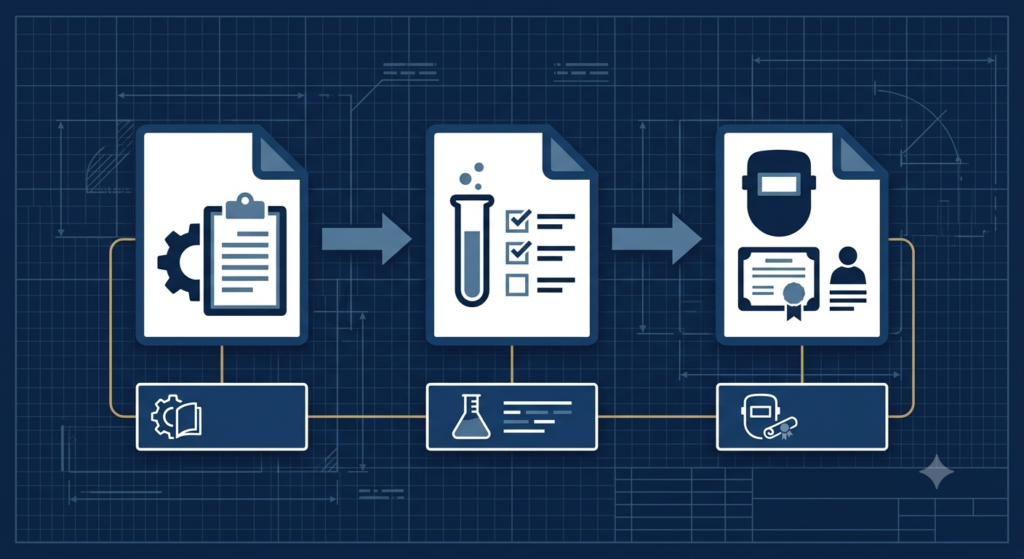
Section IX produces three distinct documents, and keeping their roles straight is the foundation for everything else in this guide.
- WPS (Welding Procedure Specification) — the instruction sheet handed to the welder. It specifies the process, joint design, materials, preheat, PWHT, and electrical parameters within qualified ranges.
- PQR (Procedure Qualification Record) — the evidence file. It records what actually happened when the test coupon was welded, plus the mechanical test results that prove the WPS produces a sound weld.
- WPQ (Welder/Welding Operator Performance Qualification) — the individual’s record. It proves a specific person can deposit sound weld metal using a qualified process, within a specific range of positions, thicknesses, and diameters.
A useful way to remember the relationship: the PQR proves the WPS works. The WPS tells the welder what to do. The WPQ proves the welder can actually do it. None of the three substitutes for either of the others, and an auditor will check all three are present and consistent.
| Document | What It Proves | Who Relies on It |
| WPS | The welding instructions for production work | Welders, welding operators, QC reviewers |
| PQR | The WPS, as written, produces a sound weld | Engineering, QC, third-party auditors |
| WPQ | A specific individual can execute a qualified WPS | Welding supervisors, QC, AVL/audit reviewers |
Essential, Supplementary Essential, and Nonessential Variables
Every WPS is built around a list of variables — process parameters and conditions that Section IX classifies by how much a change to them matters.
- Essential variables — a change beyond the qualified range requires a brand-new PQR before the WPS can be revised. These are the variables most likely to affect mechanical properties — things like welding process, base metal grouping, or filler metal classification.
- Supplementary essential variables — only apply when the application requires impact (notch-toughness) testing, such as low-temperature service. Outside of impact-tested work, a change to these variables doesn’t require requalification.
- Nonessential variables — can be changed without a new PQR, but the WPS itself must still be revised to reflect the change — it isn’t a free pass to skip documentation entirely.
| Variable Type | Effect of a Change | Typical Example |
| Essential | Requires a new PQR before the WPS can be used | Change in welding process, base metal P-Number, or filler metal F-Number |
| Supplementary Essential | Requires requalification only for impact-tested applications | Change in preheat or heat input on a notch-toughness joint |
| Nonessential | WPS revised; no new PQR needed | Change in groove design, fixturing, or cleaning method |
Welding Procedure Qualification, Step by Step
Qualifying a new WPS follows the same general sequence regardless of process or material. Here’s the path from a blank page to a finished, PQR-backed procedure.
- Define the code of construction and process — confirm which referencing Code Section applies (Section VIII, B31.3, etc.) and select the welding process or process combination the procedure will use.
- Draft a preliminary WPS (pWPS) — lay out the intended essential, supplementary essential, and nonessential variables — joint design, materials, filler metal, preheat, PWHT, and electrical parameters — before any welding happens.
- Weld the test coupon — a qualified welder welds a test coupon strictly following the pWPS, while all actual parameters used are recorded as they happen, not estimated afterward.
- Perform nondestructive examination — the coupon is visually examined, and radiography is performed where required, before it’s cut up for destructive testing.
- Run the mechanical tests — tension and guided bend specimens (and impact specimens, when required) are machined from the coupon and tested against Section IX acceptance criteria.
- Record everything on the PQR — actual parameters used during welding, plus every test result, are documented on the PQR — this record is what gives the WPS its legitimacy.
- Finalize and issue the WPS — once the PQR shows acceptable results, the WPS is finalized with qualified ranges for each variable, ready for production use.
- Qualify the welders — separately, each welder or welding operator who will perform production welds must pass their own performance qualification under the finished WPS.
Welder Performance Qualification — How It’s Different
A WPQ test answers a different question than a PQR. A PQR asks, “does this procedure produce a sound weld?” A WPQ asks, “can this specific person execute it?” That distinction shows up in what gets tested and how.
- Fewer variables — performance qualification cares about things like process, position, and material grouping (F-Number, P-Number), not the tighter chemistry and mechanical-property variables that drive procedure qualification.
- Simpler testing — most performance tests rely on visual examination plus a bend test or radiography, rather than the full tension and impact battery used to qualify a procedure.
- Continuity requirements — a welder’s qualification can lapse if they haven’t used that process within the time period Section IX specifies, even if the original test results were never in question.
This is also where AVL and ASME audits frequently find gaps: a perfectly good WPS and PQR on file, but the welder actually doing the production welding either was never qualified on that specific process and position combination, or let their qualification lapse without anyone tracking it.
Mechanical Tests You’ll See on a PQR
The specific test battery depends on process, material, and joint type, but most PQRs are built around the same core set of mechanical tests.
| Test | What It Confirms | Typical Method |
| Tension test | Weld and joint strength meet the base metal minimum | Cross-weld tensile specimens pulled to failure |
| Guided bend test | Soundness and ductility through the weld and fusion line | Face, root, or side bends formed around a specified mandrel |
| Impact test | Notch toughness at the minimum design temperature | Required when the base material or service spec calls for it (a supplementary essential trigger) |
| Fillet weld break / macro test | Fusion and soundness for fillet-only qualifications | Coupon broken or sectioned and examined for defects |
Common Audit Findings on WPS/PQR Packages
Most Section IX nonconformances found during ASME or AVL audits trace back to a short, repeating list of issues.
| What auditors flag most often: Production parameters outside the qualified range — the single most common finding — welders running outside the PQR-supported range for an essential variable like heat input or preheat.Treating nonessential changes as undocumented — a change doesn’t need a new PQR, but it still needs the WPS revised to reflect it — skipping that step leaves the WPS inaccurate.Missing supplementary essential support — running a notch-toughness application without a PQR that covers the supplementary essential variables that trigger impact testing.Lapsed welder continuity — a welder’s qualification expiring unnoticed, with production welding continuing under their name regardless.Assuming a prequalified WPS exists — unlike some structural welding codes, Section IX generally requires PQR support for a WPS; there’s no broad “prequalified” shortcut to rely on. |
Why This Matters for ASME Certification and Aramco AVL
A Section IX package is one of the first things reviewed in an ASME certification survey and one of the first traceability chains an AVL auditor follows. The chain runs from the drawing’s welding symbol, to the WPS it calls out, to the PQR that supports that WPS, to the WPQ of the welder who actually made the weld. A break anywhere in that chain — an unsupported parameter, an expired qualification, an unrevised WPS — is exactly the kind of gap a real audit is designed to surface.
Treating WPS, PQR, and WPQ as one combined package, kept current and cross-referenced rather than three separate filing exercises, is what turns Section IX from a compliance burden into a documentation asset you can hand an auditor with confidence.
| Preparing Your Welding Qualification Package? FreeDocumentsHub.com builds WPS/PQR documentation, welder qualification tracking, and full ASME Quality Control Manuals for fabricators across the Gulf region and the US — structured to hold up under a real audit. Get in touch through freedocumentshub.com to scope your qualification package. |
Conclusion
Section IX can look intimidating from the outside, but the logic underneath it is straightforward once the three documents and three variable categories are clear. A WPS tells a welder what to do. A PQR proves that instruction works. A WPQ proves the welder can follow it. Essential variables demand new evidence when they change; nonessential ones just demand an updated record. Keep that structure in mind, and reading — or building — a Section IX qualification package stops being a mystery and starts being a checklist.