
A look at the code updates, hybrid-process advances, and adoption pressures that moved robotic laser welding from a specialty process to a mainstream fabrication option in 2025.
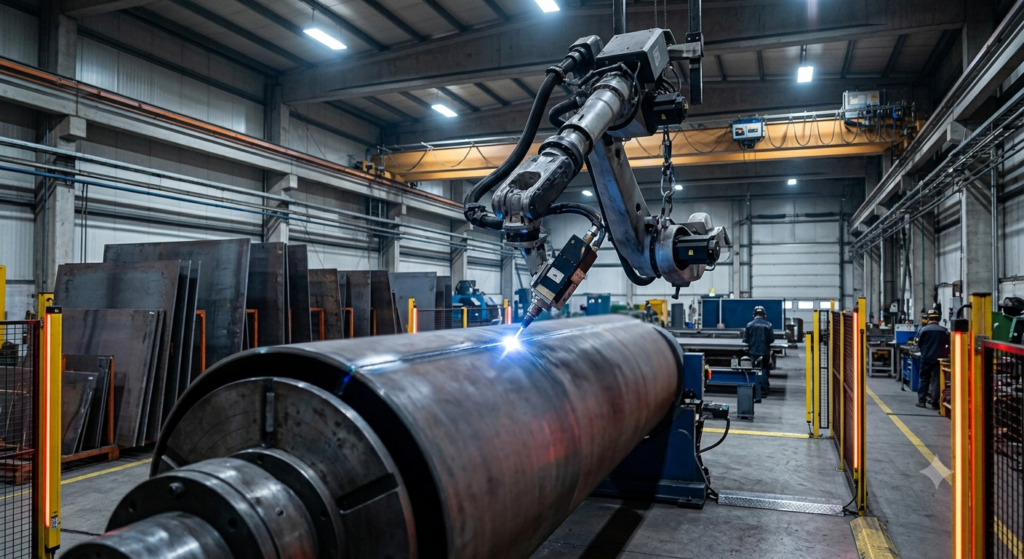
For most of the last two decades, laser welding occupied a narrow lane in oil and gas fabrication: thin-wall precision work, instrumentation housings, and a handful of specialty cladding applications. Thick-section structural steel, girth welds on large-diameter pipe, and pressure-retaining components stayed with submerged arc, GMAW, and manual TIG. That lane widened in 2025. None of the individual developments were dramatic on their own, but taken together, they mark the point where laser and hybrid laser-arc welding stopped being a laboratory curiosity for fabrication shops serving the energy sector and started showing up in code books, pipeline mill trials, and trade show floors as a production-ready option.
The code caught up: ASME Section IX, 2025 edition
The most consequential change for fabricators is also the least visible one. The 2025 edition of ASME BPVC Section IX — the qualification standard referenced by Section VIII pressure vessel work and by API and ASME piping codes across the oil and gas sector — carries dedicated welding variables and procedure specification tables for Low-Power Density Laser Beam Welding (LLBW), alongside revisions to essential variables and toughness testing requirements that apply across welding processes.
That matters because qualification, not equipment availability, has historically been the bottleneck. A shop could own a laser welding cell and still be unable to use it on code work without a qualified procedure and welders qualified to that procedure under Section IX. Clearer LLBW-specific variables give procedure writers a defined path to a qualified WPS rather than an argument with a third-party inspector about which essential variables apply by analogy from GTAW or GMAW. For ASME-certified fabricators — and for shops pursuing or maintaining Aramco AVL and similar operator vendor approvals — that is the difference between a process being technically possible and being audit-defensible.
| Why this matters for QC and welding engineers Laser beam welding now has its own essential-variable framework in Section IX rather than being qualified by analogy to other processes. Procedure qualification records (PQRs) for laser and hybrid laser-arc work have a clearer code basis going into 2026 work. Vendor approval audits referencing ASME Section IX should be checked against the 2025 edition rather than older cycles still circulating in some shops. |
Hybrid laser-arc welding gains ground on thick-wall pipe
The second shift is technical rather than regulatory. Hybrid laser-arc welding — combining a focused laser beam with a trailing or leading GMAW/GTAW arc in the same weld pool — has been studied for pipeline girth welds and thick-section structural steel since the early 2000s, largely through joint industry projects and national lab programs. Through 2024 and into 2025, published research increasingly focused on a practical problem rather than a proof-of-concept one: narrow-groove joint design for high-strength pipeline steels such as X80 and X120.
Multiple 2025 studies examined how groove width affects arc stability and droplet transfer in hybrid welding of thick high-strength steel sections, generally in the 20 to 25 millimeter range typical of large-diameter transmission pipe and pressure vessel shells. The practical finding repeated across this work is that narrower grooves reduce filler metal consumption and heat input — both attractive for productivity and for limiting heat-affected zone softening — but require tighter control of arc behavior to avoid sidewall fusion defects. That is an engineering tradeoff fabricators can now qualify around, rather than a process limitation that rules hybrid welding out of thick-section work entirely.
The earlier hybrid laser-arc pipeline work — including a U.S. Department of Transportation-backed joint industry project that combined a high-power fiber laser with a GMAW arc on a modified bug-and-band pipe welding system — established that hybrid systems could produce full-penetration root passes on X80/X100 pipe at travel speeds several times faster than conventional mechanized GMAW, with mechanical testing to API 1104. The 2025 research extends that line of work toward production-realistic joint geometries rather than idealized lab setups, which is the step that typically precedes broader field deployment.
Robots cross into laser welding
The most visible change in 2025 happened on trade show floors rather than in code committees. At FABTECH 2025 in Chicago, Universal Robots and integration partners including Hirebotics and Vectis Automation introduced new collaborative robot models and software aimed specifically at laser welding, alongside plasma cutting and finishing applications. Collaborative robot vendors framed this explicitly as laser welding moving from a specialty capability into mainstream adoption, attributing the shift to better control software, turnkey safety engineering, and falling fiber laser costs rather than any single breakthrough.
Separate market analysis for 2025 found that nearly 40 percent of new robotic welding installations were made by small and medium manufacturers, a segment historically priced out of traditional six-axis welding cells that require safety caging, dedicated programming expertise, and large floor footprints. Collaborative laser welding systems lower each of those barriers: smaller footprint, hand-guided teaching instead of offline programming, and in several 2025 product launches, built-in pre-weld and post-weld laser cleaning modes that remove rust, mill scale, or oil residue immediately before welding without chemical cleaning stations.
For oil and gas fabrication specifically, that pre-weld cleaning capability is more relevant than it might first appear. Surface contamination — oil, rust, mill coatings — is one of the most common causes of porosity and weak fusion in laser welding, and shops handling structural steel, skids, and piping components rarely receive material in a laser-clean condition. Integrated cleaning modes address a real operational gap rather than adding a feature for its own sake.
The forcing function: a welder shortage that isn’t closing
None of this adoption is happening in a vacuum. The American Welding Society’s projection of a deficit exceeding 360,000 welders in the United States by 2027 continues to function as the primary commercial driver behind robotic welding investment generally, laser included. Industry analysis covering the 2025 robotic welding market put the global market at roughly USD 7 billion in 2025, projected to grow at close to a 10 percent compound annual rate through 2030 — growth concentrated less in automotive (still the largest single end-use segment) and more in general fabrication, energy, and other sectors facing the same labor constraints as automotive faced a decade earlier.
Separately, new United States tariffs introduced in 2025 on steel and on components used in robotic welding systems prompted manufacturers and integrators to reexamine sourcing and supply chains for laser sources, robot arms, and control hardware. For fabrication shops evaluating a laser welding investment, that translates into more variability in lead times and landed equipment cost through 2025 and into 2026 than in prior years — a planning factor worth building into any capital request, separate from the technology decision itself.
What changed, at a glance
| Area | Status before 2025 | What changed in 2025 |
| Code coverage | LBW qualified largely by analogy to other processes in Section IX | Dedicated LLBW essential-variable tables in the 2025 edition |
| Thick-section joints | Hybrid laser-arc proven mainly in lab/JIP settings | Narrow-groove studies on 20–25mm high-strength steel move toward production geometries |
| Equipment access | Six-axis cells dominant; high capex, large footprint | Cobot laser welding mainstream at FABTECH 2025; ~40% of 2025 installs were SME shops |
| Surface prep | Separate chemical/mechanical cleaning stations | Integrated laser pre/post-weld cleaning modes on new cobot systems |
| Supply chain | Relatively stable sourcing for robotic welding components | 2025 US tariffs on steel and components prompt sourcing review |
What this means for fabrication shops
None of these developments make laser or hybrid laser-arc welding a drop-in replacement for SAW, GMAW, or manual welding across an oil and gas fabrication shop’s full scope of work in 2025. Submerged arc welding remains the workhorse for large-volume longitudinal seams in pipe mills, and qualified manual and semi-automatic processes still cover the majority of field and shop welding on pressure-retaining components. What changed is narrower and more specific: the regulatory, technical, and commercial barriers that kept laser-based processes out of serious consideration for code work and thick-section fabrication each moved, independently, in the same direction during 2025.
- Quality and welding engineers now have a defined Section IX path to qualify LLBW procedures rather than qualifying by analogy.
- Hybrid laser-arc research has shifted from proof-of-concept thin-section work toward joint geometries relevant to thick pipeline and pressure vessel steel.
- Equipment access has widened to small and mid-sized shops through collaborative robot platforms, not just large fabricators with dedicated automation budgets.
- The labor shortage driving automation adoption broadly shows no sign of easing before 2027, keeping pressure on shops to evaluate options beyond conventional arc processes.
For shops already pursuing ASME certification or maintaining operator vendor approvals, the practical takeaway is to treat the 2025 Section IX edition as a reference point when any laser or hybrid welding procedure enters scope — whether that procedure is qualified in-house or reviewed as part of a subcontractor’s documentation package. The technology question and the documentation question are no longer separable; 2025 is the year the code caught up to where the equipment already was.
Sources referenced: ASME BPVC Section IX (2025 edition); Universal Robots / FABTECH 2025 press materials; Optics & Laser Technology (2025); Journal of Materials Research and Technology (2025); industry market research from IFR-aligned and MarketsandMarkets-sourced reports.