
Introduction
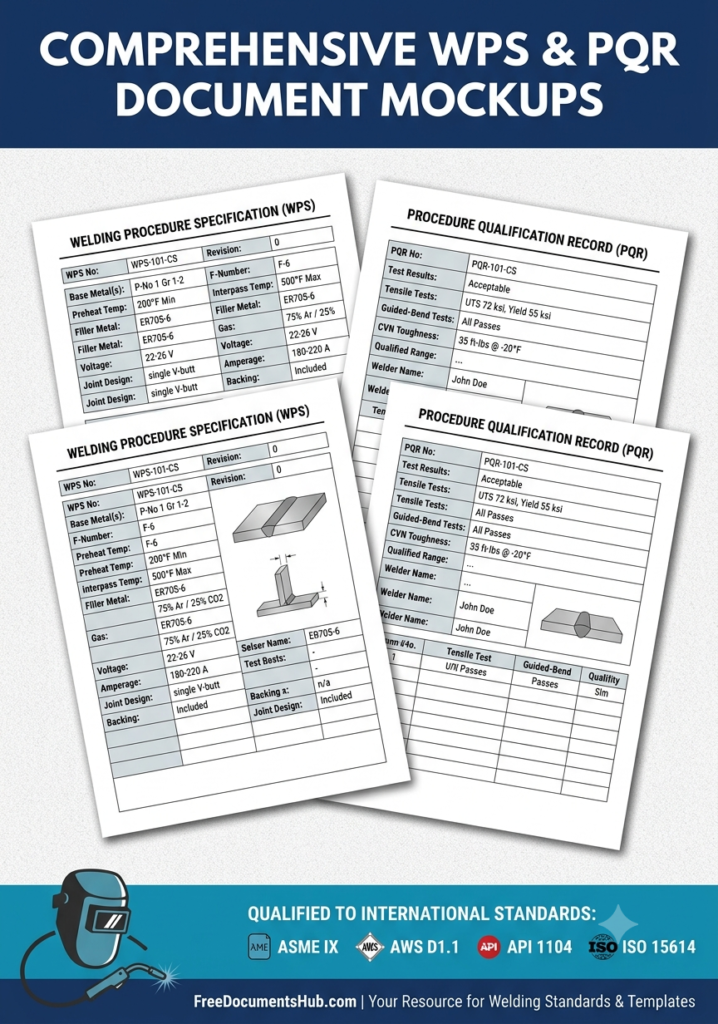
A Welding Procedure Specification (WPS) is one of the most critical documents in any fabrication or construction project. Whether you are working on a pressure vessel, piping system, structural steel, or storage tank, a WPS defines exactly how a weld must be performed — and ensures it meets the required quality and safety standard.
Without a properly prepared and qualified WPS, welding work cannot be accepted on any serious industrial project — including Saudi Aramco, EPC contracts, or third-party inspected fabrication shops.
In this guide, you will learn exactly what a WPS is, what it must contain, and how to prepare one step by step.
What Is a Welding Procedure Specification (WPS)?
A Welding Procedure Specification is a written document that provides direction to the welder (or welding operator) for making a production weld in accordance with Code requirements.
It defines all the variables that control weld quality, including the base metal, filler metal, joint design, preheat, interpass temperature, heat input, and post-weld heat treatment.
A WPS does not stand alone — it must be supported by a Procedure Qualification Record (PQR), which is the test evidence that the procedure produces acceptable mechanical properties.
The governing codes for WPS preparation include:
| Code / Standard | Applicable Scope |
| ASME Section IX | Pressure vessels and piping — most common in industrial projects |
| AWS D1.1 | Structural steel welding |
| API 1104 | Pipeline welding |
| ISO 15614 | International projects and European contracts |
Step 1 — Identify the Applicable Code and Project Requirements
Before writing a single line on the WPS, you must confirm:
- Which welding code applies (ASME IX, AWS D1.1, ISO 15614, or project specification)
- The applicable material specifications — base metals involved
- Any client or project-specific supplementary requirements such as Aramco SAES, TOTAL GS EP, or similar
This step prevents you from writing a WPS that qualifies under the wrong code or misses a project holdpoint.
Step 2 — Define the Joint Design
The WPS must fully describe the weld joint, including:
| Joint Parameter | What to Specify |
| Joint type | Butt joint, fillet joint, corner joint, T-joint, or combination |
| Groove type | V-groove, U-groove, J-groove, bevel |
| Root dimensions | Root opening and root face measurements |
| Groove angle | Included angle of the groove preparation |
| Backing | With or without backing, consumable insert, or open root |
| Important: The joint design must match exactly the configuration that was used in the PQR coupon test. |
Step 3 — Specify the Base Metal (P-Number)
ASME Section IX groups base metals into P-Numbers based on their composition and weldability. You must specify:
- The P-Number and Group Number of the base metal(s)
- The material specification — for example, ASTM A106 Gr. B or ASTM A516 Gr. 70
- The thickness range qualified — not just the coupon thickness, but the qualified range per code
For example, welding a 20mm coupon under ASME IX qualifies from 5mm to 40mm (the 2T rule applies for impact-tested joints).
Step 4 — Select the Welding Process
The WPS must clearly state the welding process or combination of processes:
| Process | Description |
| SMAW | Shielded Metal Arc Welding — commonly known as Stick welding |
| GTAW | Gas Tungsten Arc Welding — commonly known as TIG welding |
| GMAW | Gas Metal Arc Welding — commonly known as MIG or MAG welding |
| FCAW | Flux Cored Arc Welding |
| SAW | Submerged Arc Welding — used for heavy plate and vessel fabrication |
Many WPS documents cover a combination of processes, such as GTAW root pass followed by SMAW fill and cap — which is very common in piping work.
Step 5 — Specify the Filler Metal (F-Number and A-Number)
ASME Section IX classifies filler metals by F-Number (weldability grouping) and A-Number (deposited weld metal chemistry). You must specify:
- AWS classification of the electrode or wire — for example, E7018 or ER70S-6
- Filler metal size range
- Flux designation when SAW process is used
- Whether the filler is a matching, over-matching, or under-matching consumable relative to the base metal
Step 6 — Define Preheat and Interpass Temperature
Preheat is applied before welding begins, and interpass temperature is the temperature maintained between each weld pass. Both must be stated on the WPS:
| Parameter | Requirement |
| Minimum preheat temperature | Based on material type, thickness, and carbon equivalent |
| Maximum interpass temperature | Typically 250°C for carbon steel; 150°C for some alloy steels |
| Preheat method | Gas torch, electric resistance heating, or induction heating |
| Why This Matters: Failing to control preheat and interpass temperature causes hydrogen-induced cracking — the most common cause of weld failure in structural and pressure applications. |
Step 7 — Define Welding Parameters (Essential Variables)
This is the core of the WPS — the actual electrical and travel parameters the welder must follow. For each welding pass or pass range, specify:
| Parameter | Unit | Notes |
| Current type and polarity | — | DCEP, DCEN, or AC |
| Amperage range | Amps | Minimum to maximum — taken from PQR |
| Voltage range | Volts | Minimum to maximum — taken from PQR |
| Travel speed range | mm/min | Minimum to maximum |
| Heat input range | kJ/mm | (Amps × Volts × 60) ÷ Travel Speed |
These parameters are taken directly from the PQR test record and then expressed as a qualified range on the WPS.
Step 8 — Specify Shielding Gas and Flow Rate
For GTAW, GMAW, and FCAW processes, the WPS must document:
- Shielding gas composition — for example, 100% Argon, or 75% Ar / 25% CO₂
- Gas flow rate — typically expressed in litres per minute (LPM)
- Backing gas (purge gas) for root pass on pipe — gas type and flow rate
| Purge Gas Note: Purge gas is especially important for stainless steel and alloy piping to prevent oxidation on the root side of the weld. This is a mandatory inspection check point on most projects. |
Step 9 — Define Post-Weld Heat Treatment (PWHT)
Not all welds require PWHT, but when it is required by code or project specification, the WPS must include:
| PWHT Parameter | Typical Requirement |
| Heating rate | Maximum °C per hour — typically 200°C/hr for carbon steel |
| Holding temperature range | 595°C to 635°C for carbon steel (ASME IX) |
| Holding time | Minimum 1 hour per 25mm of weld thickness |
| Cooling rate | Maximum °C per hour after hold — then free cool in still air |
| Method of heating | Furnace or local resistance / induction heating |
| Thermocouple placement | Per project specification and code requirements |
ASME Section IX mandatory essential variables require the WPS to be requalified if PWHT conditions change beyond allowed limits.
Step 10 — Complete the WPS Format and Reference the PQR
Once all variables are defined, the WPS document must be formally prepared and include:
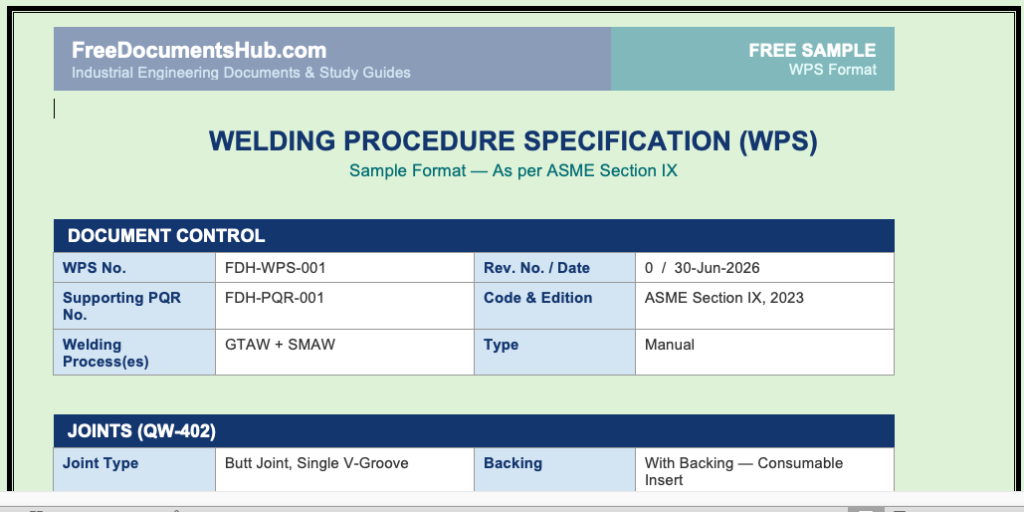
- WPS number — unique document identifier
- Revision number and date
- Supporting PQR number(s)
- Applicable code and edition
- Authorized signature — typically the Welding Engineer or QA Manager
- Position(s) qualified — 1G, 2G, 5G, 6G, etc.
| Note: One WPS can reference multiple PQRs if they cover different thickness ranges or positions. The WPS must reference its supporting PQR(s) by document number. |
| Looking for a Ready-to-Use WPS Template? Download our professional WPS and WQR document pack — formatted for Aramco and EPC projects. www.freedocumentshub.com |
Essential Variables vs. Non-Essential Variables
A common mistake when writing a WPS is not understanding the difference between essential and non-essential variables under the applicable code.
| Variable Type | Description and Examples |
| Essential Variables | Changes that require requalification (new PQR coupon test). Examples: change in P-Number, change in F-Number, change in PWHT condition, change in base metal thickness beyond qualified range. |
| Non-Essential Variables | Changes that can be made by revising the WPS without new testing. Examples: change in groove angle within design range, change in shielding gas flow rate within range. |
| Supplementary Essential Variables | Only applicable when impact testing (Charpy) is required. Examples: change in heat input beyond range, change in preheat temperature below minimum. |
Always check the applicable code clause carefully before revising a WPS. A wrong decision here can invalidate months of production welding.
Free Download Sample wps
Common Mistakes to Avoid
Several errors appear repeatedly during WPS preparation and third-party review:
- Specifying a thickness range wider than what the PQR coupon actually qualifies
- Using filler metal not covered by the qualified F-Number
- Not matching the PWHT condition between WPS and PQR
- Missing position qualifications — for example, WPS states 5G but PQR was done in 1G only
- Incorrectly calculating heat input — leading to compliance issues during inspection
- Signing the WPS without verifying PQR test results are acceptable for tensile, bend, and hardness requirements
Conclusion
Preparing a Welding Procedure Specification correctly requires a solid understanding of the applicable welding code, material behavior, and the qualification test results documented in the PQR. A WPS is not just a form to fill — it is a controlled technical document that governs every production weld on your project.
Whether you are a Welding Engineer, QA/QC Inspector, or Piping Supervisor preparing for certification, mastering WPS preparation is an essential skill in the industrial and EPC world.
| Browse All Industrial Engineering Documents Datasheets, calculation workbooks, study guides, and templates for EPC and Aramco projects. www.freedocumentshub.com | contact@freedocumentshub.com |
About the Author
| FreeDocumentsHub.com FreeDocumentsHub.com provides professional industrial engineering documents, templates, and study guides for EPC contractors, fabrication companies, and certification exam candidates operating in the GCC and Saudi Arabian industrial sector. contact@freedocumentshub.com |