
Why most steam trap failures trace back to installation, not the trap itself
Steam trap stations are one of the most overlooked components on an industrial site — small in footprint, but responsible for a huge share of energy loss when installed or commissioned incorrectly. Industry studies consistently show that 15–30% of steam traps in a typical plant are failed or leaking at any given time, and a large share of that failure rate starts with the same recurring installation mistakes. This guide walks through what a steam trap station actually is, the standards that govern it, the most common installation errors, and the commissioning sequence that catches problems before they cost you steam, energy, and rework.
1. WHAT IS A STEAM TRAP STATION?
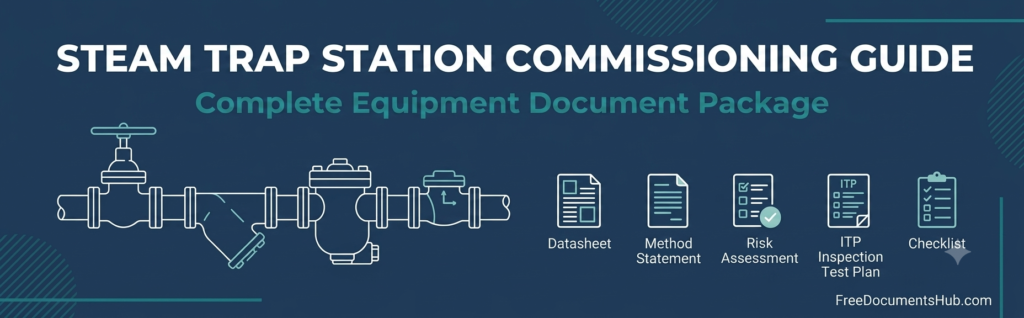
A steam trap station is not just the trap itself — it’s an assembly of components working together to remove condensate, air, and non-condensable gases from a steam line while blocking live steam from escaping. A properly specified station includes an upstream isolation valve, a strainer to protect the trap internals from debris, the trap body itself, a check valve on the discharge side to prevent backflow, and a downstream isolation valve. Many stations also include a bypass line, test point or sight glass, and a blowdown/drain valve for maintenance.
💡 A trap without an upstream strainer is one of the most common causes of premature failure — debris in the line is often the real root cause of a “bad trap.”
2. TYPES OF STEAM TRAPS — QUICK COMPARISON
| Type | Operating Principle | Best For | Limitation |
| Thermodynamic | Pressure differential across a disc | Steam mains, tracing lines | Noisy cycling; sensitive to back pressure |
| Float & Thermostatic | Float rises/falls with condensate level | Process equipment, heat exchangers | Larger footprint; freeze risk if uninsulated |
| Inverted Bucket | Buoyancy of an inverted bucket | High-pressure, variable load lines | Needs water seal to prime; can lose prime |
3. GOVERNING STANDARDS
- ASME B31.1 (Power Piping) — design and layout for steam distribution systems
- ASME B31.3 (Process Piping) — for process-side steam trap stations
- ASME B16.34 — pressure-temperature ratings for the valves in the station
- API RP 686 — machinery and piping installation recommended practice
4. FIVE INSTALLATION MISTAKES THAT CAUSE EARLY FAILURE
| Mistake | Consequence |
| Wrong orientation | Trap installed against the manufacturer’s flow-direction arrow, causing chronic cycling or blow-through. |
| Missing upstream strainer | Debris from commissioning/hydrotest enters the trap internals and damages the seat within weeks. |
| No check valve on discharge | Backflow from a shared condensate return line floods the trap body under varying loads. |
| Undersized for actual load | Trap selected on nameplate steam flow instead of measured condensate load with safety factor, causing waterlogging. |
| No test point / sight glass | Impossible to verify trap performance without shutting down the line — failures go undetected for months. |
5. COMMISSIONING SEQUENCE — THE FIVE STAGES
A repeatable commissioning sequence is what separates a trap station that runs for years from one that fails within its first month. The five stages below mirror the structure used in our full Inspection & Commissioning Checklist:
- Receiving & Storage — verify materials, protect flange faces, confirm trap internals are sealed against dirt ingress
- Installation — correct orientation, strainer basket down, verified torque on bolt-up, supports per drawing
- Pre-Commissioning — hydrostatic test held for full duration, blinds removed, valve positions confirmed against P&ID
- Commissioning / Test Run — gradual warm-up, trap discharge cycling verified, no continuous live steam loss
- Final Acceptance & Handover — punch-list closed, as-built dossier compiled, trap tagged into the asset register
💡 Skipping the gradual warm-up step is the single most common cause of water hammer damage during commissioning — never introduce steam to a cold line at full pressure.
6. WHY DOCUMENTATION MATTERS FOR QA/QC AND AUDITS
Every hold and witness point on a steam trap station commissioning run needs a signed record — not because auditors enjoy paperwork, but because a documented dossier is what lets you defend the installation months or years later when a trap fails and someone asks whether it was installed correctly. A complete package — datasheet, method statement, risk assessment, ITP, and checklist with an Excel completion tracker — turns a one-off installation into a repeatable, auditable process across every trap station on a project.
Get the Complete Steam Trap Station Document Package
Datasheet, Method Statement, Risk Assessment, ITP, and a 6-page Inspection & Commissioning Checklist with a live Excel tracker — built to ASME B31.1 / B31.3 / B16.34.
Bundle — all 5 documents: Gumroad | Lemon Squeezy | Payhip
ALL DOCUMENTS IN THIS PACKAGE
| Document | Gumroad | Lemon Squeezy | Payhip |
| Datasheet | View | View | View |
| Method Statement | View | View | View |
| Risk Assessment | View | View | View |
| ITP | View | View | View |
| Checklist + Excel Tracker | View | View | View |
| Bundle (Complete Package) | View | View | View |
Need a Custom Document Package for Your Project?
We build project-specific datasheets, method statements, and ITPs for any equipment type — contact us for a quote.
📧 contact@freedocumentshub.com
ABOUT THE AUTHOR
FreeDocumentsHub.com is built by a systems integration engineer with hands-on EPC and industrial project experience across oil & gas and process industries. We build practical, standards-based document templates so engineers and QA/QC teams don’t have to build them from scratch on every project.