
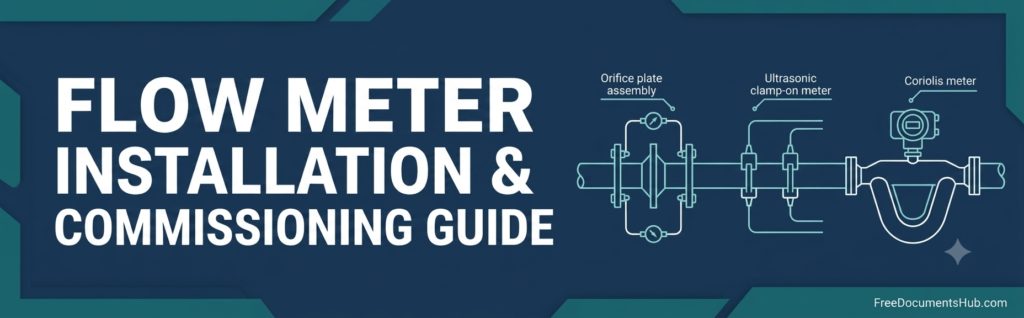
Orifice, Ultrasonic, and Coriolis — what each document in the package does for you, and why
A flow meter is only as accurate as its installation. Get the straight-run length wrong, mount it in the wrong orientation, or skip the loop check, and even a correctly specified meter will give you numbers you can’t trust. The documentation around a flow meter installation isn’t paperwork for its own sake — each document exists to catch a specific class of error before it becomes an expensive rework or a disputed custody-transfer reading. This guide breaks down what a flow meter station involves, the standards that govern it, and — document by document — exactly why each piece of the package matters, what it’s good at, where it falls short on its own, and what a ready-made version saves you.
1. ORIFICE VS. ULTRASONIC VS. CORIOLIS — QUICK COMPARISON
| Type | Principle | Best For | Limitation |
| Orifice (DP) | Pressure drop across a plate | Low-cost, well-understood applications | Needs long straight runs; limited turndown |
| Ultrasonic | Transit-time of sound across the flow | Custody transfer gas metering | Higher cost; sensitive to profile distortion |
| Coriolis | Mass-induced tube deflection | High-accuracy mass flow, multiphase-tolerant | Higher cost; size/pressure-drop limits at high flow |
2. GOVERNING STANDARDS
- ISO 5167 — orifice plate design, bore tolerance, and straight-run requirements
- AGA Report No. 9 — multipath ultrasonic gas flow meters
- ISO 10790 — Coriolis mass flow meter measurement requirements
- API MPMS Chapter 5 — additional requirements for custody-transfer applications
3. THE 5-DOCUMENT PACKAGE — WHY EACH ONE MATTERS
Every one of these five documents exists to solve a specific problem that shows up in the field. Here’s what each one actually does for you — including where it falls short on its own.
1. Datasheet
Why you need it: The datasheet is the single source of truth for the meter’s process conditions, sizing, and materials — every other document in the package (and every vendor quote) is built from it.
Advantage: Forces sizing decisions (turndown, accuracy, straight-run) to be made and documented up front, before procurement — avoiding a meter that’s technically correct but operationally wrong for the actual flow range.
Disadvantage / limitation: A datasheet on its own doesn’t install or commission anything — it’s a reference document, not an action plan, so it needs to be paired with a method statement and ITP to actually get the meter into service correctly.
Benefit of a ready-made version: A ready-made, standards-referenced template means you’re filling in project values instead of building the field list, units, and standards references from a blank page every time.
2. Method Statement
Why you need it: Flow meters are sensitive to installation error in ways many other instruments aren’t — straight-run length, orientation, and bolt-up sequence all directly affect accuracy, so the installation sequence needs to be controlled, not improvised.
Advantage: Gives the field crew and QA/QC a shared, step-by-step reference — reduces the chance of a rushed installation skipping straight-run verification or orientation checks.
Disadvantage / limitation: A generic method statement still needs site-specific adaptation (access constraints, specific meter model quirks) — it’s a strong starting point, not a substitute for a site walk-down.
Benefit of a ready-made version: Saves the hours it normally takes to draft a compliant 13-step sequence with roles, resources, PPE, and emergency arrangements from scratch for every meter on a project.
3. Risk Assessment
Why you need it: Instrument work on a live process line carries real hazards — process fluid exposure, electrical termination, pressure release — and most sites require a documented risk assessment before a permit is issued.
Advantage: Having hazards, likelihood/severity ratings, and controls pre-populated means the HSE review cycle is faster — you’re validating and adjusting, not writing from zero under time pressure.
Disadvantage / limitation: A template risk assessment reflects typical hazards for the equipment type — it won’t capture a hazard unique to your specific site layout unless someone reviews and adds to it.
Benefit of a ready-made version: A ready-made risk assessment with proper L×S risk scoring and ALARP-reduced residual risk gives you a defensible starting document that’s already structured the way auditors expect to see it.
4. ITP (Inspection & Test Plan)
Why you need it: Without a documented Hold/Witness/Review structure, there’s no formal mechanism forcing inspection at the points that actually matter — like straight-run verification or the loop check — before work proceeds past them.
Advantage: Protects both contractor and client: hold points create a paper trail proving critical steps were verified, not just performed.
Disadvantage / limitation: An ITP only works if hold points are actually respected on site — a document alone doesn’t enforce discipline, the team still has to follow it.
Benefit of a ready-made version: A ready-made 13-point ITP built around the standards that actually govern flow meters (ISO 5167, AGA 9, ISO 10790) means you’re not guessing which points deserve a hold vs. a witness vs. a review.
5. Checklist + Excel Tracker
Why you need it: A commissioning dossier needs an auditable, item-by-item record — not just a signed method statement — to prove every stage from receiving through handover was actually completed.
Advantage: The paired Excel tracker turns a static paper checklist into a live dashboard — you can see % complete per stage and overdue items at a glance across every meter on a project.
Disadvantage / limitation: Still requires someone to update status consistently — the tracker reflects what’s logged, not what’s physically true, so it’s only as good as the discipline behind the updates.
Benefit of a ready-made version: A ready-made 6-page checklist plus a working Excel dashboard (with conditional formatting and live formulas already built) saves the time of designing tracking logic from scratch for every equipment type.
We Prepare These For You
All five documents above — Datasheet, Method Statement, Risk Assessment, ITP, and Checklist + Excel Tracker — are already built and available on FreeDocumentsHub.com, ready to fill in with your project values. Instead of spending hours drafting each one from a blank page for every flow meter on a project, you download a standards-referenced template and adapt it in minutes.
💡 Available individually or as a discounted bundle covering the complete flow meter documentation package.
💡 Available individually or as a discounted bundle covering the complete flow meter documentation package.
Browse the full catalog of Equipment Document Packages and other engineering templates: FreeDocumentsHub.com — Paid Documents
4. NEED SOMETHING CUSTOM? WE ALSO OFFER REMOTE DOCUMENTATION SUPPORT
Beyond the ready-made templates, FreeDocumentsHub.com provides full documentation support remotely — if you need a correction, a project-specific adaptation, or a custom version of any document in our catalog, we can help directly.
- Your first correction or trial document is free — no cost to test the service.
- Available 24/7 by email: contact@freedocumentshub.com
- We handle corrections, custom edits, and bespoke document builds for any equipment type.
Get the Complete Flow Meter Document Package
Datasheet, Method Statement, Risk Assessment, ITP, and a 6-page Inspection & Commissioning Checklist with a live Excel tracker — built to ISO 5167 / AGA 9 / ISO 10790.
Bundle — all 5 documents: Gumroad | Lemon Squeezy | Payhip
ALL DOCUMENTS IN THIS PACKAGE
| Document | Gumroad | Lemon Squeezy | Payhip |
| Datasheet | View | View | View |
| Method Statement | View | View | View |
| Risk Assessment | View | View | View |
| ITP | View | View | View |
| Checklist + Excel Tracker | View | View | View |
| Bundle (Complete Package) | View | View | View |
Need a Custom Document Package for Your Project?
We build project-specific datasheets, method statements, and ITPs for any equipment type — first correction/trial document is free. Contact us for a quote.
📧 contact@freedocumentshub.com — available 24/7
ABOUT THE AUTHOR
FreeDocumentsHub.com is built by a systems integration engineer with hands-on EPC and industrial project experience across oil & gas and process industries. We build practical, standards-based document templates — and offer remote documentation support — so engineers and QA/QC teams don’t have to build them from scratch on every project.