
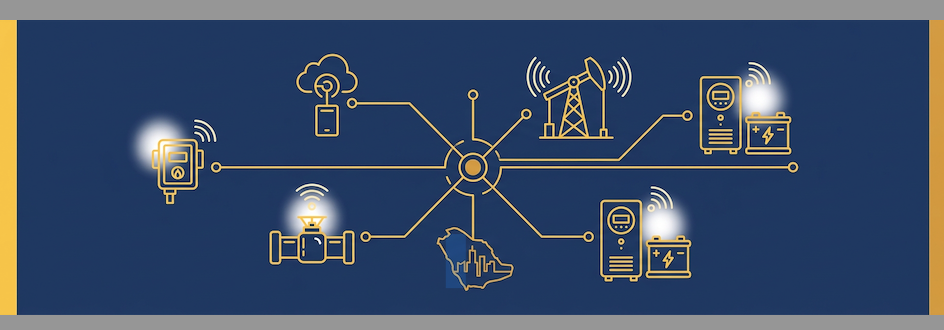
| In this article: How the Internet of Things (IoT) is reshaping oil & gas operations worldwide, current market size and growth projections for the global and Saudi Arabian IoT markets, real-world results from Saudi Aramco’s IoT deployments, and what growing IoT adoption means for EPC documentation and QA/QC teams. |
The Internet of Things (IoT) has moved from a buzzword to a core part of how modern industrial plants operate. Sensors on rotating equipment, smart gas detectors, connected UPS systems, and pipeline monitoring networks are now standard parts of new EPC scopes — not add-ons. For engineers and QA/QC professionals working in oil & gas, understanding where IoT adoption is heading isn’t optional anymore; it’s shaping what gets specified, procured, and documented on every new project.
This article looks at where the global and Saudi Arabian IoT markets stand today, how Saudi Aramco is already using IoT at scale, and what that growth means for documentation and commissioning work going forward.
1. What Is IoT, and Why Does It Matter in Industrial Settings?
IoT refers to networks of connected physical devices — sensors, controllers, meters, and monitoring equipment — that collect and exchange data automatically, without requiring a person to manually take a reading. In an industrial or oil & gas context, that means vibration sensors on rotating equipment, corrosion sensors on pipelines, smart gas detectors, connected UPS and battery systems, and remote-monitored tank gauges, all feeding data back to a central platform in real time.
The appeal for oil & gas operators is straightforward: earlier detection of problems, less unplanned downtime, safer operations, and lower maintenance costs — all measurable, bottom-line benefits rather than abstract digital transformation goals.
2. Global IoT Market Growth
Market research firms don’t fully agree on exact figures — estimates vary depending on scope and methodology — but the overall direction is consistent: strong, sustained double-digit growth through the early-to-mid 2030s, driven by industrial automation, smart manufacturing, 5G rollout, and AI-powered analytics layered on top of sensor data.
| Market | 2025/2026 Size | Forecast Size | CAGR |
| Global IoT (overall) | ~$857B–$1.06T (2026) | ~$2.0T–$5.8T by 2033–34 | ~12%–27% |
| Global Industrial IoT (IIoT) | ~$514B–$603B (2025–26) | ~$2.43T by 2035 | ~16.8% |
| IoT Solutions & Services | ~$400B (2026) | ~$1.29T by 2033 | ~18.2% |
The wide range in the headline IoT figures mostly comes down to what each report counts — some include consumer IoT (smart homes, wearables) alongside industrial and enterprise IoT, which inflates the total considerably. The Industrial IoT segment specifically — the one most relevant to EPC and oil & gas work — shows more consistent figures across sources, generally in the 13%–17% CAGR range through the mid-2030s.
A few consistent industry-wide data points worth noting: enterprise adoption of IoT for automation is already estimated at over 60%, more than half of industrial investment in IoT is now driven specifically by demand for predictive maintenance and real-time analytics, and forecasts point toward tens of billions of connected IoT devices in active use globally within the next few years.
3. Saudi Arabia’s IoT Market — Vision 2030 Driving Adoption
Saudi Arabia’s IoT market is one of the fastest-growing in the Middle East & Africa region, and the growth story here is explicitly tied to Vision 2030. Market research estimates for the Kingdom’s overall IoT market range from roughly $3 billion to $10.7 billion depending on scope, with most forecasts agreeing on a CAGR in the 7%–12% range through the early 2030s — and industrial IoT specifically growing faster, in the 12%–13% CAGR range.
| Market | 2025/2026 Size | Forecast Size | CAGR |
| Saudi Arabia IoT (overall) | ~$3.1B–$10.7B (2025–26) | ~$11.5B–$30.3B by 2029–34 | ~7%–12% |
| Saudi Arabia Industrial IoT | ~$2.9B–$4.3B (2025) | ~$8.3B–$10.1B by 2032–34 | ~12%–13% |
Several factors specific to the Kingdom are driving this growth: expanding 5G network coverage across industrial and urban centers, Vision 2030’s national digital transformation push, large-scale giga-projects (NEOM/The Line, Red Sea Project, Qiddiya) that are IoT-enabled from the ground up, and — most relevant to this audience — the energy sector’s own digitalization drive, including smart grid automation and Aramco Digital’s national industrial network initiative.
For EPC contractors and QA/QC professionals working on Saudi-based projects, this translates directly into more IoT-enabled instrumentation, smart sensors, and remote monitoring systems showing up in project scopes — which in turn means more datasheets, calibration procedures, and commissioning documentation built around connected devices rather than standalone analog equipment.
4. IoT in Practice: How Saudi Aramco Is Already Using It
Saudi Aramco’s own digitalization program offers some of the clearest, most measurable examples of IoT value in the oil & gas sector — not projections, but reported operational results.
Khurais Oil Field
Aramco has deployed thousands of IoT sensors across the Khurais oil field to continuously monitor and forecast oil well behavior. According to Aramco’s own reporting, this deployment has reduced power consumption by approximately 18%, cut maintenance costs by approximately 30%, and reduced inspection times by around 40% — all from real-time sensor data replacing manual monitoring rounds.
Abqaiq Processing Facility
Abqaiq, one of the world’s largest oil processing facilities, was inducted into the World Economic Forum’s Global Lighthouse Network in 2021 in recognition of its Fourth Industrial Revolution (4IR) deployment — including robotics, smart drones, and IoT-driven predictive modeling used to improve performance and efficiency across the facility.
Pipeline Integrity and Leak Detection
IoT-connected corrosion sensors and AI-driven analysis are increasingly used across the industry — including by Aramco — to flag corrosion hotspots and schedule maintenance before a failure occurs, extending pipeline life and reducing the risk of spills. Drone-mounted IoT sensors are also being used for remote pipeline inspection, reducing the need to send personnel into hazardous areas.
Predictive Maintenance at Scale
Aramco has integrated Asset Performance Management (APM) and predictive analytics tools into its Integrated Manufacturing Operations Management System (IMOMS), using IoT sensor data and machine learning to detect early signs of equipment failure across drilling rigs, compressors, and refinery assets — shifting maintenance from reactive/scheduled models toward genuinely predictive ones.
5. Where IoT Is Showing Up in EPC & QA/QC Scopes
For engineers and QA/QC professionals, the growth in IoT adoption is already visible in the equipment specifications and document packages being requested on new projects:
- Gas detection systems with networked, remotely monitored sensor arrays instead of standalone detector heads
- UPS and battery bank systems with remote monitoring and predictive alerting on battery health and load
- Vibration and corrosion sensors integrated directly into rotating equipment and pipeline commissioning packages
- Smart metering and grounding/earthing systems with continuous resistance monitoring rather than periodic manual testing
- Fire alarm control panels with networked, remotely diagnosable zone monitoring
The equipment is more connected, but the documentation fundamentals haven’t changed — reviewers and TPI inspectors still expect a Datasheet, Method Statement, Risk Assessment, ITP, and Checklist trail for every system, with sizing and commissioning data that proves the design basis was met. IoT-enabled equipment just adds another layer: network architecture, data points, and remote monitoring commissioning as part of that trail.
6. What This Means Going Forward
Whether the global IoT market lands closer to $2 trillion or $5 trillion by the early 2030s, and whether Saudi Arabia’s market reaches $11 billion or $30 billion, the direction is the same: more connected equipment on more projects, and documentation packages that need to keep pace with that shift. For EPC contractors and QA/QC teams, staying ahead of this means having submittal-ready documentation for both the equipment itself and the sensor/monitoring systems increasingly bundled with it.
FreeDocumentsHub.com prepares EPC and commissioning documentation for the systems already at the center of this shift — gas detection, fire alarm, UPS and battery backup, grounding and earthing systems, and more — built to the Datasheet, Method Statement, Risk Assessment, ITP, and Checklist structure reviewers expect.
Need Documentation for an IoT-Enabled System?
If your project scope includes networked or remotely monitored equipment that isn’t covered in our existing catalog, we can build a custom document package matched to your specific system architecture and project standard. Email contact@freedocumentshub.com — first correction or trial document is free, and we’re available 24/7.Market size and growth figures are drawn from publicly available industry research reports current as of August 2026; forecasts vary by source and should be treated as directional