
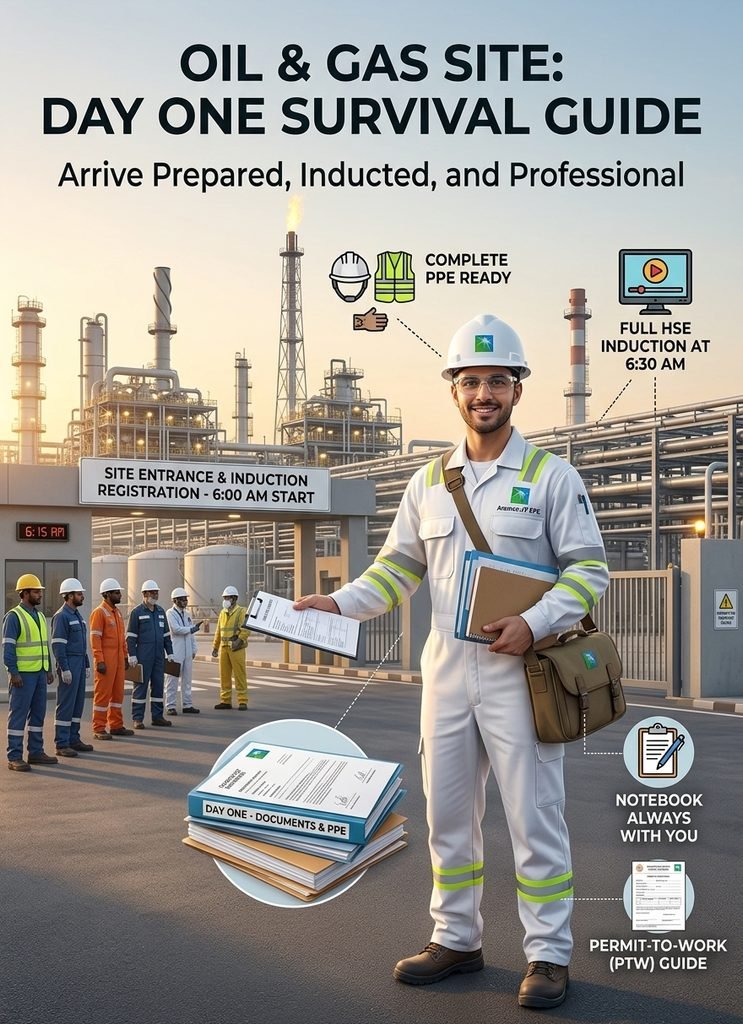
Quick Summary
- Arrive early with all documents, medical clearance, and PPE ready — don’t assume the site will sort it out for you.
- Attend the full HSE induction, no shortcuts, even if you’ve seen a safety video before.
- Observe before you act — don’t touch equipment, valves, or panels you haven’t been authorized or trained on.
- Carry a notebook everywhere. Write down names, procedures, and instructions instead of relying on memory.
- Understand the permit-to-work system before you go anywhere near live equipment.
- Ask questions — silence is not professionalism, it’s a risk on an industrial site.
Why Day One Is Different on an Industrial Site
Your first day as an engineer on an oil & gas or industrial site is nothing like a typical office job. You’re stepping into an environment where safety procedures, permit systems, and strict hierarchy exist for a reason — one mistake with equipment, PPE, or a permit-to-work can have consequences far beyond a bad first impression. For a fresh graduate, this can feel overwhelming. The good news: almost every mistake new engineers make on day one is avoidable once you know what to expect.
This guide walks through exactly what to do, what not to do, and the unwritten etiquette of showing up on an EPC or Aramco-style project site for the first time.
Before You Arrive
A large part of a smooth first day happens before you even step through the gate.
- Carry physical and digital copies of your documents — degree certificate, offer letter, ID/Iqama, medical fitness certificate, and any site-specific clearance requested by HR. Don’t assume the site office already has everything; missing paperwork is one of the most common reasons new hires get delayed at the gate.
- Confirm your PPE requirements in advance. Some sites issue PPE on day one; others expect you to arrive with your own coveralls, safety shoes, and hard hat. Ask HR or your point of contact beforehand rather than guessing.
- Arrive early, not just on time. Site gate clearance, badge issuance, and induction registration can eat up 30–60 minutes before your actual work day starts. Budget for it.
- Get a good night’s sleep before day one. Industrial sites often start early, and a sharp, alert mind matters more on your first day than any technical knowledge.
Site Induction & HSE — Don’t Treat It as a Formality
For fresh graduates coming from a classroom environment, the HSE induction can feel like a repeat of things you already studied. Treat it as anything but that.
- Attend the full induction, without shortcuts. This includes emergency assembly points, alarm types (fire vs. gas vs. evacuation), first-aid station locations, and site-specific hazards.
- Understand your PPE matrix. Different zones on an industrial site require different PPE levels — a process area may demand gas detectors and flame-resistant clothing that an office zone doesn’t.
- Learn the permit-to-work (PTW) system early. Almost nothing on an active oil & gas site happens without a permit — hot work, confined space entry, working at height, or electrical isolation all require specific permits, signed by specific authorities. As a new engineer, your job on day one is to understand the system, not to issue or execute permits yourself.
- Note emergency contact numbers and reporting lines — who to call, and who your immediate supervisor is in case of an incident.
What TO DO on Your First Day
1. Report to your supervisor and confirm your reporting structure. Find out exactly who you report to, who your discipline lead is, and where you fit in the organization chart. This avoids confusion in your first week about whose instructions to follow.
2. Carry a notebook and use it constantly. Write down names, designations, procedures, and any instruction given verbally. On a site with dozens of new faces and technical terms, your memory alone won’t be reliable enough — and taking notes signals seriousness to your supervisors.
3. Observe before you act. Spend your first day watching how things are actually done — not just how they’re written in the procedure manual. Ask questions instead of assuming, and don’t rush to demonstrate your knowledge before you understand how the site operates.
4. Get your system and document access sorted. Email, document control system, drawing registers, and any software you’ll need (AutoCAD, Primavera, SAP, etc.) — confirm access is being processed, and follow up politely if it isn’t ready by end of day.
5. Learn the document control and reporting protocol. Every industrial project runs on document control — drawings, ITPs, method statements, checklists. Understand where these live, who approves them, and how revisions are tracked, even if you won’t be creating them yet.
6. Communicate professionally and listen more than you speak. Introduce yourself clearly, be polite to everyone regardless of designation, and resist the urge to fill silences with opinions. Your first day is for absorbing information, not proving yourself.
7. Ask questions — the right way. There’s no shame in asking “I’m not sure, can you explain that?” There is real risk in staying silent about something you don’t understand, especially around safety procedures or equipment operation.
What NOT TO DO on Your First Day
1. Don’t touch any equipment, valve, panel, or machine you haven’t been authorized to operate. This is the single most important rule on an industrial site. Even something that looks simple can be part of a live process. Always ask first.
2. Don’t skip or rush through the safety induction. Even if you’ve completed similar inductions before, each site has its own hazards, layout, and procedures. Treat every induction as new.
3. Don’t be late — or leave the moment your shift technically ends. First impressions on punctuality follow you for a long time on a site with a strong hierarchy culture.
4. Don’t pretend to know something you don’t. Bluffing technical knowledge on day one — especially around safety-critical topics — is one of the fastest ways to lose credibility, and it’s genuinely dangerous in an industrial setting.
5. Don’t criticize existing processes or suggest changes on day one. Even if something looks inefficient, you don’t yet have the full context of why it’s done that way. Save suggestions for once you understand the system.
6. Don’t ignore the permit-to-work process, even informally. Never assume “it’s just a quick task” is a reason to skip a permit. This applies even if a senior colleague suggests skipping a step — you’re still responsible for following procedure.
7. Don’t isolate yourself completely — but don’t overshare either. Building rapport with your team matters, but keep first-day conversations professional. There will be time to build closer working relationships later.
Oil & Gas Site Etiquette Fresh Graduates Should Know
- Understand the client–contractor–subcontractor hierarchy. On EPC and Aramco-style projects, engineers from different companies work side by side, but reporting lines and authority levels differ. Know which company you represent and who has authority over what.
- Attend toolbox talks seriously, even if they repeat information — they’re a core part of daily site safety culture, not a formality to sit through.
- Coordinate with QA/QC and HSE officers early. These teams will be central to your daily work; building a respectful working relationship with them from day one makes future projects smoother.
- Dress and conduct yourself to site standard, not just company standard — sites often have stricter expectations around appearance, punctuality, and conduct than typical offices.
Common First-Day Mistakes Fresh Graduates Make
- Staying silent out of fear of “looking inexperienced,” instead of asking clarifying questions
- Not understanding the site’s organizational hierarchy in the first week
- Assuming HSE induction content is generic and not paying full attention
- Trying to demonstrate technical knowledge before understanding site-specific context
- Forgetting to note down instructions and having to ask the same question twice
- Underestimating how much day-to-day work depends on document control and reporting protocol
Quick Do’s & Don’ts Checklist
| Do | Don’t |
| Arrive early with all documents and PPE ready | Assume the site will sort your paperwork |
| Attend the full HSE induction attentively | Treat induction as a repeat formality |
| Learn the permit-to-work system | Touch equipment without authorization |
| Carry a notebook and take detailed notes | Rely on memory for instructions |
| Confirm your reporting structure | Guess who you report to |
| Ask questions when unsure | Bluff knowledge you don’t have |
| Observe before acting | Suggest process changes on day one |
| Be punctual and professional | Be late or leave early |
Final Thought
Your first day as an engineer isn’t about proving how much you know — it’s about showing you can be trusted to learn the right way, follow procedure, and work safely within a system that’s bigger than you. Every experienced engineer on that site was once standing exactly where you are. Show up prepared, stay observant, ask good questions, and the rest of your career on that site builds from there.