
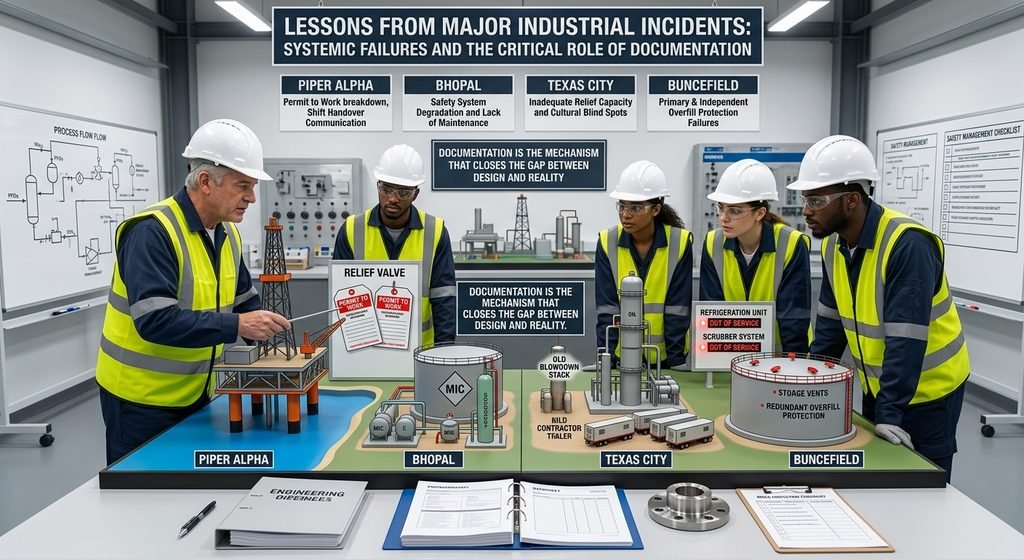
| In this article: Four of the most significant industrial incidents in oil, gas, and chemical processing history — Piper Alpha, Bhopal, Texas City, and Buncefield — and the specific documentation and process failures behind each one. These aren’t abstract case studies; they’re the reason permit systems, relief valve documentation, and maintenance records exist in the form they do today. |
Every major safety standard in use today — API 520/521, the modern Permit to Work system, process safety management regulations — exists because of a specific failure that came before it. These weren’t accidents caused by reckless individuals ignoring obvious danger. In nearly every case, the people involved were following what seemed like reasonable procedures, under normal operational pressure, with warning signs that were missed, dismissed, or never documented in a way anyone could act on. That’s what makes these incidents worth studying: the failures were systemic, not personal, and systemic failures are exactly what documentation and process discipline are built to catch.
1. Piper Alpha (1988) — When the Permit to Work System Breaks Down
Date: 6 July 1988
Location: North Sea, 120 miles off Aberdeen, Scotland
Result: 167 deaths — the deadliest offshore oil disaster in history
On the evening of the disaster, a pressure relief valve had been removed from a condensate pump for maintenance, and a blind flange fitted in its place — authorized under one permit. Separately, the pump’s motor coupling was isolated for maintenance under another permit. At shift change, the outgoing team did not clearly communicate that the relief valve was missing. The incoming night shift, working from an incomplete picture, restarted the pump. High-pressure gas escaped through the blind flange and ignited.
The official Cullen Inquiry found the root cause was a permit to work system that existed on paper but wasn’t operating as intended — no cross-referencing between permits affecting the same equipment, unclear shift handover communication, and a prior fatal incident involving the same weakness that had been investigated but not meaningfully corrected. This is precisely why a modern Permit to Work system requires physical isolation verification, not just a signature, and why permits for interrelated work need to be cross-referenced rather than issued in isolation.
2. Bhopal (1984) — When Safety Systems Exist But Aren’t Maintained
Date: 2–3 December 1984
Location: Bhopal, Madhya Pradesh, India
Result: Officially at least 3,787 deaths; estimates of total deaths and long-term health impacts range far higher; over 500,000 people exposed
A pesticide plant operated by Union Carbide India Limited stored methyl isocyanate (MIC), a highly toxic gas, in bulk storage tanks. Water entered a storage tank — likely during a maintenance or cleaning operation — triggering a runaway exothermic reaction that built pressure far beyond what the tank’s safety systems could handle. The plant had multiple layers of protection designed for exactly this scenario: a refrigeration unit to keep the MIC cool, a vent gas scrubber to neutralize escaping gas, and a flare tower to burn off any release. On the night of the disaster, investigations found these systems were degraded, understaffed, or simply not operational — the refrigeration unit had been shut down months earlier as a cost-cutting measure.
The lesson isn’t just about the initial trigger — it’s about the gap between a safety system existing on a P&ID and a safety system actually being maintained, inspected, and verified operational. A relief or containment system that isn’t included in an active maintenance and inspection program is a false sense of security, not a real one.
3. Texas City Refinery Explosion (2005) — When Relief and Blowdown Capacity Isn’t Enough
Date: 23 March 2005
Location: BP Texas City Refinery, Texas, USA
Result: 15 deaths, 180 injuries
During startup of an isomerization unit, a distillation tower (the raffinate splitter) was overfilled well beyond safe levels due to faulty level instrumentation and startup procedures that weren’t followed correctly. Excess liquid and vapor were forced into the unit’s blowdown stack — an older, atmospheric-vent design rather than a closed flare system — which itself was overwhelmed. Flammable vapor vented directly into the air at ground level, formed a vapor cloud, and ignited near a cluster of contractor trailers that had been sited too close to a process unit with a known history of releases.
Multiple investigation panels — including the U.S. Chemical Safety Board and the independent Baker Panel — identified this as a combination of an inadequate relief/blowdown design for the actual operating conditions, a startup procedure that wasn’t rigorously followed, and a corporate safety culture that had focused heavily on personal injury rates (slips, trips, falls) while under-investing in process safety — the systems, like relief and blowdown capacity, that prevent catastrophic events. It’s a direct, real-world illustration of why relief system sizing calculations (the same API 520/521 methodology behind modern PV relief documentation) have to reflect actual operating and upset conditions, not just routine ones.
4. Buncefield (2005) — When Overfill Protection Fails Twice
Date: 11 December 2005
Location: Hertfordshire Oil Storage Limited, Hemel Hempstead, UK
Result: No fatalities, but 43 injuries and one of the largest peacetime fires in UK history
A storage tank was being filled with petrol overnight. The tank had two independent layers of overfill protection: a gauge for operators to monitor fill level, and a separate automatic high-level switch designed to shut off filling if the gauge was missed. On the night of the incident, the gauge had been sticking intermittently since a service months earlier, and the automatic high-level switch was inoperable — it needed a padlock to hold its check lever in the working position, and the padlock wasn’t fitted. With no working alert and no automatic shutoff, the tank was overfilled by roughly 250,000 litres of petrol, which escaped through the tank’s roof vents. In cold, still conditions, the fuel formed a dense vapor cloud roughly 360 metres across before igniting.
This incident sits directly alongside the same tank venting and overfill protection systems we covered in our Pressure/Vacuum Relief Systems article — it’s a real-world case of both the primary instrumentation and the independent backup safety layer failing simultaneously, neither one caught in time because neither was being properly tested and verified as part of routine maintenance. It’s the clearest possible argument for why field verification of relief and safety devices — confirming nameplate data, testing set points, checking that safety-critical hardware like a padlock interlock is actually in place — can’t be treated as a formality.
The Common Thread
None of these four incidents happened because a system didn’t exist on paper. Piper Alpha had a permit to work system. Bhopal had refrigeration, scrubbing, and flaring systems. Texas City had a blowdown stack and startup procedures. Buncefield had two independent layers of overfill protection. In every case, the failure was between the documented design and the verified, maintained, actually-operating reality on the day it mattered.
That gap is exactly what QA/QC documentation — datasheets referencing the correct design basis, method statements followed step by step, ITPs with real hold points, checklists that get physically completed rather than assumed, and calibration records that are actually current — exists to close. Good documentation doesn’t just satisfy an auditor. It’s the mechanism that turns a system that exists on a drawing into a system that’s verified to work.
This article summarizes publicly available investigation findings (the Cullen Inquiry, CSB and Baker Panel reports, and UK HSE/Competent Authority reports) for educational purposes. Figures and details are drawn from official investigation reports and are presented here for safety awareness, not as a complete account of every contributing factor.