
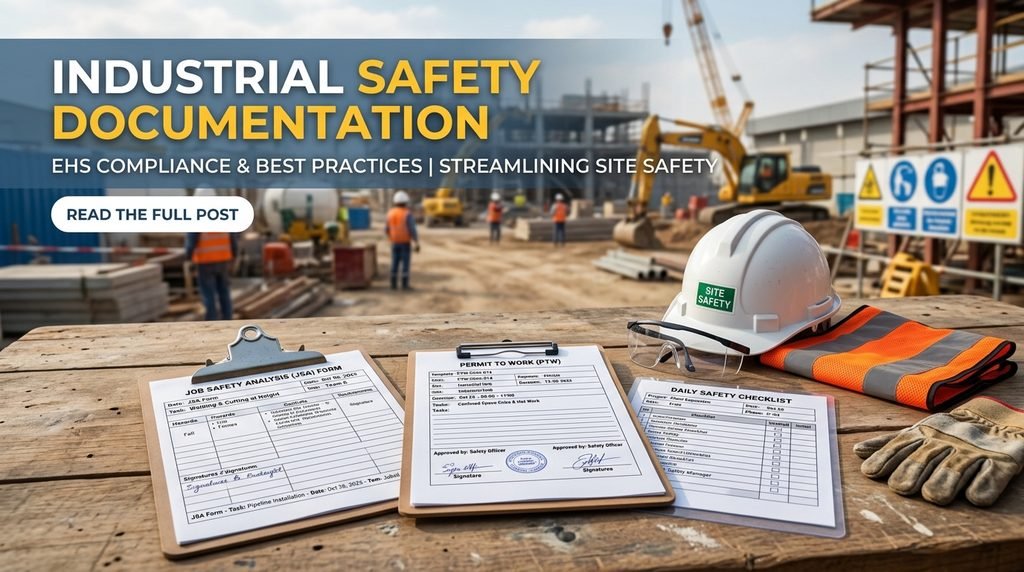
| In this article: What Toolbox Talks, Permit to Work templates, and Job Safety Analyses (JSAs) actually are, why each one exists as a separate OSHA-aligned document, what you risk without them, and which specific 29 CFR standards each one supports. Includes a free Working at Height JSA download and our complete OSHA Master Bundle — 40 documents across all three categories, available now on Gumroad and Payhip. |
Downlad Free and paid docs
Downlad Free and paid docs
Most safety programs don’t fail because nobody cared about safety. They fail because the documentation trail has gaps — a toolbox talk that was delivered but never logged, a permit that was issued without a matching hazard analysis, a JSA that exists for one task but not the ten similar ones done every week. When OSHA inspectors, insurance auditors, or incident investigators show up, they’re not asking whether your crew is careful. They’re asking whether you can prove it, in writing, task by task.
Three document types sit at the center of that proof: Toolbox Talks, Permit to Work templates, and Job Safety Analyses (JSAs). Each one does a different job, and a complete safety program needs all three working together — not just one.
Toolbox Talks — Why They Exist
A Toolbox Talk is a short, topic-focused safety briefing delivered before a shift or task begins — typically 5 to 15 minutes, covering one specific hazard or safe-work topic in plain language. Common topics include heat stress, electrical safety, confined space awareness, PPE use, housekeeping, manual handling, fatigue management, and emergency response.
Toolbox Talks matter because OSHA training requirements across multiple standards (including 1910.132, 1910.146, and 1910.1200) explicitly require documented employee training — not just training that happened, but training that’s recorded, with topics, dates, and attendee sign-offs. A verbal safety reminder with no paper trail doesn’t satisfy that requirement. A logged Toolbox Talk with a sign-off sheet does.
Permit to Work Templates — Why They Exist
A Permit to Work formally authorizes a specific hazardous task — hot work, confined space entry, excavation, electrical isolation — for a defined time and place, only after the hazards have been reviewed and controls verified. We covered the full Permit to Work system in detail in a previous article; the short version is that a permit is what stops a hazardous task from starting before the right precautions are confirmed and documented.
Without a permit system, hazardous work proceeds on trust rather than verification — and when something goes wrong, there’s no record of who authorized it, what precautions were checked, or what conditions were confirmed before the job started.
Job Safety Analysis (JSA) — Why They Exist
A JSA breaks a specific task down into its individual steps, and for each step, identifies the hazards present and the controls required to manage them — required PPE, permit references, and a stop-work authority reminder for the crew. Where a Toolbox Talk covers a general topic and a Permit authorizes a specific job, a JSA is the task-level hazard breakdown that connects the two: it’s the document that shows exactly how a task will be done safely, step by step, before anyone picks up a tool.
Our free Working at Height JSA download is a working example of this format — breaking a height-related task into individual steps with hazards and controls, required PPE, the applicable permit reference, a stop-work authority reminder, and crew sign-off, all in one page.
Which Document Supports Which OSHA Standard
Each hazard category ties back to a specific 29 CFR standard, and the document type (or types) needed to demonstrate compliance varies by category:
| Hazard Category | Document(s) | Governing Standard |
| Working at Height / Fall Protection | JSA + Permit | 29 CFR 1926.501 (construction, 6 ft) / 1910.28 (general industry, 4 ft) — fall protection systems and thresholds. |
| Confined Space Entry | JSA + Permit | 29 CFR 1910.146 (general industry permit-required confined spaces) / 1926 Subpart AA (construction). |
| Lockout/Tagout (Electrical Isolation) | JSA + Permit | 29 CFR 1910.147 — control of hazardous energy. |
| Hot Work / Welding, Cutting, Brazing | JSA + Permit + Talk | 29 CFR 1910 Subpart Q / 1926.350–354 — welding, cutting, and fire prevention. |
| Excavation | JSA + Permit | 29 CFR 1926 Subpart P (1926.651/652) — excavation and trenching protection. |
| Scaffolding | JSA + Talk | 29 CFR 1926.451 — scaffold construction and use. |
| Chemical Handling / Hazard Communication | JSA + Talk | 29 CFR 1910.1200 / 1926.59 — labeling, SDS access, and training. |
| Powered Industrial Trucks / Vehicle Safety | JSA + Talk | 29 CFR 1910.178 — operator training and evaluation. |
| PPE (General) | JSA + Talk | 29 CFR 1910.132 (general industry) / 1926.95 (construction) — hazard assessment and PPE selection. |
| Crane Operation / Lifting & Rigging | JSA + Permit | 29 CFR 1926.1400 series — construction crane and rigging requirements. |
Heat stress and fatigue management don’t have a single dedicated OSHA standard the way fall protection or LOTO do — they’re enforced primarily under the General Duty Clause (Section 5(a)(1) of the OSH Act), which is exactly why documented Toolbox Talks and JSAs matter even more for these topics: they’re your evidence of a proactive safety program in the absence of a specific numbered rule to point to.
What You Gain With Ready-Made Documentation
- Time — a 40-document library built from scratch by an EHS team can take weeks; downloading a pre-built, OSHA-aligned set takes minutes.
- Consistency — every document references the same standards in the same format, so your safety program reads as one coherent system, not a patchwork built by different people at different times.
- Audit readiness — when an inspector or client auditor asks for training records, permits, or hazard analyses for a specific task, you have them ready rather than assembling them under pressure.
- Editable ownership — templates in Word format mean you’re not locked into someone else’s software; you customize site names, hazards, and sign-off fields to match your actual operation.
What You Risk Without It
- OSHA citations and fines — missing or incomplete documentation is one of the most common findings in OSHA inspections, independent of whether an actual incident occurred.
- Indefensible incident investigations — if a task-related injury happens and there’s no JSA or permit on file for that task, the absence of documentation itself becomes a liability.
- Failed client or insurance audits — many operators and insurers require documented evidence of toolbox talks, permits, and JSAs as a condition of working on-site or maintaining coverage.
- Inconsistent crew behavior — without a written, step-by-step JSA, different crews handle the same hazardous task differently, increasing the chance that someone skips a control nobody wrote down.
Get the Documents
The Working at Height JSA is available now as a free download — a working example of the JSA format described above, ready for immediate site use.
Download the free Working at Height JSA
For the complete library, the OSHA Master Bundle includes all 40 documents in one package — 20 Toolbox Talks, 10 Permit to Work templates, and 10 JSAs — covering Working at Height, Confined Space Entry, Hot Work, Lifting & Rigging, Electrical Safety & LOTO, Excavation, Scaffolding, PPE, Manual Handling, Heat Stress, Housekeeping, Radiography Safety, Sandblasting & Painting, Crane Operation, Fall Protection Systems, Permit to Work Awareness, Chemical Handling, Vehicle Safety, Fatigue Management, and Emergency Response, with every document citing the applicable OSHA 29 CFR standard.
Get the OSHA Master Bundle (40 Documents)
Both are also available on Payhip. If your project needs these documents customized to your site name, task list, or company format — or built for a specific operator or client standard — we prepare that remotely. Email contact@freedocumentshub.com, available 24/7, and your first correction or trial document is free.
This bundle references OSHA 29 CFR standards for general informational and training purposes. It is not a substitute for a full compliance review by a qualified safety professional and does not constitute legal advice. Employers remain responsible for verifying current OSHA requirements, applicable state-plan standards, and any updates to the cited regulations before relying on this content for compliance purposes.