
Published by : Iftakhar
When an OSHA compliance officer walks onto your job site or audit log requests hit your inbox, generic safety forms become an immediate liability. Most free templates floating around the internet suffer from the exact same flaw: they are padded with surface-level advice (“be careful around edges”) while omitting any direct reference to federal standards. If a safety meeting form or job planning sheet doesn’t tie back to federal regulations, you aren’t running an audit-ready site—you are relying on guesswork.
Building a robust safety documentation system from scratch, however, requires dozens of hours of regulatory cross-referencing. Drafting a complete set of construction safety templates from raw statutory text means pulling apart Title 29 of the Code of Federal Regulations, aligning subparts, and translating legal density into practical job-site workflows.
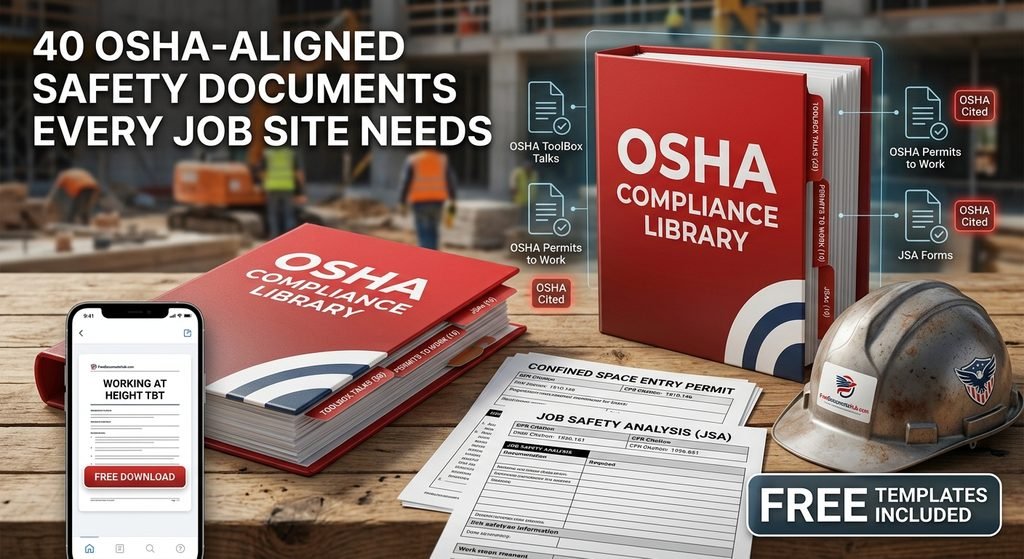
To eliminate this overhead, we engineered a complete 40-document compliance library where every single safety form explicitly cites its governing OSHA standard.
Understanding the Core Safety Triad: TBT, PTW, and JSA
A common friction point for HSE managers, site coordinators, and subcontractors is confusing the core operational documents used on-site. Using a Job Safety Analysis when you legally require a Permit to Work creates significant compliance gaps. Here is how the three document types function in a regulatory system:
- Toolbox Talks (TBT): Brief, 5-to-10-minute safety briefings delivered at the crew level before shifts start. They focus on raising immediate hazard awareness for a single task or environmental condition, establishing a baseline of standard safe practices.
- Job Safety Analysis (JSA): Systematic, step-by-step risk assessment forms created prior to executing high-risk or non-routine work. A JSA form OSHA layout breaks job tasks down into individual steps, identifies specific operational hazards for each, and mandates required engineering, administrative, or PPE controls.
- Permit to Work (PTW): High-level formal authorization documents required for inherently dangerous operations. An OSHA permit to work establishes written authorization, pre-task isolation verification (such as energy control or atmospheric testing), and designated safety roles before work can commence.
Inside the 40-Document Safety Library
Our complete library covers 20 Toolbox Talks, 10 Permit to Work templates, and 10 Job Safety Analyses. Every standard operating procedure and field form cites the exact applicable regulation across 29 CFR 1910 (General Industry) and 29 CFR 1926 (Construction).
1. Toolbox Talks (20 Field Briefings)
Designed for daily pre-shift briefings, these single-page sheets translate complex regulations into concise crew discussions. Examples include:
- Working at Heights: Direct field review citing
29 CFR 1926.501(Duty to have fall protection) and29 CFR 1910.28, covering trigger heights, anchor inspection requirements, and leading-edge hazards. - Portable Ladder Safety: Structured safety review citing
29 CFR 1926.1053and29 CFR 1910.23, establishing the 4:1 setup rule, three-point contact, and duty rating checks. - Scaffolding Hazards: Hazard awareness guide citing
29 CFR 1926.451, detailing guardrail specs, planking integrity, and competent person inspections.
2. Permit to Work Templates (10 High-Hazard Controls)
When high-risk tasks are active, oral instructions are insufficient. Our high-hazard permit systems establish explicit operational control protocols:
- Hot Work Permit: Covers open flames, welding, or cutting operations citing
29 CFR 1910.252and29 CFR 1926.350-354. Includes mandatory 35-foot combustible clear zones and designated fire watch sign-offs. - Confined Space Entry Permit: Comprehensive entry clearance citing
29 CFR 1910.146(Permit-required confined spaces) and29 CFR 1926 Subpart AA. Includes multi-gas atmospheric testing logs (Oxygen, LEL, H2S, CO) and attendant verification. - Lockout/Tagout (LOTO) Authorization: Hazardous energy control form citing
29 CFR 1910.147, enforcing zero-energy state verification, lock application protocols, and group LOTO handoffs.
3. Job Safety Analyses (10 Activity Risk Assessments)
Each job safety analysis template in this bundle provides a pre-structured table mapping out tasks, hazard descriptions, and mandatory safety controls:
- Trenching & Excavation JSA: Risk breakdown citing
29 CFR 1926.651and1926.652, evaluating soil classification, atmospheric risks, utility mark-outs, and protective shoring/sloping requirements. - Steel Erection & Overhead Crane JSA: Task assessment citing
29 CFR 1926.754and29 CFR 1910.179, covering rigging capacities, tag line requirements, and drop-zone perimeter controls. - Chemical Handling & HazCom JSA: Task control mapping citing
29 CFR 1910.1200and29 CFR 1926.59, mandating SDS reviews, secondary container labeling, and specific chemical PPE selection.
Regulatory Transparency: Calling Out Edge Cases
A primary trust metric in compliance documentation is knowing where standard jurisdiction starts and stops. Many generic template sites invent false standard numbers for non-regulated topics. We do not.
For critical topics like Manual Handling / Ergonomics and Heat Stress Prevention, OSHA does not maintain specific, dedicated vertical standard codes. Where federal standards do not explicitly exist, our documents state this clearly and reference compliance controls under the OSHA General Duty Clause (Section 5(a)(1)) alongside current NIOSH recommendations. We prioritize technical honesty over fabricated regulations.
Download Your Free OSHA Toolbox Talk Template
We want HSE supervisors and site contractors to evaluate the exact quality, citation accuracy, and field layout of our library before making any purchase.
Download our complete, unredacted Working at Height OSHA Toolbox Talk Template free of charge on FreeDocumentsHub.com. It includes full 29 CFR 1926.501 citations, worker sign-off rosters, and discussion prompts formatted for immediate field deployment.
Equip Your Field Teams Today
Stop spending late nights writing field forms or risking non-compliance with unreferenced internet templates. Access our field-tested, regulatory-cited OSHA compliance documents immediately:
- Complete 40-Document Master Safety Bundle: Includes all 20 Toolbox Talks, 10 Permits to Work, and 10 JSAs in fully editable formats.
- Individual 10-Pack Bundles: Select individual sets tailored specifically to TBTs, PTWs, or JSAs based on your current operational needs.
Visit the [FreeDocumentsHub Shop] today to download your templates and build a standardized, audit-ready safety library in minutes.
Regulatory Disclaimer: These template documents are provided for reference and administrative support purposes only. They do not guarantee OSHA compliance, legal protection, or complete risk elimination. Occupational hazards vary by job site, equipment, and jurisdiction. These templates do not replace site-specific risk assessments, formal competent person reviews, or certified safety professional oversight. FreeDocumentsHub is an independent publisher and is not affiliated with, endorsed by, or representative of OSHA or any government agency.