
By Mohammad Iftakhar Ahmad | Years of Gulf Industrial Experience | Founder, FreeDocumentsHub.com
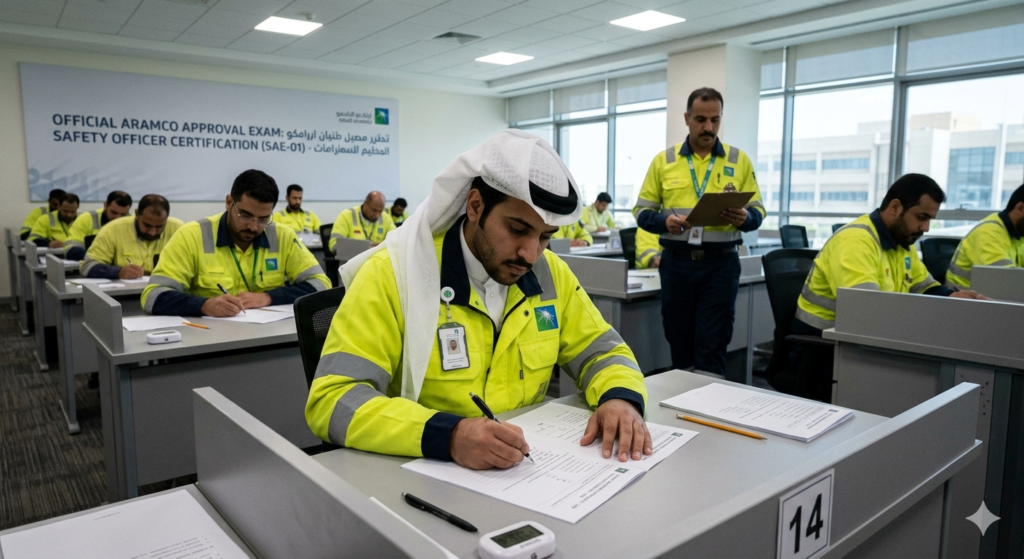
Every year, thousands of engineers and professionals apply for positions with Saudi Aramco, SABIC, ADNOC, and major Gulf contractors. Most of them have the knowledge. Most of them have the experience.
Most of them still fail.
Not because they are not qualified. But because they did not prepare correctly in the 24 hours before their test or interview.
After 19 years working on Gulf projects — with Aramco contractors, SABIC vendors, EPC companies across the Kingdom — I have seen this pattern repeat itself hundreds of times. I have watched highly experienced engineers fail basic technical interviews. And I have watched relatively junior candidates walk into the same room and get selected.
The difference was never knowledge alone. It was always preparation.
This is the complete 24-hour preparation system I recommend to every engineer and professional preparing for a Gulf technical test or interview.
First — Understand What an Interview or Test Actually Is
Before we talk about preparation, let us understand the purpose of an interview or technical test.
You have years of knowledge and experience accumulated over your career. The interviewer has 30 minutes — sometimes less — to evaluate you.
Their job is to find out, in that short window of time, how much you know and how well you can communicate it under pressure.
This means the test is not just about knowledge. It is about your ability to compress your knowledge and deliver it clearly, confidently, and professionally in a very short time.
Think about it this way. If you have deep knowledge but cannot explain it clearly in 30 minutes — you fail. If you have limited knowledge but you can present what you know precisely, clearly, and professionally — you pass.
This is not unfair. This is exactly how the real work environment operates. On a live Aramco project, your supervisor does not have time to wait while you slowly recall your knowledge. You must think and communicate fast, clearly, and professionally. The interview is testing exactly this skill.
The person who passes is the person who can take their years of experience and compress it — clearly, confidently — into 30 minutes.
The Complete 24-Hour Preparation System
STEP 1 — Research the Company (4 Hours)
This is the step most candidates skip entirely. It is also the step that separates selected candidates from rejected ones.
Do not walk into any interview without deeply knowing who is sitting across from you and what they need.
Spend at least 4 hours researching the following:
- What has this company done in the last 5 years — major projects, expansions, awards, milestones
- What is their reputation in the market — are they growing, stable, or under pressure
- How many employees do they have — are they a small contractor or a large EPC firm
- What is the organisational structure — who reports to whom, what departments exist
- What role are they hiring for — read the job description ten times, not once
- What kind of candidate have they historically selected for this role
- What problems is this company currently trying to solve — and how does your role fit into their solution
Where to find this information: the company website, LinkedIn company page, Aramco vendor registration records, news articles, and conversations with people who have worked there.
When you walk into an interview knowing more about their company’s recent projects than some of their own employees — they feel it immediately. You are no longer just another candidate in a pile of CVs. You are someone who takes things seriously. Someone who prepares. Someone who is already thinking like one of their team members.
This single step alone will put you ahead of 80% of other candidates.
STEP 2 — Read Your Profession (6 Hours)
Not new topics. Not new theories. Your own core profession.
Go back to the fundamentals of your discipline. Spend 6 solid hours reading and reviewing:
- Core technical knowledge for your specific role — instrumentation, electrical, mechanical, safety, civil
- Relevant Gulf industry standards and codes — NFPA, IEC, ASME, API, Aramco Engineering Standards, SAES
- Key definitions and terminology that any interviewer will expect you to know immediately
- Recent developments or changes in your field that a current practitioner would know
- Any specific technical areas mentioned in the job description
Your brain needs to be switched into professional mode — not everyday mode — when you sit in front of the interviewer. Reading your profession for 6 hours switches that mode on.
Think of it like warming up before a sport. You know how to play. But without warming up, your performance is slower, less sharp, less confident. Six hours of focused reading is your warm-up.
STEP 3 — Practical Practice (2 Hours)
This is the most critical step. And it is the step almost nobody does properly.
Most candidates review their knowledge in their head. They think about possible questions. They mentally go through answers.
This is not practice. This is imagination.
Real practice means doing it physically — out loud, on paper, as if the interview is happening right now.
For a verbal interview:
Sit in a chair. Place another chair in front of you — empty or with someone you trust. Ask yourself every question the interviewer might ask. Then answer out loud, clearly, professionally, using your proper technical terminology. Hear your own voice. Feel the words. Notice where you hesitate, where you are confident, where you need to improve.
Repeat the difficult questions until the answers feel natural and automatic.
For a written technical exam:
Write your answers by hand on paper. Repeatedly. Until your hand and brain are working together automatically. When you sit in the exam hall, your pen should move without hesitation.
The goal of this practice is simple: by the time you walk into the room, the words and answers must feel like second nature — not things you are trying to remember under pressure.
The 5 Things That Will Make You Different From Every Other Candidate
Technical preparation alone is not enough. The candidate who gets selected has all five of these elements working together.
1. Communication Skills
Read. Write. Speak. Practice all three every day — not just before an interview.
Communication is the delivery vehicle for your knowledge. If your knowledge is the cargo and communication is the vehicle — a broken vehicle means the cargo never arrives.
The candidate who speaks clearly, writes precisely, and listens attentively wins every time over the technically superior candidate who cannot communicate.
2. Mental Preparation
Clear your mind 24 hours before. Remove all distractions. Close unnecessary tasks. Avoid stressful conversations.
Your mind is your most important tool in an interview. A cluttered, stressed, distracted mind cannot perform at its best regardless of how much knowledge it contains.
Sleep well. Pray. Be calm. Walk in with a clear head.
3. Physical Preparation
Sleep at least 7-8 hours the night before. Eat a proper meal before the interview — not a heavy one, but enough. Dress professionally the night before so there is zero stress in the morning. Arrive early — 15 minutes minimum.
Your body affects your confidence directly. A tired, hungry, rushed body produces a tired, slow, unconfident mind. Physical preparation is not separate from professional preparation. It is part of it.
4. One Track Mindset
During your preparation and during the interview itself — stay completely focused on what this specific role requires.
Do not try to show everything you know. The interviewer did not ask about everything you know. They asked a specific question. Answer it specifically, professionally, and completely — then stop.
Candidates who try to impress by going off-topic, talking too much, or showing unrelated knowledge actually reduce their score. Focused, precise, on-topic answers demonstrate a professional mind.
5. Single Profession Identity
Know exactly what you are. An instrumentation engineer. A fire and gas safety specialist. A document controller. A project manager.
Own your profession completely. Do not present yourself as someone who can do everything. The candidate who walks in and says “I am an expert in exactly this — and here is the evidence” convinces the interviewer far more than the candidate who says “I have experience in many things.”
Depth beats breadth in a technical interview every time.
The Final Principle — Knowledge Is Not Enough. Delivery Is Everything.
I want to leave you with the most important lesson from 19 years of working on Gulf industrial projects and seeing hundreds of people interviewed, tested, and evaluated.
Limited knowledge delivered perfectly beats deep knowledge delivered poorly — every single time.
This is not about being shallow. This is about understanding that knowledge has no value if it cannot be communicated. The purpose of an education, of years of experience, of all the training you have done — is to build a mind that can solve problems, communicate clearly, and deliver results.
When you walk into an Aramco interview or technical test — you are not being asked to prove your knowledge. You are being asked to prove your mind. Your analytical power. Your memory. Your communication ability. Your problem-solving capability. Your professional identity.
If you do the 24-hour preparation correctly — research, study, practice, communication, mental and physical readiness — you walk in as a professional who is ready to perform. Not nervous. Not hoping. Ready.
That readiness is felt by every interviewer the moment you walk through the door.
Summary — Your 24-Hour Preparation Checklist
- 4 hours — Research the company: last 5 years, reputation, structure, role expectations
- 6 hours — Read your profession: fundamentals, standards, codes, terminology
- 2 hours — Practical practice: answer questions out loud, write answers by hand
- Communication: read, write, speak — all three
- Mental: clear your mind, remove distractions, sleep well
- Physical: dress prepared, eat well, arrive early
- One track focus: answer what they ask, stay on topic
- Single profession identity: know exactly what you are and own it
I have spent 19 years watching professionals succeed and fail in Gulf technical interviews and examinations. The preparation system above is what the successful ones — consistently — had in common.
If you are preparing for an Aramco test, a Gulf contractor interview, or any professional examination — I hope this helps you walk in ready.
What is the one area of interview preparation you find most difficult? Leave a comment below — I read every response personally.
The hardest part for me is explaining my strengths clearly and I find behavioural questions the most difficult during interviews
go to my website there is guide.
Can i get the details in pdf format
yes on my website new guide uploaded
I have interview next month
I neeed help
download new guide from my website.