
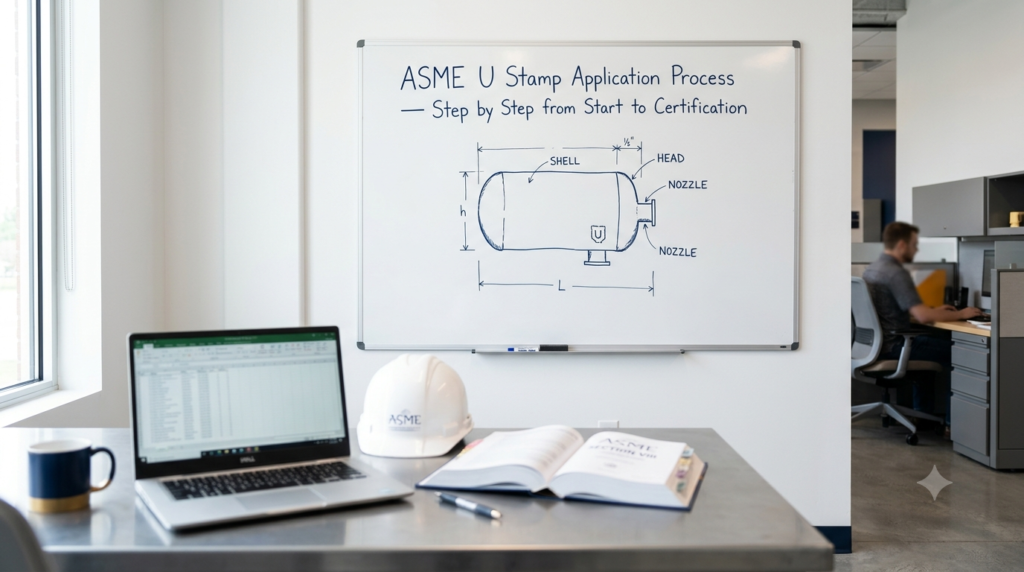
If you manufacture pressure vessels — or you’re evaluating a fabricator before signing a contract — the ASME “U” Stamp is the single most important credential in the conversation. It tells the buyer, the inspector, and the regulator that a vessel was designed, fabricated, inspected, and documented in accordance with the ASME Boiler and Pressure Vessel Code (BPVC), Section VIII, Division 1.
But getting the U Stamp isn’t a form you fill out and mail in. It’s a structured certification process that touches your quality system, your personnel, your documentation, and ultimately an on-site audit. Here’s the process broken down step by step, from first decision to first stamped vessel.
What the U Stamp Actually Certifies
Before the steps, one clarification that trips up a lot of buyers and even some new manufacturers: ASME does not certify individual vessels. It certifies your quality system — your organization’s demonstrated ability to consistently build vessels that meet Code requirements. A vessel is only “stamped” once your shop has proven, through audit, that it can reliably produce Code-compliant work.
This is also why a Form U-1 Manufacturer’s Data Report matters so much. It’s the document that formally ties a specific vessel back to your certified fabrication and quality system. No Form U-1, no valid stamp — regardless of what’s welded onto the nameplate.
Step 1: Decide on Scope and Do Your Homework
Start by defining exactly what you intend to build — vessel types, materials, pressure/temperature ranges, welding processes. This scope determines which parts of Section VIII, Division 1 apply to you and shapes everything downstream, including your quality manual and the audit itself.
At this stage:
- Review the current BPVC edition on ASME’s website. The 2025 BPVC edition became mandatory for all new construction on January 1, 2026 — if your quality manual still references an older edition, that’s a gap an auditor will flag immediately.
- Purchase the relevant Code books and standards; you’ll need them as working references, not just for the audit.
- Review ASME’s certification checklists and available training resources so your team understands what “compliant” looks like before you start writing procedures.
Step 2: Engage an Authorized Inspection Agency (AIA)
You cannot get certified without a relationship with an Authorized Inspection Agency — typically an insurance company’s inspection arm or an independent third-party inspection organization. The AIA will:
- Advise you on what your quality system needs to demonstrate
- Perform in-process inspections on your vessels going forward
- Conduct a pre-review of your quality manual and shop readiness before ASME’s own audit
- Participate in the final joint review with ASME
Choosing the right AIA early saves time later — they’ll flag weaknesses in your quality system before ASME ever sees it.
Step 3: Build Your Quality Control (Quality System) Manual
This is the technical core of the application. Your Quality Control Manual is a written description of every procedure that governs how you design, purchase materials, fabricate, weld, inspect, test, and document a pressure vessel. ASME’s audit exists almost entirely to confirm that this manual is both accurate and actually followed on your shop floor.
A typical manual covers:
- Organizational structure and responsibility for quality decisions
- Material control and traceability
- Welding procedures and welder qualification records
- Nondestructive examination (NDE) procedures
- Heat treatment, where applicable
- Inspection and testing (including hydrostatic/pneumatic testing)
- Nonconformance and corrective action handling
- Document control and record retention
- Calibration of measuring and test equipment
Train your personnel on the manual before the audit — auditors interview staff on the shop floor, and “the manual says X but the welder does Y” is one of the most common findings that delays certification.
Step 4: Create a CA Connect Account and Submit Your Application
New applicants apply through ASME’s CA Connect portal. You’ll submit the application form, your signed Accreditation and Certification Agreement, and pay the associated fee. Certification costs vary by scope, but budget in the range of a few thousand dollars for the application and audit fees alone — before accounting for Code books, training, and any quality-system consulting.
Once submitted, ASME will schedule your review/survey date. The extent of that review is scaled to the scope of activities you declared in your application, so an accurate, well-thought-out scope statement upfront avoids surprises later.
Step 5: Pre-Review with Your AIA
Before ASME shows up, your AIA typically conducts its own readiness review — essentially a dry run of the audit. This is your last opportunity to catch gaps: missing procedure sign-offs, outdated Code references, incomplete welder qualification records, or documentation that doesn’t match what’s actually happening on the shop floor.
Treat this stage seriously. A clean AIA pre-review is the strongest predictor of a smooth ASME audit.
Step 6: The ASME Joint Review (On-Site Audit)
This is the formal survey, conducted jointly by an ASME team and your AIA representative. The review evaluates:
- Whether your Quality Control Manual meets Section VIII, Division 1 requirements
- Whether your organization actually implements what the manual describes
- Personnel competency — engineers, welders, inspectors, and QC staff
- A demonstration vessel or in-process work, if applicable, showing the full workflow from material receipt to final inspection
Auditors will ask to see records, not just hear descriptions — traceability documents, NDE reports, calibration logs, and training records should all be ready and consistent.
Step 7: Certification and Stamping
If the review is successful, ASME issues a Certificate of Authorization, and you receive your U Stamp. From here:
- The stamp must be applied to vessels exactly as ASME specifies — correct size, location, and required markings
- Every stamped vessel must be accompanied by a completed Form U-1, connecting the physical vessel to your certified fabrication and quality records
- Your AIA continues performing in-process inspections on an ongoing basis — certification isn’t a one-time event, it’s an ongoing relationship
Step 8: Maintain and Renew
The U Stamp is not permanent. Certification is typically valid for three years, after which it must be renewed through re-evaluation of your quality system and manufacturing capability. (Note: the UM Stamp, used for miniature vessels, runs on a shorter one-year cycle.)
Between renewals:
- Run internal audits against your own Quality Control Manual
- Update the manual whenever the BPVC edition changes — an active stamp issued under a prior code cycle does not automatically mean your quality manual reflects the current mandatory edition
- Keep training records current as staff turn over
A Note for Buyers and Procurement Teams
If you’re specifying or purchasing pressure vessels rather than building them, two practical checks are worth doing before you sign a contract:
- Ask for the Form U-1 on any vessel represented as U-stamped. Without it, the stamp isn’t properly tied to a certified fabrication record.
- Ask which BPVC edition the fabricator’s quality manual references. A valid three-year certificate from an earlier code cycle doesn’t guarantee the shop has updated its manual to the current mandatory edition — that’s a question worth asking directly rather than assuming.
Also worth knowing: ASME itself does not “approve,” “certify,” or “rate” individual items — the accurate language is that a vessel is “built in accordance with the requirements of the ASME Boiler and Pressure Vessel Code.” Marketing language claiming ASME “certifies” a specific vessel is technically inaccurate and worth treating as a flag.
Final Thoughts
The U Stamp process rewards preparation. Shops that struggle with certification almost always underinvested in the Quality Control Manual stage — either writing a manual that doesn’t reflect real shop practice, or skipping the internal training needed to make sure staff can execute it consistently. Get the manual right, choose your AIA carefully, and treat the pre-review as seriously as the real audit, and the joint review becomes a formality rather than a hurdle.
Need Documentation Support for Your Certification or Project?
At Free Documents Hub, we specialize in ready-to-use documentation for oil & gas, EPC, and industrial professionals — including inspection and commissioning checklists, QA/QC document templates, HSE bridging documents, and exam prep resources built by people with real industry experience. If you’re preparing for an ASME audit, an Aramco CBT exam, or simply need well-structured technical documentation without starting from a blank page, we can help you move faster and with more confidence. Visit freedocumentshub.com or reach out to us directly — we’d be glad to discuss what you need and point you to the right resources. contact@freedocumentshub.com