
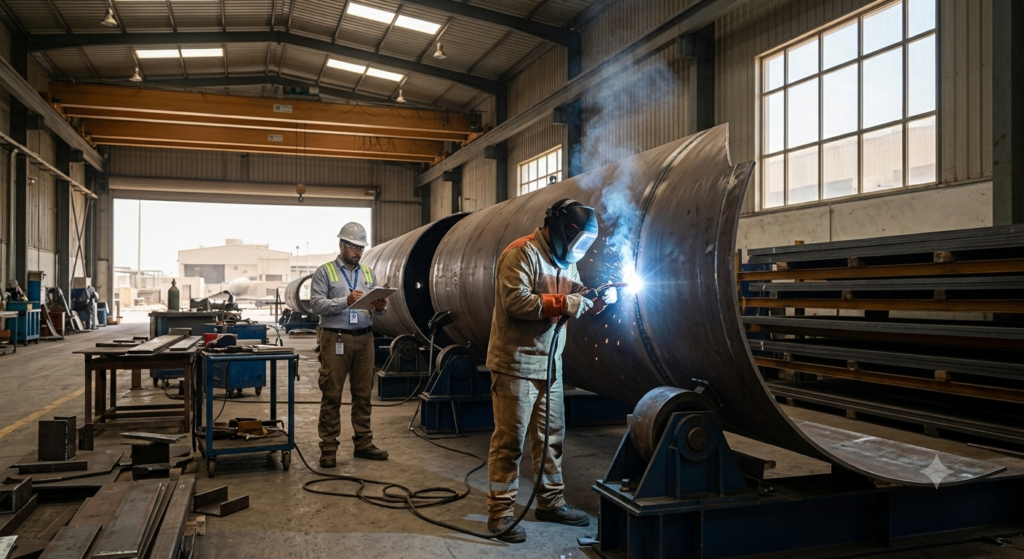
A complete roadmap for pressure vessel fabricators pursuing ASME Section VIII authorization — from scope decision to certificate in hand.
| Need Your U Stamp Documentation Package Ready — Fast? FreeDocumentsHub prepares Quality Manuals, WPS/PQR, ITP, MTR, and MDR packages remotely for ASME U Stamp and Aramco AVL applicants. Free trial available. Order in minutes on WhatsApp — 24/7. Chat with us on WhatsApp: FreeDocumentsHub.com/whatsapp, contact@freedocumentshub.com |
For a fabrication shop, the ASME U Stamp is the single credential that decides whether you can legally build and sell unfired pressure vessels into most industrial markets. It is not a product certification and not a government license — it is ASME’s confirmation that your shop operates a Quality Control System capable of consistently producing vessels that meet the Boiler and Pressure Vessel Code (BPVC), Section VIII. Getting there is a defined, auditable process, but it typically takes four to eight months and touches nearly every department in the shop: engineering, welding, NDE, procurement, and management. This guide walks through every step in order, what each one actually requires, and where shops most often lose time.
| What the U Stamp Actually Certifies ASME does not “approve” or “rate” a vessel — it certifies the manufacturer’s Quality Control System. The stamp is applied under a Certificate of Authorization, valid for a fixed cycle and renewed through periodic surveys. Related marks — U2 (Div. 2), U3 (Div. 3), UM (miniature vessels), and R (repair) — follow similar but separate application tracks. |
Step 1 — Confirm the Scope You Actually Need
Before any paperwork starts, define exactly what the shop will fabricate: vessel type, design pressure and temperature range, materials, and which BPVC Division applies. Most shop-fabricated vessels fall under Section VIII, Division 1 (the standard U Stamp). Higher-pressure or more complex designs may require Division 2 (U2) or Division 3 (U3), and very small vessels may qualify for the UM stamp instead. Scope drives every decision that follows, including which welding procedures need qualifying and what the Quality Manual has to cover, so get this right first rather than discovering a gap during the audit.
Step 2 — Select an Authorized Inspection Agency (AIA)
An AIA — typically the inspection arm of a boiler and machinery insurance carrier, or an independent inspection organization — is a mandatory partner throughout the process, not an optional add-on. The AIA’s Authorized Inspector (AI) reviews your Quality Manual, inspects fabrication in progress once certified, and co-signs the Joint Review with ASME. Shops should contact two or three AIAs, compare inspection coverage and fee structure, and formalize the relationship with a written agreement before drafting the Quality Manual, since the AIA will expect input into its structure.
Step 3 — Build the Quality Control System and Manual
This is the core deliverable of the entire application. The Quality Manual is a written, shop-specific description of how every stage of vessel fabrication is controlled — not a generic template. ASME’s Authorized Inspection process and BPVC Section VIII both expect the manual to be implemented in practice, not just filed.
| Quality Manual Element | What It Must Cover |
| Design Control | How design calculations, drawings, and code-required reviews are handled |
| Material Control | Receiving, identification, and traceability of plate, pipe, and forgings (MTR verification) |
| Welding Control | WPS/PQR qualification records and welder performance qualification (WPQ) tracking |
| Examination & Inspection | NDE methods, hold points, and in-process inspection responsibilities |
| Heat Treatment | PWHT procedures and record-keeping where required by the code |
| Nonconformance Control | How NCRs are raised, dispositioned, and closed |
| Calibration | Control of measuring and test equipment |
| Records Retention | Data Report (Form U-1) generation and document archiving |
Shops that already run ISO 9001 have a head start on structure, but the content still needs to map directly to Section VIII’s mandatory appendix requirements — a generic manual is the single most common reason for a failed or delayed Joint Review.
Step 4 — Qualify Procedures and Train Personnel
With the Quality Manual drafted, the shop needs the technical records that prove the system works in practice:
- Welding Procedure Specifications (WPS) and supporting Procedure Qualification Records (PQR) for every joint type and material combination in scope
- Welder Performance Qualifications (WPQ) for each welder assigned to code work
- NDE procedures matched to qualified or certified personnel (ASNT SNT-TC-1A or a company written practice)
- Internal training so engineering, QC, and shop floor staff can explain their role in the system to an auditor, not just follow a checklist
Step 5 — Purchase the Applicable Code Books and Standards
ASME requires applicants to own current editions of the applicable BPVC sections (Section VIII plus supporting sections such as Section II for materials, Section V for NDE, and Section IX for welding). As of the current code cycle, the 2025 BPVC edition became mandatory for new construction on January 1, 2026 — shops applying now, or renewing, should confirm their Quality Manual and referenced editions are aligned to it rather than an older cycle.
Step 6 — Submit the Application and Accreditation Agreement
The formal application goes directly to ASME: the completed application form, a signed Accreditation and Certification Agreement, and the applicable fee. This step is largely administrative, but it triggers ASME’s internal review of the requested scope and schedules the survey window — so it should only be submitted once the Quality Manual and supporting records are genuinely ready, not as a placeholder to “start the clock.”
Step 7 — Run the System Before the Audit
ASME and the AIA expect to see an operating system, not a paper one. Before the Joint Review, the shop should complete at least one internal trial run — a mock fabrication cycle that generates real design review records, WPS/PQR references, in-process inspection sign-offs, NDE reports, and a completed Form U-1. Internal audits against the Quality Manual, with findings actually closed out, give the AI evidence the system is functioning rather than freshly written for the visit.
Step 8 — AIA Pre-Review
Most AIAs conduct an informal pre-review before the official ASME survey — walking the Quality Manual against actual shop practice and flagging gaps. This step is not mandatory everywhere, but skipping it is a common reason shops fail their first Joint Review. Treat AIA findings from this stage as required corrective actions, not suggestions.
Step 9 — The ASME Joint Review
The Joint Review is a joint on-site audit conducted by an ASME-designated Team Leader together with the AIA’s Authorized Inspector. The team verifies that the Quality Manual matches actual practice across every function it covers — design control, material traceability, welding, NDE, and records — and typically reviews a live or recent fabrication job end-to-end. Findings are documented; some are minor and correctable within days, others require a follow-up visit before certification can proceed.
| Where Shops Lose Time Quality Manual copied from a template without shop-specific procedure references — the single most common finding. WPS/PQR records that don’t match the welding processes actually used on the shop floor. No documented internal audit history before the AIA pre-review. Code books referencing an outdated BPVC edition after a code-cycle mandatory date has passed. |
Step 10 — Certificate Issuance and First Stamping
Once the Joint Review closes out successfully, ASME issues the Certificate of Authorization, and the shop receives its U Stamp along with a unique Certificate Mark and Manufacturer’s Serial Number sequence. From this point, every vessel built within the certified scope requires a completed Form U-1 Data Report, AI sign-off before shipment, and stamping per Section VIII marking requirements.
Step 11 — Maintain the Certificate
The U Stamp is not a one-time achievement. ASME certification runs on a three-year cycle (one year for UM), with periodic surveys by the AIA to confirm the Quality System is still being followed as written. Shops that update procedures, add welders, or change scope mid-cycle need to keep the Quality Manual current — an expired manual reference or an unqualified welder found during a routine survey can suspend stamping rights until corrected.
Typical Timeline and Cost Range
| Phase | Typical Duration |
| AIA selection & agreement | 2 – 4 weeks |
| Quality Manual development | 4 – 10 weeks |
| Procedure qualification (WPS/PQR/WPQ) | 3 – 8 weeks (can run in parallel) |
| Trial run & internal audit | 2 – 4 weeks |
| AIA pre-review to corrective action closeout | 2 – 6 weeks |
| ASME application processing to Joint Review | 4 – 8 weeks |
| Total, first-time applicants | 4 – 8 months |
Where FreeDocumentsHub Fits
The technical documentation backbone of a U Stamp application — the Quality Manual structure, WPS/PQR packages, ITPs, and MTR verification records — is exactly the work most shops underestimate on time. FreeDocumentsHub prepares these packages remotely, aligned to the current BPVC edition and structured around what AIAs and ASME survey teams actually check, so your team’s time goes into running the shop floor trial rather than formatting paperwork.
| Need Your U Stamp Documentation Package Ready — Fast? FreeDocumentsHub prepares Quality Manuals, WPS/PQR, ITP, MTR, and MDR packages remotely for ASME U Stamp and Aramco AVL applicants. Free trial available. Order in minutes on WhatsApp — 24/7. Chat with us on WhatsApp: FreeDocumentsHub.com/whatsapp, contact@freedocumentshub.com |