
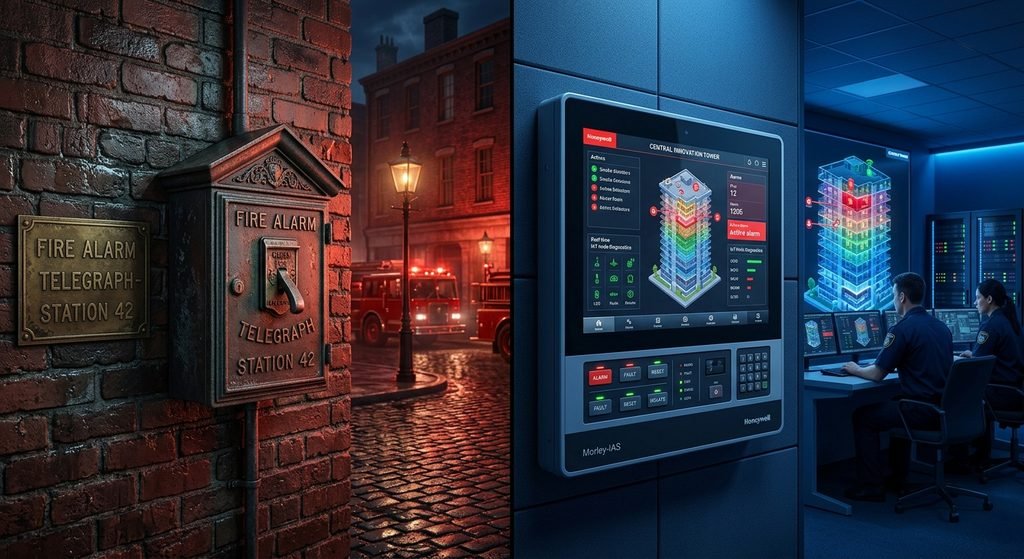
Fire detection and alarm systems represent one of the most critical safety engineering innovations of the modern industrial and built environment. What originated in the mid-19th century as a simple mechanical telegraph alert system has transformed into a complex network of intelligent, IoT-enabled sensors powered by edge computing, multi-criteria algorithm processing, and automated building integration.
Understanding the historical evolution of fire detection, the mechanics of data transmission through each technological era, and modern smart system architectures provides vital insights for safety engineers, facility managers, and compliance specialists.
Key Historical Milestones and Data Transmission Architecture
+-----------------------------------------------------------------------------------+
|                        FIRE ALARM EVOLUTION & DATA TIMELINE                       |
+-----------------------------------------------------------------------------------+
|  ERA              |  SYSTEM TYPE            |  DATA / SIGNAL TRANSMISSION         |
+-------------------+-------------------------+-------------------------------------+
|  1850s–1890s      |  Telegraphic Municipal  |  Unidirectional Morse Code Pulses   |
|  1900s–1970s      |  Conventional Hardwired |  Analog Voltage & Current Loops     |
|  1980s–2000s      |  Addressable Multiplex  |  Digital Binary Data Packets        |
|  2010s–Present    |  Smart IoT & Cloud AI   |  Wireless Mesh, API & BACnet Data   |
+-----------------------------------------------------------------------------------+
1. The Origins: Municipal Telegraphic Alarm Systems (1850s–1890s)
Who Invented the First Fire Alarm System?
The world’s first municipal electric fire alarm system was invented in Boston, Massachusetts, by Dr. William F. Channing and Moses G. Farmer. Patented in 1851 and operational by April 1852, their system revolutionized emergency signaling by adapting Samuel Morse’s electromagnetic telegraph technology specifically for municipal public safety.
System Architecture & Physical Operation
The Channing-Farmer system consisted of a central alarm station linked via miles of copper wire to dozens of heavy cast-iron “pull boxes” mounted on public street corners throughout the city. Inside each pull box was a spring-wound mechanical key movement connected to a rotating wheel with notched teeth.
Data Handling & Signal Processing
Data transmission in this era was entirely mechanical-electrical, operating on a unidirectional, binary-pulse framework:
- Initiation: When a citizen turned a handle on the exterior box, it released the internal mechanical clockwork.
- Pulse Generation: As the notched wheel rotated, its teeth physically opened and closed an electrical contact circuit powering a direct-current (DC) telegraph line.
- Encoding: Each box had a unique tooth profile representing a specific numerical code (e.g., three notches, a pause, then two notches signaled Box 32).
- Decoding & Dispatch: At the central alarm station, the incoming electrical pulses energized an electromagnet that struck a bell and punched matching holes into a paper tape recording strip. The operator read the code, identified the neighborhood location on a master map, and manually dispatched local horse-drawn fire engines.
2. The Hardwired Era: Zone-Based Conventional Systems (1900s–1970s)
As industrial facilities and commercial skyscrapers expanded during the 20th century, internal building protection required automatic fire detection. This brought the commercial development of bimetallic heat detectors, pneumatic rate-of-rise thermal sensors, and eventually ionization and photoelectric smoke detectors (invented by Walter Jaeger and Swiss physicist Ernst Meili in the 1930s–1940s).
System Architecture
Buildings were divided physically into distinct operational regions called Zones (e.g., Zone 1: Basement, Zone 2: Ground Floor, Zone 3: West Wing). All initiating devices within a given zone were connected in parallel along a dedicated two-wire electrical circuit returning to a central Fire Alarm Control Panel (FACP).
Data Handling & Current-Loop Monitoring
Conventional systems relied on simple analog current-loop dynamics rather than digital data packets:
- Normal (Supervised) State: The FACP maintained a constant low DC voltage across the circuit loop. A small end-of-line (EOL) resistor placed at the far end of the zone wire allowed a tiny supervisory current to flow back to the panel, confirming continuity and proving that wires were not cut or broken.
- Alarm State: Smoke or heat detectors functioned as simple electrical switches. When triggered, the detector closed its contact, short-circuiting the loop past the internal resistor.
- Signal Interpretation: The sudden drop in loop resistance caused a sharp spike in circuit current. The FACP detected this current jump, energizing an internal relay to ring mechanical gongs and illuminate a single light bulb representing that entire zone.
[ FACP Panel ] ---> (+ Line) ---> [ Smoke Det #1 ] ---> [ Smoke Det #2 ] ---> [ EOL Resistor ]
      |                               |                      |                      |
      +--------------- (- Line) ------+----------------------+----------------------+
Critical Limit of Conventional Data
While effective for basic notification, conventional systems had a major operational drawback: zero precise localization. If a single detector tripped in a 50,000-square-foot warehouse assigned to “Zone 4,” facility personnel and firefighters had to manually search every room in that zone to find the actual origin of the fire.
3. The Digital Revolution: Addressable & Multiplex Systems (1980s–2000s)
The micro-computer revolution of the late 1970s and 1980s transformed life safety engineering through the creation of Addressable Fire Alarm Systems.
System Architecture
Instead of grouping devices into separate physical wire runs, addressable systems utilized a continuous digital communication loop called a Signaling Line Circuit (SLC). Dozens or hundreds of individual detectors, manual pull stations, waterflow switches, and control modules were connected to the same pair of wires.
Each sensor was assigned a unique digital address using onboard DIP switches, rotary dials, or internal EEPROM programming.
Data Handling & Polling Protocols
Addressable panels function via structured digital protocols using high-speed time-division multiplexing:
- Sequential Polling: The main central processor continuously sends out high-speed digital data packets along the SLC loop, polling each address in sequence (e.g., “Device 001, state your status; Device 002, state your status…”).
- Device Handshake: Every device on the loop contains a micro-modem that listens for its specific binary address. When called, the sensor transmits a digital payload back to the panel containing its real-time operational status (Normal, Alarm, Trouble, or Maintenance Required).
- Analogs-to-Digital Sensing: Advanced “Analog-Addressable” systems shifted the decision-making burden back to the control panel. Rather than just reporting “Fire” or “No Fire,” the sensor periodically transmitted raw analog values representing exact smoke obscuration percentages (%/ft) or real-time temperature values ($^\circ\text{C}$). The panel’s central CPU analyzed these data curves against mathematical algorithms to detect true fires while rejecting environmental noise like dust or steam.
+----------------------------------------------------------------------------------+
|                           ADDRESSABLE SLC LOOP DATA FLOW                         |
+----------------------------------------------------------------------------------+
|  [ FACP Master CPU ]  === (Digital Polling Packet: 24V FSK Data) ===>  [ SLC Loop ] |
|                                                                          ||      |
|  [ Device #042: Server Room ] <--- (Responds: Analog Smoke Level = 1.2%) =+      |
+----------------------------------------------------------------------------------+
4. Modern Smart Systems: IoT, AI Analytics, and Wireless Integration (Present Day)
Today’s fire safety architecture incorporates high-density multi-criteria sensing, edge-computing intelligence, enterprise cloud analytics, and seamless integration with smart building infrastructures.
+-----------------------------------------------------------------------------------+
|                        MODERN SMART FIRE INFRASTRUCTURE                           |
+-----------------------------------------------------------------------------------+
|  COMPONENT            |  FUNCTIONAL ROLE IN MODERN SAFETY MATRIX                  |
+-----------------------+-----------------------------------------------------------+
|  Multi-Criteria Heads | Real-time monitoring of CO, IR, Heat, and Optical Smoke   |
|  Edge Processors      | Sensor-level digital processing to eliminate false alerts |
|  Wireless Mesh (RF)   | Self-healing network connectivity (Frequency Hopping)    |
|  BMS Integration      | Automated HVAC, Access Control, and Elevator overrides    |
|  Cloud Telemetry      | Real-time mobile alerts and off-site predictive maintenance|
+-----------------------------------------------------------------------------------+
Advanced Multi-Criteria Edge Sensing
Modern heads no longer rely on single detection principles. Intelligent multi-criteria detectors house four separate sensors inside a single casing:
- Photoelectric optical chamber (to detect slow, smoldering fires)
- Thermal thermistor (to capture rapid temperature spikes)
- Carbon Monoxide (CO) electrochemical cell (to spot incomplete combustion gas)
- Infrared (IR) optical sensor (to detect flicker frequencies from open flames)
Edge Data Processing: An onboard microchip running machine learning algorithms processes data from all four sensors concurrently. If smoke rises slightly but no CO, heat, or IR shift is detected, the sensor classifies the event as dust or cooking vapor and suppresses the alarm. If smoke, thermal rise, and CO increase together, the edge processor validates a true fire event in milliseconds.
Cloud Data Processing & Predictive Maintenance
Modern Fire Alarm Control Panels are connected to internet gateways via secure LTE cellular modems or encrypted Ethernet connections:
- Real-time Facility Dashboard: Facility managers monitor system health, voltage drops, battery impedances, and dirty detector thresholds remotely via web portals and mobile apps.
- Predictive Maintenance: AI algorithms track drift compensation data across thousands of installed heads, notifying technicians precisely which smoke sensor will require cleaning weeks before it triggers a trouble fault.
- First Responder Telemetry: During an active emergency, smart systems stream real-time floor plans directly to responding fire department tablets, showing the exact speed and direction of smoke propagation through the building structure.
Smart Building Management (BMS) Interoperability
Today’s fire panels interface with building automations over standardized open protocols like BACnet, Modbus, or LonWorks:
- HVAC Smoke Control: The fire system signals air handlers to shut down return dampers and activate stairwell pressurization fans to keep escape routes clear of smoke.
- Access Control: All magnetic door locks unlock automatically upon alarm activation to prevent personnel trapping.
- Elevator Recall: Cars are directed automatically to the primary egress floor and locked out of service to keep occupants from using them during a fire.
Remote Design & Technical Documentation Services
Designing, specifying, and documenting code-compliant life safety systems requires rigorous technical execution and adherence to international design standards (such as NFPA 72, BS 5839, and EN 54).
At Free Documents Hub, we specialize in providing professional remote engineering design support, standard operating procedures (SOPs), safety compliance frameworks, and comprehensive technical documentation for commercial and industrial facilities.
How We Support Your Engineering Projects:
- Custom Project & Contract Documentation: Complete, end-to-end development of technical specifications, maintenance procedures, hazard risk assessments, and compliance packages tailored to client and international standards.
- Digital Template Resources: Access our growing digital library of engineering templates, inspection checklists, and operational frameworks:
- Visit Our Store on Gumroad: https://iftakhar.gumroad.com/
- Visit Our Store on Payhip: https://payhip.com/b/pLP7W
- Free Trial Evaluation: We provide free sample packages and document trials so you can evaluate our technical work before committing to a service contract.
📩 Get in Touch: Need customized life safety documentation, technical drafting assistance, or a free trial sample? Contact our engineering and documentation team today at contact@freedocumentshub.com!