
What Every Project Engineer Must Verify Before Sign-Off category: Fire Safety | Industrial Documentation tags: fire alarm, NFPA 72, handover checklist, FAT, SAT, commissioning, FACP author: FreeDocumentsHub.com website: www.freedocumentshub.com
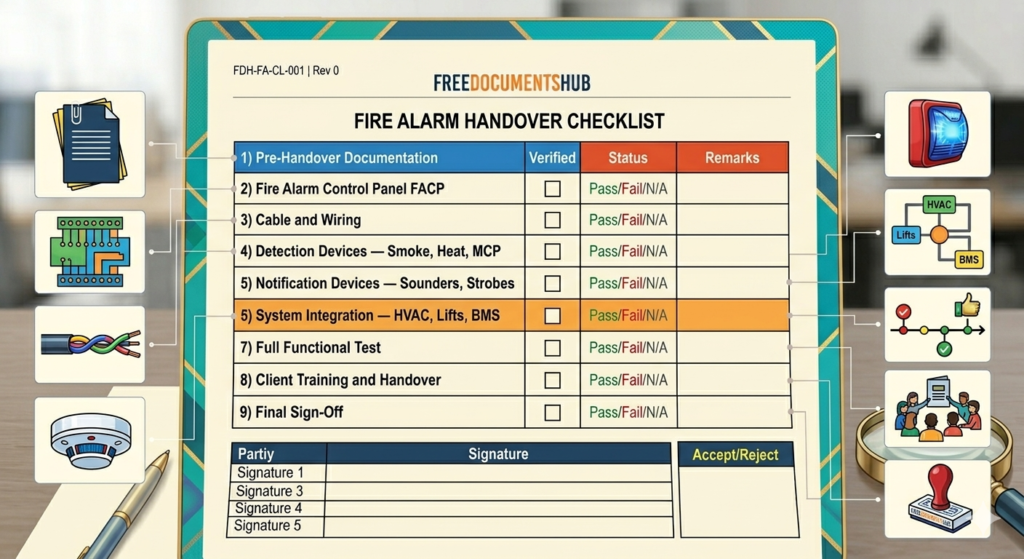
Fire Alarm System Handover Checklist — What Every Project Engineer Must Verify Before Sign-Off
Most fire alarm systems are installed correctly. But many are handed over incorrectly.
The difference between a properly commissioned fire alarm system and a liability risk is not the brand of the panel or the quality of the detectors. It is the quality of the handover process.
This post gives you the complete fire alarm system handover checklist used on industrial and commercial projects — 98 verification points across 9 sections — so that when you sign off, you sign with confidence.
Why Fire Alarm Handover Gets Rushed — And Why That Is Dangerous
Project completion pressure is real. The client wants occupancy. The contractor wants to close the contract. The project manager wants to move resources to the next job.
In that pressure, fire alarm handover checklists get treated as paperwork rather than as the critical last line of defence between a safe building and a building where the life safety system fails on the day it is needed most.
A fire alarm system that was never properly verified is not a commissioned system. It is an installed system. There is a significant difference.
The 9 Sections of a Complete Fire Alarm Handover Checklist
Section 1 — Pre-Handover Documentation Verification
Before any physical testing begins, all documents must be in order. This includes as-built drawings approved by the client or Authority Having Jurisdiction (AHJ), operation and maintenance manuals, device datasheets and certificates, cable schedules, loop drawings with device addresses marked, the Cause and Effect matrix, Factory Acceptance Test (FAT) certificate for the fire alarm control panel, and all material submittals.
If any document is missing at handover, the handover is incomplete regardless of how well the system performs during testing.
Section 2 — Fire Alarm Control Panel (FACP) Verification
The panel is the brain of the system. Verification covers physical installation, dedicated AC supply with correct voltage, backup battery capacity and charge current, standby time test (minimum 24 hours standby plus 5 minutes alarm as per NFPA 72), all loop cards communicating without faults, device addresses matching as-built drawings, event log cleared, time and date set, and panel access restricted with key handed to client only.
Section 3 — Cable and Wiring Verification
Cable type must match the specification — fire resistant or LSOH as required. All cables must be labelled at both ends matching the cable schedule. Insulation resistance test must be carried out — minimum 1 MΩ per loop. End-of-line resistors must be installed with correct values. No open circuits or short circuits on any loop. Cable penetrations through fire-rated walls must be sealed with approved fire-rated sealant.
Section 4 — Detection Devices Verification
Every single detection device must be tested individually. For smoke detectors this means canned smoke test with alarm confirmation at the panel. For heat detectors, confirmation of correct rating for the application — rate of rise or fixed temperature. For Manual Call Points, test with the correct test key at every location, confirming alarm at panel, then resetting correctly.
Detector spacing must comply with the applicable standard. For NFPA 72, the standard maximum coverage area for spot-type smoke detectors is 929 m² (10,000 sq ft) with maximum 9.1 m (30 ft) spacing under smooth ceilings.
Section 5 — Notification Devices Verification
Sounders must produce a minimum 65 dB sound pressure level at 3 metres. Strobe lights must flash at 1 Hz. Circuit supervision must be confirmed — a fault must appear at the panel if the sounder circuit is broken. All notification devices must activate simultaneously on any alarm condition.
Section 6 — System Integration and Output Verification
Fire alarm integration outputs must be physically tested — not assumed. HVAC shutdown, elevator recall to ground floor, access control door release, fire brigade notification, remote monitoring centre signal, and all relay output modules must each be tested and confirmed operational. The Cause and Effect matrix must be tested zone by zone.
Section 7 — Full System Functional Test
One hundred percent of all detection devices must be tested. No sampling. No spot checks. Every device. Every zone. AC power failure test — battery backup automatically activates. Battery discharge test — system remains operational for required duration. AC power restore — mains restores, battery recharging confirmed. Zero outstanding faults at end of full functional test.
Section 8 — Client Training and Handover Items
The system is only as safe as the people who operate it. Client training must cover panel operation, alarm response, silence, reset, fault acknowledge, and the weekly and monthly test procedures required to keep the system in compliance. Spare parts, panel keys, warranty certificates, maintenance schedule, and documentation package must all be physically handed over with signed receipts.
Section 9 — Final Handover Sign-Off
Zero outstanding faults on panel at time of handover. All punch list items closed. AHJ or Civil Defence inspection certificate issued. Defects liability period start date agreed and documented. Handover acceptance signatures from contractor project engineer, contractor safety officer, client representative, AHJ representative, and third-party inspector where applicable.
The Most Common Fire Alarm Handover Failures
After reviewing hundreds of fire alarm handover records, these are the most common failures found:
Battery standby time not tested. The battery is installed and visually inspected, but the actual standby duration test is skipped. If the battery is undersized or degraded, the system fails within hours of a mains power outage.
Integration outputs assumed, not tested. The fire alarm installer tests the detectors. Nobody tests whether the HVAC actually shuts down. On the day of a real fire, the smoke spreads through the entire building through the HVAC system that was never tested to shut off.
Client training skipped. The system is handed over. Nobody explains to the building manager how to reset the panel after a false alarm. The next false alarm causes a 4-hour shutdown because nobody knows the reset procedure.
Documentation package incomplete. As-built drawings are not updated to reflect field changes. Three years later, when a maintenance engineer needs to trace a fault, the drawings do not match the installation.
AHJ sign-off not obtained. The contractor issues a handover certificate but no Civil Defence or AHJ approval has been obtained. The building is occupied with a life safety system that has no official authority approval.
Download the Complete Fire Alarm Handover Checklist
The complete 98-point Fire Alarm System Handover Checklist — covering all 9 sections with verification tick boxes, Pass/Fail/N/A status columns, remarks fields, and final sign-off signatures — is available free on FreeDocumentsHub.com.
Document Number: FDH-FA-CL-001 | Revision 0 | 2026
Available 24 hours, 7 days a week.
www.freedocumentshub.com contact@freedocumentshub.com
FreeDocumentsHub.com — Industrial Documents and Training for Engineers and Safety Professionals Worldwide.