
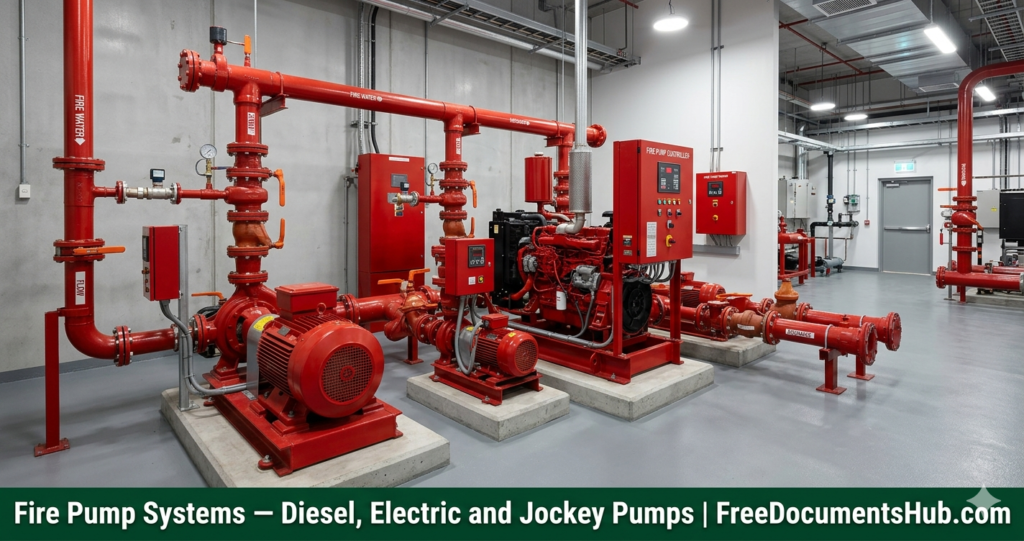
A fire pump system is the heart of any water-based fire protection system. Sprinklers, hydrants, and hose reels all depend on one thing — adequate water pressure and flow when the alarm activates. If the fire pump fails to start or fails to deliver the required pressure, every downstream system becomes useless regardless of how well it was designed and installed.
Understanding the three pumps that make up a complete fire pump set — electric main pump, diesel standby pump, and jockey pressure maintenance pump — is essential for every fire protection engineer, HSE officer, and commissioning engineer.
The Three Pumps and Why All Three Are Required
A complete fire pump set always contains three pumps working together as a system. Each has a specific role. None is optional.
1. Electric Main Pump
The electric main pump is the primary water supply source for the fire protection system. It is sized to deliver the full design flow rate at the required residual pressure — sufficient to supply all system demand simultaneously at the hydraulically most remote point.
The electric pump starts automatically when system pressure drops to the pump start pressure set point. This pressure drop occurs when a sprinkler activates, a hydrant valve opens, or a hose reel is used.
Key requirements:
- Dedicated electrical supply from a reliable source — separate from normal building power circuits
- Automatic start on pressure drop — no manual intervention required
- Cannot be set to automatically stop — must run until manually stopped by an authorised person
- Listed and approved for fire pump service — NFPA 20 / EN 12845
Critical rule: The electric fire pump must never be on the same circuit as normal building electrical loads. A power failure that affects the building must not affect the fire pump supply.
2. Diesel Standby Pump
The diesel engine driven pump is the safety net of the entire fire protection system. Its sole purpose is to ensure the fire protection system continues to operate when mains electrical power is unavailable — during a power cut, a grid failure, or an electrical fault that has taken out the main pump supply.
Fires and power failures frequently occur together. The diesel pump exists because of this reality.
The diesel pump starts automatically on two conditions:
- Mains power failure to the electric pump
- Electric pump failure to achieve required pressure within a set time
Key requirements:
- Weekly automatic test run — engine must start and run to confirm readiness
- Fuel tank sized for minimum 6 hours continuous operation — NFPA 20
- Battery system for engine starting — two independent batteries
- Engine coolant, oil level, and fuel level monitored and alarmed
- Housed in a ventilated enclosure — exhaust discharged safely outside
- Starts within 10 seconds of receiving the start signal
The most common diesel pump failure: Battery not maintained. Engine starts perfectly during weekly test but fails on demand during a real incident because battery was never load tested or replaced. Weekly test run is not sufficient alone — battery load test annually is mandatory.
3. Jockey Pump (Pressure Maintenance Pump)
The jockey pump — also called the pressure maintenance pump or make-up pump — is a small pump that runs continuously to maintain system pressure at the design standby pressure. It is not a firefighting pump. It does not have the capacity to supply any meaningful firefighting flow.
Its purpose is to compensate for minor system leakage and maintain the pressure band that triggers the main and diesel pumps at the correct set points.
How it works:
- System pressure drops slightly due to minor leakage
- Jockey pump starts automatically and restores pressure
- If jockey pump cannot restore pressure — pressure continues to drop
- At the main pump start pressure — electric main pump starts automatically
- This sequence is the early warning system for the entire pump set
Why the jockey pump is critical for diagnostics: A jockey pump that is starting and stopping frequently — more than once or twice per hour — is telling you that the system has a leak. This is a fault that must be investigated. A system with significant leakage may not maintain adequate pressure when the main pump starts under full fire demand.
Pump Set Controller — The Brain of the System
All three pumps are controlled by a fire pump controller panel. The controller:
- Monitors system pressure continuously
- Starts and stops the jockey pump automatically
- Starts the main electric pump on pressure drop
- Starts the diesel pump on mains failure or electric pump failure
- Sends alarm signals to the fire alarm panel — pump running, pump fault, mains failure, low fuel, high engine temperature
- Provides manual start capability for testing
- Logs all pump operations and alarms
The controller must be listed for fire pump service. It must be located where it is accessible and visible. All alarm signals must be transmitted to a constantly attended location.
NFPA 20 — The Governing Standard
NFPA 20 — Standard for the Installation of Stationary Pumps for Fire Protection — is the primary standard governing fire pump design, installation, testing, and maintenance globally. Key requirements every engineer must know:
- Pump room must be heated — minimum 4°C to prevent freezing in cold climates
- Pump suction must be from a reliable, dedicated water supply
- Pump discharge must connect to the fire protection system only — no other services
- Pressure relief valve required on pump discharge — prevents overpressure on deadhead condition
- Weekly test: run pump for minimum 10 minutes — record suction pressure, discharge pressure, and flow
- Annual test: full flow test at design conditions — compare to original acceptance test results
Common Failures — What Causes Fire Pump Systems to Fail
Electric pump fails to start automatically Cause: Controller set to manual instead of automatic. Pressure switch fault. Controller power supply failure.
Diesel pump fails to start Cause: Flat battery. Empty fuel tank. Engine not serviced. Weekly test not conducted. Coolant temperature too low.
System pressure not maintained Cause: System leakage. Jockey pump undersized. Pressure switch settings incorrect.
Pump runs but no water delivered Cause: Suction isolation valve closed. Pump running in reverse rotation. Suction pipe air locked.
Pump overheats on test Cause: Minimum flow bypass not installed or blocked. Pump running at shutoff (no flow) for extended period.
Testing and Acceptance
Before any fire pump system is placed in service — a full acceptance test must be conducted and witnessed. NFPA 20 requires:
- Pump started automatically from pressure drop
- Flow measured at 100%, 150%, and shutoff conditions
- Results plotted on pump curve — actual performance must match rated curve
- Diesel pump automatic start on simulated mains failure confirmed
- All alarms confirmed at fire alarm panel
- All results recorded and signed by contractor and client representative
Download Free Fire Protection Documents
FreeDocumentsHub.com publishes free and premium professional engineering documents for fire protection engineers worldwide — ITPs, method statements, commissioning checklists, and more.
www.freedocumentshub.com — Available 24 Hours, 7 Days a Week
Published by FreeDocumentsHub.com — written by engineers with 19+ years of Gulf industrial project experience.
Perfect information I appreciate you
thank you
Nice information.
noted