
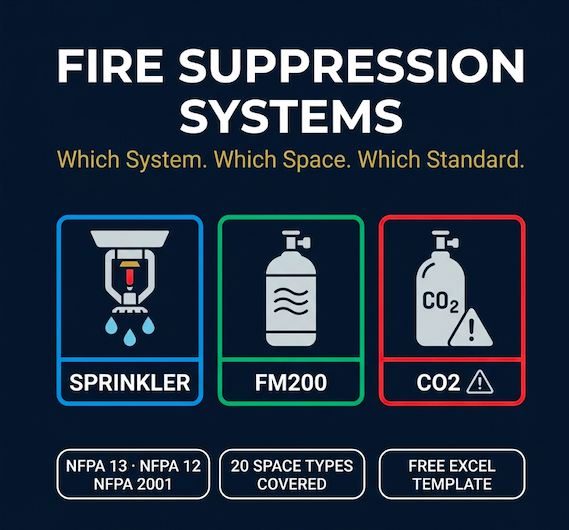
Fire Suppression Systems —
Sprinkler, FM200 and CO2:
The Complete Professional Guide
When to use sprinkler, when to use clean agent, when CO2 is mandatory — and when it will kill you. The complete technical guide with space selection, maintenance requirements, common failures, and a free Excel reference template for site managers and safety officers.
Table of Contents
- Suppression vs Detection — Understanding the Difference
- The Three Primary Suppression Systems
- Sprinkler Systems — How They Work and Where They Apply
- FM200 Clean Agent — The Server Room Standard
- CO2 Systems — Powerful, Effective, and Lethal
- Side by Side — Which System for Which Space
- Space Selection Quick Reference
- Maintenance — What Gets Missed and What That Costs
- Common Problems and Solutions
- Standards Alignment
- Free Download — Excel Template
Suppression vs Detection — Understanding the Difference
Fire detection systems — smoke detectors, heat detectors, manual call points — tell you a fire has started. They alarm. They notify. They give you time to evacuate. But they do not stop the fire. That is the job of the suppression system.
A suppression system is activated by detection — either automatically when detectors trigger the control panel, or manually when a person operates a release station. Once activated, it delivers a suppression agent — water, clean gas, or CO2 — to the protected space with the specific goal of extinguishing or controlling the fire before it spreads.
The relationship between detection and suppression is critical. A suppression system with poor detection will not activate fast enough. A detection system with no suppression will alarm perfectly while the building burns. Both must be designed, installed, and maintained as an integrated system — not as separate items.
“The fire alarm tells you the house is on fire. The suppression system does something about it. Both are non-negotiable — neither works properly without the other.”
The Three Primary Suppression Systems
Three suppression systems cover the vast majority of industrial, commercial, and institutional applications. Each uses a fundamentally different agent, works on a different suppression principle, and is suited to a different set of environments. Understanding all three — and critically, understanding where each must never be used — is essential for every safety officer, site manager, and engineer.
Sprinkler System
Water delivered through heat-activated sprinkler heads. Each head activates individually at its trigger temperature. The most widely used suppression system globally — scalable, reliable, and relatively inexpensive.
FM200 Clean Agent
HFC-227ea gaseous agent discharged as a total flood. Zero residue — no damage to electronics or documents. Safe for personnel at design concentration. Gold standard for server rooms and control rooms.
CO2 System
Carbon dioxide total flooding. Suppresses fire by reducing oxygen below combustion level. Extremely effective for engine rooms, cable tunnels, and industrial plant. Immediately lethal at fire-fighting concentrations.
Sprinkler Systems — How They Work and Where They Apply
A sprinkler system consists of a network of pressurised pipes fitted with sprinkler heads. Each head contains a heat-sensitive element — either a glass bulb filled with glycerine or a fusible link — that holds the head closed. When the temperature at the head reaches the activation temperature, the element fails, the head opens, and water discharges in a specific pattern over a defined coverage area.
The most important principle in sprinkler design that most people get wrong: sprinkler heads activate individually — not all at once. A fire in one corner of a warehouse activates only the heads directly above the fire. The rest remain closed. This is exactly opposite to what most people imagine when they think of a film scene where all the heads activate simultaneously. That only happens in cinema, not in correctly designed sprinkler systems.
The Four Types of Sprinkler System
- Wet pipe — pipes are always filled with pressurised water. Fastest response. Most common. Not suitable where pipes may freeze.
- Dry pipe — pipes filled with pressurised nitrogen or air. Water only enters on activation. Used in cold storage, unheated car parks, and freezer areas.
- Pre-action — requires two separate triggers before water enters the pipes. Used in archives, data centres, and spaces where accidental discharge would be catastrophic. Significantly reduces false discharge risk.
- Deluge — all heads are open simultaneously. Used in high-hazard areas — aircraft hangars, transformer bunds, paint spray booths. Designed to flood the entire area instantly.
Sprinkler Head Temperature Ratings — What Every Site Manager Must Know
Every sprinkler head is rated for a specific activation temperature. Fitting the wrong temperature class in a space is one of the most common installation errors — and one that causes both false activations and failure to activate.
- 57°C (Orange bulb) — Standard. General office and occupied spaces.
- 68°C (Red bulb) — Standard. Most common — warehouses, production areas.
- 79°C (Yellow bulb) — Intermediate. Spaces with elevated ambient temperatures.
- 93°C (Green bulb) — High temperature. Boiler rooms, laundries, close to heat sources.
- 141°C (Blue bulb) — Extra high. Attic spaces, above false ceilings in hot climates.
- In Saudi Arabia — ambient temperatures in uninsulated roof spaces can exceed 60°C in summer. Standard 68°C heads in roof spaces will false-activate. Always use minimum 93°C or 141°C in roof spaces across the Gulf.
FM200 Clean Agent — The Server Room Standard
FM200 (HFC-227ea, heptafluoropropane) is a colourless, electrically non-conductive gas that suppresses fire through a combination of heat absorption and interruption of the chemical chain reaction that sustains combustion. It leaves absolutely zero residue — the protected space and everything in it is completely unaffected by the discharge, other than the brief cold from the rapidly expanding gas.
This zero-residue property makes FM200 the default choice for any space where the contents are more valuable or critical than the space itself — server rooms, control rooms, electrical switchgear rooms, archival storage, telecommunications equipment rooms, and any space where water or CO2 would cause damage that exceeds the value of the equipment the suppression is trying to protect.
How FM200 Suppresses Fire
FM200 works on two mechanisms simultaneously. First, it absorbs heat from the flame — rapidly cooling the combustion reaction below the temperature at which it can sustain itself. Second, it interferes with the free radical chain reaction that propagates combustion at the molecular level. The result is fire suppression in seconds — typically the entire protected space is flooded to the design concentration within 10 seconds of discharge.
Design Concentration and Personnel Safety
FM200 is designed to achieve a minimum concentration of 6.25% by volume in the protected space. At this concentration, it is effective against most Class A, B, and C fires. Critically, this concentration is safe for personnel — it does not significantly reduce oxygen levels and is not toxic at design concentrations. However, at concentrations above 9–10%, the risk of cardiac sensitisation increases, and the space must be evacuated.
FM200 System Requirements — Non-Negotiable
- The protected room must be sealed — gaps under doors, open cable penetrations, or HVAC dampers that do not close will allow the agent to escape and reduce concentration below effective levels.
- A door-hold-open device must release and close the door automatically on system activation.
- A manual abort switch must be installed outside the room — to prevent discharge if a person is inside when the alarm activates.
- A 60-second pre-discharge delay is standard — giving time to abort if the detector has false-alarmed or a person is inside.
- Cylinder storage temperature must remain above -20°C — agent liquefies and cannot be discharged at low temperatures.
⚠ The Environmental Reality of FM200
FM200 has a Global Warming Potential (GWP) of 3,220 — meaning each kilogram discharged is equivalent to 3,220 kg of CO2 in terms of greenhouse effect. A single discharge of a 200 kg FM200 system is equivalent to burning 644 tonnes of CO2. This is driving a global regulatory shift toward alternatives — Novec 1230 (GWP=1), FK-5-1-12, and inert gas systems (IG-541, IG-55) are increasingly specified on environmentally sensitive projects. Be aware of evolving F-Gas regulations in your jurisdiction.
CO2 Systems — Powerful, Effective, and Lethal
Carbon dioxide fire suppression works by flooding the protected space with CO2 to a concentration that reduces the oxygen level below 15% — the threshold below which most combustion cannot be sustained. CO2 is heavier than air, colourless, odourless at low concentrations, and completely clean — it leaves no residue and dissipates without trace after the space is ventilated.
It is also one of the most dangerous systems in the entire fire protection inventory. At the concentrations required for fire suppression — typically 34 to 75% by volume — CO2 causes rapid unconsciousness and death within minutes. There is no warning smell. There is no visible indication. A person who walks into a CO2-flooded space will lose consciousness before they can react.
⚠ CO2 IS IMMEDIATELY DANGEROUS TO LIFE — Read This Before Specifying
- CO2 at fire-fighting concentrations (34–75%) causes rapid unconsciousness and death. This is not a slow process — incapacitation can occur within seconds.
- CO2 systems must NEVER be installed in normally occupied spaces without an extraordinarily robust life-safety design.
- A mandatory pre-discharge alarm of minimum 30 seconds is required before any CO2 discharge — this is a life-safety requirement, not a procedural one.
- Every CO2 protected space must have posted evacuation procedures, audible alarms clearly audible inside the space, visual warning beacons, and SCBA available at the entry point for emergency use.
- Entry prohibition signage must be posted on every access point — with a clear warning that CO2 discharge may occur and the space may contain lethal concentrations.
- More people have been killed by CO2 suppression systems than by the fires they were designed to prevent. Most fatalities occur during maintenance, testing, or immediately after accidental discharge. Treat every CO2 protected space as a confined space with a potentially lethal atmosphere.
Where CO2 is the Correct Choice
CO2 remains the international standard for marine engine rooms (mandated by SOLAS), industrial generator rooms, large cable tunnels, offshore pump rooms, transformer bunds, and other unmanned or rapidly evacuated industrial spaces. Its effectiveness, low agent cost, zero residue, and proven performance in industrial environments make it irreplaceable in these applications — provided the life-safety requirements are rigorously designed and maintained.
Side by Side — Which System for Which Space
| Parameter | Sprinkler System | FM200 / Clean Agent | CO2 System |
|---|---|---|---|
| Agent | Water | HFC-227ea gas | Carbon dioxide gas |
| Suppression Method | Cooling — removes heat | Heat absorption + chain reaction interruption | Oxygen displacement — smothers fire |
| Effect on Contents | Significant water damage possible | Zero residue — no damage | Zero residue — cold shock risk to hot components |
| Personnel Safety | Safe — water not harmful | Safe at design concentration (≤9%) | LETHAL at fire-fighting concentrations |
| Pre-Discharge Alarm | Not required (individual head activation) | Recommended — 30–60 second delay | MANDATORY — minimum 30 seconds |
| Primary Application | Warehouses, buildings, camps, production floors | Server rooms, control rooms, archives | Engine rooms, cable tunnels, offshore, unmanned plant |
| Recharge Cost | Low — refills from water supply | High — USD 15–25 per kg of agent | Moderate — CO2 cheaper than FM200 |
| Capital Cost (relative) | Low — USD 15–35 per m² | High — USD 80–200+ per m² | Medium — USD 40–100 per m² |
| Environmental Impact | Minimal — water only | High GWP (3,220) — F-Gas regulated | Low — GWP=1, natural gas |
| Key Standard | NFPA 13 / BS EN 12845 | NFPA 2001 / EN 15004 / ISO 14520 | NFPA 12 / EN 15004-2 / IMO SOLAS |
Space Selection Quick Reference
The single most common error in fire suppression design is selecting the wrong system for the space — most often choosing sprinkler for a space where water will cause catastrophic damage, or specifying CO2 for a space that is occupied. Use this table as a first-pass guide. Every project requires a formal hazard assessment by a qualified fire protection engineer.
| Space / Area | Sprinkler | FM200 | CO2 |
|---|---|---|---|
| Warehouse / General Storage | ✅ REC | ❌ NO | ⚠ LIMITED |
| Server Room / Data Centre | ❌ NO | ✅ REC | ⚠ CAUTION |
| Electrical Switchgear Room | ❌ NO | ✅ REC | ⚠ UNMANNED ONLY |
| Control Room / SCADA | ❌ NO | ✅ REC | ❌ NO |
| Commercial Kitchen | ⚠ WET CHEMICAL | ❌ NO | ❌ NO |
| Production Floor | ✅ REC | ⚠ PARTIAL | ⚠ LIMITED |
| Archive / Document Storage | ⚠ PRE-ACTION | ✅ REC | ⚠ UNMANNED ONLY |
| Engine Room (Marine / Industrial) | ⚠ FOAM-WATER | ⚠ SUITABLE | ✅ REC |
| Fuel Storage / Flammable Liquid | ⚠ FOAM DELUGE | ❌ NO | ⚠ ENCLOSED ONLY |
| Generator Room | ⚠ SUITABLE | ⚠ SUITABLE | ✅ REC (UNMANNED) |
| Hotel / Accommodation / Camp | ✅ REC | ❌ NO | ❌ NO |
| Cable Tunnel | ⚠ CAUTION | ⚠ SHORT SECTIONS | ✅ REC |
| Car Park (Basement) | ✅ REC | ❌ NO | ❌ NO |
| Transformer Room | ❌ NO | ⚠ INDOOR ONLY | ✅ REC (OIL-COOLED) |
Maintenance — What Gets Missed and What That Costs
Fire suppression systems fail in the field not because they were badly designed or poorly installed — but because they were not maintained. The pattern is consistent across industries and geographies: a system is commissioned, signed off, and then left untested for years. Nobody checks the cylinder pressures. Nobody runs the pump. Nobody verifies that the control valve is still open. The system looks operational. It is not.
The Three Most Commonly Missed Maintenance Items
- FM200 / CO2 cylinder weight check. Gaseous suppression system cylinders lose agent slowly over time through valve leakage. A cylinder that has lost more than 5% of its original charge weight will not achieve the design concentration on discharge — the fire may not be suppressed. Cylinders must be weighed monthly and compared against the baseline weight recorded at commissioning. Most sites skip this entirely.
- Sprinkler control valve position. The main control valve must be open for the sprinkler system to function. On many sites, this valve is closed temporarily for maintenance or leak repair — and nobody reopens it. NFPA 25 requires the valve position to be visually confirmed weekly and the valve to be sealed or locked open. On sites without this discipline, the sprinkler system has been effectively disabled.
- Pre-discharge alarm testing (CO2 systems). The pre-discharge alarm is the only life-safety barrier between CO2 discharge and personnel inside the protected space. It must be tested regularly — not just annually. A failed pre-discharge alarm on a CO2 system is a potentially fatal defect. It must be treated as a system-out-of-service condition until repaired.
Minimum Maintenance Schedule — All System Types
- Weekly: Control valve position check — sprinkler systems. Cylinder pressure gauge reading — FM200/CO2. Fire alarm panel status — no faults.
- Monthly: Fire pump 10-minute run test. FM200/CO2 cylinder weight verification. One detector per zone function test.
- Quarterly: Main drain flow test — sprinkler. Nozzle inspection — FM200/CO2. Abort switch and manual override function check.
- Annual: Full system test. Pump flow test to rated capacity. Agent concentration analysis — FM200. Full CO2 valve and nozzle inspection. All certificates to be issued by a licensed engineer.
Common Problems and Solutions
| Problem | Root Cause | Corrective Action |
|---|---|---|
| FM200 system discharges but fire is not suppressed | Room integrity failure — agent escapes through gaps under doors, open cable penetrations, or HVAC dampers that did not close on activation. Design concentration not achieved. | Door-fan room integrity test (NFPA 2001 Annex B) to find leakage points. Seal all cable penetrations with intumescent compound. Fit automatic door closers. Verify HVAC dampers close on alarm. |
| Sprinkler system false activates with no fire | Wrong temperature rating for ambient conditions — 68°C heads in roof spaces or near heat sources where ambient temperature reaches 50°C+ in summer. Also: physical damage to head, steam from nearby process. | Replace all heads in high-ambient areas with correct temperature class (93°C or 141°C for Gulf roof spaces). Inspect heads near steam sources. Replace any heads showing corrosion or physical damage. |
| CO2 pre-discharge alarm fails to activate | Sounder or beacon wiring fault. Battery backup failure. Detection panel fault. Component end-of-life. Most common cause: system not tested since commissioning. | Immediate — treat as system out of service. Post warning signs on all entry points. Test and repair the alarm circuit before returning system to service. Implement weekly alarm test discipline. |
| Sprinkler pipe corrosion and pinhole leaks | Oxygen-rich water in wet pipe systems causes internal corrosion over time — particularly at the top of pipes where trapped air accumulates. Accelerated in coastal environments with high humidity. | Nitrogen inerting of wet pipe systems (NFPA 13 Annex A) — replace oxygen-rich water with nitrogen-pressurised system. Internal pipe inspection at 25-year interval. Consider corrosion inhibitor for high-risk environments. |
| FM200 cylinders losing pressure between annual services | Valve seat wear or contamination causing slow leak. Cylinder valve not fully closed after last service. Ambient temperature cycling causing repeated pressure changes that fatigue valve seals. | Monthly weight check is the only reliable early detection. Cylinders losing more than 5% weight — valve service or replacement required. Keep cylinder storage area at stable temperature above -20°C. |
| Sprinkler system fails to activate in a fire | Most common causes: control valve closed (system disabled). Sprinkler head painted over during redecoration (paint blocks the heat-sensitive element). Head temperature rating too high for the fire scenario. | Weekly valve position check — mandatory. Inspect all heads for paint, corrosion, or physical obstruction during annual maintenance. Replace painted heads immediately — do not attempt to clean. Verify temperature ratings match current use of space. |
Standards Alignment
NFPA 13 — Sprinkler Systems
The primary standard for the installation of sprinkler systems. Covers all aspects of system design — hazard classification, water supply requirements, pipe sizing, sprinkler head selection, spacing, and position. NFPA 13 defines three occupancy hazard categories: Light Hazard (offices, hotels), Ordinary Hazard (warehouses, production), and Extra Hazard (flammable liquids, high-piled storage). System density and coverage area requirements differ significantly between these categories.
NFPA 25 — Inspection, Testing and Maintenance
The maintenance bible for installed sprinkler systems. Defines every inspection task, its frequency, the method of testing, and the acceptance criteria. Any site operating a sprinkler system should have NFPA 25 as the reference document for their maintenance programme — not a generic checklist.
NFPA 2001 — Clean Agent Systems
The design, installation, and maintenance standard for FM200, Novec 1230, and other clean gaseous suppression agents. Specifies minimum design concentrations, discharge time requirements (within 10 seconds), room integrity requirements, and hold time (minimum 10 minutes at design concentration).
NFPA 12 — CO2 Systems
Governs total flooding and local application CO2 systems. Contains the life-safety requirements that are mandatory for every CO2 installation — pre-discharge alarm timing, ventilation shutdown, personnel warning systems, and entry procedures. The standard is explicit that CO2 at fire-fighting concentrations is immediately dangerous to life.
SAES-B-067 — Saudi Aramco Fire Protection
The Saudi Aramco Engineering Standard that governs all fire protection on Aramco facilities — including suppression systems. All equipment must be from the Aramco Approved Vendors List, all designs must be submitted for Aramco review, and all systems must be commissioned with Aramco witness. SAES-B-067 references NFPA standards as the technical basis but adds Aramco-specific requirements on top.
📥 Free Download — Fire Suppression Systems Excel Template
5-sheet professional Excel for site managers and safety officers: System comparison, 20-space selection guide, 12-month inspection log, and incident and discharge record with investigation summary.
The Right System in the Right Space
Three systems. Three different agents. Three completely different risk profiles. The engineer or safety officer who understands all three — their strengths, their limitations, and critically their dangers — will make better decisions at every stage of a project, from specification through to the maintenance programme that keeps the system functional years after commissioning.
Sprinkler for occupied spaces and general areas. FM200 for electronics, documents, and sensitive equipment. CO2 for unmanned industrial and marine applications — and only with the full life-safety envelope that the standard demands. No exceptions.
The system that is not maintained is not a suppression system. It is false assurance. Check the valve. Weigh the cylinder. Test the alarm. These are not bureaucratic exercises — they are the difference between suppression and catastrophe.
More Free Industrial Documents
Fire alarm guides, gas detection references, smoke and heat detector selection, commissioning checklists, and now the complete fire suppression reference — all free at FreeDocumentsHub.com.
Download Free Fire Suppression Template www.freedocumentshub.com