
INTRO PARAGRAPH:
Fire detection technology is going through its biggest transformation since addressable systems arrived in the 1980s. IoT connectivity, artificial intelligence, cloud monitoring, and solar-powered remote sensors are changing what is possible — and what clients expect. In this guide, we break down the key trends, the technologies behind them, and what this means for fire protection engineers working in oil & gas, industrial, and commercial projects across the Gulf and worldwide.
Why Conventional Fire Detection Is No Longer Enough
The traditional model is simple and it works: detector triggers, panel alarms, outputs activate. But it has real limits.
A conventional or addressable system tells you THAT detector 047 in Zone 3 has activated. It does not tell you WHY. It cannot tell you whether the alarm is genuine or a nuisance event from steam or dust. And it cannot warn you that detector 047 has been drifting toward an alarm threshold for six weeks due to contamination — before that drift causes an unplanned evacuation of a live production facility.
This is exactly the gap that smart fire detection is designed to close.
The Four Pillars of Smart Fire Detection
Smart fire detection adds four capability layers on top of certified life safety infrastructure:
✅ Connected Sensing — Every device transmits continuous data, not just alarm state. Real-time visibility of every detector's health and environment.
✅ Edge Intelligence — Processing happens at the device, not just the panel. Faster response, fewer false alarms, works even without cloud connectivity.
✅ Cloud Analytics — Historical data across multiple sites enables predictive maintenance, remote diagnostics, and portfolio-level management.
✅ System Integration — Fire detection communicates with BMS, SCADA, suppression, and security systems for coordinated emergency response.
KEY POINT: Smart fire detection does not replace NFPA 72 or BS 5839 compliant systems. It adds intelligence on top of certified life safety infrastructure.
IoT Communication Protocols — Which One for Your Project?
The communication layer is the foundation of any IoT fire detection system. Here is a quick comparison:
[TABLE]
Protocol | Range | Best For | Key Note
LoRaWAN | 2–15 km | Remote wellheads, pipeline stations | Ultra-low power, low data rate
4G / LTE-M | Cellular | Offshore platforms, mobile assets | Ongoing SIM cost
Wi-Fi 6 | 50–100 m | Commercial buildings, campuses | Needs IT infrastructure
Zigbee Mesh | 10–100 m | Dense indoor deployments | Watch proprietary lock-in
BACnet/IP | LAN/WAN | BMS integration | Needs IT network
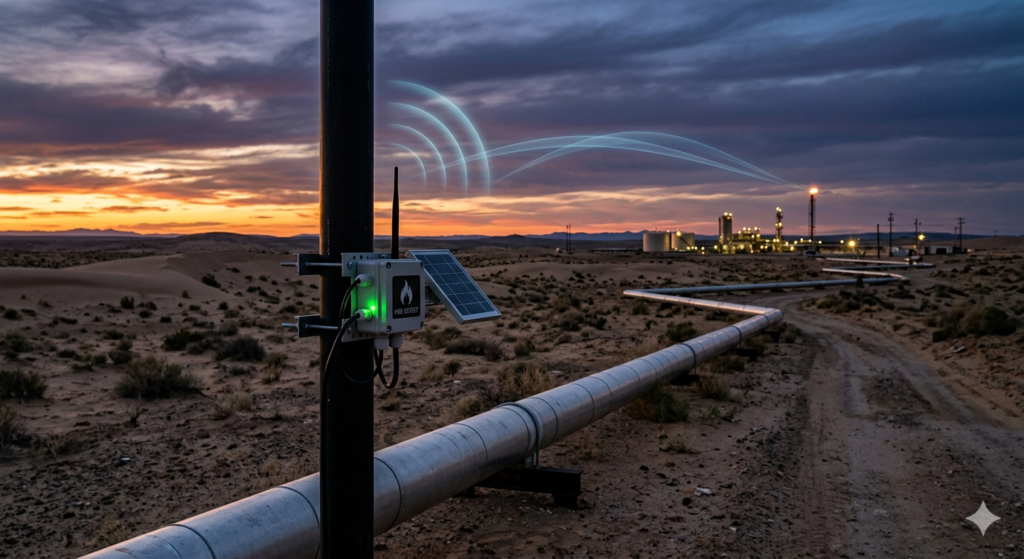
For Gulf oil & gas remote sites, LoRaWAN combined with solar power and ATEX certification is rapidly becoming the default choice for remote monitoring deployments.
AI Fire Detection — What the Technology Actually Does
AI in fire detection works at two levels.
At the detector level (edge AI): Modern intelligent detectors embed machine learning models trained on millions of fire signatures. The detector does not just ask "is smoke present?" — it asks "does this pattern of smoke, temperature, humidity, and rate of change match a genuine fire or a known false alarm trigger?"
Results from field deployments: false alarm reductions of 60 to 85 percent with no reduction in genuine fire detection sensitivity.
At the cloud platform level: AI algorithms analyse continuous detector data streams to identify contamination trends, sensitivity drift, and devices approaching end of life — weeks or months before they fail or create a nuisance alarm.
Smart Fire Detection in Oil & Gas — What Makes It Different
Oil and gas facilities demand an entirely different design philosophy from commercial fire protection:
• Hydrocarbon fires spread at catastrophic speed — detection must happen in seconds
• Hazardous area classifications require ATEX/IECEx certified IoT equipment throughout
• Complex environments create false alarm risk — steam, dust, welding fumes, vibration
• Remote locations require remote monitoring as a fundamental design requirement
• Missed alarm consequence is mass casualty — engineering standard must match the risk
Multi-sensor fusion is now considered best practice in oil & gas: combining smoke, heat, CO, UV/IR flame detection, and gas detection in a single device increases alarm confidence and dramatically reduces false alerts.
The 5-Year Roadmap — What Is Coming 2025 to 2030
Six technologies are moving from pilot to mainstream in this window:
1. Drone-based fire inspection — Autonomous UAVs performing aerial thermal imaging — pilot deployments already live in KSA (2025–2026)
2. Digital twin integration — Real-time fire risk modelling in facility 3D digital twin with live evacuation simulation (2026–2027)
3. Predictive AI weeks ahead — Models predicting fire risk from process data 2–4 weeks in advance (2026–2028)
4. 5G private networks — Ultra-low latency fire alarm transmission on 5G private campus networks — Aramco 5G rollout ongoing (2025–2026)
5. Blockchain audit trails — Immutable inspection and alarm records for regulatory compliance (2027–2030)
6. Self-testing detectors — Devices that autonomously certify their own sensitivity and report results to the cloud platform — products launching now (2025)
What This Means for You as an Engineer
The majority of fire protection engineers in the Gulf are still specifying conventional and basic addressable systems. The skills gap is real and growing.
The engineer who understands IoT architecture, cloud platforms, AI detection, and cybersecurity requirements today is already ahead of most of the market.
Three practical steps:
1. Complete one IoT platform training course — Honeywell, Siemens, and Hochiki all offer free online training
2. Add IoT and cloud monitoring sections to your next specification — even if the client does not require it, demonstrating capability wins work
3. Stay current with NFPA 72-2025 — it contains expanded IoT and remote monitoring provisions
Download the Complete Guide — Free
We have produced a complete technical guide on this topic — FDH-FG-001: Smart Fire Detection and IoT Future Trends — covering all six chapters in full, including communication protocol comparison tables, multi-sensor fusion applications, cloud platform comparison, cybersecurity requirements, and the full 5-year technology roadmap.
👉 Download FREE: FDH-FG-001 Smart Fire Detection IoT Guide
https://iftakhar.gumroad.com/l/kyeqqn
CLOSING PARAGRAPH:
Smart fire detection is not about replacing life safety compliance. It is about making compliant systems smarter, more reliable, and more manageable. The engineer who combines deep knowledge of NFPA 72, BS 5839, and Aramco standards with fluency in IoT technology will define the next generation of industrial fire protection.
If you found this guide useful, subscribe to our newsletter — Fire Protection & HVAC Engineering — for weekly insights, free document templates, and exam preparation resources.
FreeDocumentsHub.com | contact@freedocumentshub.com |