
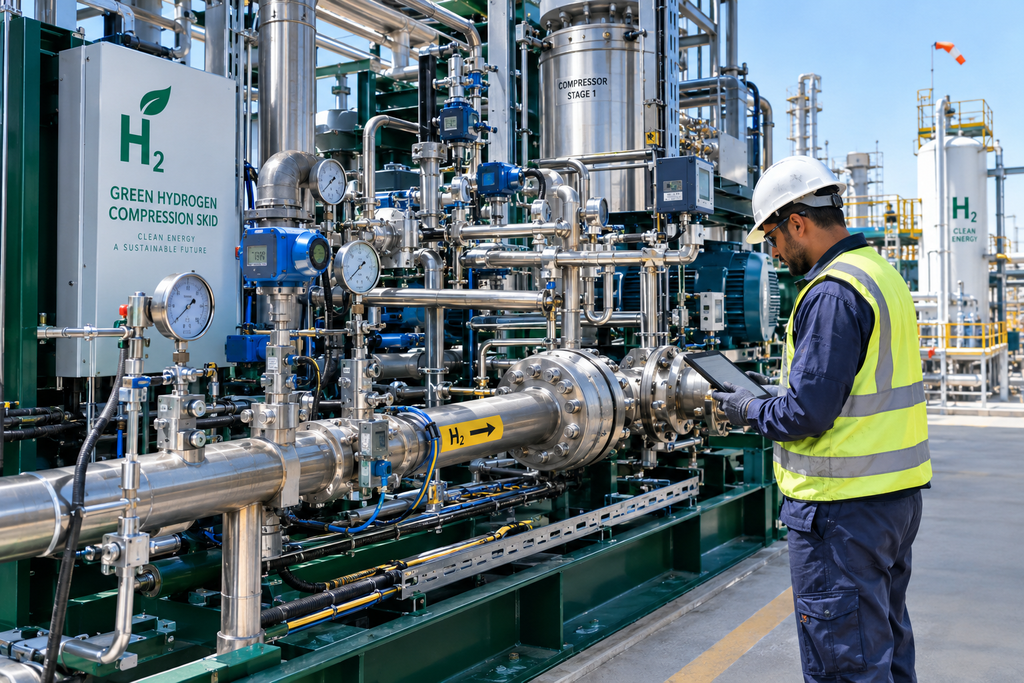
As the global energy transition accelerates toward net-zero emissions, green hydrogen is emerging as the cornerstone fuel for decarbonizing heavy industry, power generation, and transportation. However, transporting and handling molecular hydrogen introduces extreme technical challenges that traditional hydrocarbon pipeline codes cannot fully resolve.
Hydrogen is the smallest and lightest element in the universe. Its minute molecular size allows it to permeate steel matrices, interact with microstructural defects, and cause catastrophic structural degradation known as Hydrogen Embrittlement (HE). To secure the safety and longevity of clean energy infrastructure, engineers must transition away from standard process piping codes (such as ASME B31.3) and master the rigorous design, testing, and material mandates set forth in ASME B31.12: Hydrogen Piping and Pipelines.
1. The Physics of Hydrogen Embrittlement in Metals
Hydrogen embrittlement is not a single failure mechanism, but a collection of phenomena where metals experience a severe loss of ductility and fracture toughness under stress after absorbing atomic hydrogen.
+-------------------------------------------------------------------------+
|                  HYDROGEN EMBRITTLEMENT MECHANISM IN STEEL              |
+-------------------------------------------------------------------------+
|   Molecular Hydrogen ($H_2$) in Gas Stream                              |
|                          │                                              |
|                          ▼ (Dissociation at metal surface)              |
|   Atomic Hydrogen ($H$) Adsorption & Permeation                         |
|                          │                                              |
|                          ▼ (Diffusion into interstitial lattice sites)  |
|   Trapping at Dislocation Sites, Inclusions, & Grain Boundaries         |
|                          │                                              |
|                          ▼ (Stress Concentration + Internal Pressure)   |
|   Micro-Void Formation, Loss of Ductility, & Premature Cracking         |
+-------------------------------------------------------------------------+
How Hydrogen Attacks Metallic Structures
- Dissociation: Gaseous hydrogen ($H_2$) contacting a bare metal surface dissociates into atomic hydrogen ($H$).
- Diffusion: Due to its high diffusivity, atomic hydrogen penetrates the crystal lattice—particularly in body-centered cubic (BCC) structures like carbon and low-alloy steels.
- Trapping: Hydrogen atoms accumulate at high-stress regions, micro-voids, non-metallic inclusions, and dislocation networks.
- Failure: Under mechanical stress, localized embrittlement causes premature, brittle crack propagation without prior plastic deformation, leading to sudden, catastrophic rupture.
2. ASME B31.12: The Regulatory Framework for Hydrogen Systems
For decades, hydrogen systems were designed using general process piping codes like ASME B31.3, treating hydrogen merely as a hazardous flammable fluid. Recognizing that hydrogen requires specialized rules, ASME introduced B31.12, which is divided into distinct sections:
- Part IP (Industrial Piping): Covers plant-boundary piping systems, analogous to B31.3 but tailored explicitly for hydrogen service.
- Part PL (Pipelines): Covers cross-country and transmission pipelines, analogous to B31.8.
- Parts GR, PK, and SL: Provide mandatory rules for general requirements, non-metallic/alternative materials, and specific material classifications.
Unlike conventional codes, ASME B31.12 assumes that hydrogen-exposed carbon steels will suffer a reduction in mechanical performance. It forces engineers to incorporate material degradation factors directly into their design calculations.
3. Material Selection and the Material Performance Factor ($H_f$)
When designing high-pressure hydrogen infrastructure, selecting the correct material is the single most critical decision an engineer will make.
Carbon Steels vs. Austenitic Stainless Steels
- Carbon Steels (e.g., API 5L X52, X60, SA-106 Gr. B): Highly susceptible to hydrogen embrittlement. While economical for large-scale pipelines, ASME B31.12 restricts their maximum specified minimum yield strength (SMYS) and penalizes their design capacity.
- Austenitic Stainless Steels (e.g., SS 304L, SS 316L): Possess a face-centered cubic (FCC) crystal structure, making them largely immune to hydrogen embrittlement at ambient temperatures. They are the preferred choice for valves, instrumentation lines, and high-pressure compression skids.
- Nickel Alloys & Special Metals: Highly resistant, though subject to cost constraints. Titanium and aluminum alloys also perform well in specific low-temperature hydrogen applications.
The ASME B31.12 Wall Thickness Equation & $H_f$ Factor
In standard B31.3 design, engineers use the full allowable stress ($S$) of the material. In ASME B31.12 Part PL (and built into Part IP tables), the strength of carbon steel is “derated” using a mandatory Material Performance Factor ($H_f$):
$$t = \frac{P \cdot D}{2 \cdot (S \cdot F \cdot E \cdot H_f) + \text{extras}}$$
Where:
- $t$ = Required nominal wall thickness
- $P$ = Internal design pressure
- $D$ = Outside diameter of the pipe
- $S$ = Specified minimum yield strength or allowable stress
- $F$ = Design factor
- $E$ = Longitudinal weld joint quality factor
- $H_f$ = Material Performance Factor (ranging from $0.5$ to $1.0$ based on material grade, cleanliness, and test verification)
The Engineering Impact: Trying to use high-strength carbon steels (such as API 5L X70 or X80) to save weight results in a low $H_f$ factor under B31.12, forcing engineers to specify thicker walls to maintain structural safety margins.
4. Fabrication, Welding, and Post-Weld Heat Treatment (PWHT)
Fabrication controls under ASME B31.12 are exceptionally strict because welding introduces microstructures—such as untempered martensite—that are acutely vulnerable to hydrogen cracking.
| Fabrication Parameter | Standard ASME B31.3 Approach | ASME B31.12 Hydrogen Requirements |
| Carbon Steel Hardness Limits | Permissible up to 250 HV or standard regional limits | Strictly controlled; maximum hardness typically capped at 22 HRC (approx. 248 HV) to prevent sulfide/hydrogen stress cracking. |
| Post-Weld Heat Treatment (PWHT) | Exempted for thin-wall carbon steel piping below specific thickness thresholds. | Frequently mandatory regardless of thickness to relieve residual stresses and soften the weld Heat-Affected Zone (HAZ). |
| Welding Consumables | Standard low-hydrogen electrodes matching base metal strength. | Must match or under-match yield strength carefully; strict control over moisture content in fluxes to eliminate diffusible hydrogen pickup. |
| Non-Destructive Examination (NDE) | Spot radiography or standard visual checks based on fluid service category. | 100% volumetric examination (Radiography or Phased Array Ultrasonic Testing) often mandated for high-pressure hydrogen loops. |
5. Component Integrity: Valves, Gaskets, and Sealing Elements
Piping is only as strong as its weakest component. Under ASME B31.12, auxiliary components must be engineered specifically to mitigate hydrogen leakage and permeation:
- Valves: Must feature fire-safe designs (API 607 / API 6FA) due to hydrogen’s extremely low ignition energy and wide flammability range. Valve packing must utilize flexible graphite combined with metallic seals rather than standard PTFE, which permits high hydrogen permeation rates.
- Gaskets: Spiral-wound gaskets with graphite fillers or metal-jacketed configurations are specified to prevent joint blowouts caused by molecular migration.
- Instrumentation: Tubing and fittings must use certified grade 316/316L stainless steel with strict dimensional tolerances to prevent fitting relaxation under thermal cycling.
Summary: Navigating the Green Hydrogen Compliance Landscape
Designing green energy infrastructure under ASME B31.12 bridges the gap between traditional mechanical engineering and advanced materials science. By acknowledging hydrogen embrittlement head-on, incorporating the Material Performance Factor ($H_f$), enforcing strict hardness thresholds ( $\le 22\text{ HRC}$ ), and utilizing austenitic stainless steels where appropriate, plant engineers can guarantee safe, reliable, and code-compliant hydrogen assets for decades to come.
🎓 Bridge the Gap Between Theory & Industrial Execution
Mastering international design codes, managing complex material specifications, and maintaining field-ready technical documentation requires specialized professional training. At Free Documents Hub, we provide expert remote training specializing in industrial engineering design, compliance codes, and technical documentation frameworks. Our programs bridge the gap between academic theory and real-world shop-floor execution. Whether you want to master ASME B31.12 hydrogen systems, pressure vessel design, or quality assurance (QA/QC) workflows, we have you covered.
🛠️ Explore Our Digital Resource Libraries:
- Gumroad Store: https://iftakhar.gumroad.com/[cite: 2]
- Payhip Store: https://payhip.com/b/pLP7W[cite: 2]
📩 Claim Your Free Trial: Elevate your technical skills and code compliance expertise today. Contact our engineering team at contact@freedocumentshub.com to claim your FREE trial sample!