
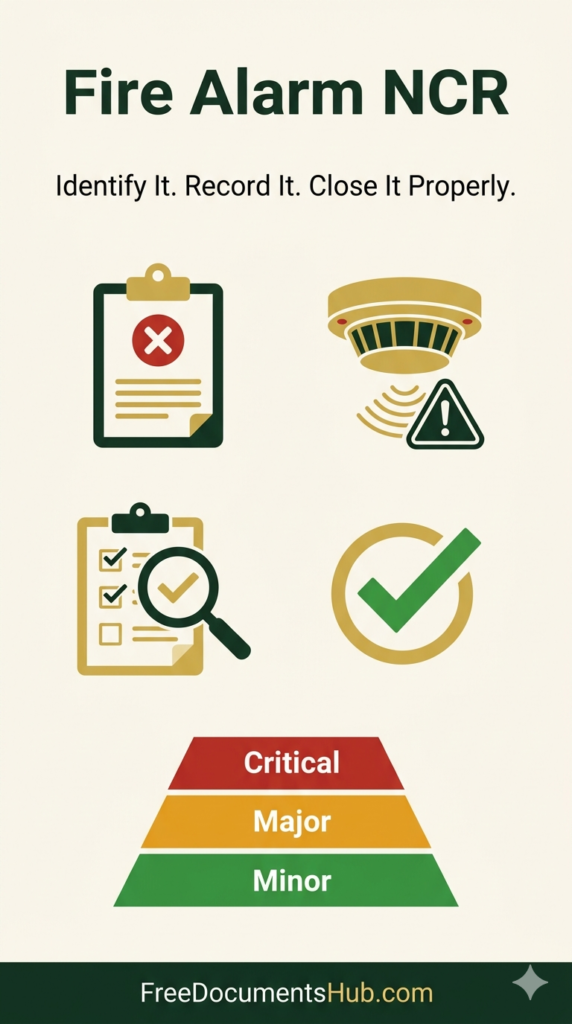
Fire Alarm NCR — Non-Conformance Report:
The Complete Professional Guide
What an NCR is, when to raise one, the three severity levels, the 8-step closure process, six NCR categories, and what you risk by ignoring non-conformances on a fire alarm project. Free Excel template included.
Table of Contents
- What Is a Fire Alarm NCR?
- When Is an NCR Raised — and Who Can Raise One?
- The Three Severity Levels — Critical, Major, and Minor
- Six NCR Categories on Fire Alarm Projects
- The 8-Step NCR Closure Process
- Structure of the NCR Excel Template
- Advantages of a Proper NCR System
- What Happens When NCRs Are Ignored
- Standards and Regulatory Alignment
- Free Download — Excel Template
- Conclusion
What Is a Fire Alarm NCR?
A Non-Conformance Report (NCR) is a formal quality control document raised when any aspect of a fire alarm system installation, design, commissioning, or associated documentation is found to deviate from the approved drawings, project specification, applicable standard, or contractual requirement. It is the official mechanism through which a defect or deviation is identified, recorded, investigated, corrected, verified, and formally closed.
The NCR is not an informal observation or a verbal comment. It is a controlled document with a unique reference number, a structured format, defined response timelines, and a formal multi-party sign-off process. It exists because in the quality management of life-safety systems, no defect can be allowed to remain unresolved — and no resolution can be claimed without documentary evidence that it was carried out correctly.
On a fire alarm project, an NCR might be raised because a smoke detector has been installed too close to an air conditioning vent, violating the minimum separation distance required by NFPA 72. It might be raised because a cable fails its insulation resistance test. It might be raised because a sounder does not produce the minimum 65 dB(A) audibility level at the far end of a zone. It might be raised because a zone label in the fire alarm control panel is incorrect. In every case, the response is the same: the NCR is raised, the root cause is investigated, a corrective action is implemented, and the correction is independently verified before the NCR is formally closed.
“An NCR is not a punishment. It is a quality tool. It is the system that ensures every defect on a fire alarm project is found, fixed, and verified — before it becomes someone’s emergency.”
The distinction between an NCR and an informal snag or punch list item is important. A snag list is a practical tool for tracking minor outstanding items at the end of a project. An NCR is a formal quality record that is numbered, tracked, and retained as part of the project’s permanent quality documentation. It has contractual weight. It requires formal authorisation to close. And it forms part of the evidence base that demonstrates the project was managed to a defined quality standard.
On projects governed by ISO 9001, NFPA 72, or BS 5839, the NCR system is not optional. It is the documented proof that the contractor’s quality management system is functioning — that defects are being identified and corrected in a controlled manner rather than being ignored, concealed, or informally resolved without record.
When Is an NCR Raised — and Who Can Raise One?
An NCR is raised at the moment a non-conformance is identified — not at the end of the project, not during the final inspection, and not after handover. The purpose of the NCR system is to capture defects as early as possible, while they are still accessible and correctable at minimum cost and disruption. A non-conformance found during cable installation is far cheaper to correct than one found during commissioning. A non-conformance found during commissioning is far cheaper to correct than one found after the client has accepted the system.
Who Can Raise an NCR?
On a well-managed fire alarm project, any qualified party present on site has both the right and the professional obligation to raise an NCR when they identify a non-conformance. This includes:
- The Site Engineer or Supervisor — who observes installation work as it proceeds and identifies deviations from the approved method statement or drawings
- The Consultant or Project Manager — who conducts periodic site inspections against the ITP hold and witness points
- The Commissioning Engineer — who discovers a device or system performance failure during functional testing
- The Client Representative — who witnesses commissioning and observes a result that does not meet the specification
- The HSE Officer — who identifies a safety-related installation non-conformance such as missing fire stopping or incorrect cable installation in a hazardous area
- The Contractor’s QC Inspector — who conducts internal quality audits before presenting work to the client or consultant for inspection
It is worth noting that the most professionally mature contractors raise NCRs against their own work — through internal quality inspection — before the client or consultant has an opportunity to raise them. This approach, called internal NCR management, demonstrates a genuine quality culture. It means defects are found and fixed before they become client concerns, before they delay inspection sign-offs, and before they damage the contractor’s professional standing.
What Triggers an NCR?
An NCR is triggered by any of the following observations during a fire alarm project:
- Installation deviates from the approved drawings or method statement
- A test result does not meet the defined acceptance criterion
- A device does not function as specified during commissioning
- A material arrives on site that does not match the approved Material Approval Sheet (MAS)
- A document is found to be at the wrong revision or contains incorrect information
- A safety requirement has not been met — for example, missing fire stopping at a cable penetration
- The quality of workmanship is below the standard required by the specification
The Three Severity Levels — Critical, Major, and Minor
Not all non-conformances carry the same risk or require the same urgency of response. The NCR system uses a three-tier severity classification to prioritise the response, define the maximum acceptable response time, and ensure that the most dangerous defects receive immediate attention while lower-risk items are managed proportionately.
🔴 CRITICAL
Non-conformance that directly compromises life safety, system integrity, or regulatory compliance. The system cannot be accepted, commissioned, or handed over until this NCR is closed.
Examples: Device non-responsive during testing. Cable insulation resistance below 1 MΩ. Battery backup below minimum duration. Sounder inaudible in occupied area.
⏱ Response: Within 24 hours
🟡 MAJOR
Non-conformance that significantly affects installation quality or system performance but does not cause immediate system failure. Must be resolved before commissioning sign-off.
Examples: Detector installed within 300mm of AC vent. MCP mounted above 1.4m AFF. Sounder below 65 dB(A) minimum. Missing fire stopping at wall penetration.
⏱ Response: Within 3 working days
🟢 MINOR
Non-conformance that is a deviation from specification but has minimal impact on system performance. Must be resolved before practical completion but does not block commissioning.
Examples: Zone label error in panel. Minor cable routing deviation from drawing. Cable label missing at one junction box. Document at wrong revision.
⏱ Response: Within 5 working days
The severity classification must be agreed between the raising party and the contractor at the time the NCR is issued. Where there is disagreement about severity — for example, whether a particular installation deviation is Major or Critical — the consultant or project manager’s determination is final. Any attempt by a contractor to downgrade the severity of an NCR to reduce response pressure is a quality management failure that consultants and experienced clients will recognise immediately.
The Golden Rule of NCR Severity
When in doubt about severity classification, always assign the higher level. The cost of treating a Major NCR as Critical is a slightly faster response time. The cost of treating a Critical NCR as Major is a life-safety system that is accepted with an unresolved defect that could cause it to fail during an emergency.
- When a device fails its functional test — it is CRITICAL
- When a cable fails its IR test — it is CRITICAL
- When battery backup is insufficient — it is CRITICAL
- When fire stopping is missing — it is MAJOR minimum
- When mounting height is wrong — it is MAJOR minimum
Six NCR Categories on Fire Alarm Projects
Every NCR raised on a fire alarm project falls into one of six defined categories. The category identifies the nature of the non-conformance and determines which party is primarily responsible for the corrective action. Understanding these categories also helps organisations analyse patterns in their NCR data — repeated NCRs in the same category signal a systemic problem that requires a management response, not just individual corrective actions.
| Category | Description | Responsible Party | Standard Reference |
|---|---|---|---|
| Installation | Physical installation deviates from approved drawings, specification, or applicable standard. The most common NCR category on fire alarm projects. | Fire Alarm Sub-Contractor | NFPA 72 Ch.10 / BS 5839 S.22 |
| Design | Engineering design does not meet standard requirements or client specification. May require consultant involvement to resolve. | Designer / Consultant | NFPA 72 Ch.17 / BS 5839 S.20 |
| Commissioning | System does not perform as required during commissioning testing. Device failure, system performance below threshold, or interface failure. | Commissioning Engineer | NFPA 72 Ch.14 / BS 5839 S.26 |
| Material | Supplied material does not match the approved Material Approval Sheet. Unapproved substitution or damaged material installed. | Contractor / Procurement | EN 54 / Project MAS |
| Documentation | Project documents are incorrect, missing, superseded, or not updated to current revision. Includes drawings, test records, and ITP sign-offs. | Document Controller / Engineer | ISO 9001 Cl.7.5 |
| Workmanship | Quality of physical installation work is below the standard required by the specification, regardless of whether dimensions or positions are correct. | Fire Alarm Sub-Contractor | Project Specification / Method Statement |
When the same category generates repeated NCRs across a project — for example, three separate Installation NCRs for detector positioning within the same week — this is a pattern that the contractor must address at a management level. Repeated NCRs in the same category indicate that individual corrections are being made but the underlying cause is not being addressed. The site supervisor needs retraining, the method statement needs revision, or the inspection process needs strengthening. An NCR system that only corrects individual defects without analysing patterns is missing half its value.
The 8-Step NCR Closure Process
An NCR is not closed by fixing the problem. It is closed by fixing the problem, verifying the fix independently, documenting the verification, and obtaining formal sign-off from the authorised parties. Every step in the process below is mandatory. Skipping any step means the NCR remains open — regardless of whether the physical corrective work has been completed.
Non-Conformance Identified
⏱ Immediate — as observedAny qualified party on site identifies a deviation from the approved specification, drawing, or standard during inspection, testing, or site observation. The observation is noted immediately — not at the end of the day, not at the weekly meeting, but at the moment of identification. Early identification limits the extent of the non-conformance and reduces the cost of correction.
NCR Form Raised and Numbered
⏱ Same day as identificationThe raising party completes the NCR Individual Form. The form captures: project identification, the zone and specific location of the non-conformance, a precise technical description of what was found, the applicable standard or requirement that has been violated, the severity classification, and the NCR category. A unique NCR number is assigned from the NCR Register. This number follows the NCR through its entire lifecycle and is how it is tracked and referenced in all subsequent communications.
NCR Registered and Formally Issued
⏱ Within 24 hours of raisingThe NCR is entered into the NCR Register with status set to OPEN. The contractor receives formal written notification of the NCR — typically by email with the completed NCR form attached. The formal notification starts the response clock. From this point, the contractor has the defined response time (24 hours for Critical, 3 working days for Major, 5 working days for Minor) to submit a Corrective Action Plan.
Root Cause Analysis
⏱ Within 48 hours of NCR issueThe responsible party analyses why the non-conformance occurred — not just what happened, but the underlying cause. Was it a workmanship failure because the technician was not briefed correctly on the method statement? Was it a material substitution because procurement used an unapproved cable? Was it a design error that was not caught during the drawing review? Identifying the root cause is what prevents the same non-conformance from recurring. A corrective action that fixes the symptom without addressing the cause will be followed by the same NCR being raised again.
Corrective Action Plan Submitted
⏱ Within defined response time per severityThe contractor submits a written Corrective Action Plan (CAP) that defines exactly what will be done to correct the non-conformance, who will do it, and by what date each action step will be completed. The CAP must address both the immediate corrective action (fixing the specific defect) and, where applicable, the preventive action (the systemic change that prevents recurrence). The consultant or client representative reviews and approves the CAP before physical corrective work begins.
Corrective Action Implemented
⏱ Per target dates in the approved CAPThe physical corrective work is carried out on site as described in the approved CAP. The site engineer supervises the work and confirms that it has been executed as planned. For Critical NCRs involving devices or cables, re-testing is performed immediately after the corrective work and results are recorded before the verification step. No corrective action is considered complete until the physical work and any associated re-testing have been finished and documented.
Independent Verification and Re-Inspection
⏱ Within 2 working days of corrective work completionThe party who raised the NCR — or their designated representative — independently verifies that the corrective action has been implemented correctly and that the non-conformance has been fully resolved. This is not a self-certification by the contractor. It is an independent check. The verifying party physically inspects the corrected installation, reviews the re-test results, takes photographic evidence of the corrected condition, and records their findings. If the corrective action is inadequate, the NCR remains open and the process returns to Step 5.
NCR Formally Closed
⏱ Upon satisfactory verificationAll authorised parties sign the NCR closure section — the contractor’s QC manager, the site engineer, and the consultant or client representative. The NCR Register is updated: status changes from OPEN to CLOSED, the closure date is recorded, and any as-built drawing updates required as a result of the NCR are confirmed as complete. The closed NCR with all its supporting documentation — the original form, the CAP, the re-test records, and photographic evidence — is retained as a permanent part of the project quality file.
Structure of the NCR Excel Template
The free Excel template available for download below is structured across five professional sheets, each serving a specific function in the NCR management process. Together they provide a complete NCR management system that can be implemented on any fire alarm project from day one of mobilisation.
| Sheet | Title | Content & Purpose |
|---|---|---|
| Sheet 1 | Cover Page | Branded document identification — project number, document number, revision, applicable standard, status. The submission face of the document for client and consultant. |
| Sheet 2 | NCR Register | Master tracking log for all NCRs on the project. 8 sample NCR entries across all severity levels and categories. Automatic COUNTIF formulas for Critical, Major, Minor, Open, Closed, and Total count summary. Colour-coded severity and status columns for immediate visual status at a glance. |
| Sheet 3 | NCR Form Template | Complete individual NCR form with 7 structured sections: Identification, Description, Standard Violated, Root Cause Analysis, Corrective Action Plan, Verification Checklist, and Authorisation Signatures. Ready to duplicate for each new NCR raised. |
| Sheet 4 | Categories & Severity Guide | Severity classification table with definitions, response times, and examples. Six NCR category definitions with descriptions, common examples, and standard references. Reference guide for consistent NCR classification across the project team. |
| Sheet 5 | NCR Process & Closure | Full 8-step NCR closure process with timing requirements for each step. Use this as the reference guide for briefing site teams and subcontractors on how the NCR process works on this project. |
Advantages of a Proper NCR System
✓ With a Proper NCR System
- Every defect is formally recorded and tracked
- Root causes are identified and addressed
- Corrective actions are verified independently
- Contractual quality obligations are demonstrated
- Patterns of non-conformance are visible and manageable
- Legal protection in case of post-handover disputes
- Civil Defence and regulatory approval supported
- Client confidence — visible quality management
- Permanent quality record for the project file
✗ Without a Proper NCR System
- Defects go unrecorded and may not be corrected
- Root causes are never identified — problems recur
- No independent verification of corrective work
- No documentary evidence of quality management
- Patterns invisible — systemic problems compound
- No legal protection — liability exposure after handover
- Regulatory approval at risk
- Client loses confidence in contractor capability
- No quality record — disputes unresolvable
NCRs Protect the Contractor as Much as the Client
A common misconception among contractors is that NCRs are adversarial instruments — tools used by clients and consultants to create problems and withhold payment. This misunderstanding causes contractors to resist or resent the NCR process rather than embracing it as a professional tool that protects their own interests.
Consider this scenario: a fire alarm system is handed over, the client accepts it, and six months later a zone fails to operate during an alarm condition. The investigation identifies a cable fault in the zone. Without an NCR record showing that the cable was inspected, tested, and found compliant at handover, the contractor has no defence. With a complete NCR record — including IR test values at handover — the contractor can demonstrate that the cable was in acceptable condition at the point of handover, and that whatever caused the fault developed after the system left the contractor’s care. The NCR system is the contractor’s most important post-handover protection document.
NCRs Build a Learnable Quality History
Over multiple projects, an organisation that consistently manages NCRs properly accumulates a quality history that is genuinely valuable. Which installation errors recur most frequently? Which zones or system types generate the most commissioning NCRs? Which subcontractors generate the most workmanship NCRs? This data — visible only in a properly maintained NCR register — allows quality managers to make evidence-based decisions about training requirements, subcontractor selection, pre-inspection protocols, and method statement revisions. This is quality management at its most mature and most powerful.
What Happens When NCRs Are Ignored
⚠ The Real Cost of Unmanaged NCRs
- Defects persist in the installed system — reducing reliability from day one
- Commissioning cannot be signed off — practical completion blocked
- Civil Defence approval withheld — building occupancy delayed
- Client withholds retention payment — cash flow impact on contractor
- Post-handover defects become contractor liability with no defence
- Regulatory inspection failure — potential prohibition notice
- In an emergency — system fails to operate as designed
The Cascade Effect of Unresolved Critical NCRs
A Critical NCR that is left unresolved creates a cascade of consequences that compound over time. The non-responsive detector in Zone 03 does not just mean one device is faulty. It means the zone has incomplete coverage. It means the commissioning report cannot record a clean test result for that zone. It means the ITP hold point for commissioning cannot be signed off. It means the consultant cannot certify the system as compliant. It means the Civil Defence inspector will not issue the fire safety certificate. It means the building cannot be occupied. And it means every day the building remains unoccupied, someone — the developer, the facility owner, or the contractor — is losing money.
All of this flows from one unresolved Critical NCR. The cost of raising and closing the NCR properly — replacing the detector, re-testing, and getting the independent sign-off — is measured in hours and a few hundred Saudi Riyals. The cost of ignoring it is measured in weeks of delay and tens of thousands of Riyals in financial impact.
The Legal Exposure of No NCR Records
On a fire alarm project, the absence of NCR records is itself a quality failure. It means either that the project was installed perfectly with no deviations whatsoever — which is statistically implausible on any real project — or that defects were found and resolved informally without documentation. In the event of a post-handover dispute about installation quality, an insurer’s investigation, or a criminal investigation following a fire event, the absence of NCR records raises an immediate question: were defects concealed rather than corrected? This question, once raised in an investigation, is very difficult to answer satisfactorily without documentary evidence. No NCR records is not proof of no defects. It is proof of no quality management.
Standards and Regulatory Alignment
ISO 9001 — Quality Management Systems
ISO 9001 Clause 8.7 specifically addresses the control of nonconforming outputs — requiring that organisations identify, document, and control outputs that do not conform to requirements to prevent their unintended use or delivery. For a fire alarm installation company certified to ISO 9001, the NCR system is the primary mechanism through which this clause is implemented. A third-party ISO 9001 audit will examine the NCR records as evidence that the organisation’s quality management system is functioning as described in its quality manual. Missing, incomplete, or poorly managed NCR records are a finding in an ISO 9001 audit.
NFPA 72 — Inspection, Testing, and Maintenance
NFPA 72 Chapter 14 requires that all inspection and testing results be documented and that any deficiencies identified during inspection or testing be corrected. The NCR system is the documented mechanism through which NFPA 72’s deficiency correction requirement is implemented and evidenced. On projects where NFPA 72 compliance must be demonstrated to the authority having jurisdiction (AHJ), the NCR records form part of the compliance evidence package.
BS 5839 Part 1 — Commissioning and Maintenance
BS 5839 Part 1 requires that any system that does not perform as specified during commissioning be investigated, corrected, and re-tested before the system is certified as compliant. The NCR system provides the documented framework through which this requirement is satisfied — capturing the deficiency, the corrective action, and the re-test result in a single controlled record.
Saudi Civil Defence Requirements
The Saudi Civil Defence authority requires that fire alarm systems installed in commercial and industrial buildings in the Kingdom meet the applicable design and installation standards before the fire safety certificate is issued. NCR records demonstrating that all identified non-conformances were formally resolved prior to the commissioning certificate being issued are part of the documentation package that supports Civil Defence approval. A system presented for Civil Defence inspection with open NCRs will not receive approval until those NCRs are closed.
📥 Free Download — Fire Alarm NCR Excel Template
5-sheet professional Excel template: Cover Page, NCR Register with 8 sample entries and auto-count formulas, Individual NCR Form (7 sections), Categories & Severity Guide, and 8-Step NCR Process Flow. NFPA 72 / BS 5839 / ISO 9001 aligned.
Conclusion
The Non-Conformance Report is one of the most important quality control documents on a fire alarm project — and one of the most consistently underused. On projects where the NCR system is properly implemented from day one, defects are found early, corrected properly, verified independently, and documented permanently. The result is a system that is installed correctly, commissioned cleanly, and handed over with a complete quality record that protects every party involved for the life of the building.
On projects where the NCR system is absent, treated informally, or actively avoided, defects accumulate. Some are corrected informally without record. Some are not corrected at all. The system is commissioned with known but undocumented deficiencies. The handover documentation does not reflect reality. And when — not if — a defect causes a problem after handover, no one has the documentary protection that a proper NCR system would have provided.
Fire alarm systems protect human lives. The NCR system protects the quality of fire alarm systems. It is not an administrative burden. It is a professional obligation — and for any contractor serious about their reputation, their legal standing, and the safety of the people who will rely on the systems they install, it is non-negotiable.
Download the free Excel template, implement it from the first day of your next fire alarm project, and demonstrate through every NCR you raise and close that quality management is not just a policy in your quality manual — it is a practice on your site.
More Free Industrial Documents
Method statements, commissioning reports, NCR templates, ITP checklists, and professional training materials — all free, all available immediately.
Download Free NCR Template www.freedocumentshub.com