
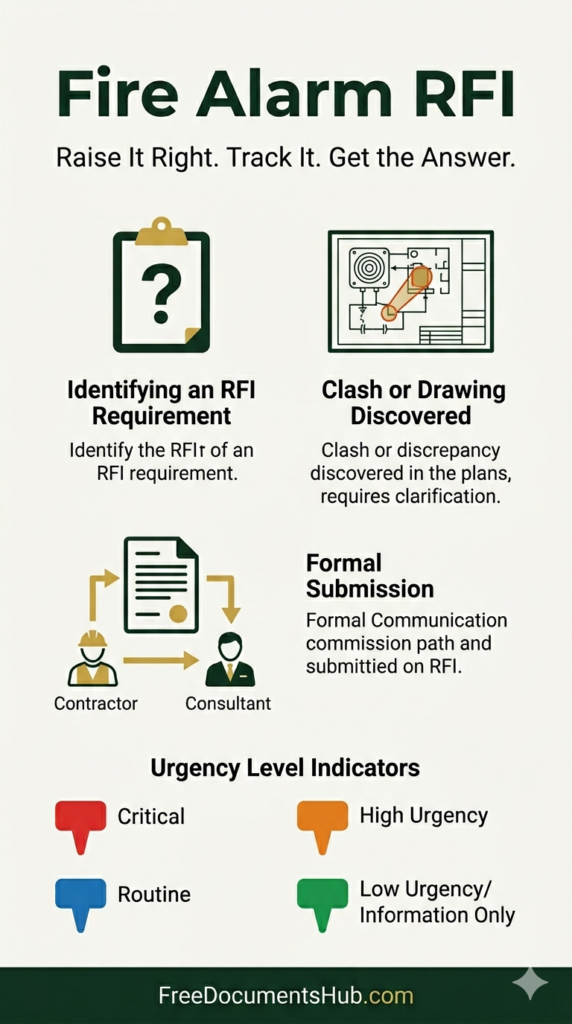
Fire Alarm RFI —
Request for Information:
The Complete Professional Guide
What an RFI is, when to raise one, the 5 categories, 4 urgency levels, the 7-step process, how it differs from an NCR and a snag — and what you risk by skipping it. Free Excel template included.
Table of Contents
- What Is a Fire Alarm RFI?
- RFI vs NCR vs Snag — Understanding the Difference
- When to Raise an RFI — and When Not To
- The 5 RFI Categories on Fire Alarm Projects
- The 4 Urgency Levels — and Why They Matter
- The 7-Step RFI Process
- How to Write an RFI That Gets a Fast Response
- Advantages of a Proper RFI System
- What Happens When RFIs Are Ignored
- Standards Alignment
- Free Download — Excel Template
- Conclusion
What Is a Fire Alarm RFI?
A Request for Information (RFI) is a formal written document raised by a contractor, engineer, or installer to obtain a clarification, confirmation, or decision from the design consultant, client, or relevant authority — when the existing approved documents do not provide a clear, unambiguous answer to a question that must be resolved before work can proceed correctly.
On a fire alarm project, an RFI might be raised because the approved drawing shows detector spacing that cannot be achieved on an irregular ceiling without violating NFPA 72 Table 17.6.3.1.1. It might be raised because the specification calls for FR-LSOH cable but the routing passes through a cooking extraction duct where MICC may be required. It might be raised because the architectural drawing shows a manual call point at 1.6 metres above finished floor level while BS 5839 requires a maximum of 1.4 metres — and the two documents conflict directly.
In every one of these cases, the installer faces a choice: make a decision independently and proceed — or raise an RFI and get a formal, documented answer from the authorised party. The first approach is fast. The second is professional, defensible, and correct.
“An RFI is not a sign of weakness or incompetence. It is a sign of professionalism. It says: I will not guess on a life-safety system. I will get the right answer, in writing, from the right person.”
The RFI serves several functions simultaneously. It is a question that requires an answer. It is a formal notification that a clarification gap exists in the design or specification. It is a schedule protection mechanism — if the RFI is not answered on time, the responsibility for any resulting delay shifts from the contractor to the party that failed to respond. And it is a permanent project record that documents how every design ambiguity was resolved.
RFI vs NCR vs Snag — Understanding the Difference
Three documents are commonly confused on fire alarm projects — the RFI, the NCR, and the snag list item. Understanding the difference between them is essential for using each one correctly and at the right time.
RFI — Request for Information
Raised before work is done, when a question needs to be answered before proceeding correctly. The issue is a gap or ambiguity in the design or specification — not a defect in the installation. The contractor is asking for guidance.
NCR — Non-Conformance Report
Raised after work is done, when the completed installation does not conform to the approved drawing, specification, or standard. The issue is a defect in what was built — not a gap in the design. The contractor is being notified of a failure.
Snag List Item
An informal record of minor outstanding items at the end of a project — typically used during final inspection. Unlike an NCR, it has no formal root cause analysis or corrective action plan requirement. It is a practical completion punch list, not a quality management document.
The practical implication of this distinction is important. An RFI raised before work begins prevents an NCR after work is done. If the contractor installs the MCP at 1.6 metres because the architectural drawing showed 1.6 metres — without raising an RFI to resolve the conflict with BS 5839’s 1.4 metre maximum — the result is an NCR for incorrect mounting height. The NCR could have been prevented entirely by an RFI raised at the right moment.
This is why experienced project managers track both documents together. A project with many NCRs and few RFIs is a project where the team is installing first and asking questions later. A project with well-timed RFIs has fewer NCRs — because design ambiguities are resolved before they become installation defects.
When to Raise an RFI — and When Not To
The RFI is a powerful tool when used correctly and a project management burden when overused. Understanding when to raise one — and when the answer already exists in the documents — is a professional skill that separates experienced engineers from inexperienced ones.
Raise an RFI When:
- Two approved documents conflict — the drawing shows one thing, the specification shows another, and proceeding requires a decision about which governs
- A site condition was not anticipated in the design — a structural beam blocks the cable route, an equipment item is not where the drawing shows it, or a ceiling height differs from the design assumption
- The specification is ambiguous — a clause can be interpreted in more than one way and the wrong interpretation would result in a non-compliant installation
- A material substitution is required — the specified item is unavailable, discontinued, or unsuitable for the actual site conditions
- A quantity discrepancy exists between documents — the drawing shows 14 detectors but the BOQ shows 16 and procurement must begin
- A standard requirement conflicts with a drawing — the applicable standard is more restrictive than what the design assumed
Do Not Raise an RFI When:
- The answer is clearly stated in the approved drawings, specification, or applicable standard — raising unnecessary RFIs wastes everyone’s time and reduces the credibility of genuine RFIs
- The question is about general industry practice rather than a project-specific requirement — consult the standard directly
- The issue is a defect in completed work — raise an NCR, not an RFI
- The clarification is needed for information only and does not affect any current or near-term work activity
The Golden Rule of RFI Management
Always check the documents thoroughly before raising an RFI. A good rule of thumb used by experienced project engineers:
- Check the drawing — is the answer there?
- Check the specification — is the answer there?
- Check the applicable standard (NFPA 72, BS 5839, SAES-B-067) — is the answer there?
- If the answer is genuinely not in any of these — raise the RFI
- If the documents conflict — raise the RFI
- If the answer exists but proceeding on that basis carries risk — raise the RFI
The 5 RFI Categories on Fire Alarm Projects
Every RFI raised on a fire alarm project falls into one of five defined categories. The category identifies the nature of the question and determines which party is best placed to answer it. Correct categorisation also helps project managers identify patterns — repeated RFIs in the same category signal a systemic gap in the design or specification that needs to be addressed at a document level, not just answered case by case.
| Category | When to Use | Common Fire Alarm Examples | Typically Directed To |
|---|---|---|---|
| Design | The approved design drawing or specification is unclear, incomplete, or does not cover a specific site condition encountered during installation | Detector spacing on irregular ceiling / Zone boundary definition / Detection type selection for specific hazard / Sounder placement in acoustically complex space | Design Consultant / Fire Safety Engineer |
| Installation | The installation method is unclear or site conditions differ from what the drawing assumed — cable routing, panel location, or mounting arrangement | Cable routing conflict with structural element / Panel location obstruction / Conduit specification in hazardous area / Detector mounting on sloped ceiling | Design Consultant / Client PM |
| Material | A specified material is unavailable, requires substitution, or its specification requires clarification for the actual site conditions | FR-LSOH vs MICC cable in duct / Detector model substitution due to supply chain / FACP battery Ah rating confirmation / Cable size upgrade for long runs | Design Consultant / Saudi Aramco Proponent / Manufacturer |
| Commissioning | A commissioning test requirement is unclear or test results raise a question that requires engineering judgement before the system can be accepted | Audibility test method in high-noise industrial area / Battery backup calculation for non-standard FACP / Cause and effect matrix interpretation / Detector response time acceptance criteria | Design Consultant / FACP Manufacturer / Fire Safety Consultant |
| Documentation | A conflict, missing document, or revision discrepancy in the project documents requires formal resolution before proceeding | Drawing revision conflict — two versions in circulation / BOQ vs drawing quantity discrepancy / ITP hold point authority ambiguity / Specification clause superseded by addendum | Design Consultant / Document Controller / Client PM |
The 4 Urgency Levels — and Why They Matter
Not all RFIs have the same time pressure. The urgency classification system ensures that the responding party understands the schedule impact of a delayed response — and that the contractor has a documented basis for claiming delay costs if the response does not arrive on time.
🔴 URGENT
Work stoppage imminent. Cannot proceed without this answer. Procurement or installation is blocked right now.
⏱ Response: 24–48 hours
🟡 HIGH
Near-term activity starting within 3–5 days is affected. Procurement decision or drawing revision needed.
⏱ Response: 3 working days
🔵 MEDIUM
Needed before next phase begins but does not stop current work. Plan ahead to avoid disruption.
⏱ Response: 5 working days
🟢 LOW
Clarification needed but no current or near-term activity is affected. Work can continue on other items.
⏱ Response: 10 working days
The urgency level must reflect reality — not the contractor’s desire for a fast response on every question. Marking every RFI as URGENT destroys the system’s credibility. Consultants and clients who receive a stream of URGENT RFIs for questions that are clearly not urgent begin to ignore the urgency classification entirely — which means the genuinely urgent ones are not treated with the priority they deserve.
The discipline of assigning the correct urgency level is as important as the discipline of raising the RFI in the first place. An URGENT classification should be reserved for situations where the work genuinely stops without the answer. A HIGH classification covers procurement and schedule-critical items. MEDIUM and LOW cover the planning and clarification questions that need resolution before the next phase but do not stop current activities.
When a consultant fails to respond within the defined urgency timeframe — and the contractor has documented evidence of the RFI submission and the required response date — the contractor has a formal basis for claiming extension of time and associated costs for any resulting delay. This is one of the most commercially valuable functions of the RFI system that many contractors overlook entirely.
The 7-Step RFI Process
A properly managed RFI follows a defined process from the moment the question is identified to the moment the answer is formally accepted and the RFI is closed. Every step is documented. Every decision is recorded. The result is a permanent project record that shows exactly how every design ambiguity was resolved — and by whom.
Clarification Need Identified
⏱ Immediately on identificationDuring design review, material procurement, or site installation — the engineer identifies a question that cannot be answered from existing approved documents without risk of error or rework. The identification should happen as early as possible — preferably during design review before mobilisation, not on the day the work was planned to begin.
Check Existing Documents First
⏱ Before raising — same dayBefore raising an RFI, the engineer confirms the answer is not already available in the approved drawing set, project specification, or applicable standard. Unnecessary RFIs create noise in the project communication system, consume the consultant’s review time, and reduce the credibility of genuine RFIs. A two-minute document check before raising saves hours of unnecessary correspondence.
RFI Form Completed and Numbered
⏱ Same day as identificationThe engineer completes the RFI Individual Form with a precise, unambiguous statement of the question. The form references the specific drawing number and revision, the document clause, and the applicable standard requirement. A unique RFI number is assigned from the RFI Register. The urgency level is assigned based on the genuine schedule impact. A proposed solution — the contractor’s recommended interpretation — is included where available, to expedite the response.
RFI Registered and Formally Issued
⏱ Within 24 hours of raisingThe RFI is entered in the RFI Register with status OPEN and issued formally to the responsible party by email with the completed form attached. The date of formal issue is recorded — this is the date from which the response clock runs. The directing party receives formal notification of the required response date. On Aconex-managed projects, the RFI is issued through the document management system to create an auditable transmission record.
Response Received and Reviewed
⏱ Per urgency response timeThe directing party provides a formal written response. The contractor reviews the response for completeness and technical accuracy. If the response fully answers the question — it is accepted and the RFI proceeds to closure. If the response is partial, ambiguous, or contradicts other approved documents — the RFI remains OPEN, the contractor documents the inadequacy, and the RFI is reissued with a request for a complete response. A partial response that is accepted without challenge creates the same problem the original RFI was raised to resolve.
Work Proceeds — Drawing Updated if Required
⏱ Immediately after acceptanceOnce the RFI response is accepted, work proceeds based on the confirmed answer. If the response requires a revision to the approved drawings — for example, a detector is relocated or a cable route is changed — the consultant issues a revised drawing referencing the RFI number as the basis for the revision. The RFI number is noted in the drawing revision cloud. All affected procurement, installation, and testing activities are updated to reflect the accepted response.
RFI Formally Closed
⏱ Upon confirmed implementationOnce the response has been received, accepted, and the relevant work has been completed based on the confirmed answer — the RFI Register is updated: status changes from OPEN to CLOSED, the response date and days open are recorded, and the answering party is identified. The closed RFI remains in the register as a permanent project record. At project close-out, the complete RFI register is submitted as part of the handover documentation package.
How to Write an RFI That Gets a Fast Response
The quality of the RFI directly affects the speed and completeness of the response. A poorly written RFI — vague question, no document references, no proposed solution — forces the consultant to spend time understanding what is being asked before they can begin to answer it. This adds days to the response time. A well-written RFI gives the consultant everything they need to provide a complete answer in a single review cycle.
Five Elements of an Effective RFI:
- A precise, single question. One RFI, one question. Do not bundle multiple unrelated questions into a single RFI — it makes tracking, responding, and closing far more difficult. If there are three questions, raise three RFIs.
- Specific document references. Every RFI must reference the exact drawing number, revision, sheet, and zone — and the specific specification clause or standard reference that is unclear or conflicting. “The drawing” is not a reference. “Fire Alarm Layout Drawing FA-101 Rev A, Sheet 3, Zone 02” is a reference.
- A clear statement of the conflict or ambiguity. Explain exactly what the conflict is: “Drawing FA-101 Rev A shows MCP-03 at 1.6m AFF. BS 5839-1 Clause 26.2 requires maximum 1.4m AFF. These two requirements conflict. Clarification required on which governs.”
- The impact of not receiving a response by the required date. State concisely what work is blocked and what the schedule consequence is. This gives the responding party context for the urgency and provides the contractor’s documentary basis for delay claims if needed.
- A proposed solution. Where the contractor has a clear preferred interpretation — state it. “Contractor proposes to install MCP-03 at 1.4m AFF per BS 5839-1 requirement, subject to consultant confirmation.” This gives the consultant a specific answer to confirm or reject, rather than requiring them to generate an answer from scratch. Proposed solutions dramatically reduce response times.
Advantages of a Proper RFI System
✓ With a Proper RFI System
- Design ambiguities resolved before installation — not after
- Fewer NCRs — questions answered before mistakes are made
- Formal basis for delay claims if responses are late
- Permanent record of every design decision
- Drawing revisions triggered and tracked
- Procurement decisions documented and defensible
- Client and consultant accountability — response times tracked
- Handover documentation is complete and traceable
✗ Without a Proper RFI System
- Engineers make independent decisions on ambiguous items
- NCRs raised for defects that RFIs would have prevented
- No basis for delay claims when design information is late
- No record of how design conflicts were resolved
- Procurement decisions made on unconfirmed assumptions
- Post-handover disputes with no documentary resolution history
- Rework cost borne by contractor for decisions made without authority
The RFI as a Schedule Protection Tool
One of the most underused functions of the RFI system is its role as a schedule protection mechanism. When a contractor raises an RFI and clearly states the required response date — and that date is not met — the contractor has a formally documented basis for claiming an extension of time for any resulting delay. This basis does not exist if the contractor simply made an assumption and proceeded without raising the question formally.
On large industrial projects in Saudi Arabia and the Gulf, extension of time claims supported by RFI records are routinely accepted by clients and arbitrators. The RFI register is presented as evidence that the contractor identified the information gap, raised the question formally, stated the required response date, and was forced to either wait or proceed at risk because the response was late. Without the RFI record, this claim cannot be made. With it, the claim is straightforward.
The RFI as a Design Improvement Tool
At the project level, analysing RFI patterns reveals systemic gaps in the design. If ten RFIs are raised about detector placement on irregular ceilings across different zones, this signals that the design drawings did not adequately address this situation — and the consultant needs to issue a general instruction covering all similar cases rather than answering each RFI individually. A project manager who monitors RFI categories and volumes can identify these patterns early and request proactive design clarifications that prevent the next batch of RFIs from being needed at all.
What Happens When RFIs Are Ignored
⚠ The Real Cost of Unmanaged RFIs
- Engineers make independent decisions on ambiguous items — some correct, some not
- Incorrect decisions result in NCRs — rework at contractor cost
- Material is procured on wrong specification — replacement cost and delay
- Installation is completed to wrong standard — full remediation required
- No delay claim basis — contractor absorbs cost of late design information
- Post-handover disputes impossible to resolve — no decision trail
- In the worst case — the system fails because a design conflict was resolved incorrectly
The Rework Cost of Skipping the RFI
Consider the example of the MCP mounting height conflict. The architectural drawing shows 1.6 metres. BS 5839 requires 1.4 metres maximum. The installer, faced with conflicting information and no RFI process, makes a pragmatic decision: install at 1.6 metres per the drawing. The system is installed across twelve zones with MCPs at 1.6 metres throughout. The consultant witnesses commissioning, identifies the non-compliance with BS 5839, and raises an NCR. All twelve MCPs must be lowered, their cable runs adjusted, the wall made good, and everything repainted. The cost of this rework — in labour, materials, and schedule — is many times the cost of the single RFI that would have resolved the conflict before a single MCP was installed.
This is the fundamental mathematics of the RFI system. The cost of raising an RFI is measured in minutes. The cost of not raising one is measured in days of rework and thousands of Riyals.
The Legal Exposure of Proceeding Without Clarity
On a fire alarm project — a life-safety system — proceeding on incorrect assumptions has consequences that extend beyond rework cost. If a system is installed based on an incorrect interpretation of a conflicting specification, and that interpretation results in a detection gap or a response delay during an actual fire event, the investigation will ask: why was the conflicting specification not formally raised and resolved before installation? If there is no RFI record — no evidence that the conflict was identified, documented, and referred to the appropriate authority for resolution — the contractor’s position in any subsequent inquiry is very difficult to defend.
Standards Alignment
NFPA 72 — National Fire Alarm and Signaling Code
NFPA 72 does not define a specific RFI format, but its requirements for documented design review, approved drawings, and formal resolution of field conditions create the environment in which the RFI system operates. When an NFPA 72-compliant installation requires a field decision that deviates from the approved design — for example, a detector relocation due to an obstructed ceiling — that decision must be documented and approved. The RFI is the mechanism through which this approval is obtained and recorded.
BS 5839 Part 1 — Code of Practice
BS 5839 Part 1 requires that the fire alarm system be installed in accordance with approved design drawings and specifications, and that any deviation from the approved design be formally authorised before implementation. The RFI is the formal authorisation mechanism — it raises the deviation, obtains the consultant’s response, and documents the approved resolution. Without this mechanism, any deviation from the approved design is an unauthorised change — which is itself a non-conformance.
SAES-B-067 — Saudi Aramco Fire Protection
On Saudi Aramco projects, the RFI process is a contractual requirement managed through the project’s document control system — typically Aconex or a similar platform. All RFIs must be formally transmitted through the approved system, and responses must come from the Saudi Aramco Proponent Engineer or their designated representative. Verbal responses and email clarifications that are not formally issued through the document control system do not constitute approved answers for the purpose of Aramco project compliance. This makes the formal RFI process not just good practice but a contractual obligation on every Aramco project.
📥 Free Download — Fire Alarm RFI Excel Template
5-sheet professional Excel template: Cover Page, RFI Register with 8 sample entries and auto-count formulas, Individual RFI Form (7 sections), Categories and Urgency Guide, and 7-Step RFI Process Flow. NFPA 72 / BS 5839 / SAES-B-067 aligned.
Conclusion
The Request for Information is one of the most valuable — and most underused — tools in the fire alarm project communication toolkit. It costs almost nothing to raise. It takes minutes to complete correctly. And it consistently prevents the most expensive, disruptive, and avoidable problems that fire alarm projects encounter: the rework that results from incorrect assumptions, the delay claims that cannot be made because questions were never formally asked, and the post-handover disputes that cannot be resolved because design decisions were never documented.
Every ambiguity in a fire alarm project design is a risk. The RFI is the mechanism that converts that risk into a documented, answered, and resolved decision — before work proceeds, before material is procured, and before a defect is created that could have been prevented entirely.
The five categories, four urgency levels, and seven-step process described in this guide are not bureaucratic overhead. They are the framework that turns a question into a permanent project record — one that protects the contractor, the client, the consultant, and ultimately the people who will rely on the fire alarm system to work correctly when it matters most.
Download the free Excel template, implement it from the first day of design review on your next fire alarm project, and raise every RFI at the right time — before the work, not after the mistake.
More Free Industrial Documents
Method statements, commissioning reports, NCR templates, RFI registers, ITP checklists — all free, all available immediately.
Download Free RFI Template www.freedocumentshub.com