
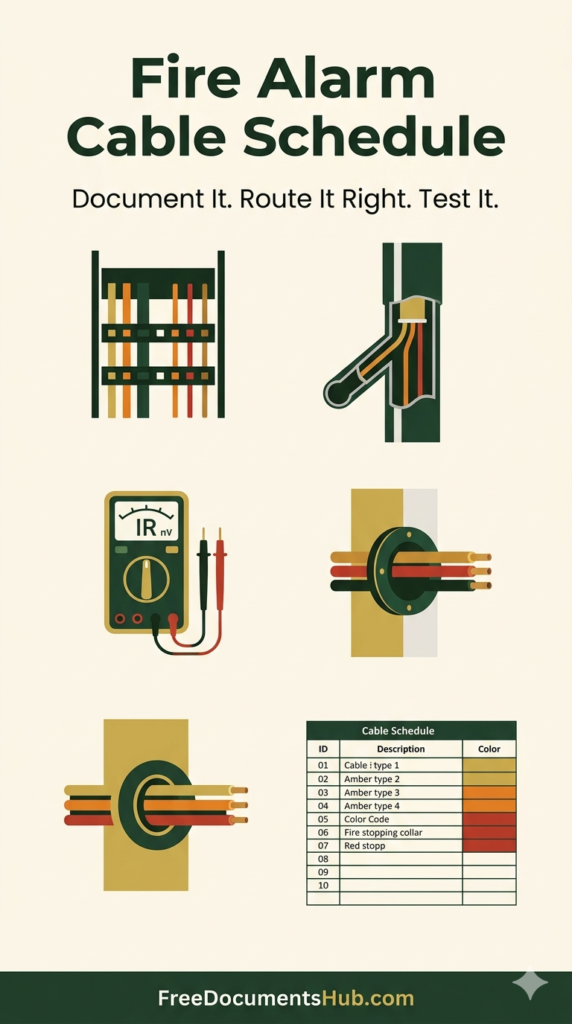
Fire Alarm Cable Schedule
and Routing:
The Complete Professional Guide
Cable types, selection criteria, routing rules, separation requirements, IR testing, fire stopping, and full standards alignment — everything you need to document and execute a compliant fire alarm cable installation. Free Excel template included.
Table of Contents
- What Is a Fire Alarm Cable Schedule?
- Cable Types — Selection and Standards
- Cable Sizing — Getting It Right
- Cable Routing — Rules and Requirements
- Separation from Power Cables
- Fire Stopping at Penetrations
- IR Testing and Continuity — The Proof of Quality
- Cable Labelling Requirements
- Structure of the Excel Template
- Advantages of a Complete Cable Schedule
- What Happens Without One
- Standards Alignment
- Free Download — Excel Template
- Conclusion
What Is a Fire Alarm Cable Schedule?
A Fire Alarm Cable Schedule is a structured technical document that provides a complete, referenced record of every cable installed in a fire alarm system — its identification number, the zone or loop it serves, its start and end points, its cable type and specification, the route it follows, its measured length, and the results of all electrical tests carried out on it before and after installation.
It is not a drawing. It is a document that works alongside the fire alarm layout drawings to provide the detailed cable-level data that the drawings cannot practically show. Where the drawing shows the position of a detector and the general cable route, the cable schedule shows the specific cable reference, the exact cable specification used, the conduit reference it runs through, the measured length, the insulation resistance test result, and whether the cable passed or failed its acceptance tests.
Together, the fire alarm layout drawing and the cable schedule provide the complete technical picture of the installation. Either document without the other is incomplete. A fire alarm system handed over with drawings but no cable schedule is a system whose installation quality cannot be independently verified — and cannot be maintained correctly for the life of the building.
“The cable is the nervous system of the fire alarm installation. The cable schedule is the document that proves that nervous system was installed correctly — and gives every future engineer the information they need to maintain it.”
The cable schedule serves multiple audiences simultaneously. For the installation team, it is the reference document that defines which cable goes where and to what specification. For the commissioning engineer, it is the checklist that drives the pre-commissioning electrical testing programme. For the client and consultant, it is the quality record that demonstrates every cable was tested and verified before the system was energised. For the maintenance team, it is the baseline reference that makes fault diagnosis faster and more accurate for the life of the system.
Cable Types — Selection and Standards
The selection of the correct cable type for a fire alarm system is not a matter of preference or cost optimisation. It is a technical and regulatory requirement. Fire alarm cables must maintain circuit integrity during a fire event — meaning the cable must continue to carry the signal or power that activates the alarm even while the surrounding building is burning. Different cable types achieve this to different degrees, and different applications require different levels of fire performance.
FR-LSOH
Fire Resistant — Low Smoke Zero Halogen. The standard specification for general fire alarm signal and sounder circuits in commercial and industrial buildings. Provides minimum 30-minute circuit integrity under fire conditions. Low smoke output and zero halogen content make it mandatory in occupied buildings and public spaces where smoke toxicity is a concern during evacuation.
IEC 60331-25 · BS 6387 CWZ · NFPA 72 Cl.12.2
MICC
Mineral Insulated Copper Clad. The highest-performing fire alarm cable available. Provides 120-minute circuit integrity minimum. Required where cable routes pass through high-temperature areas — kitchen extraction ducts, boiler rooms, plant rooms, and hazardous areas. The copper sheath also provides inherent EMI shielding. More expensive than FR-LSOH but provides unmatched fire performance.
IEC 60702-1 · BS 6387 CWZ · SAES-B-067
FR-XLPE
Fire Resistant Cross-Linked Polyethylene. Used for power supply cables and mains input to the FACP where enhanced fire resistance is specified. Higher temperature rating than standard PVC — suitable for most commercial and industrial mains supply applications. Provides the fire resistance needed for the supply circuit that keeps the panel operational during a fire.
IEC 60331-1 · IEC 60332-3 · NFPA 72 Cl.12
Standard PVC — NEVER USE
Standard PVC cables must never be used for any fire alarm circuit. PVC insulation melts at relatively low temperatures and provides no fire resistance. When exposed to fire, PVC cables fail rapidly — cutting off the very signals the fire alarm system needs to operate during an emergency. If PVC cables are found in a fire alarm installation, raise an NCR immediately.
NOT COMPLIANT — NFPA 72 · BS 5839 · SAES-B-067
Why Cable Type Matters During a Fire
The fundamental requirement for fire alarm cables is circuit integrity — the ability to continue carrying an electrical signal while surrounded by fire. NFPA 72 and BS 5839 both require that fire alarm circuit wiring maintains its function for a defined period during a fire event. This is not just a code compliance requirement. It is the physical mechanism that keeps the alarm system operational while the building burns — allowing detection signals to reach the panel, allowing the panel to drive the sounders, and allowing people to evacuate.
A fire alarm system installed with non-fire-resistant cable may function perfectly during normal operation and during testing. But when an actual fire occurs and the cable is exposed to high temperatures, the circuit fails — exactly when it is needed most. The cable type selection decision, made during procurement and documented in the cable schedule, is one of the most consequential quality decisions in a fire alarm installation.
Cable Sizing — Getting It Right
Cable sizing for fire alarm systems is determined by three factors: the loop resistance requirement defined by the FACP manufacturer, the voltage drop that occurs over the cable length, and the current-carrying capacity required for the circuit. For most standard fire alarm signal circuits, the dominant factor is loop resistance — the total resistance of the cable loop from the panel to the last device and back.
Standard Size Selection
- Detection loops — conventional systems: 2-core 1.0mm² is the minimum; 2-core 1.5mm² is strongly recommended for all runs over 50 metres and for any installation where long-term reliability is the priority
- Detection loops — addressable systems: 2-core 1.5mm² as standard; always check the FACP manufacturer’s data sheet for maximum loop resistance and capacitance limits
- Sounder and VAD circuits: 2-core 1.5mm² as standard; calculate voltage drop for runs over 50 metres to confirm the sounder receives adequate voltage at the end of the circuit
- Mains supply to FACP (230VAC): 3-core 2.5mm² as standard; this must be a dedicated circuit from the distribution board
- Long cable runs over 100 metres: Upsize to 2-core 2.5mm² and always calculate voltage drop — do not assume standard sizing is adequate
The Voltage Drop Calculation — When It Matters
For sounder circuits and long detection loops, voltage drop must be calculated before specifying cable size. The formula is simple:
- Voltage drop (V) = Current (A) × Resistance per metre (Ω/m) × Length (m) × 2
- The multiplier of 2 accounts for the outward and return conductors
- For FR-LSOH 1.5mm² copper cable: resistance is approximately 12.1 Ω/km (0.0121 Ω/m)
- If the calculated voltage drop exceeds 10% of the supply voltage, upsize the cable
- For a sounder at the end of a 80m run drawing 100mA: Drop = 0.1A × 0.0121 × 80 × 2 = 0.19V — acceptable on a 24VDC circuit
- Always document this calculation in the cable schedule remarks column
Cable Routing — Rules and Requirements
Cable routing defines the physical path that every cable takes from its source to its destination. The routing decisions made during installation have permanent consequences — for system performance, for maintenance accessibility, and for the fire resistance of the circuits. Every routing decision must be based on the approved drawings and must comply with the requirements of the applicable standard.
General Routing Principles
- Follow the approved drawing. Cable routes must follow the approved fire alarm layout drawing. Any deviation — because of a structural obstruction, a clash with another service, or a site condition not shown on the drawing — must be formally documented. Either raise an RFI before deviating, or update the as-built drawing after. A cable that follows a different route from the drawing without documentation is a defect waiting to be discovered at the next inspection.
- Minimum bending radius. Fire alarm cables must not be bent tighter than six times the cable outer diameter at any point in the installation. Sharp bends damage the conductor insulation and can cause insulation resistance failures that appear intermittently — the most difficult type of fault to diagnose and locate.
- Cable support intervals. Cables must be supported at maximum 1.5 metre intervals on cable trays and at maximum 750mm intervals in vertical runs. Unsupported cables sag, create mechanical stress at termination points, and are vulnerable to physical damage.
- Avoid heat sources. Route cables away from hot pipes, heating equipment, and high-temperature plant. The ambient temperature along the cable route affects the cable’s current-carrying capacity and its long-term insulation integrity. Where routing near heat sources is unavoidable, use MICC cable.
- Use metallic conduit or tray. Fire alarm cables should be installed in metallic conduit or on metallic cable trays throughout — not in plastic conduit, not clipped directly to the ceiling structure without protection. Metallic containment provides mechanical protection, earthing continuity, and additional fire resistance for the cable run.
Routing Through High-Risk Areas
Certain areas require special routing treatment. Kitchen areas — where cooking equipment produces high ambient temperatures — require MICC cable rather than FR-LSOH. Cable routes through fire-rated walls or floor slabs must be fire-stopped after installation. Cable routes through plant rooms, boiler rooms, or electrical switchrooms must be assessed for temperature and EMI exposure and the appropriate cable type selected accordingly.
On Saudi Aramco projects governed by SAES-B-067, cable routing in classified hazardous areas requires explosion-proof conduit systems with appropriate sealing fittings. The cable schedule must record the conduit material, rating, and sealing arrangement for every cable run through a classified area.
Separation from Power Cables
One of the most consistently violated requirements in fire alarm cable installation — and one of the most important — is the minimum separation distance between fire alarm signal cables and power distribution cables. This requirement exists for two reasons: electromagnetic interference (EMI) from power cables can induce false signals in fire alarm circuits, and proximity to power cables can expose fire alarm cables to fault currents that damage or destroy the alarm circuit.
| Condition | Minimum Separation | Standard Reference | Notes |
|---|---|---|---|
| General — FA cable parallel to LV power cable | 300mm (12 inches) throughout run | NFPA 72 Cl.12.3.1 / BS 5839-1 Cl.26 | Applies continuously — not just at crossing points |
| Crossing point — FA cable crossing power cable | Cross at 90° — perpendicular only | NFPA 72 Cl.12.3.1 | Minimises inductive coupling — document every crossing in routing record |
| Physical separation impossible | Metallic conduit for FA cable OR separate metallic trunking | NFPA 72 Cl.12.3.1 / BS 5839-1 | Metallic shielding provides equivalent protection to physical separation |
| MICC cable — separation requirement | 50mm minimum — inherently shielded | IEC 60702-1 | MICC copper sheath provides EMI shielding — reduced separation acceptable |
| HV cables above 1kV | Consult electrical engineer — additional shielding required | BS 5839-1 Cl.26 | Not common in standard buildings — specific assessment required |
The separation requirement must be verified at every point along the cable route — not just at the panel end or the device end. A cable that maintains 300mm separation for 95% of its run but crosses within 50mm of a power cable for 2 metres has a non-compliant installation. The cable schedule’s routing record section must document the separation check at every identified crossing or parallel run point, with the measured separation, the result, and the engineer’s sign-off.
⚠ The Most Common Separation Violation
The most frequently identified separation violation on fire alarm projects is at cable tray crossing points — where fire alarm cables on one tray run parallel to power cables on a tray directly above or below. In most buildings, cable trays are stacked vertically in ceiling voids with minimal spacing. A 300mm separation between trays carrying fire alarm and power cables is rarely achieved without specific routing design. This violation is visible, easily measured, and consistently noted by consultants during inspection. Document and verify every parallel run before commissioning.
Fire Stopping at Penetrations
Every point at which a fire alarm cable passes through a fire-rated wall, floor slab, or ceiling must be fire-stopped. This is not optional and it is not a detail that can be addressed after commissioning. Fire stopping at cable penetrations is a fundamental requirement of the building’s passive fire protection strategy — and a fire alarm cable that passes through an unsealed penetration in a fire-rated wall has created a pathway through which fire, smoke, and toxic gases can travel from one fire compartment to another, potentially faster than the fire alarm system can warn people to evacuate.
The cable schedule’s fire stopping record must document every penetration — its location referenced to the approved drawing, the cables passing through it, the size of the penetration, the fire stopping material used, the name of the person who applied it, the date, and the inspection result. This record is part of the handover documentation package and is inspected by the Civil Defence authority during the fire safety certificate process.
Approved Fire Stopping Materials
- Intumescent sealant — the most common fire stopping material for small penetrations up to 100×100mm. Applied using a sealant gun, it expands when exposed to heat to seal the annular space around the cable. Products from Hilti, STI, and 3M are widely used and hold appropriate fire resistance certifications.
- Intumescent collars — used for larger penetrations and for penetrations through floor slabs. The collar is fitted around the cable or conduit on both sides of the penetration and expands under heat to seal the opening. Required where the penetration size exceeds 50mm diameter for a single cable or conduit.
- Fire stopping pillows — used for large openings containing multiple cables. Compressed mineral wool pillows fill the void around the cables and provide both fire and smoke stopping. Must be installed to the manufacturer’s specification with the correct number of pillows per unit area.
- Mortared seals — used in structural penetrations where the architect specifies a rigid seal. The annular space is filled with fire-rated mortar after cables are installed.
All fire stopping materials must be certified to the fire resistance rating of the wall or floor they protect. A fire stopping material rated at 60 minutes must not be used in a penetration through a 90-minute fire-rated wall. The cable schedule’s fire stopping record must note the product used, its fire resistance rating, and the certification reference.
IR Testing and Continuity — The Proof of Quality
The insulation resistance (IR) test and the continuity test are the two electrical tests that verify the physical quality of every cable installation. They must be carried out on every cable — before termination and again after termination — and every test result must be recorded in the cable schedule. These tests are not optional pre-commissioning rituals. They are the documented proof that the cable installation is electrically sound.
Insulation Resistance Test
The IR test measures the resistance between the cable conductors and between each conductor and earth, using a high-voltage DC test source (typically 250VDC for 24VDC signal cables and 500VDC for 230VAC supply cables). A high insulation resistance confirms that the cable insulation is intact — there are no breaks, abrasions, or contamination points that would allow current to leak from the conductor to earth or between conductors.
Acceptance criterion: minimum 1 MΩ for all fire alarm cables. In practice, a new, correctly installed cable will typically measure hundreds or thousands of MΩ on a short run and above 100 MΩ on longer runs. A result below 1 MΩ indicates an insulation fault that must be located and rectified before the cable is commissioned. The cable schedule records the actual measured value — not just PASS or FAIL — because this baseline value is essential for future maintenance comparison.
Continuity Test
The continuity test measures the end-to-end resistance of each conductor in the cable, confirming that the conductor is intact with no breaks or high-resistance connections. For fire alarm signal cables, the total loop resistance — the combined resistance of the outward and return conductors — must not exceed the FACP manufacturer’s specified maximum for the loop or zone length. Typical acceptance criterion is 40 Ω per kilometre, or approximately 0.04 Ω per metre of conductor length.
The continuity test also verifies that terminations have been made correctly — a high-resistance reading at one end of a cable usually indicates a poor termination at a terminal block or junction box rather than a fault in the cable itself. Every continuity result is recorded in the cable schedule against the cable reference number.
When to Test
- Before termination: IR test each cable before connecting to devices or panels. This tests the cable in isolation — if the result fails, the fault is in the cable, not the termination or connected device.
- After termination: IR test again after all terminations are made. If the result is significantly lower than the pre-termination test, the fault is in the termination or in the connected device.
- Before commissioning: Final IR and continuity test across the complete installed circuit — panel to all devices and back — as part of the pre-commissioning checklist. This is the result recorded as the commissioning baseline.
Cable Labelling Requirements
Every cable in a fire alarm system must be labelled — at both ends and at every intermediate junction box, pull box, or cable tray crossing point. Cable labelling is not an aesthetic requirement. It is a functional one. An unlabelled cable in a ceiling void is indistinguishable from every other cable in that void. When a fault develops three years after installation, the maintenance engineer trying to identify which cable serves the affected detector has no means of doing so without following the cable physically — which may require dismantling ceiling tiles, scaffolding, and significant time.
The cable label must show the cable reference number as listed in the cable schedule — for example, CA-009 — which allows immediate cross-reference to the schedule’s zone, route, specification, and test results. The label must be durable — printed on a heat-shrink sleeve, a metallic tag, or a self-laminating wrap — and must remain legible for the life of the installation. Handwritten adhesive labels are not acceptable. They become illegible within months in the temperature and humidity conditions of a typical ceiling void.
The cable schedule must record that cable labelling has been completed — and the commissioning engineer must verify labels at both ends of each cable during pre-commissioning inspection. A cable with a missing or incorrect label is a documentation non-conformance that must be corrected before sign-off.
Structure of the Excel Template
| Sheet | Title | Content |
|---|---|---|
| Sheet 1 | Cover Page | FDH branded document identification — document number, revision, NFPA 72 / BS 5839 / IEC 60331 / SAES-B-067 reference, status |
| Sheet 2 | Cable Schedule | 18 sample cable entries across 4 zones plus sounder loop and mains supply — cable reference, zone, from/to, cable specification, route reference, measured length, core count, size, IR result, continuity result, PASS/FAIL — auto summary formulas for total cables, pass count, fail count, total passed metres |
| Sheet 3 | Cable Routing Record | Three sections: conduit and cable tray register with fire rating and cables carried; cable separation compliance check at each crossing point; fire stopping record for all wall and floor penetrations |
| Sheet 4 | IR Test & Continuity Log | Acceptance criteria reference box; full IR and continuity test log with test voltage, measured values, test date, instrument reference, tester name, and PASS/FAIL result — auto summary |
| Sheet 5 | Cable Standards Reference | Cable type selection guide (FR-LSOH, MICC, FR-XLPE, PVC NOT permitted); cable size selection guide with loop resistance criteria; minimum separation requirements table with standard references |
Advantages of a Complete Cable Schedule
✓ With a Complete Cable Schedule
- Every cable is traceable by reference number
- IR test baseline established for life of system
- Fire stopping record available for Civil Defence
- Separation compliance documented and defensible
- Fault diagnosis faster and more accurate
- Maintenance costs lower — less time tracing cables
- Handover documentation complete and professional
- Legal protection — installation quality documented
- As-built accuracy confirmed by test results
✗ Without a Complete Cable Schedule
- Cables untraceable — no reference system
- No IR baseline — degradation undetectable
- Fire stopping record absent — Civil Defence risk
- Separation violations undetected and undocumented
- Fault diagnosis slow and expensive
- Maintenance costs high — extensive physical tracing
- Handover documentation incomplete
- No legal protection for post-handover faults
- System quality unverifiable by third party
The Maintenance Value of IR Test Baselines
One of the most practically valuable functions of the cable schedule is the IR test baseline it establishes at commissioning. A new FR-LSOH cable on a typical 30-metre run will measure above 500 MΩ on its first IR test. If the annual maintenance test three years later shows the same cable measuring 15 MΩ — still above the 1 MΩ pass threshold — the maintenance engineer sees a significant degradation trend. The cable is not yet failing. But it is moving toward failure. With the baseline from the cable schedule, this trend is visible and the cable can be investigated and replaced proactively — before it fails during an alarm condition.
Without the baseline, the maintenance engineer sees 15 MΩ and records PASS. The trend is invisible. The cable continues to degrade until it fails at the worst possible time.
What Happens Without a Cable Schedule
⚠ The Real Consequences
- Fault diagnosis becomes a physical search — hours or days of ceiling tile removal
- Wrong cables identified during maintenance — risk of accidental disconnection
- IR degradation goes undetected — cables fail during emergencies
- Fire stopping gaps unrecorded — building compartmentation compromised
- Civil Defence inspection failure — fire safety certificate withheld
- Handover documentation rejected — practical completion blocked
- No legal defence for post-handover cable faults
- Non-compliant cable types impossible to identify without physical inspection
The Cost of an Unlabelled, Unscheduled Cable Installation
Consider a fire alarm system installed without a cable schedule in a medium-sized commercial building — 150 detectors, 8 zones, approximately 80 cables. Three years after installation, Zone 04 shows a persistent fault — intermittent loss of communication with three detectors. The maintenance engineer needs to identify which cables serve those detectors, trace the fault, and replace the affected cable.
With a cable schedule: the engineer looks up the three detector addresses, identifies cables CA-031, CA-032, and CA-033, sees they all run through route CT-04, goes directly to that conduit run, tests each cable, finds the fault in CA-032 at junction box JB-04-B, and replaces the cable. Total time: four hours.
Without a cable schedule: the engineer opens ceiling tiles at each detector, physically traces the cables backward toward the panel, trying to identify which of the dozens of cables in each void is the correct one. Three days later, having traced the route through four ceiling voids and two junction boxes, the fault is found. Total time: three days.
The cable schedule paid for the time to prepare it many times over in the first maintenance call.
Standards Alignment
NFPA 72 — National Fire Alarm and Signaling Code
NFPA 72 Chapter 12 addresses wiring methods and equipment for fire alarm systems. It requires that all wiring be installed in a neat and workmanlike manner and comply with applicable installation requirements. Specific requirements include: fire alarm cables must be supported independently of the building’s structural system; conductors must be protected from physical damage; and cables in the same raceway must be fire alarm system conductors only — no mixing with general wiring. The 300mm separation requirement from power conductors is specifically addressed in Clause 12.3.1.
BS 5839 Part 1 — Code of Practice
BS 5839 Part 1 Section 26 addresses the installation of fire alarm cables in detail. It requires fire-resistant cables throughout, specifies that cable routes should be as short as practical and not pass unnecessarily through fire-risk areas, defines the 300mm minimum separation from power cables, and requires that all cable penetrations through fire compartment boundaries be fire-stopped. The standard also requires that a record of all installed cables be kept — this record is the cable schedule.
IEC 60331 — Fire Resistant Cable Performance
IEC 60331 defines the test methods and performance requirements for cables intended to maintain circuit integrity under fire conditions. IEC 60331-25 covers cables with cross-sectional areas up to 300mm² tested at 750°C for 90 minutes. When specifying fire alarm cables, the product must hold a valid IEC 60331 certificate appropriate to the fire performance requirement. The cable schedule should record the IEC 60331 part and the fire resistance duration for every cable type specified.
SAES-B-067 — Saudi Aramco Fire Protection
SAES-B-067 governs fire protection systems on Saudi Aramco facilities and projects. For fire alarm cables on Aramco sites, the standard requires fire-resistant cable throughout, metallic conduit protection in process areas and hazardous locations, specific cable types in classified areas, and complete documentation of all cable installations including IR test records. The cable schedule submitted to Saudi Aramco must be comprehensive, signed by the contractor’s engineer, and cross-referenced to the approved fire alarm drawing set.
📥 Free Download — Fire Alarm Cable Schedule Excel Template
5-sheet professional Excel template: Cover Page, Cable Schedule with 18 sample entries and auto formulas, Cable Routing Record with separation compliance and fire stopping log, IR Test and Continuity Log, Cable Standards Reference guide. NFPA 72 / BS 5839 / IEC 60331 / SAES-B-067 aligned.
Conclusion
The fire alarm cable schedule is the foundational technical document of every fire alarm installation. It begins during design — as the cable selection and routing decisions are made — and it grows through installation, testing, and commissioning to become the complete, verified record of how the system’s nervous system was built. At handover, it is the document that proves the installation was done correctly. Throughout the building’s operational life, it is the reference that makes maintenance faster, fault diagnosis more accurate, and system reliability higher.
Getting the cable selection right — FR-LSOH for standard circuits, MICC for high-temperature routes, and never PVC — protects the system’s ability to function during the emergency it was built to manage. Getting the routing right — separation maintained, conduit protected, bending radii respected — ensures the cable reaches the end of its designed life without premature failure. Getting the testing right — IR tests recorded at baseline with actual values, continuity confirmed at every circuit — provides the maintenance baseline that makes the difference between a system that degrades silently and one that is maintained proactively.
Download the free Excel template, adapt it to your project, fill in every cable from day one of installation, and hand over a document that demonstrates your quality and technical capability — one cable reference at a time.
More Free Industrial Documents
Method statements, commissioning reports, NCR templates, RFI registers, ITP checklists, cable schedules — all free, all available immediately.
Download Free Cable Schedule Template www.freedocumentshub.com