
Addressable vs Conventional
Fire Alarm Systems:
The Complete Professional Guide
Architecture, detection precision, wiring, cost analysis, selection criteria, standards alignment, and the 10-year total cost of ownership comparison every engineer and project manager needs to understand.
Table of Contents
- The Two Systems — an Overview
- How a Conventional System Works
- How an Addressable System Works
- The 10 Most Important Differences
- The Cost Analysis — Initial vs Total Life Cost
- How to Select the Right System
- The Three Most Common Selection Mistakes
- Standards Alignment
- Structure of the Excel Template
- Free Download — Excel Template
- Conclusion
The Two Systems — an Overview
Every fire alarm system installed in a commercial or industrial building uses one of two fundamental detection architectures: conventional or addressable. These two architectures differ in how they identify the location of a fire, how they wire the detection devices, how they handle cable faults, and how they can be programmed to respond to an alarm condition. The choice between them is one of the most consequential technical decisions in a fire alarm project — and it is made before a single cable is pulled or a single device is ordered.
Understanding this choice — what each system can and cannot do, where each is appropriate, and what each costs not just at installation but over the full life of the building — is foundational knowledge for every fire alarm engineer, project manager, and facilities professional.
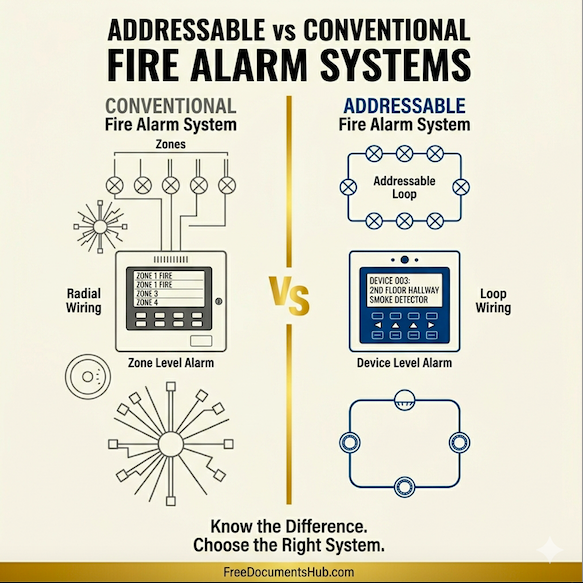
Zone-Based Detection
Divides the building into zones. When any device in a zone activates, the panel shows the zone — not the specific device. Simple, low cost, fast to install. Suitable for small buildings where zone-level identification is sufficient.
Typical use: Buildings under 500m², small shops, simple warehouses.
SAES-B-067: Not acceptable for Saudi Aramco facilities.
Device-Level Detection
Every device has a unique address. When any device activates, the panel shows the exact device — its address and its programmed location description. More complex, higher cost, more capable. Required for all but the simplest installations.
Typical use: All buildings over 500m², multi-floor, industrial, Aramco projects.
SAES-B-067: Minimum acceptable standard.
How a Conventional System Works
A conventional fire alarm system divides the protected building into detection zones — typically one zone per floor, one zone per area, or one zone per defined space. Each zone is served by a dedicated two-wire circuit that runs from the panel to the first device in the zone, continues through all subsequent devices, and terminates at an end-of-line resistor at the last device.
When any device on the zone circuit activates — a smoke detector triggers, a heat detector reaches its threshold, or a manual call point is operated — the device changes its electrical impedance. The panel detects this change and registers an alarm for that zone. The panel knows that Zone 03 has activated. It does not know which of the fifteen devices on Zone 03 caused the alarm. To find the specific device, someone must physically walk the zone and look for the activated detector’s LED indicator.
Wiring Architecture
Conventional zones use radial (star) wiring — each zone circuit runs outward from the panel and does not return. This creates a significant vulnerability: if the cable is broken at any point along the zone circuit, all devices beyond the break point are lost. The panel registers a zone fault, but cannot monitor the portion of the zone beyond the break. A single cable fault can silently disable a significant portion of a zone’s detection coverage.
The end-of-line resistor at the last device serves as the circuit supervision mechanism. Under normal conditions, the panel measures a specific resistance on the circuit. If this value changes significantly — cable break, corroded connection, missing resistor — the panel generates a fault. This supervision is continuous but provides only zone-level information.
The Fundamental Limitation
The conventional system’s fundamental limitation is its inability to identify individual devices. This limitation has three practical consequences that grow more significant as the building grows larger:
- Alarm investigation is slow. When Zone 03 alarms, someone must search the entire zone to find the activated device. In a zone covering one floor of a large building, this search can take fifteen to thirty minutes.
- Fault diagnosis is slow. When Zone 03 shows a fault, the engineer must physically check every device on the zone to find the faulty one. This takes time and disrupts building operations.
- Cause and effect programming is zone-wide only. The panel cannot activate a specific output — AHU shutdown, lift recall — in response to a specific device. It can only respond at zone level. For buildings with complex output requirements, this is a design limitation that cannot be engineered around.
How an Addressable System Works
An addressable fire alarm system replaces the zone circuit concept with a loop circuit. A single two-wire cable leaves the panel, passes through every device in sequence, and returns to the panel — forming a complete loop. Each device on the loop carries a unique address — a number from 001 to 250 or higher — programmed into the device using switches or a programming tool before or during installation.
The panel communicates with every device individually, polling each address in rapid sequence — a complete loop poll typically completes in under one second. Each device responds with its current status: normal, alarm, fault, or isolated. Because every device has a unique address and the panel knows each device’s status individually, the panel can display not just which zone but exactly which device — at which address, in which location — has activated or faulted.
“When a Zone 03 conventional alarm sounds, someone searches for fifteen minutes. When an addressable alarm sounds showing ‘L1-042 — Smoke Det — Server Room East’, the engineer goes directly to that device. The investigation takes sixty seconds.”
Loop Wiring and Fault Tolerance
The loop wiring of an addressable system provides a significant reliability advantage over conventional radial wiring. Because the cable forms a complete loop — leaving the panel at one terminal and returning at another — a single open-circuit fault anywhere on the loop does not disable all devices. The panel switches to a degraded mode, polling devices from both ends of the loop simultaneously. All devices except those immediately adjacent to the break remain operational.
With Class A (Style 6/7) wiring and isolator modules — placed between groups of devices at regular intervals — even a short-circuit fault is contained. The isolator nearest the fault activates automatically, disconnecting only the small section between two isolators while keeping the rest of the loop fully operational. This level of fault tolerance is architecturally impossible with conventional radial wiring.
Programming Intelligence
The addressable panel’s intelligence lies in its programmable cause and effect logic. Every device address can be assigned specific output actions — which sounders activate, which AHU shuts down, which lift is recalled, which suppression zone releases — in response to that specific device’s alarm. This device-level targeting of outputs is what makes addressable systems essential for complex buildings where different areas require different responses to different alarm conditions.
The 10 Most Important Differences
| Parameter | Conventional | Addressable |
|---|---|---|
| Alarm Identification | Zone level — 10 to 20 devices per zone | Exact device — address and location on display |
| Wiring Style | Radial — does not return to panel | Loop — returns to panel from both ends |
| Single Cable Fault | Disables all devices beyond fault point | Loop remains operational via both ends |
| Fault Identification | Zone level — manual search required | Exact device — address and fault type displayed |
| Cause and Effect | Zone-wide outputs only | Device-specific or zone-specific outputs |
| Device Intelligence | Passive — threshold switch only | Smart — microprocessor with communication |
| Installation Speed | Faster — simple radial wiring | Slower — loop planning and device addressing |
| Initial Cost | Lower — simpler hardware | Higher — intelligent devices and panel |
| Maintenance Cost | Higher — slow fault diagnosis | Lower — instant fault identification |
| SAES-B-067 Compliance | Not acceptable for Aramco | Minimum acceptable standard |
The Cost Analysis — Initial vs Total Life Cost
The most common argument for choosing a conventional system over an addressable system is cost. And in terms of initial installation cost, the argument is valid — a conventional system for a given number of devices is genuinely less expensive to install than an addressable system covering the same area. The mistake is treating initial cost as total cost.
Over the operational life of the building — which for a fire alarm system is typically fifteen to twenty-five years — the cost profile of the two systems reverses. The addressable system’s higher initial investment is recovered through lower maintenance costs, faster fault diagnosis, lower false alarm rates, and the avoidance of the increasingly expensive retrofits that conventional systems require as buildings grow and change.
Indicative Cost Comparison — 50 Device System
Conventional — Initial Cost
SAR 22,900Panel: SAR 3,500 · Devices (50×): SAR 7,500 · MCPs (8×): SAR 800 · Sounders (6×): SAR 600 · Cable: SAR 4,000 · Labour: SAR 5,000 · Commissioning: SAR 1,500
Addressable — Initial Cost
SAR 53,700Panel: SAR 12,000 · Devices (50×): SAR 20,000 · MCPs (8×): SAR 2,400 · Sounders (6×): SAR 1,800 · Cable: SAR 5,000 · Labour: SAR 8,000 · Commissioning: SAR 4,500
On initial cost alone, the conventional system appears to be the clear winner — SAR 30,800 cheaper for a 50-device installation. But this comparison ends on day one of a twenty-year operational life.
The 10-Year Total Cost Reversal
10-Year Total Cost of Ownership — 50 Device System
- Conventional — annual maintenance cost: SAR 15,000/year (zone searches, slow fault diagnosis, high false alarm attendance)
- Addressable — annual maintenance cost: SAR 6,300/year (instant fault ID, lower false alarm rate, efficient servicing)
- Conventional — 10-year maintenance total: SAR 150,000
- Addressable — 10-year maintenance total: SAR 63,000
- Conventional — 10-year total cost (install + maintenance): SAR 172,900
- Addressable — 10-year total cost (install + maintenance): SAR 116,700
- 10-year saving with addressable: SAR 56,200
The total cost analysis demonstrates a conclusion that experienced facilities managers and building owners have reached empirically: the addressable system is not just the better technical choice — for any building that will be operated and maintained professionally over its intended life, it is also the better financial choice.
The break-even point — the year at which the addressable system’s lower maintenance costs have offset its higher installation cost — typically occurs between years three and five depending on the building’s fault frequency and false alarm rate. After break-even, every subsequent year of operation represents a growing financial advantage for the addressable system.
How to Select the Right System
The selection between conventional and addressable is not primarily a financial decision — it is a technical and regulatory one. The correct answer is determined by the building’s characteristics, the applicable regulatory standard, and the operational requirements of the facility.
Use Conventional Only If ALL of These Are True
- Building area is under 500m² and single storey or maximum two floors
- Maximum 50 devices — zone-level identification is practically manageable
- No cause and effect outputs required — no HVAC, lifts, suppression, or BMS outputs
- Not a Saudi Aramco, SABIC, or major industrial project
- The fire authority has confirmed conventional is acceptable for this occupancy type
- Initial cost is genuinely the overriding constraint and the client has accepted the long-term maintenance implications
Use Addressable If ANY of These Are True
- Building area exceeds 500m² or the building has more than two floors
- More than 50 devices are required
- Exact device identification is required — by the building operator or the fire service
- Cause and effect outputs are required — HVAC, lifts, suppression, door holders, BMS
- The project is on a Saudi Aramco facility — SAES-B-067 mandates addressable as minimum
- The building is a hospital, hotel, school, data centre, or other high-risk or complex occupancy
- Long-term maintenance efficiency is a priority for the client
- BMS integration or remote monitoring at device level is required
⚠ The Non-Negotiable Rule for Saudi Aramco Projects
SAES-B-067 is explicit: addressable fire alarm systems are the minimum acceptable standard for all Saudi Aramco facilities. A contractor who specifies or installs a conventional fire alarm system on an Aramco project — regardless of the building size or the client’s budget pressure — has installed a non-compliant system. The project will not pass Saudi Aramco inspection and the system will not receive approval. The cost of replacing a conventional system with addressable after installation is far greater than the initial cost difference. Specify addressable from day one on every Aramco project.
The Three Most Common Selection Mistakes
Mistake 1 — Choosing Conventional for a Building That Is Too Large
The most frequent selection error is specifying a conventional system for a building that is slightly larger or more complex than the conventional architecture can practically serve. A three-storey office building with 120 devices across twelve zones — chosen because the contractor has more experience with conventional systems and the initial cost is lower — produces a system where a zone alarm requires a physical search of an entire floor, where fault diagnosis takes hours rather than minutes, and where the cause and effect requirements for HVAC shutdown and lift recall cannot be met.
The building is not well served by the conventional system. The building operator struggles with it from the first maintenance visit. And the eventual cost of upgrading to addressable — which becomes necessary within five to ten years in most cases — far exceeds the initial saving that motivated the original decision.
Mistake 2 — Specifying Conventional on an Aramco Project to Save Cost
On Saudi Aramco and other major industrial projects where budget pressure is real and the project timeline is tight, there is sometimes an attempt to specify a conventional system as a cost-saving measure. This approach fails without exception. SAES-B-067’s requirement for addressable systems is a technical standard, not a preference. Saudi Aramco inspectors are experienced and will identify a conventional system during inspection. The project does not progress until the system is upgraded. The cost saving becomes a cost overrun.
Mistake 3 — Treating Initial Cost as Total Cost
As demonstrated in the cost analysis above, comparing conventional and addressable systems on initial cost alone is a financial error. The decision-maker who approves a conventional system to save SAR 30,000 on a 50-device installation and then spends SAR 87,000 more on maintenance over the following ten years has not saved money. They have deferred cost — and paid more in total for a worse outcome. Total cost of ownership over the building’s operational life must be the basis of the financial comparison, not the installation invoice.
Standards Alignment
NFPA 72 — Wiring Styles and Circuit Integrity
NFPA 72 defines circuit wiring styles that apply to both conventional and addressable systems. Style B (Class B) — the conventional radial circuit — requires that a single open-circuit fault does not prevent alarm signals from being received from points on the circuit that are not affected by the fault, but does allow that points beyond the fault may be lost. Style 4 through Style 7 — applicable to addressable loop wiring — provide progressively higher levels of fault tolerance, with Style 7 surviving both open-circuit and short-circuit faults without losing any device functionality. The selection of wiring style is a fundamental design decision that must be stated explicitly in the fire alarm system specification.
BS 5839 Part 1 — System Categories
BS 5839 Part 1 defines fire alarm system categories from Category M (manual only) through Category L1 (full automatic life protection throughout). For Category L1 and L2 systems — which cover most commercial and industrial buildings — the standard effectively requires addressable technology for buildings of any significant size, because the detection coverage, zone identification, and maintenance requirements cannot practically be met with conventional zone-level systems. The standard does not explicitly prohibit conventional technology in all cases, but its requirements for large buildings make addressable the only practical choice.
EN 54 — European Product Standards
EN 54-2 defines the performance requirements for fire alarm control panels. EN 54-4 covers power supply equipment. EN 54-17 and EN 54-18 cover isolator devices — the loop isolator modules that are an essential component of a properly designed addressable system. All equipment used on fire alarm projects in Europe and many Gulf states must hold EN 54 certification from a notified body. The EN 54-2 standard applies to both conventional and addressable panels, but the test scope for addressable panels is more extensive due to the additional protocol and programming capabilities involved.
SAES-B-067 — Saudi Aramco Fire Protection
Saudi Aramco Engineering Standard SAES-B-067 is the governing document for fire protection systems on all Saudi Aramco facilities. The standard requires addressable fire alarm systems as the minimum for all facilities covered by its scope. High-hazard process areas and refineries require analogue addressable systems with the additional capabilities of continuous analogue reporting, pre-alarm, and drift compensation. Vendors and system makes must be from the Saudi Aramco Approved Vendors List (AVL). Any system not meeting these requirements will not be accepted at inspection and will not receive the Saudi Aramco fire safety approval that is a prerequisite for facility operation.
Structure of the Excel Template
| Sheet | Title | Content |
|---|---|---|
| Sheet 1 | Cover Page | FDH branded document — NFPA 72 / BS 5839 / EN 54 / SAES-B-067 reference |
| Sheet 2 | Full Comparison Table | 30-parameter side-by-side comparison across 7 categories: Technical Architecture, Detection Capabilities, Programming, Installation, Cost, Standards, and Applications |
| Sheet 3 | Selection Decision Guide | 7 criteria for conventional (all must be YES) and 9 criteria for addressable (any one means addressable). Clear, structured decision framework for project specification |
| Sheet 4 | Cost Analysis | 50-device system initial cost breakdown in SAR for both systems + 10-year total cost of ownership showing addressable saves SAR 56,200 over building life |
| Sheet 5 | Technical Spec Checklist | 25 pre-installation specification checks across 5 sections — System Selection, Panel, Device, Cable, Commissioning — with Conv/Addr columns showing which apply to each system type |
📥 Free Download — Addressable vs Conventional Excel Template
5-sheet professional Excel: Full 30-parameter comparison, Selection Decision Guide, 10-year Cost Analysis (SAR values), and 25-item Technical Spec Checklist. NFPA 72 / BS 5839 / EN 54 / SAES-B-067 aligned.
Conclusion
The choice between addressable and conventional fire alarm systems is not a close call for the majority of projects. For any building above the simplest single-storey, single-zone application — and for every Saudi Aramco, SABIC, or major industrial project without exception — addressable is the correct technical answer. The higher initial cost is real. The long-term total cost advantage, the superior fault tolerance, the device-level detection precision, the programmable cause and effect capability, and the compliance with SAES-B-067 and the requirements of BS 5839 for complex buildings — all point in the same direction.
The professional who specifies conventional when addressable is needed is not saving their client money. They are creating a system that will cost more to maintain, perform less reliably, and require expensive upgrade or replacement within ten years. The professional who specifies addressable — correctly, with a full understanding of the cost comparison over the building’s operational life — is delivering a system that serves the building and its occupants for twenty years at lower total cost than the alternative.
Download the free Excel template, use the selection decision guide to confirm the right system for your project, complete the technical spec checklist before procurement, and present the 10-year cost analysis to any client who questions why addressable costs more on day one.
More Free Industrial Documents
Method statements, commissioning reports, NCR and RFI templates, cable schedules, FACP guides, and now the complete addressable vs conventional comparison — all free.
Download Free Comparison Template www.freedocumentshub.com