
Smoke Detectors — Types,
Selection and Placement:
The Complete Professional Guide
Ionisation, photoelectric, multi-sensor, and beam — the four smoke detector types explained, compared, and applied. Plus the exact placement rules, spacing requirements, and the selection mistakes that cause false alarms and missed fires.
Table of Contents
- Why Detector Selection Matters More Than Most Engineers Think
- The Four Types of Smoke Detector
- Ionisation Smoke Detectors
- Photoelectric (Optical) Smoke Detectors
- Multi-Sensor Detectors
- Beam Smoke Detectors
- Selection by Space Type — Which Detector Goes Where
- The Never-Use Rules
- Placement Rules and Spacing Requirements
- Special Placement Situations
- Structure of the Excel Template
- Standards Alignment
- Free Download — Excel Template
- Conclusion
Why Detector Selection Matters More Than Most Engineers Think
A fire alarm system with the wrong detector type in the wrong location will either generate constant false alarms — or miss an actual fire entirely. Both outcomes are catastrophic. The first destroys the credibility of the system, trains occupants to ignore alarms, and ultimately creates the conditions for a real fire to be dismissed. The second kills people.
The selection of the correct smoke detector type for a given space is not a specification detail that can be left to a generic drawing note reading “smoke detector — type as per schedule.” It is a technical decision that requires understanding how each detector type works physically, what fire signatures it can detect, what environmental conditions will cause it to false alarm, and what the specific risk profile of the protected space demands.
“The most dangerous fire alarm installation is not one with no detectors. It is one with the wrong detectors — detectors that the building occupants have learned to ignore because they alarm constantly on non-fire conditions.”
This guide covers everything a fire alarm engineer, designer, or project manager needs to make correct detector selection decisions — based on the physics of how each detector type works, the standards that govern their application, and the practical experience of what goes wrong when the wrong choice is made.
The Four Types of Smoke Detector
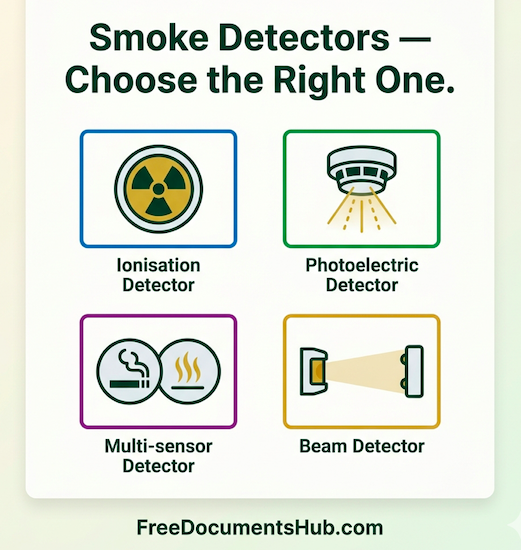
Four distinct detector technologies are used in professional fire alarm installations. Each detects smoke through a different physical mechanism, responds to different fire signatures, and is suitable for different environments. Understanding these four types is the foundation of correct detector selection.
Ionisation
Uses radioactive Americium-241 to ionise air in a sensing chamber. Smoke particles disrupt the ion flow and trigger the alarm. Responds fastest to fast-flaming fires with small, invisible smoke particles.
Best for: Fast-flaming fires · Escape routes · Clean spaces
Photoelectric (Optical)
An infrared LED beam inside the chamber is scattered by smoke particles onto a photocell. Responds best to slow-smouldering fires with large visible smoke particles. The most widely specified type globally.
Best for: Offices · Bedrooms · Corridors · Server rooms
Multi-Sensor
Combines optical and heat sensing — sometimes CO as well. Multiple sensors cross-verify before triggering an alarm. Dramatically reduces false alarm rates while maintaining fast response to all fire types.
Best for: Kitchen boundaries · Mixed-risk spaces · High-value areas
Beam Detector
Projects an infrared or laser beam across a large open space. Smoke reduces the beam intensity and triggers the alarm. The only practical solution for high-bay spaces and large open areas.
Best for: Warehouses · Atriums · Hangars · Spaces over 8m high
Ionisation Smoke Detectors
The ionisation smoke detector uses a small amount of radioactive material — Americium-241 — to ionise the air inside a sensing chamber. This ionised air conducts a small electrical current between two charged plates. When smoke enters the chamber, the smoke particles attach to the ionised air molecules, reducing the electrical current. When the current drops below a threshold, the alarm triggers.
The physics of this mechanism makes ionisation detectors particularly sensitive to the tiny, invisible combustion particles produced by fast-flaming fires — burning petrol, rapidly burning paper, fast-developing open fires. These particles are too small to scatter light effectively in a photoelectric detector, but they disrupt the ion current immediately in an ionisation detector.
Limitations of Ionisation Detectors
The same sensitivity that makes ionisation detectors fast to respond to fast-flaming fires makes them highly susceptible to false alarms from non-fire aerosols — cooking fumes, steam from bathrooms and kitchens, aerosol sprays, and even cigarette smoke. This susceptibility makes them inappropriate for any space where these conditions exist.
Ionisation detectors also contain radioactive material — which creates a disposal regulatory requirement at end of life. In some jurisdictions and for some applications, this has led to ionisation detectors being replaced entirely by photoelectric types, which do not carry the regulatory disposal burden and have a lower false alarm rate in most occupied building environments.
Ionisation vs Photoelectric — The Key Difference
- Ionisation detects: small invisible particles from fast-flaming fires
- Photoelectric detects: large visible particles from slow-smouldering fires
- Most fatal residential fires produce slow-smouldering smoke first — photoelectric wins on life-safety performance for sleeping areas
- Ionisation has a higher false alarm rate in occupied spaces — photoelectric is now the preferred global specification
- Many fire codes and authorities worldwide now specify photoelectric as standard — check local requirements
Photoelectric (Optical) Smoke Detectors
The photoelectric smoke detector works on the principle of light scattering. Inside the detector’s sensing chamber, an infrared LED emits a light beam at an angle that does not normally reach the photocell receiver. When smoke particles enter the chamber, they scatter the infrared light in all directions — including toward the photocell. When the photocell receives scattered light above a threshold level, the alarm triggers.
This mechanism is highly effective at detecting the large, visible smoke particles produced by slow-smouldering fires — the type most commonly associated with fatal residential and commercial fires. Burning foam furniture, smouldering electrical wiring, burning timber and structural materials all produce this type of smoke in the early stages of a fire.
Why Photoelectric Is Now the Standard Specification
Photoelectric detectors have become the dominant global specification for point smoke detection for three reasons. First, research has consistently shown that slow-smouldering fires — which photoelectric detectors detect best — are responsible for the majority of fire fatalities, particularly in sleeping occupancies where people cannot self-evacuate without early warning. Second, photoelectric detectors have a significantly lower false alarm rate than ionisation detectors in most occupied building environments — reducing the false alarm problem that erodes the credibility of fire alarm systems over time. Third, photoelectric detectors contain no radioactive material and carry no special disposal requirement.
On analogue addressable systems, photoelectric detectors provide a continuous analogue output — the actual light scattering level — which the panel uses for pre-alarm warnings, drift compensation, and contamination detection. This continuous analogue reporting makes photoelectric detectors the natural technology for sophisticated modern fire alarm systems.
⚠ Do Not Use Photoelectric in These Spaces
Despite being the most widely specified type, photoelectric detectors are not suitable for all environments. Dusty industrial areas accumulate dust on the detector’s optical surfaces over time, gradually increasing the background scatter level. If not regularly cleaned and tested, contaminated photoelectric detectors eventually generate false alarms or — more dangerously — reduce in sensitivity to actual smoke. In high-dust environments, more frequent maintenance is mandatory and alternative detection methods should be considered.
Multi-Sensor Detectors
The multi-sensor detector combines two or more detection technologies — typically optical smoke sensing combined with heat sensing, and sometimes CO sensing as well — in a single detector housing. The panel processes the signals from each sensor simultaneously and applies programmed logic to decide whether an alarm condition exists. Typically, a significant reading on any single sensor triggers a pre-alarm, while readings on two or more sensors simultaneously trigger a full alarm.
This cross-verification approach dramatically reduces the false alarm rate compared to any single-technology detector — because the environmental conditions that cause one sensor to give a false reading rarely cause simultaneous false readings on a second sensor of a different type. Steam that triggers an optical sensor does not simultaneously raise the temperature enough to trigger a heat sensor. A dust cloud that scatters light in the optical chamber does not produce a CO reading. The cross-verification requirement filters out most false alarm sources while maintaining fast response to actual fires, which produce signals on multiple sensors simultaneously.
When to Specify Multi-Sensor
Multi-sensor detectors are the correct choice for spaces where the false alarm rate from single-technology detectors would be unacceptable — particularly spaces adjacent to cooking areas, areas with intermittent steam or humidity, and high-value spaces where a false alarm response has significant operational or financial consequences. They are also specified for mixed-risk environments where the fire signature is unpredictable — the multi-sensor’s ability to respond to both fast-flaming and slow-smouldering fires makes it more versatile than either single technology alone.
On analogue addressable systems, multi-sensor detectors provide separate analogue values for each sensor type — the panel can see the individual optical reading, the heat reading, and the CO reading simultaneously. This level of diagnostic detail enables extremely precise alarm decision-making and makes post-incident analysis far more informative than single-sensor data alone.
Beam Smoke Detectors
A beam smoke detector projects an infrared or laser beam from a transmitter across a large open space to either a receiver unit on the opposite wall, or a reflector that returns the beam to a combined transmitter-receiver unit. Under normal conditions, the beam travels unobstructed and the receiver measures a baseline intensity level. When smoke is present in the beam path, the smoke particles absorb and scatter the beam — reducing the intensity at the receiver. When the intensity drops below a threshold, the alarm triggers.
The beam detector’s fundamental advantage is its ability to provide detection coverage across a large area with a single detector. A single beam spanning 100 metres protects the entire beam path width with one transmitter and one receiver — a coverage area that would require dozens of point detectors and extensive cable installation to achieve with conventional technology.
Design Considerations for Beam Detectors
- Beam path must be clear. Any permanent obstruction in the beam path will cause a continuous fault. The beam path must be planned carefully during design — no racking, equipment, or structure should be placed in the beam path after installation.
- Alignment is critical. Beam detectors must be precisely aligned during installation and checked annually. Building movement — thermal expansion, structural settlement — can misalign the beam over time and requires periodic re-alignment.
- Mounting height. For warehouse applications, beam detectors are typically mounted at ceiling level or at a specified height below the ceiling. The mounting height affects the smoke concentration the beam will encounter — higher mounting means the beam intercepts smoke earlier as it rises.
- Sensitivity setting. Beam detector sensitivity must be set carefully — too sensitive and the detector alarms on light haze, dust, or insects; too insensitive and it misses low-density smoke from early-stage fires. The sensitivity setting should be documented in the commissioning record.
For Saudi Aramco projects, beam detectors in large process areas and storage facilities are specified per SAES-B-067 requirements. The beam path, mounting height, and sensitivity settings must be submitted for proponent review and approval before installation.
Selection by Space Type — Which Detector Goes Where
The correct detector for a given space is determined by three factors: the likely fire type in that space, the environmental conditions that could cause false alarms, and the regulatory requirements for that occupancy type. The following table covers the most common space types encountered in commercial and industrial projects.
| Space / Location | Recommended Detector | Key Reason |
|---|---|---|
| Standard office | Photoelectric (Optical) | Responds best to slow smouldering fires typical of office environments. Lower false alarm rate than ionisation in occupied spaces. |
| Office adjacent to kitchen | Multi-Sensor | Single sensor types generate high false alarm rates near cooking. Cross-verification dramatically reduces unwanted activations. |
| Bedroom / sleeping area | Photoelectric (Optical) | Responds to slow smouldering fires that develop in sleeping areas. Provides earliest warning of smoke before flames develop. |
| Escape route / corridor | Photoelectric (Optical) | Standard specification for escape routes. Reliable detection without the high false alarm rate of ionisation in high-traffic areas. |
| Server room / data centre | Photoelectric or VESDA (air sampling) | Standard photoelectric for general smoke. VESDA for very early warning where suppression is installed. |
| Commercial kitchen (cooking zone) | Rate-of-Rise Heat Detector — NOT smoke | Smoke detectors of any type generate excessive false alarms in kitchens. Heat detector is the correct specification. |
| Warehouse — ceiling below 8m | Photoelectric (Optical) | Standard point detector coverage at normal ceiling height. |
| Warehouse — high bay above 8m | Beam Smoke Detector | Point detectors ineffective at high ceiling heights — smoke dilutes before reaching the detector. Beam covers full path. |
| Atrium / large open space | Beam Smoke Detector | Large volume, high ceiling. Beam is the only practical detection solution across the full space. |
| Plant room / boiler room | Heat Detector — NOT smoke | High ambient temperature and steam make all smoke detectors unreliable in this environment. |
| Hotel guest room | Photoelectric (Optical) | Sleeping risk area. Lower false alarm rate critical — false alarms in occupied hotel rooms cause major operational disruption. |
| Petrochemical / process area | Multi-Sensor or Analogue Addressable Photoelectric | High reliability required. Analogue addressable provides pre-alarm. Confirm requirements against SAES-B-067 for Aramco projects. |
The Never-Use Rules
Certain combinations of detector type and space type are not just inadvisable — they are incompatible. Installing the wrong detector type in these spaces will result in constant false alarms, detector failure, or missed fire detection. These combinations must be identified at the design stage and never allowed to reach installation.
⚠ Never Use Ionisation Detectors In:
- Kitchens, canteens, or any space with cooking activity
- Bathrooms, shower rooms, or any space with steam
- Laundry areas or drying rooms
- Garages or spaces where vehicle exhaust may be present
- Areas where aerosol products are regularly used
⚠ Never Use Any Smoke Detector In:
- Commercial kitchens in the cooking zone — use heat detectors
- Boiler rooms, plant rooms, or areas with high ambient temperature
- Spray paint booths or areas with solvent vapours
- Car wash areas or areas subject to regular water spray
- Areas with constant high dust levels without a rigorous cleaning programme
⚠ Never Use Beam Detectors In:
- Small rooms or spaces where a clear 5-metre minimum beam path cannot be achieved
- Areas with obstructions that cannot be permanently cleared from the beam path
- Areas subject to structural vibration or movement that will cause beam misalignment
- Areas where fork-lift or vehicle traffic operates in the beam path
Placement Rules and Spacing Requirements
Detector selection determines what type of detector is used. Detector placement determines whether it will actually detect a fire at the speed and reliability that life safety demands. The placement rules defined in NFPA 72 and BS 5839 are not conservative bureaucratic requirements — they are the result of extensive fire testing that determined the maximum spacing at which detectors will reliably detect fires before conditions become untenable for occupants.
| Spacing Parameter | NFPA 72 | BS 5839-1 | Notes |
|---|---|---|---|
| Maximum spacing between detectors | 9.1m (30 feet) between centres on flat ceiling | 7.5m between detector centres | BS 5839 is more conservative — use 7.5m for UK and Gulf projects |
| Maximum distance — wall to first detector | Half of max spacing = 4.55m from wall | 3.75m from wall to first detector centre | Apply to all four walls of the room |
| Maximum coverage per detector | 83m² on flat ceiling | Defined by spacing formula: spacing² for square grid | Maximums only — reduce for irregular ceilings, obstructions, or high-risk areas |
| Maximum ceiling height | Up to 9.1m (30 feet) | Up to 10.5m | Above these heights — beam detectors or alternative detection required |
| Minimum distance from wall | No minimum defined — use half spacing as guide | 300mm minimum from any wall | Detector too close to wall creates dead zone — poor air movement at wall junctions |
| Minimum distance from air supply diffuser | 300mm from any HVAC supply diffuser | 500mm from supply air diffusers | Air supply dilutes smoke and delays detection — maintain clearance |
| Minimum distance from partition or beam | Detector must see below any beam or partition | 300mm from structural beams or partitions | Beams over 200mm deep require additional detectors beyond the beam |
These spacing rules assume a flat, unobstructed ceiling of standard height. Any deviation from these ideal conditions — sloped ceilings, ceiling beams, open-plan spaces with partitions, ceiling voids, high air movement from HVAC systems — requires specific additional placement measures that are covered in Section 10.
Special Placement Situations
The most common installation errors in smoke detector placement are not violations of the basic spacing rules — they are failures to apply the special rules that apply when ceiling or space conditions deviate from the flat, unobstructed standard. These situations require specific additional measures, and missing them creates detection gaps that will not be revealed until an actual fire occurs.
| Situation | Rule Required | Standard Reference | Common Mistake |
|---|---|---|---|
| Sloped ceiling — pitch over 1:8 | Place detector within 900mm of highest point. Additional detectors at normal spacing from the peak. | NFPA 72 Cl.17.7.3.1 / BS 5839-1 Cl.20.4 | Placing detectors only at standard grid spacing — smoke accumulates at the peak first and reaches a peak-mounted detector long before one at standard spacing. |
| Ceiling beams deeper than 200mm | Treat each beam bay as a separate room. At least one detector per beam bay. | NFPA 72 Cl.17.7.3.5 / BS 5839-1 Cl.20.3 | Installing detectors in alternate bays only — smoke trapped in beam bays without detectors creates undetected fire development zones. |
| Open plan with high partitions | Partitions over 75% of floor-to-ceiling height divide the space — treat as separate rooms. | NFPA 72 Cl.17.7.3.6 / BS 5839-1 Cl.20.2 | Treating the entire open plan as one area when partitions create separate smoke compartments that require independent detection. |
| Ceiling voids over 800mm deep | Detectors required in the void at standard spacing — void is a separate detection zone. | NFPA 72 Cl.17.7.6 / BS 5839-1 Cl.21 | Omitting detectors from ceiling voids — fires originating in voids go undetected until smoke penetrates the ceiling tiles and reaches the room-level detectors. |
| High air movement above 1m/s | Consider beam detector or air sampling — point detectors ineffective in high velocity airstreams. | BS 5839-1 Cl.20.5 / NFPA 72 Cl.17.7.5 | Placing point detectors directly in high-velocity airstreams from HVAC systems — smoke diluted to below alarm threshold before reaching the detector. |
| Stepped ceiling — different levels | Treat each ceiling level as a separate area. Apply full spacing rules to each level independently. | NFPA 72 Cl.17.7 / BS 5839-1 Cl.20 | Assuming detectors on an upper level cover an adjacent lower level — smoke from a fire at the lower level rises to the lower ceiling and is contained there. |
Structure of the Excel Template
| Sheet | Title | Content |
|---|---|---|
| Sheet 1 | Cover Page | FDH branded, NFPA 72 / BS 5839 / EN 54 / SAES-B-067 reference |
| Sheet 2 | Detector Types Comparison | 12-parameter side-by-side — Ionisation vs Photoelectric vs Multi-Sensor vs Beam — detection principle, best smoke type, false alarm susceptibility, coverage, cost, maintenance, SAES-B-067 notes |
| Sheet 3 | Selection Guide | 15 space types with recommended detector and key reason + 4 never-use exclusion rules covering all detector types |
| Sheet 4 | Placement Rules and Spacing | NFPA 72 vs BS 5839 spacing comparison table + 7 special placement situations with standard references and common mistakes highlighted |
| Sheet 5 | Detector Schedule Template | 16 sample detector entries — offices, server room, warehouse beam TX/RX, kitchen boundary, bedrooms, ceiling void — with loop, address, ceiling height, coverage, drawing reference, and status — auto summary formulas |
Standards Alignment
NFPA 72 — National Fire Alarm and Signaling Code
NFPA 72 Chapter 17 covers the requirements for initiating devices including smoke detectors. It defines spacing requirements for spot-type detectors (9.1m maximum, 83m² maximum coverage on flat ceilings), special conditions for sloped ceilings, ceiling beams, and partitions, and the requirements for detectors in concealed spaces. Chapter 17 also defines the performance requirements for detector sensitivity and the testing intervals for installed detectors. NFPA 72 does not specify which detector type must be used in each space — it sets the performance requirements and leaves type selection to the designer based on the space’s conditions.
BS 5839 Part 1 — Code of Practice
BS 5839 Part 1 Section 20 defines placement requirements for point smoke detectors including the 7.5m maximum spacing, the 3.75m maximum distance from walls, the 300mm minimum clearance from walls and partitions, and the requirements for sloped ceilings and ceiling beams. Section 21 addresses detectors in concealed spaces. BS 5839 is more prescriptive than NFPA 72 in some areas — the 7.5m spacing rule is more conservative than NFPA’s 9.1m, and BS 5839 provides more specific guidance on the treatment of ceiling voids and partitioned spaces.
EN 54 — Fire Detection and Fire Alarm Systems
EN 54 is the European product standard series for fire detection equipment. EN 54-7 covers point-type smoke detectors using optical or ionisation principles. EN 54-12 covers line-type smoke detectors (beam detectors). EN 54-29 covers multi-sensor fire detectors. All detectors used on European and many Gulf projects must hold EN 54 certification from a notified body. The EN 54-7 standard defines the sensitivity range within which a smoke detector must respond — detectors set outside this range are not compliant regardless of their other characteristics.
SAES-B-067 — Saudi Aramco Fire Protection
SAES-B-067 requires that smoke detectors on Saudi Aramco facilities be from the Aramco Approved Vendors List and meet the specified sensitivity and response requirements. The standard specifies detector types for different facility areas — photoelectric for general office and accommodation areas, multi-sensor or analogue addressable for high-risk areas, and beam detectors for large open spaces and high-bay storage. All detector placement must comply with the spacing requirements of the applicable standard and must be shown on approved fire alarm layout drawings submitted to the Saudi Aramco proponent engineer before installation.
📥 Free Download — Smoke Detector Types, Selection & Placement Excel
5-sheet professional Excel template: Detector Types Comparison (12 parameters), Selection Guide (15 space types + never-use rules), Placement Rules with NFPA 72 vs BS 5839 comparison, Special Placement Situations, and Detector Schedule Template with 16 sample entries.
Conclusion
Smoke detector selection and placement are two of the most consequential technical decisions in a fire alarm project — and two of the most frequently made incorrectly. An ionisation detector in a kitchen that generates a false alarm every time someone cooks is not a minor inconvenience. It is a system that trains the building’s occupants to ignore the alarm. And a system whose alarms are ignored is no system at all.
The four detector types covered in this guide — ionisation, photoelectric, multi-sensor, and beam — each have a specific application domain based on how they physically detect smoke, what environmental conditions cause them to false alarm, and what fire signatures they respond to most reliably. Matching the detector type to the space type is the single most important decision in fire alarm design after the choice of system architecture.
The placement rules that follow — the spacing limits, the wall distance requirements, the special rules for sloped ceilings, ceiling beams, partitions, and voids — are not bureaucratic compliance requirements. They are the result of fire testing that determined the conditions under which detection will be fast enough to allow safe evacuation. Deviating from them without specific engineering justification creates detection gaps that will remain invisible until a real fire reveals them.
Download the free Excel template, use the selection guide for your next project, document every placement decision against the applicable standard, and produce a detector schedule that proves every detector was selected and placed correctly — before the first cable is pulled.
More Free Industrial Documents
Method statements, commissioning reports, NCR and RFI templates, cable schedules, FACP guides, and now the complete smoke detector reference — all free.
Download Free Smoke Detector Template www.freedocumentshub.com