
Heat Detectors — Types
and Applications:
The Complete Professional Guide
Fixed temperature, rate-of-rise, and combined — the three heat detector types explained, compared, and applied. Plus the EN 54-5 temperature classification system, application guide for 15 space types, spacing rules, and the critical difference between heat and smoke detection.
Table of Contents
- When Heat Detection Is the Answer
- The Three Heat Detector Types
- Fixed Temperature Heat Detectors
- Rate-of-Rise Heat Detectors
- Combined Rate-of-Rise and Fixed Temperature
- The EN 54-5 Temperature Classification System
- How to Select the Correct Temperature Class
- Application Guide — 15 Space Types
- Spacing and Placement Rules
- Structure of the Excel Template
- Standards Alignment
- Free Download — Excel Template
- Conclusion
When Heat Detection Is the Answer
Heat detectors are not an inferior alternative to smoke detectors. They are the correct solution for a specific and well-defined set of environments — spaces where smoke detectors cannot function reliably because the environment itself produces the conditions that trigger smoke detector false alarms. In these spaces, heat detection is not a compromise. It is the technically correct specification.
The fundamental question when specifying detection for any space is not “smoke or heat?” It is “what are the normal environmental conditions in this space, and which detection technology can distinguish a real fire from those conditions reliably?” In a standard office, a slow-smouldering fire in a paper bin produces smoke that a photoelectric detector detects accurately, while normal office conditions produce no signals that would cause a false alarm. Smoke detection is clearly correct.
In a commercial kitchen, the same photoelectric detector cannot distinguish between the smoke from a fire and the smoke from normal cooking. It cannot distinguish between the steam from a fire and the steam from a boiling pot. Every significant cooking activity becomes a potential false alarm. In this environment, heat detection is not a second choice — it is the only viable choice.
“Heat detectors do not replace smoke detectors. They serve the environments that smoke detectors cannot — the hot, the steamy, the dusty, and the chemically complex spaces where smoke detection generates constant false alarms.”
This guide covers the three heat detector types, the temperature classification system that governs their selection, the 15 most common applications where heat detection is required or preferred, the spacing rules that govern their placement, and the relationship between heat detection and the broader fire alarm system design. The free Excel template includes all reference tables, an application guide, and a detector schedule template ready for immediate use on your next project.
The Three Heat Detector Types
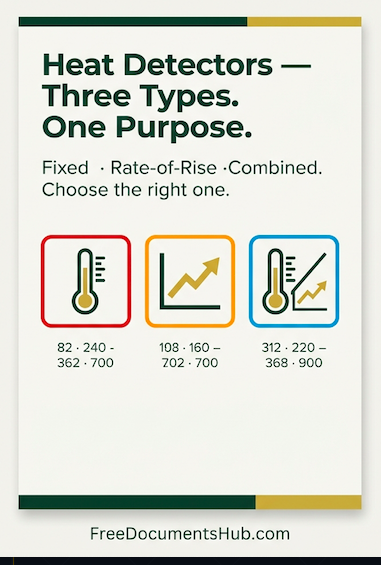
Heat detectors are divided into three types based on the mechanism they use to detect fire. Each type detects different fire signatures, responds at different speeds, and is suitable for different applications. Understanding the distinction between them is the foundation of correct heat detector specification.
Fixed Temperature
Triggers when ambient temperature reaches a pre-set fixed threshold — 57°C, 70°C, 90°C, or higher. Simple, reliable, low false alarm rate. Non-resettable fusible element in most types — must be replaced after activation.
Best for: Kitchens · Boiler rooms · Plant rooms · High-temp areas
Rate-of-Rise
Triggers when temperature rises faster than a defined rate — typically 8.3°C per minute or more. Responds faster than fixed temperature to rapidly developing fires. Can false alarm from rapid non-fire temperature changes.
Best for: Warehouses · Storage areas · General industrial spaces
Combined ROR + Fixed
Combines both mechanisms. Triggers on EITHER rapid rate of rise OR reaching the fixed temperature threshold — whichever occurs first. The most versatile type — recommended as default for most heat detection applications.
Best for: Most general heat detection applications requiring reliability
Fixed Temperature Heat Detectors
The fixed temperature heat detector triggers when the ambient air temperature at the detector reaches a pre-set threshold. This threshold — 57°C, 70°C, 90°C, or higher — is set during manufacture and corresponds to the EN 54-5 temperature class of the detector. The detection mechanism is typically a fusible element or bimetallic strip that deforms or melts at the threshold temperature, completing or breaking an electrical circuit and triggering the alarm.
The fixed temperature detector’s primary strength is its simplicity and its immunity to false alarms from rapid temperature changes. Because it responds only to absolute temperature — not to the rate of change — it is completely immune to false alarms from rapid HVAC cycling, door opening in cold weather, or other rapid but non-fire temperature fluctuations. A space must actually reach the threshold temperature for the alarm to trigger. In most protected environments, this only happens during an actual fire.
Limitations — Slow Response to Fast Fires
The fundamental limitation of the fixed temperature detector is its slow response to rapidly developing fires. In a fast-developing fire, the air temperature at ceiling level rises quickly — but it must physically reach the detector’s fixed threshold before the alarm triggers. During the time it takes for the air temperature to climb from normal operating temperature to the alarm threshold, the fire may have grown significantly. For spaces where a fast fire response is critical, the rate-of-rise or combined type is more appropriate.
Non-Resettable After Activation
Most fixed temperature detectors use a fusible element — a component that physically melts or deforms at the alarm temperature. Once this element has activated, the detector cannot be reset. It must be replaced. This is an important operational consideration: after any activation — whether from a real fire or from a genuine high-temperature condition — all fixed temperature detectors in the affected area must be replaced before the system is returned to normal service. The replacement requirement must be factored into the maintenance programme and the spare parts inventory.
Fixed Temperature — The Correct Specification for Cooking Areas
- Cooking area maximum normal temperature: up to 45°C from cooking heat
- Select a class rated for ceiling temperatures above 45°C — EN 54-5 Class D (99°C alarm, 70°C max ceiling) is typically appropriate
- The detector will not activate during normal cooking — only when fire causes temperatures to rise above the threshold
- No false alarms from steam, cooking fumes, or normal heat output from kitchen equipment
- Always confirm the maximum normal operating temperature in the specific kitchen before specifying the class
Rate-of-Rise Heat Detectors
The rate-of-rise (ROR) heat detector monitors the rate of temperature change rather than the absolute temperature level. It triggers when the temperature rises faster than a defined threshold — in NFPA 72 terms, typically 8.3°C (15°F) per minute or more. The detection mechanism typically uses an air chamber with a small vent — in normal conditions, the chamber and the surrounding air remain at equilibrium. In a fire, the temperature rises rapidly, pressurising the air in the chamber faster than the vent can release it. The pressure difference activates the alarm.
The rate-of-rise detector’s primary advantage is speed. In a rapidly developing fire, the temperature at ceiling level begins rising immediately — long before the absolute temperature reaches the threshold required by a fixed temperature detector. The ROR detector responds to this early rapid rise and triggers the alarm significantly earlier than a fixed temperature detector in the same fire scenario. For spaces where early warning of fast-developing fires is the primary concern, this speed advantage is significant.
The False Alarm Risk
The rate-of-rise mechanism’s sensitivity to rapid temperature change is also its vulnerability. Any situation that causes a rapid non-fire temperature rise can trigger a false alarm — a heating system switching on suddenly, a steam release from a process, a door being opened between a cold and hot space, or rapid HVAC discharge. In environments where these conditions occur regularly, the ROR detector’s false alarm rate can be unacceptably high. This is why the combined type — which adds a fixed temperature backup — is preferred for most applications where ROR sensitivity is desired.
Resettable After Activation
Unlike the fusible-element fixed temperature detector, most rate-of-rise detectors are resettable. After the temperature normalises, the air chamber returns to equilibrium and the detector resets automatically. This means that after a test activation, or after an ROR false alarm, the detector does not need to be replaced. However, before resetting and returning the system to service after any activation, the area must be inspected to confirm no structural damage or residual heat source exists.
Combined Rate-of-Rise and Fixed Temperature
The combined rate-of-rise and fixed temperature detector integrates both detection mechanisms in a single unit. It triggers on whichever condition occurs first — either the temperature rises at a rate exceeding the ROR threshold, or the absolute temperature reaches the fixed temperature threshold. This combination makes it the most versatile heat detector type and the preferred specification for most general heat detection applications.
The combined type resolves the primary weakness of each individual type. The fixed temperature element provides backup for slow-developing fires that a rate-of-rise detector might miss — fires where temperature rises slowly and uniformly, never exceeding the rate threshold but eventually reaching dangerous levels. The rate-of-rise element provides early warning for fast-developing fires that would take too long to reach the fixed threshold. Together, the two mechanisms cover the full range of fire temperature signatures — slow and fast — reliably and with a lower false alarm rate than rate-of-rise alone.
The Recommended Default Specification
For most heat detection applications where both fast and slow fire types are possible — warehouses, storage areas, car parks, generator rooms, general industrial spaces — the combined type is the correct default specification. The marginal additional cost over a fixed temperature detector is justified by the improved response to fast fires, and the fixed temperature backup eliminates the false alarm vulnerability of rate-of-rise-only detectors.
When the project specification or the client requires explicit justification of the detector type, the combined type can be described accurately as providing “both early warning of fast-developing fires and reliable detection of slow-developing fires — in a single detector, without increased false alarm susceptibility.”
The EN 54-5 Temperature Classification System
EN 54-5 is the European standard for point-type heat detectors. It defines eight temperature classes — Class A1 through Class G — each covering a specific range of alarm temperatures and maximum ceiling temperatures. Every heat detector used on a European or Gulf project must hold EN 54-5 certification and must be specified to the correct class for the ambient temperature conditions of the protected space.
| EN 54-5 Class | Alarm Temperature | Max Ceiling Temp | Typical Application |
|---|---|---|---|
| A1 | 54°C (129°F) | 25°C max | Standard offices, corridors, bedrooms — normal ambient environments |
| A2 | 54°C (129°F) | 25°C max | Most general building applications — widely specified combined type |
| B | 69°C (156°F) | 40°C max | Attics, roof voids, slightly warm industrial spaces |
| C | 84°C (183°F) | 55°C max | Warm plant rooms, mild industrial areas, generator rooms |
| D | 99°C (210°F) | 70°C max | Commercial kitchens, hot plant rooms, high-temperature process areas |
| E | 114°C (237°F) | 85°C max | High-temperature industrial processes |
| F / G | 132°C / 150°C | 100°C / 115°C | Extreme industrial high-temperature environments |
The temperature class is not a specification that can be chosen arbitrarily or based on cost. It must be calculated based on the maximum normal operating temperature of the protected space. Specifying too low a class produces constant false alarms as normal operating temperatures trigger the alarm. Specifying too high a class delays detection — the fire must develop to a much higher temperature before the alarm triggers, reducing the evacuation time available to occupants.
How to Select the Correct Temperature Class
The selection of the correct EN 54-5 temperature class follows a five-step process that is straightforward when the maximum normal operating temperature of the space is known — and dangerously incorrect when it is guessed or assumed.
- Determine the maximum normal operating temperature of the space. This is the highest temperature that the space reaches during normal operation — not during a fire. For a commercial kitchen, this might be 45°C near the cooking equipment. For a boiler room, it might be 60°C near the boiler casing. For a standard office, it is typically below 25°C.
- Add a 20°C safety margin. The alarm threshold must be at least 20°C above the maximum normal operating temperature to prevent false alarms from normal temperature excursions. A kitchen with 45°C maximum normal operating temperature requires an alarm threshold of at least 65°C.
- Select the class whose alarm temperature exceeds the calculated minimum AND whose maximum ceiling temperature exceeds the maximum normal operating temperature. Both conditions must be met. For the 45°C kitchen: Class C (84°C alarm, 55°C max ceiling) fails — the 55°C ceiling limit is above 45°C but the margin is insufficient. Class D (99°C alarm, 70°C max ceiling) is correct — both conditions are satisfied comfortably.
- Verify by confirming the maximum ceiling temperature in the space does not exceed the class maximum. If the kitchen ceiling temperature during peak cooking reaches 68°C, Class D (70°C max ceiling) remains acceptable with 2°C margin. If it reaches 72°C, a higher class is needed.
- Specify the confirmed class on the fire alarm drawings and in the detector schedule. The class designation must appear on every document that references the detector specification.
⚠ The Most Common Temperature Class Error
The most frequent temperature classification error is specifying Class A1 or A2 (54°C alarm) for spaces that regularly reach temperatures above 35°C during normal operation. A kitchen, boiler room, or plant room with a standard Class A2 detector will generate false alarms every time the space heats up to normal operating temperature. The error is often discovered not during design review but during the first week of operation — when the fire alarm activates during a normal cooking shift and the building evacuates unnecessarily. Prevent this by calculating the required class — never assume Class A2 is universal.
Application Guide — 15 Space Types
The following table covers the 15 most common spaces where heat detection is required or preferred — either because smoke detection is excluded by environmental conditions or because the specific fire risk profile makes heat detection the technically correct choice.
| Space / Location | Recommended Type | Key Reason |
|---|---|---|
| Commercial kitchen — cooking zone | Fixed Temperature 90°C (Class D) | Cooking produces constant smoke and steam. Any smoke detector false alarms continuously. Heat detection responds only to dangerous temperature rise. |
| Commercial kitchen — general area | Combined ROR + Fixed 70°C (Class C) | Away from direct cooking but still elevated ambient. Combined type for reliable detection without false alarms. |
| Boiler room | Fixed Temperature 70°C (Class C) | High ambient temperature from boiler. Smoke detectors false alarm from steam. Fixed temp set above normal operating temp. |
| Plant room / mechanical room | Fixed Temperature 70°C (Class C) | Equipment heat and dust exclude smoke detectors. Fixed temperature appropriate for the environment. |
| Car park — covered | Combined ROR + Fixed 57°C (Class A2) | Vehicle exhaust excludes smoke detectors. CO detection is primary — heat detector supports fire alarm. |
| Laundry / drying room | Fixed Temperature 57°C (Class A2) | Steam from drying equipment triggers smoke detectors constantly. Fixed temperature reliable in this environment. |
| Bakery / food production | Fixed Temperature 70°C or 90°C | Cooking processes produce smoke, steam, and flour dust that exclude smoke detectors entirely. |
| Paint spray booth | Fixed Temperature — High Temp (Exproof) | Solvent vapours and aerosols exclude smoke detectors. Explosion-proof rated detector required in classified area. |
| Storage warehouse — general | Combined ROR + Fixed 57°C | No specific environmental exclusion but fast fire risk from stored goods. Combined provides best all-round coverage. |
| Loft / roof void | Fixed Temperature 57°C (Class A2) | Dust and fibres in roof voids cause smoke detector false alarms. Fixed temperature reliable in inaccessible spaces. |
| Swimming pool plant room | Fixed Temperature 57°C (Class A2) | Chlorine fumes and humidity from pool treatment exclude smoke detectors completely. |
| Sauna / steam room | Fixed Temperature — Very High Temp | Extreme ambient temperature from normal operation requires very high fixed threshold to avoid constant false alarms. |
| Generator room | Combined ROR + Fixed 70°C (Class C) | Diesel exhaust and equipment heat. Combined type provides fast response to rapid fire development. |
| Industrial oven area | Fixed Temperature 90°C or Higher | Very high ambient temperature from oven operation requires high fixed threshold for reliable discrimination. |
| Attic space | Combined ROR + Fixed 57°C (Class A2) | Dust excludes smoke detectors. Combined type provides reliable all-round coverage in inaccessible space. |
Spacing and Placement Rules
Heat detectors require closer spacing than smoke detectors — a fact that surprises many engineers who assume the spacing rules are the same. The reason is physics: heat dissipates much faster than smoke rises. Smoke from a fire at floor level will travel to ceiling level and spread across the ceiling relatively quickly. Heat generated at floor level dissipates into the surrounding air as it rises — arriving at the ceiling at a significantly lower temperature than at the fire source. The effective detection radius of a heat detector is therefore smaller than that of a smoke detector, requiring more detectors per unit area to provide equivalent coverage.
- NFPA 72 maximum spacing: Up to 37m² per detector on a flat ceiling at standard height — approximately 6.1m between detector centres. Compare this with 83m² for smoke detectors under the same standard.
- BS 5839-1 maximum spacing: Maximum 30m² per detector, approximately 5.3m between centres. More conservative than NFPA 72 — apply BS 5839 for UK and Gulf projects.
- Wall to first detector: Half the maximum spacing — same rule as smoke detectors.
- Maximum ceiling height: Up to 7.5m for heat detectors (NFPA 72). Above this height, heat dissipates to below alarm threshold before reaching the detector — beam detectors or alternative detection required.
- Minimum clearance from HVAC supply: 300mm — same as smoke detectors. Air supply dilutes heat and delays detection.
- Structural beams over 200mm: Each beam bay requires at least one detector — same rule as smoke detectors. Heat, like smoke, is trapped by deep structural beams.
Key Difference — Heat vs Smoke Spacing
When converting a design from smoke to heat detection — for example, when a kitchen expansion changes a smoke-detected space to a heat-detected space — the detector spacing cannot simply be maintained. The existing smoke detectors at 9.1m spacing (NFPA) or 7.5m spacing (BS) will be too far apart for heat detection coverage. Additional detectors are required to bring spacing within the heat detector maximums of 6.1m (NFPA) or 5.3m (BS). This change must be reflected on the as-built drawings and in the detector schedule.
Structure of the Excel Template
| Sheet | Title | Content |
|---|---|---|
| Sheet 1 | Cover Page | FDH branded — NFPA 72 / BS 5839 / EN 54-5 / SAES-B-067 reference |
| Sheet 2 | Heat Detector Types | 12-parameter comparison — Fixed Temperature vs Rate-of-Rise vs Combined — detection principle, response to fast and slow fires, false alarm susceptibility, alarm temperatures, EN 54-5 classification, resettability, cost, SAES-B-067 notes |
| Sheet 3 | Application Guide | 15 space types with recommended detector type and reason + Heat vs Smoke decision guide covering 8 decision factors |
| Sheet 4 | Temperature Classification | Complete EN 54-5 Class A1 through G table with alarm temperatures, ceiling temperature limits, and application ranges + 5-step temperature class selection method with worked example |
| Sheet 5 | Placement and Spacing | Heat detector vs smoke detector spacing comparison — NFPA 72 and BS 5839 — 8 parameters + 10-entry heat detector schedule with EN 54-5 class specified for each entry |
Standards Alignment
NFPA 72 — National Fire Alarm and Signaling Code
NFPA 72 Chapter 17 covers heat detectors under initiating devices. Section 17.6 defines the requirements for heat detector listing and performance including sensitivity, spacing, and ceiling height limitations. NFPA 72 defines heat detector spacing at a maximum of 37m² per detector on flat ceilings of standard height, with the spacing reduction required for higher ceilings specified in Table 17.6.3.5.1. The standard requires that heat detectors be listed and labelled by a nationally recognised testing laboratory and that they meet the performance requirements of their listed rating.
BS 5839 Part 1 — Code of Practice
BS 5839 Part 1 Section 19 covers heat detectors including classification, selection, and placement requirements. The standard requires that heat detectors be classified to EN 54-5 and that the correct temperature class be selected based on the maximum ambient temperature of the protected space. Section 19 defines the maximum spacing of 30m² per detector and specifies the additional requirements for sloped ceilings, ceiling beams, and ceiling voids — identical in principle to the smoke detector requirements but with the tighter spacing limits that reflect heat’s faster dissipation compared to smoke.
EN 54-5 — Heat Detectors — Point Detectors
EN 54-5 is the product standard that defines the performance requirements, test methods, and temperature classification system for point-type heat detectors. All heat detectors used on European and Gulf projects must hold EN 54-5 certification from an accredited testing body. The standard defines the eight temperature classes (A1 through G), the test conditions that each class must survive, and the marking requirements that identify the class on the detector housing. The letter suffix — R for rate-of-rise, S for static plus rate-of-rise — identifies the detection mechanism in combination with the class letter.
SAES-B-067 — Saudi Aramco Fire Protection
SAES-B-067 requires heat detectors on Saudi Aramco facilities to be from the Approved Vendors List and to meet EN 54-5 certification requirements. The standard specifies heat detection for kitchen areas, plant rooms, and other high-temperature spaces where smoke detection is excluded. All heat detector specifications must be submitted on the fire alarm layout drawing for proponent review. The temperature class must be explicitly stated on the drawing — a drawing that specifies only “heat detector” without an EN 54-5 class designation will not pass proponent review.
📥 Free Download — Heat Detector Types & Applications Excel
5-sheet professional Excel: Types Comparison (12 parameters), Application Guide for 15 spaces, EN 54-5 Classification Table with 5-step selection method, Spacing comparison NFPA 72 vs BS 5839, and Heat Detector Schedule Template with 10 sample entries.
Conclusion
Heat detectors are the correct specification for a clearly defined set of environments — environments where the conditions that produce false alarms in smoke detectors are present as a normal part of operations. Specifying a smoke detector in a commercial kitchen is not a conservative choice. It is a technically incorrect choice that will produce a system that generates constant false alarms, conditions occupants to ignore the alarm, and ultimately fails at its fundamental life-safety purpose.
The three heat detector types — fixed temperature, rate-of-rise, and combined — each have a specific performance profile. The combined type is the most versatile and is the correct default for most general heat detection applications. The fixed temperature type is the most reliable in high-temperature, high-contamination environments like commercial kitchens and boiler rooms. The rate-of-rise type provides the fastest response to rapidly developing fires but requires stable ambient temperature conditions to avoid false alarms.
The EN 54-5 temperature classification system is the technical framework that ensures the detector’s alarm threshold is correctly matched to the ambient temperature conditions of the protected space. Selecting the wrong class — too low and the detector false alarms from normal operating temperatures, too high and the fire must develop significantly before detection — is one of the most consequential design errors in a fire alarm project. Calculate it correctly every time.
Download the free Excel template, use the application guide and temperature class selection method on your next project, and document every heat detector specification with its EN 54-5 class clearly stated on the drawings and in the schedule.
More Free Industrial Documents
Smoke detector guides, commissioning reports, NCR templates, cable schedules, FACP guides, and now the complete heat detector reference — all free.
Download Free Heat Detector Template www.freedocumentshub.com