
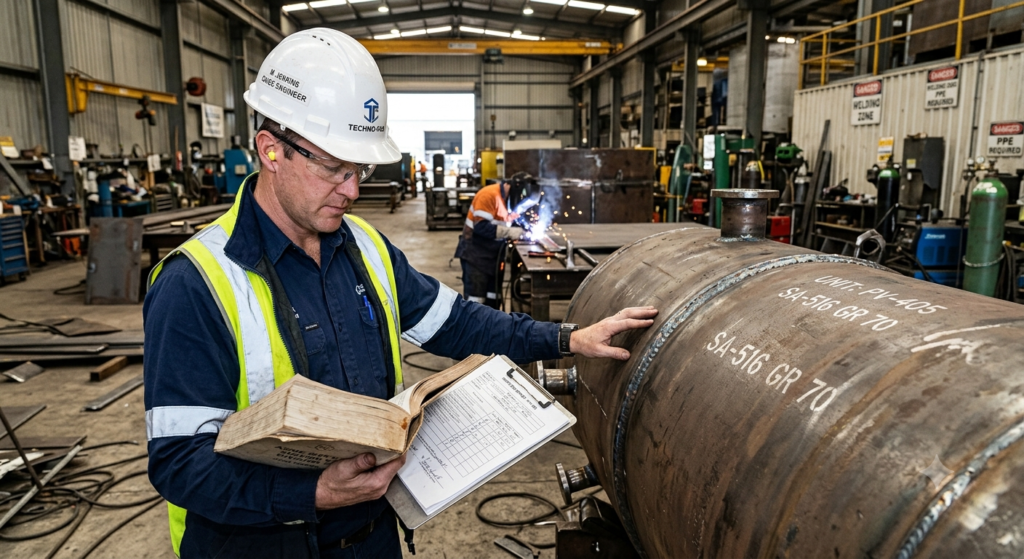
If you work anywhere near pressure vessels, boilers, or piping systems, you have probably heard the phrase “the ASME Code” used as though everyone already knows what it means. In reality, the ASME Boiler and Pressure Vessel Code (BPVC) is not one document. It is a collection of more than a dozen separate Sections, each covering a different type of equipment, material, or activity.
For engineers, fabricators, welders, and quality inspectors working toward ASME U Stamp certification or Saudi Aramco AVL approval, knowing which Section governs which task is not optional — it is the difference between a clean audit and a stalled application. This guide breaks down every Section of the BPVC in plain language, so you can stop guessing and start referencing the Code with confidence.
What Is the ASME Boiler and Pressure Vessel Code?
The American Society of Mechanical Engineers (ASME) first published the BPVC in 1914, after a series of boiler explosions in factories and ships made it clear that the industry needed a common set of safety rules. What started as a single rulebook for power boilers has grown into a multi-volume Code covering nearly every type of pressure-retaining equipment used in industry today.
ASME updates the Code on a regular cycle, issuing a new edition every two years along with addenda in between. Each contract, purchase order, or vendor approval document references a specific edition and addenda, which is why getting the edition reference right matters as much as following the rules themselves.
The BPVC is not a law on its own, but it has been adopted into law by most U.S. states and Canadian provinces, and it is referenced directly in regulations and owner specifications across the Middle East, including Saudi Arabia. In practice, that makes it one of the most enforced industrial codes in the world.
Why the BPVC Matters in Industrial Fabrication
For a fabrication workshop, the BPVC is not background reading — it shapes daily decisions on the shop floor:
- Legal and contractual requirement — most jurisdictions and owner-operators require BPVC compliance before equipment can be installed or sold
- Client and vendor approval requirement — companies like Saudi Aramco require documented compliance with specific Sections as part of vendor registration
- Common technical language — the Code lets an inspector in Houston and a fabricator in Dammam interpret the same drawing the same way
- Foundation for certification stamps — the U, S, and R stamps that allow a shop to legally build and repair pressure equipment are all built on BPVC rules
Almost every documentation package a fabrication workshop submits — WPS and PQR records, material test reports, NDE reports, and data books — exists because a specific Section of the BPVC requires it.
How the Code Is Organized
The current BPVC is published as twelve numbered Sections (I through XII), plus a continuously updated set of Code Cases and Interpretations. Code Cases provide approved rules for new materials or methods that have not yet been written into the main Code text. Interpretations are official ASME answers to specific technical questions, used to clarify how a rule should be applied.
Each Section is published as its own standalone book, and several Sections are split further into Parts or Divisions. The table below gives you a one-glance map of all twelve before we go through each one in detail.
| Section | Title | Primary Scope |
| I | Power Boilers | Design, fabrication, and inspection of power boilers used in power plants and process steam systems |
| II | Materials (A, B, C, D) | Specifications for ferrous and non-ferrous materials, welding filler metals, and allowable stress data |
| III | Nuclear Power Plant Components | Vessels, pumps, valves, and containment for nuclear facilities, under strict QA programs |
| IV | Heating Boilers | Low-pressure steam and hot water heating boilers for commercial and residential buildings |
| V | Nondestructive Examination | RT, UT, MT, PT, and other NDE methods, plus qualification of procedures and personnel |
| VI | Care of Heating Boilers | Recommended (non-mandatory) guidelines for safe operation and maintenance of heating boilers |
| VII | Care of Power Boilers | Recommended (non-mandatory) guidelines for operating and maintaining power boilers |
| VIII | Pressure Vessels (Div 1, 2, 3) | Design, fabrication, and inspection rules for unfired pressure vessels; basis of the U Stamp |
| IX | Welding, Brazing & Fusing | WPS and PQR development, plus welder and welding operator qualification testing |
| X | Fiber-Reinforced Plastic Vessels | Design and fabrication of FRP/composite pressure vessels for corrosive or specialty service |
| XI | Inservice Inspection (Nuclear) | Ongoing inspection, testing, repair, and replacement rules for nuclear plant components |
| XII | Transport Tanks | Design, fabrication, and inspection of tanks used to transport pressurized cargo by rail or road |
Section-by-Section Breakdown
Section I — Power Boilers
Section I covers the design, fabrication, installation, and inspection of power boilers — the high-pressure, high-temperature steam-generating equipment used in power plants and large industrial process systems. If a boiler feeds a steam turbine or supplies high-pressure process steam, it almost certainly falls under this Section.
Section II — Materials
Section II is essentially the Code’s materials encyclopedia, split into four Parts: Part A (ferrous specifications), Part B (non-ferrous specifications), Part C (welding rods, electrodes, and filler metals), and Part D (allowable stress values and physical properties). Every other Section that mentions a material grade is pointing back to Section II for its exact specification.
Section III — Nuclear Power Plant Components
Section III sets rules for vessels, pumps, valves, piping, and containment systems used in nuclear power plants. It operates under a far more rigorous quality assurance program than other Sections, reflecting the consequences of failure in a nuclear environment, and is itself divided into multiple subsections covering different component classes.
Section IV — Heating Boilers
Section IV covers low-pressure heating boilers — steam boilers operating at 15 psi or below, and hot water boilers operating at or below 160 psi and 250°F. These are the boilers found in commercial buildings, hospitals, and residential heating systems, as opposed to the high-pressure equipment in Section I.
Section V — Nondestructive Examination
Section V is the rulebook for inspection methods: radiographic testing (RT), ultrasonic testing (UT), magnetic particle testing (MT), penetrant testing (PT), eddy current testing (ET), and visual testing (VT). Other Sections, such as VIII and IX, reference Section V whenever they require a weld or material to be examined.
Section VI — Recommended Rules for the Care of Heating Boilers
Section VI is a guideline document, not a stamping requirement. It provides recommended practices for the safe operation, care, and maintenance of heating boilers once they are already in service.
Section VII — Recommended Guidelines for the Care of Power Boilers
Section VII mirrors Section VI but for power boilers, offering non-mandatory operating and maintenance guidance aimed at plant operators rather than fabricators.
Section VIII — Pressure Vessels
Section VIII is the most widely referenced Section in industrial fabrication, covering unfired pressure vessels across three Divisions: Division 1 (design by rules, the most common path for standard vessels), Division 2 (alternative rules permitting higher allowable stresses through more rigorous design-by-analysis), and Division 3 (rules for vessels operating at very high pressure). The U Stamp — the certification mark most fabrication workshops are working toward — is built on Section VIII compliance.
Section IX — Welding, Brazing, and Fusing Qualifications
Section IX governs how Welding Procedure Specifications (WPS) and Procedure Qualification Records (PQR) are developed, and how welders and welding operators are tested and qualified. Almost every other Section that involves a weld points back to Section IX to confirm the procedure and the welder are both qualified.
Section X — Fiber-Reinforced Plastic Pressure Vessels
Section X covers vessels built from fiber-reinforced plastic and other composite materials, commonly used in corrosive chemical service, water treatment, and other applications where metallic vessels are not the best fit.
Section XI — Rules for Inservice Inspection of Nuclear Power Plant Components
Section XI picks up where Section III leaves off, governing the ongoing inspection, testing, repair, and replacement of nuclear power plant components throughout their operating life.
Section XII — Transport Tanks
Section XII covers the design, fabrication, and inspection of tanks used to transport pressurized commodities by rail or road, including portable tanks moved between sites.
How the Sections Work Together: A Real Example
The Sections rarely operate alone. Consider a workshop fabricating a standard pressure vessel under Section VIII, Division 1:
- The shell and head materials are selected from specifications in Section II, Parts A and B
- The welding procedure used to join them is qualified under Section IX, with a WPS and supporting PQR
- The completed welds are examined using methods and acceptance criteria from Section V
- The vessel’s design thickness, openings, and reinforcement are calculated using the rules in Section VIII itself
- The finished documentation package supports the U Stamp and the Manufacturer’s Data Report, Form U-1
A single vessel can touch four or five Sections before it ever leaves the shop floor. This is exactly why vendor approval audits ask for evidence across multiple documents at once rather than a single certificate.
The BPVC and Saudi Aramco Vendor Approval
For fabrication workshops pursuing Saudi Aramco Approved Vendor List (AVL) status, the BPVC is the technical backbone of the entire application. Aramco’s auditors are checking that a shop’s welding procedures map back to Section IX, that material certificates trace back to Section II specifications, that NDE reports follow Section V methods, and that the vessel design itself complies with Section VIII.
Holding a National Board or ASME U Stamp is strong supporting evidence, but it is not the same thing as Aramco AVL approval — the two processes are related but separate, and a vendor application is usually stronger when it shows the underlying BPVC compliance directly rather than relying on the stamp alone.
Common Misconceptions About the BPVC
- “The ASME Code” is one book — in reality it is twelve Sections plus continuously updated Code Cases and Interpretations
- Section VIII is the only Section that matters — true for many vessel fabricators, but welding, materials, and NDE Sections are just as essential to compliance
- The Code edition does not matter much — in fact, contracts and vendor approvals specify an exact edition and addenda, and using the wrong one can invalidate documentation
- A U Stamp automatically means Aramco AVL approval — the two are related but independently assessed processes
Free Download: ASME BPVC Sections Quick Reference Chart
To help you keep all twelve Sections straight without flipping back through this article, we have put together a free one-page Quick Reference Chart covering every Section, its scope, and what it is most commonly used for.
| Download the free ASME BPVC Sections Quick Reference Chart below. No email required — just click and download. |
Final Thoughts
The ASME Boiler and Pressure Vessel Code can feel intimidating from the outside, but it is built on a simple logic: different equipment and different risks get different rulebooks, and those rulebooks lean on each other for materials, welding, and inspection requirements. Once you can place a document, a stamp, or a question into the right Section, the rest of the Code becomes far easier to navigate.
This article is part of our ongoing ASME Standards series on FreeDocumentsHub.com. If you found it useful, you may also want to read our breakdown of the ASME U Stamp — what it is, who needs it, and how to get one.