
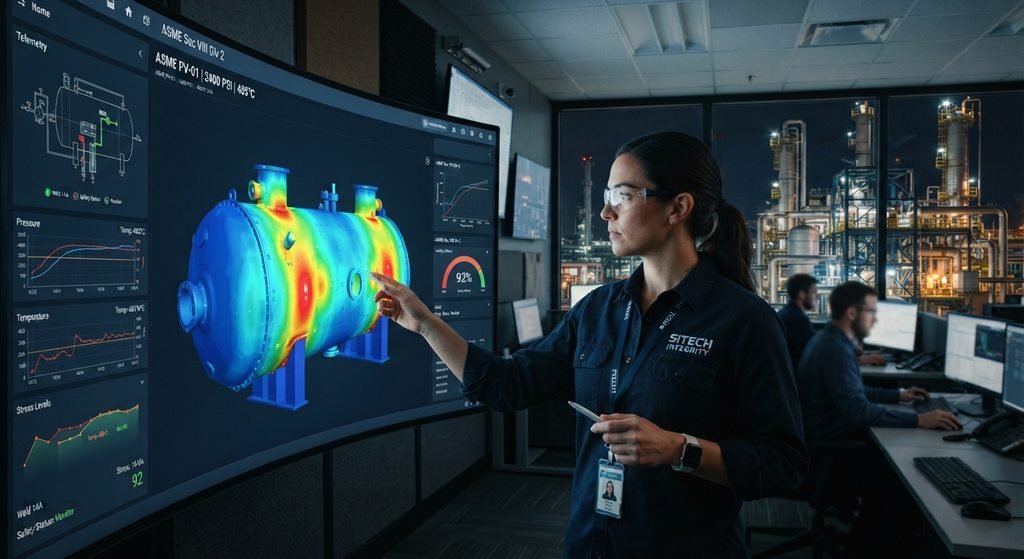
In heavy process industries—ranging from oil refineries and chemical manufacturing to nuclear power generation—pressure vessels operate under extreme stresses, fluctuating temperatures, and corrosive environments. Traditionally, maintaining the mechanical integrity of these critical assets relied on calendar-based preventive maintenance schedules and periodic shutdown inspections mandated by codes such as ASME Section VIII and API 510.
However, the advent of Industry 4.0 is reshaping asset integrity management. At the forefront of this shift is the Digital Twin—a dynamic, real-time virtual replica of a physical pressure vessel synchronized continuously through Industrial Internet of Things (IIoT) sensors.
By combining real-time operating parameters with physics-based engineering formulas and international design codes, digital twins allow plant engineers to transition from reactive inspections to continuous, predictive pressure vessel lifecycle management.
1. What is a Digital Twin for Industrial Pressure Vessels?
A pressure vessel digital twin is not merely a static 3D CAD model or a SCADA dashboard. It is a multi-physics, code-compliant computational model that mirrors the actual physical state, structural health, and operating history of an active vessel over time.
+-------------------------------------------------------------------------+
|                    DIGITAL TWIN DATA ARCHITECTURE                       |
+-------------------------------------------------------------------------+
|   PHYSICAL ASSET (Plant)       |  REAL-TIME IIOT SENSOR LAYER           |
|   - Pressure Vessel            |  - Ultrasonic Thickness Sensors        |
|   - High-Pressure Piping       |  - High-Temp Strain Gauges & PT/TT      |
|   - Heat Exchangers            |  - Acoustic Emission Transducers       |
+--------------------------------+----------------------------------------+
                                 |  (Continuous Data Stream via Edge/Cloud)
                                 v
+-------------------------------------------------------------------------+
|                  PHYSICS-BASED DIGITAL TWIN CORE                        |
+-------------------------------------------------------------------------+
|  - ASME Sec VIII Div 1/2 Stress Calculations                            |
|  - Real-Time Finite Element Analysis (FEA)                             |
|  - Dynamic Remaining Useful Life (RUL) & Fatigue Models                |
+-------------------------------------------------------------------------+
                                 |
                                 v
+-------------------------------------------------------------------------+
|                   PREDICTIVE ASSET INTEGRITY DASHBOARD                  |
+-------------------------------------------------------------------------+
|  - Automated Corrosion Rate Tracking & Wall Loss Warnings              |
|  - RBI (Risk-Based Inspection) Interval Adjustments                    |
|  - Code-Compliant Audit Logs & ECN Documentation Generation             |
+-------------------------------------------------------------------------+
Key Components of a Pressure Vessel Digital Twin
- The Physical Layer: The operating equipment (e.g., a reactor shell, gas separator, or boiler drum).
- The Sensor & IoT Layer: Wireless non-intrusive sensors installed across critical stress nodes, nozzles, and high-corrosion zones.
- The Physics Engine: Algorithmic routines using design equations from ASME BPVC Section VIII Division 1 & Division 2.
- The Analytical Model: Machine learning algorithms trained on historical operating telemetry to forecast material degradation, creep, and fatigue cycling.
2. Integrating IoT Sensor Networks for Real-Time Telemetry
To build an accurate digital twin, continuous real-time data must feed the virtual model. Traditional plants rely on spot-check measurements taken every few years during plant turnarounds. Digital twins, by contrast, utilize specialized Industrial IoT hardware:
- Non-Intrusive Ultrasonic Thickness (UT) Sensors: Permanently mounted on vessel walls and elbows to continuously measure wall loss from internal corrosion or erosion with micron-level precision.
- High-Temperature Strain Gauges: Positioned at high-stress concentrations (such as nozzle-to-shell junctions or support skirts) to monitor mechanical strain induced by pressure surges or thermal expansion.
- Acoustic Emission (AE) Transducers: Detect high-frequency elastic waves emitted by micro-crack initiation or active stress corrosion cracking (SCC) prior to surface manifestation.
- Pressure and Temperature Transmitters ($P/T$): Capture transient operational spikes, thermal cycles, and process excursions that cause low-cycle fatigue.
3. Merging Real-Time Telemetry with ASME Section VIII Code Rules
The true power of a pressure vessel digital twin lies in marrying real-time sensor streams with governing design standards like the ASME Boiler and Pressure Vessel Code (BPVC).
Dynamic Stress Calculation
Under ASME Section VIII, Division 1 (Design-by-Formula), the required nominal shell thickness $t$ for a cylindrical shell subjected to internal design pressure $P$ is calculated as:
$$t = \frac{P \cdot R_i}{S \cdot E – 0.6 \cdot P} + CA$$
Where:
- $P$ = Internal design pressure (psi or MPa)
- $R_i$ = Inside radius of the shell (inches or mm)
- $S$ = Maximum allowable stress value of the material at design temperature (psi or MPa)
- $E$ = Joint efficiency factor based on NDE examination
- $CA$ = Corrosion allowance (inches or mm)
In a conventional design workflow, $P$ and $CA$ are static conservative estimates. In a Digital Twin environment, the actual remaining wall thickness $t_{\text{current}}(\tau)$ is measured continuously via embedded UT sensors, and the operational pressure $P(\tau)$ is updated millisecond by millisecond.
The system dynamically calculates the actual hoop stress $\sigma_h(\tau)$ developed in the vessel wall:
$$\sigma_h(\tau) = \frac{P(\tau) \cdot D_i}{2 \cdot t_{\text{current}}(\tau) \cdot E}$$
If pressure spikes coincide with accelerated localized wall loss, the Digital Twin immediately recalculates the adjusted maximum allowable working pressure (MAWP) and alerts operators long before the vessel breaches code safety margins.
Design-by-Analysis (Division 2) Integration
For complex or high-pressure applications governed by ASME Section VIII, Division 2, the digital twin utilizes real-time process data to feed automated Finite Element Analysis (FEA) models. This allows plant engineers to map dynamic thermal gradients, evaluate peak thermal stresses, and assess cumulative fatigue damage using miner’s linear damage rule:
$$D_{\text{fatigue}} = \sum \frac{n_i}{N_i} \le 1.0$$
Where $n_i$ represents the actual operational cycles recorded by IoT sensors at a given stress range, and $N_i$ is the allowable cycle limit defined by the ASME fatigue curves.
4. Predictive Maintenance and Remaining Useful Life (RUL)
By replacing static assumptions with continuous empirical telemetry, digital twins shift plant maintenance strategies from time-based overhauls to Risk-Based Inspection (RBI) and Predictive Maintenance (PdM).
| Evaluation Metric | Traditional Inspection (API 510 / ASME) | Digital Twin-Enabled Operations |
| Data Collection | Periodic manual UT thickness readings during turnarounds | Continuous, real-time wireless IIO-UT sensor streaming |
| Corrosion Tracking | Linear extrapolation based on two historical data points | Dynamic, non-linear corrosion rate tracking based on real process chemistry |
| Fatigue Monitoring | Estimated cycle counts based on operator logbooks | Real-time counting of thermal/pressure transients via rainflow algorithms |
| Maintenance Action | Fixed 5-year or 10-year internal visual inspection intervals | Condition-based maintenance triggered only when structural limits are approached |
| Shutdown Risks | Unexpected leakages between scheduled inspection windows | Early warning alerts months prior to potential safety factor breach |
Real-Time RUL Computation
The dynamic Remaining Useful Life (RUL) of a vessel component operating in a corrosive environment is computed as:
$$RUL = \frac{t_{\text{current}} – t_{\text{min}}}{CR_{\text{real-time}}}$$
Where:
- $t_{\text{current}}$ = Live measured wall thickness from IIoT transducers.
- $t_{\text{min}}$ = Code-calculated minimum required wall thickness per ASME rules.
- $CR_{\text{real-time}}$ = Current localized corrosion rate derived over moving time windows.
If chemical process changes cause a sudden surge in $CR_{\text{real-time}}$, the twin automatically updates the vessel’s retired date and adjusts recommended inspection windows within the plant’s computerized maintenance management system (CMMS).
5. Integrating Non-Destructive Examination (ASME Section V)
A digital twin is only as accurate as its baseline geometry. When a pressure vessel is fabricated or modified, baseline NDE inspections—such as Digital Radiography (DR), Phased Array Ultrasonic Testing (PAUT), or Time-of-Flight Diffraction (TOFD) conducted per ASME Section V—are performed.
+-------------------------------------------------------------------------+
|                  ASME SEC V NDE DATA INTEGRATION                        |
+-------------------------------------------------------------------------+
|  Baseline NDE Data (PAUT/DR/TOFD Scans per ASME Sec V)[cite: 4, 5]     |
|                                  │                                      |
|                                  ▼                                      |
|  Volumetric Spatial Mesh (3D Defect Mapping: Porosity, Inclusions)     |
|                                  │                                      |
|                                  ▼                                      |
|  Real-Time Operational Stress Superposition (Digital Twin Core)         |
|                                  │                                      |
|                                  ▼                                      |
|  Automated Fracture Mechanics & Crack Propagation Analysis              |
+-------------------------------------------------------------------------+
By uploading full volumetric scan datasets into the digital twin, known baseline indications (such as allowable non-critical weld inclusions or minor geometric discontinuities) are mapped in 3D space. As operational stress telemetry flows in, the twin calculates localized stress intensity factors ($K_I$) at the exact coordinates of those volumetric indications to ensure they remain below critical crack propagation thresholds.
6. Key Implementation Challenges & The Path Forward
While the benefits of digital twins are transformative, implementing them across heavy industrial facilities presents notable engineering challenges:
- Harsh Environment Sensor Reliability: IIoT sensors attached to vessels operating above $400^\circ\text{C}$ or in sub-zero offshore conditions must maintain calibration without signal drift over years of service.
- Cybersecurity & Data Governance: Integrating field-level OT (Operational Technology) sensor networks with cloud-based digital twin physics engines requires robust cybersecurity per IEC 62443 standards.
- Code Compliance & Regulatory Acceptance: While major standards organizations recognize digital monitoring, physical sign-offs by certified inspectors (e.g., Authorized Inspectors holding NBIC/API commissions) remain legally mandatory for major repairs and re-certifications.
Summary: The Future of Asset Integrity Management
Digital twins represent the ultimate synthesis of mechanical engineering physics, data science, and code compliance. By combining real-time IoT telemetry with the rigorous structural rules of ASME Section VIII and ASME Section V, plant operators can maximize equipment uptime, eliminate catastrophic failures, and optimize the total lifecycle cost of critical pressure equipment.
🎓 Bridge the Gap Between Theory & Industrial Execution
Navigating modern industrial digitalization, mastering international design codes (ASME, ISO, API), and maintaining field-ready technical documentation requires specialized skill sets.
At Free Documents Hub, we specialize in providing high-quality, field-ready engineering templates, technical documentation frameworks, and operational standards tailored for plant professionals and engineering firms.
We also offer specialized remote training programs designed to bridge the gap between academic theory and real-world industrial practice, helping engineers master:
- ASME Section VIII (Div 1 & Div 2) and Section V NDE Literacy
- Quality Assurance (QA/QC) Frameworks & Industrial Documentation
- Design for Manufacturability (DFM) & Asset Integrity Management[cite: 2]
🛠️ Explore Our Digital Resource Libraries:
- Gumroad Store: https://iftakhar.gumroad.com/[cite: 2]
- Payhip Store: https://payhip.com/b/pLP7W[cite: 2]
📩 Claim Your Free Trial: Want to elevate your technical documentation skills, master code compliance, or request custom project support? Contact our engineering team today at contact@freedocumentshub.com to claim your FREE trial sample!