
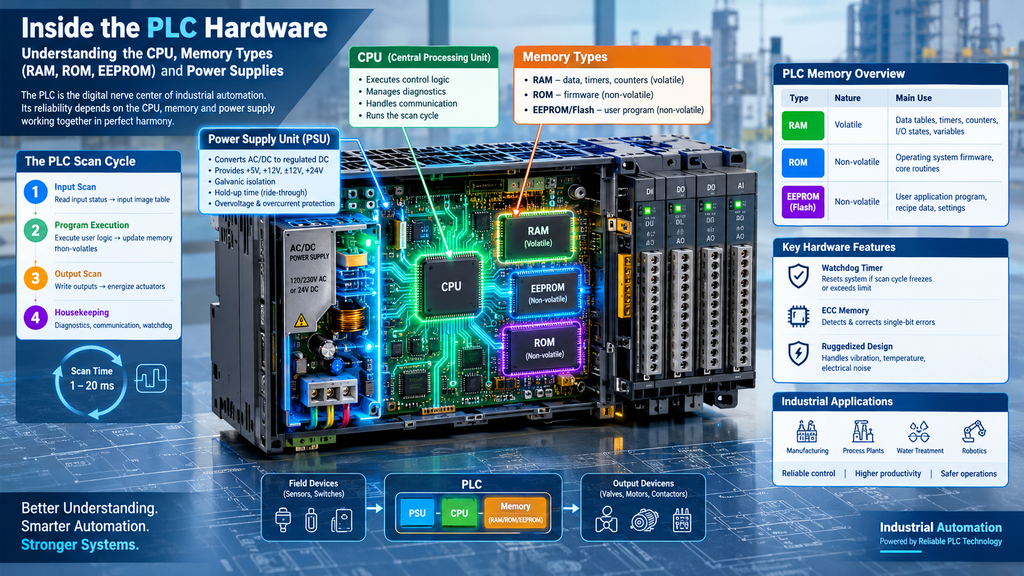
In the world of modern industrial automation, the Programmable Logic Controller (PLC) serves as the undisputed digital nerve center. From high-speed automotive assembly lines and chemical processing plants to water treatment facilities and robotics cells, PLCs orchestrate complex electromechanical processes with split-second precision.
While control engineers spend countless hours writing ladder logic, structured text, or function block diagrams, the reliability of any automation system ultimately rests on its hardware architecture. Understanding what happens beneath the enclosure casing—specifically inside the Central Processing Unit (CPU), the diverse memory subsystems, and the robust power supply unit (PSU)—is essential for designing fault-tolerant, high-performance industrial systems.
1. The Central Processing Unit (CPU): The Brain of the PLC
At the heart of every PLC lies the Central Processing Unit. Unlike general-purpose computers designed to run operating systems like Windows or Linux, a PLC CPU is a dedicated, ruggedized microprocessor engineered specifically to execute deterministic control algorithms in harsh industrial environments—characterized by electrical noise, extreme temperatures, and continuous vibration.
Core Processing Responsibilities
The CPU coordinates all internal operations of the controller. Its primary functions include:
- Executing User Control Logic: Reading input statuses, evaluating boolean and arithmetic instructions, and updating output states based on the programmed software.
- Managing System Diagnostics: Continuously monitoring internal hardware health, communication port status, battery voltage, and memory integrity.
- Handling Communication Protocols: Managing data exchange with Human-Machine Interfaces (HMIs), Supervisory Control and Data Acquisition (SCADA) systems, Variable Frequency Drives (VFDs), and remote I/O nodes via industrial Ethernet (e.g., Profinet, EtherNet/IP) or serial buses (e.g., Modbus).
The Deterministic PLC Scan Cycle
Unlike standard computing where tasks are handled asynchronously through interrupts and multithreading, a PLC operates on a continuous, cyclic execution model known as the Scan Cycle. Understanding the scan cycle is critical for troubleshooting timing issues and high-speed machine control.
| Scan Cycle Phase | Action Performed | Engineering Significance |
| 1. Input Scan | The CPU samples the physical state of all input terminals (sensors, pushbuttons, limit switches) and copies their states into the input image table memory. | Captures real-time field conditions at a frozen instant in time. |
| 2. Program Execution | The CPU executes the user program line-by-line (or rung-by-rung) from top to bottom, reading from and writing to the memory tables. | Calculates output states based on current input images and internal memory variables. |
| 3. Output Scan | The CPU takes the finalized output image table and updates the physical output terminals, energizing or de-energizing relays, solenoids, and motor starters. | Drives physical actuators in the manufacturing plant. |
| 4. Housekeeping | Performs internal diagnostics, communication updates, peripheral servicing, and watchdog timer resets. | Ensures system stability and prevents lockups or communication dropouts. |
The total time required to complete one full cycle is called the Scan Time, typically ranging from 1 to 20 milliseconds depending on program complexity and processor speed.
2. PLC Memory Types: Storing Programs and Data
A PLC requires robust memory storage to hold both the operating firmware and the user-defined control program, as well as to temporarily store operational data during execution. Industrial memory is broadly categorized into volatile (loses data when power is removed) and non-volatile (retains data without power) types.
A. Random Access Memory (RAM)
- Nature: Volatile electronic memory.
- Role: RAM is used primarily for the Data Table and variable storage. It holds timer/counter accumulated values, internal relay states ($M$ or $B$ bits), analog input/output registers, and data blocks.
- The Battery Backup Challenge: Because RAM is volatile, modern PLCs incorporate a small lithium coin cell battery or supercapacitor. If main plant power fails, the battery maintains RAM contents so that machine recipes, production counts, and intermediate states are not lost. When the battery voltage drops below a critical threshold, a diagnostic fault is flagged on the CPU module.
B. Read-Only Memory (ROM)
- Nature: Non-volatile semiconductor memory.
- Role: ROM stores the foundational operating system firmware supplied directly by the PLC manufacturer. This includes the core executive program, hardware initialization routines, communication stack handlers, and instruction set interpreters.
- Characteristics: The end-user cannot write to or alter standard ROM chips. This guarantees that critical system software remains secure and uncorrupted even during catastrophic power surges or total power loss.
C. EEPROM and Flash Memory
- Nature: Electrically Erasable Programmable Read-Only Memory (and modern high-density Flash memory).
- Role: EEPROM acts as permanent non-volatile storage for the user application program (the ladder logic or structured text written by the engineer).
- Operational Integration: When a PLC is powered on, the CPU typically copies the user program from the non-volatile EEPROM into high-speed RAM for rapid execution. Many advanced modular PLCs feature removable memory cartridges or SD cards containing EEPROM, allowing maintenance technicians to swap out a failed CPU module and restore the entire machine program within seconds simply by inserting the card into the new hardware.
3. Power Supply Units (PSU): Fueling the Control Architecture
In industrial environments, incoming electrical power is notoriously unstable, prone to voltage sags, electrical surges, harmonic distortion, and electromagnetic interference (EMI). The Power Supply Unit (PSU) in a PLC rack is much more than a simple transformer; it is a heavily regulated conversion and conditioning module.
Core Functions of the PLC Power Supply
- Voltage Conversion: Step down and rectify standard industrial line voltages (typically 120V/230V AC or 24V DC) down to clean, tightly regulated internal logic voltages (+5V DC for processor logic and ICs, +12V/-12V DC or +24V DC for communication circuits and loop-powered sensors).
- Galvanic Isolation: Using transformers and optocouplers to provide complete electrical isolation between the noisy industrial field power circuits and the sensitive microelectronic control circuits inside the CPU and backplane.
- Power-Loss Ride-Through (Hold-up Time): During brief brownouts or power dips, internal capacitors in the PSU maintain regulated DC output voltages for a few milliseconds (hold-up time). This brief window allows the CPU to detect impending power failure, execute an orderly shutdown routine, store critical retentive data to non-volatile memory, and safely drop all digital outputs to prevent erratic machine behavior.
- Overvoltage and Overcurrent Protection: Built-in electronic crowbar circuits and thermal fuses protect expensive backplane modules against short circuits on field wiring or massive utility grid spikes.
4. Hardware Integration and Industrial Reliability
The synergy between the CPU, memory architecture, and power supply forms the backbone of industrial dependability. Modern PLC hardware is designed with rigorous fault-tolerance features:
- Watchdog Timers: An independent hardware timer monitored by the CPU. If a software bug or electrical noise causes the scan cycle to freeze or exceed its maximum allowed duration, the watchdog timer instantly trips, cutting power to outputs and forcing a safe system reset.
- Error-Correcting Code (ECC) Memory: Higher-end process controllers use ECC RAM to automatically detect and correct single-bit memory errors caused by ambient electrical noise or cosmic radiation, preventing random controller crashes in critical infrastructure.
🎓 Accelerate Your Engineering Career with Free Documents Hub
Knowing how internal PLC hardware operates is only half the battle; mastering industrial automation standards, control documentation, and quality compliance is what sets top-tier engineers apart.
At Free Documents Hub, we offer specialized remote training programs covering industrial engineering design, PLC programming, quality control, and technical documentation. Our programs are specifically designed to bridge the gap between academic theory and real-world shop-floor execution.
🛠️ Ready to elevate your engineering credentials?