
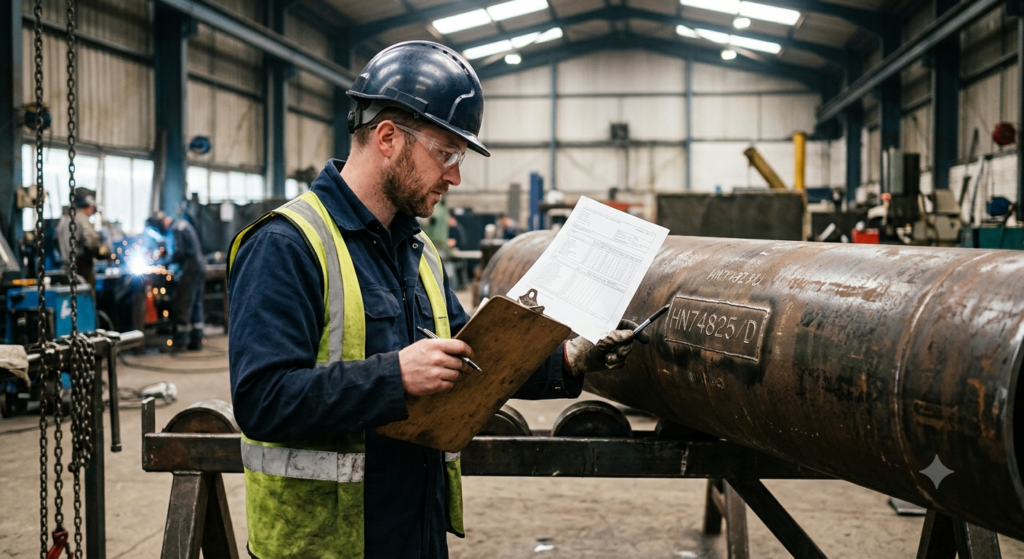
A Material Test Report — commonly called an MTR, CMTR, or mill certificate — is one of the most frequently requested and most frequently disputed documents in industrial vendor approval. Saudi Aramco auditors, ASME Authorized Inspectors, and EPC quality engineers all ask for it before they accept a single piece of material into a project. Yet many workshops still submit an MTR that does not match the material on the shop floor, does not match the project specification, or is not a valid mill document at all.
This guide explains exactly what an MTR is, what it must contain, how to read every field on it, and how to tell a genuine certificate from one that will not survive an audit.
| Struggling to Get Your Material Documentation Audit-Ready? FreeDocumentsHub helps fabrication workshops compile complete, traceable material certification packages that satisfy Saudi Aramco AVL auditors and ASME Authorized Inspectors — no rejected submissions, no last-minute scrambling before an audit. → Get in touch through FreeDocumentsHub.com |
What Is a Material Test Report (MTR)?
A Material Test Report is a document issued by the material manufacturer — a steel mill, pipe mill, forging shop, or fastener producer — certifying that a specific batch of material meets the chemical composition and mechanical property requirements of the purchase order and the governing specification (ASTM, ASME, API, or equivalent).
It goes by several names depending on the industry and the region: Certified Material Test Report (CMTR), mill certificate, mill cert, or material certificate. Whatever the name, it serves one purpose — proving that the material you received is the material you paid for, and that it meets the code requirements for the service it will be used in.
The certification level itself is governed internationally by EN 10204, which defines exactly who is allowed to issue the report and how independent that verification must be. This single standard is the reason one MTR can satisfy a low-pressure structural job while a near-identical-looking certificate gets rejected on a pressure vessel project.
Why MTRs Matter for Vendor Approval and Quality Compliance
- Material traceability is a hard requirement under ASME Section II, ASME Section VIII, API specifications, and Saudi Aramco engineering standards — material without a traceable MTR cannot legally go into pressure-retaining or safety-critical fabrication.
- A valid MTR is the front line of defense against counterfeit or substituted material entering a fabrication job — a problem regulators and operators take extremely seriously.
- The MTR becomes part of the Manufacturing Data Report (MDR) / final data book handed to the client and the Authorized Inspector — it cannot be added or corrected after the fact.
- A missing, mismatched, or invalid MTR is consistently one of the top non-conformances raised during Saudi Aramco AVL audits, and one of the most common reasons vendor registration gets delayed or suspended.
What Information Appears on a Genuine MTR
A complete, code-compliant MTR will always contain the following fields. If any of these are missing, treat the document as incomplete until the mill confirms otherwise.
- Heat / Lot / Cast Number — the unique identifier that ties the paper document to the physical material. This is the single most important field on the entire report.
- Material Specification & Grade — e.g., ASTM A106 Grade B, ASME SA516 Grade 70, matching exactly what the purchase order calls for.
- Mill / Manufacturer Name and Location — a real, traceable producer with a verifiable address and registration.
- Chemical Composition — percentages of Carbon, Manganese, Phosphorus, Sulfur, Silicon, Chromium, Nickel, Molybdenum and other elements relevant to the grade, each compared against the specification’s allowable range.
- Mechanical Properties — yield strength, tensile strength, elongation percentage, hardness, and Charpy impact values where the code requires impact testing.
- Heat Treatment Condition — for example Normalized, Quenched & Tempered, or As-Rolled — this affects mechanical properties and must match the design requirement.
- Dimensions, Size, and Quantity — matching the purchase order line item.
- NDT Results (where applicable) — ultrasonic or radiographic test results for plates and forgings supplied with built-in NDT.
- Certificate Type per EN 10204 — stated explicitly as 2.1, 2.2, 3.1, or 3.2.
- Mill Stamp, Certificate Number, and Authorized Signature — the formal authentication that makes the document a certified report rather than an internal worksheet.
Understanding EN 10204 Certificate Types
EN 10204 defines four certificate types based on who performs the inspection and how independent that inspection is from the production line. Confusing a 2.1 declaration with a 3.1 inspection certificate is one of the fastest ways to fail a documentation review.
| Type | Issued / Verified By | Independent Check? | Typical Use |
| 2.1 | Manufacturer | No | Declaration of compliance only — general, non-critical material |
| 2.2 | Manufacturer | No | Test report based on non-specific (batch) inspection |
| 3.1 | Manufacturer’s own QC dept, independent of production | Internal, independent department | Most common requirement for ASME / Aramco pressure equipment |
| 3.2 | Manufacturer + purchaser’s appointed inspector or independent third party | Yes — external/independent body | Highest assurance; critical service, Category III/IV vessels, AI witness |
How to Read an MTR — Step by Step
- Step 1 — Match the heat/lot number. Locate the heat or lot number on the certificate and confirm it matches the marking physically stamped, painted, or tagged on the material itself. If the numbers don’t match, the certificate does not belong to that material.
- Step 2 — Confirm specification and grade. Check that the spec and grade on the MTR are identical to what the purchase order and project specification require — not just a ‘similar’ or ‘equivalent’ grade.
- Step 3 — Check the chemical composition. Compare each reported element against the allowable range in the governing ASTM/ASME specification. A single element outside range invalidates the material for that grade.
- Step 4 — Check the mechanical properties. Verify yield strength, tensile strength, elongation, and (if applicable) impact values meet or exceed the code’s minimum requirements.
- Step 5 — Confirm the heat treatment condition. Make sure the condition listed matches what the design calls for — mechanical properties are only valid for the stated heat treatment condition.
- Step 6 — Confirm the certificate type. Check that the EN 10204 type (2.1/2.2/3.1/3.2) matches what the contract or project specification actually requires.
- Step 7 — Check the mill name, certificate number, and signature. Confirm these are present and consistent with the mill’s known certification format.
How to Verify an MTR Is Genuine — Red Flags to Watch For
Reading an MTR tells you what it claims. Verifying it tells you whether those claims are true. Watch for these warning signs before accepting any certificate into your documentation package.
| Red Flags on an MTR No heat/lot number, or a heat number that does not match the marking on the materialMechanical or chemical values that look suspiciously ‘perfect’ or identical across unrelated certificatesMissing mill letterhead, logo, address, or contact detailsNo signature, stamp, or certificate number anywhere on the documentUnits that are inconsistent with the mill’s normal reporting practiceA mill name that cannot be independently verified or locatedLow-resolution scans or photocopies with visible editing artifactsCertificate type that does not match what the project specification requires |
Practical Verification Steps
- Cross-check the mill against the client’s Approved Manufacturer or Approved Source List before accepting material.
- Use the mill’s online certificate verification portal where one is available — most major producers now offer this.
- Request Positive Material Identification (PMI) testing on-site to confirm the alloy content physically matches what the MTR claims.
- Request a mill-stamped original rather than a photocopy whenever there is any doubt.
- For high-value or critical material, contact the mill directly and confirm the certificate number against their own records.
MTR Traceability and Saudi Aramco AVL / ASME Vendor Approval
During a Saudi Aramco AVL audit or an ASME survey for U Stamp accreditation, the auditor or Authorized Inspector does not simply read your MTRs in a folder — they physically check heat numbers stamped on the actual material against the MTRs in your data book, often at random, sometimes against the Inspection and Test Plan (ITP) witness points.
If a heat number on the shop floor cannot be traced back to a valid, matching MTR, the finding is treated as a serious non-conformance. Depending on severity, this can mean a rejected lot, a delayed shipment, or — in repeated cases — suspension from the Approved Vendor List itself. Material traceability is not a paperwork formality in this industry; it is the foundation the entire approval system is built on.
Common Mistakes Workshops Make With MTRs
- Filing MTRs by purchase order number instead of heat number, which makes traceability nearly impossible to demonstrate during an audit.
- Accepting a generic ‘material certificate’ instead of confirming it is a properly mill-issued, correctly-typed EN 10204 document.
- Not checking which certificate type the project specification actually requires before placing the material order.
- Losing the link between the MTR and the physical material once it enters cutting, beveling, or fabrication.
- Submitting an MTR in the final data book that does not match the NDT or PMI results recorded later in the same package.
| Free Download: MTR Verification Checklist Grab the one-page reference card covering every required MTR field, the EN 10204 certificate types at a glance, and the red flags checklist from this article — print it and keep it at the material receiving station. → Download the free MTR Verification Checklist below |
Conclusion
An MTR is only as useful as the traceability behind it. A workshop that knows how to read every field, match every heat number, and recognize a red flag before it reaches the data book is a workshop that passes audits the first time — instead of scrambling to explain a mismatch after the fact.
If your team is preparing a Saudi Aramco AVL submission, an ASME U Stamp survey, or simply wants its material documentation audit-proof, getting the MTR process right is one of the highest-leverage places to start.
| Preparing for Saudi Aramco AVL or ASME Vendor Approval? FreeDocumentsHub helps fabrication workshops build complete, audit-ready documentation packages — from material traceability and MTR verification to full vendor registration data books. → Get in touch through FreeDocumentsHub.com |