
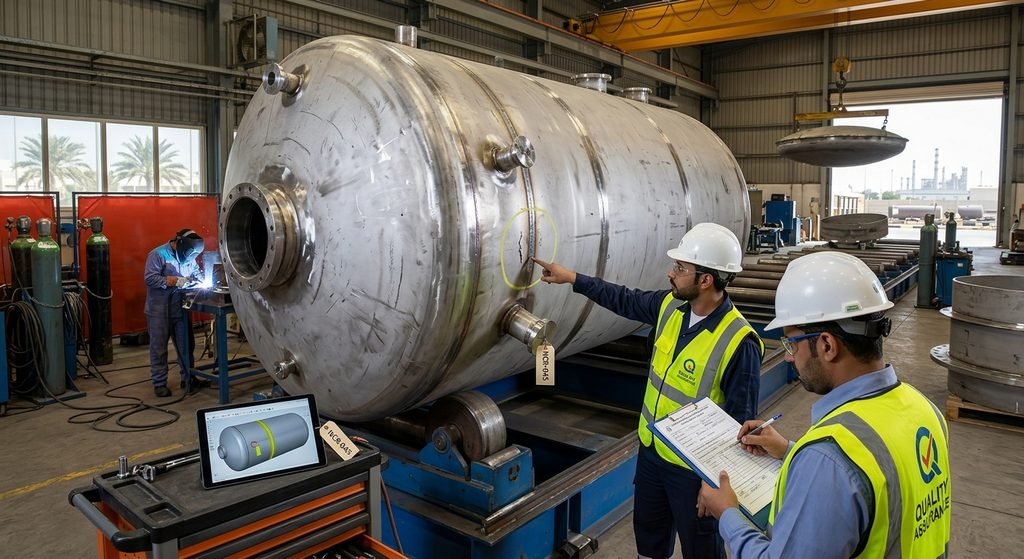
| In this article: What an NCR (Non-Conformance Report) is, the different types of NCR used in pressure vessel fabrication and plant maintenance, why the NCR system exists, the step-by-step procedure to raise, disposition, and close one, and the full set of documents required to support it. All documents referenced are available ready-made on our Gumroad and Payhip stores, or built custom to your project — contact us, available 24/7. |
Every pressure vessel fabrication shop and every operating plant eventually finds something that doesn’t match the drawing, the spec, or the code. A weld that fails NDE, a plate thickness that measures under minimum, a nameplate that doesn’t match the material certificate — these things happen on every project, no matter how careful the workmanship. What separates a well-run QA/QC system from a weak one isn’t whether non conformances happen; it’s whether there’s a documented, auditable process for catching, evaluating, and closing them. That process runs through the Non-Conformance Report, or NCR.
What Is an NCR?
An NCR (Non-Conformance Report) is a formal quality document raised whenever a product, material, process, or activity fails to meet a specified requirement — a code, a drawing, a project specification, or an approved procedure. It’s the mechanism that stops a nonconforming item from silently moving forward in fabrication or staying in service, and instead forces a documented decision about what happens to it.
NCRs are a core requirement of ISO 9001 quality management systems and are explicitly expected under ASME Section VIII (pressure vessel fabrication) and API-based inspection and maintenance programs. A vessel fabricator or plant without a working NCR system has no defensible way to prove that a known defect was properly evaluated rather than simply ignored.
Types of NCR
NCRs are generally classified two ways: by severity, and by source. Both classifications matter — severity determines who has to approve the disposition, and source determines which department and which documents are involved in resolving it.
By Severity
| Classification | Description |
| Critical / Major NCR | Affects the pressure boundary, structural integrity, or safety-critical function of the item — e.g., a weld defect exceeding code acceptance criteria, wrong material grade installed, missed post-weld heat treatment. Requires engineering, client, and often third-party (TPI) approval before disposition. |
| Minor NCR | Does not affect fitness for service, safety, or code compliance — e.g., a cosmetic surface finish issue, a minor dimensional deviation within engineering judgment, a documentation formatting error. Can usually be dispositioned at the QC/engineering level without client escalation. |
By Source
| Category | Typical Examples |
| Material NCR | Wrong grade or heat number supplied, missing or mismatched material test certificate, material damage during handling. |
| Welding/Fabrication NCR | Weld defects, unqualified welder or WPS used, incorrect joint preparation, dimensional distortion from welding. |
| NDE NCR | Radiography, ultrasonic, or magnetic particle results showing indications beyond acceptance criteria. |
| Dimensional NCR | Out-of-tolerance dimensions, nozzle orientation errors, shell/head mismatch. |
| Documentation/Procedural NCR | Missing sign-offs, use of an outdated procedure revision, incomplete traceability records. |
Why the NCR System Is Implemented
An NCR system exists to make sure nonconformances are caught, evaluated, and resolved through a documented, repeatable process rather than an informal decision made on the shop floor or in the field. Specifically, it:
- Prevents a defective or non-compliant item from progressing to the next fabrication stage or remaining in service undetected.
- Creates a permanent, auditable record that regulators, clients, and third-party inspectors can review.
- Forces a documented engineering disposition — Use-As-Is, Repair, Rework, or Reject — rather than an undocumented judgment call.
- Feeds root cause analysis and corrective action, so the same nonconformance doesn’t repeat across the project.
- Protects the fabricator, contractor, and client by clearly recording who identified the issue, who approved the resolution, and how it was verified.
The NCR Procedure — Step by Step
1. Identification and Initiation
Anyone in the QC, inspection, welding, or maintenance chain — including client or TPI representatives — can identify and initiate an NCR. The nonconforming item is immediately tagged or physically segregated (‘hold’ status) to prevent it from being used, shipped, or returned to service before a disposition is made.
2. NCR Documentation
An NCR number is assigned, and the report is completed with the drawing/spec reference, a clear description of the nonconformity, the applicable code clause, photographs where relevant, and the inspector’s or engineer’s initial assessment.
3. Disposition Review
A Material Review Board (MRB) — typically QC, engineering, and for major NCRs, the client and/or TPI — reviews the NCR and assigns one of four dispositions: Use-As-Is (with engineering justification), Repair, Rework, or Reject/Scrap. For pressure boundary items, this step almost always requires client and TPI sign-off before work proceeds.
4. Root Cause Analysis (Major NCRs)
For major or recurring nonconformances, a root cause analysis is performed — commonly a 5-Why or fishcone/Ishikawa method — to identify the underlying cause rather than just the symptom.
5. Corrective Action
Based on the root cause, a corrective action is defined and implemented — this might be a procedure revision, additional welder training, a supplier corrective action request, or a process control change — to prevent recurrence.
6. Repair/Rework Execution
If the disposition is Repair or Rework, the work is carried out under an approved repair procedure, often requiring the same qualification level (WPS/welder qualification) as the original fabrication.
7. Verification and Re-Inspection
The repaired or reworked item is re-inspected and, where applicable, re-tested (re-NDE, re-hydrotest) to confirm it now meets the original requirement.
8. Closure
Once verification is complete and all required approvals are on file, the NCR is formally closed and logged in the NCR register, with the full documentation package retained as part of the project’s quality records and final data book.
Documents Required to Support an NCR
A properly closed NCR isn’t a single form — it’s a documentation package. A complete NCR file typically includes:
NCR Form/Report — the core document — nonconformity description, code/spec reference, photos, and initial assessment.
Root Cause Analysis Report — documents the investigation into why the nonconformance occurred (for major/recurring NCRs).
Disposition/MRB Approval Record — records the Use-As-Is, Repair, Rework, or Reject decision and who approved it.
Repair/Rework Procedure — the approved procedure used to correct the nonconformance, where applicable.
Re-Inspection/Re-Test Report — NDE, dimensional, or hydrotest results confirming the corrected item now meets requirements.
Corrective Action Report (CAPA) — documents the action taken to prevent recurrence.
NCR Register/Log — tracks every NCR raised on the project by number, status, and closure date for audit purposes.
For pressure vessel fabrication under ASME Section VIII, this full package typically becomes part of the vessel’s final data book — meaning incomplete or missing NCR documentation can hold up final acceptance and stamping.
NCR in Plant Maintenance, Not Just Fabrication
The same system applies during plant turnarounds and routine inspections — not only new fabrication. When an inspector finds corrosion, wall thickness below the minimum required, or a defect during a scheduled shutdown, an NCR is raised the same way: identified, tagged, dispositioned (often feeding into a Fitness-for-Service or Risk-Based Inspection assessment), repaired or accepted with engineering justification, and closed with full documentation. The paperwork discipline doesn’t change just because the vessel is already in service rather than on the fabrication floor.
Where to Get These Documents
Templates for NCR forms, MRB disposition records, root cause analysis reports, corrective action reports, and NCR registers — matched to ASME Section VIII and ISO 9001 formats — are available ready-made on our Gumroad and Payhip stores, ready for instant download and project customization.
If your project needs these documents built to your specific numbering system, client format, or a scope not currently listed in our catalog, we prepare custom NCR and quality documentation packages remotely. Email contact@freedocumentshub.com — we’re available 24/7, and your first correction or trial document is free.
This article is intended as general technical background on the NCR process and does not replace project-specific quality procedures or a qualified QA/QC engineer’s review.