
Your workshop can fabricate perfectly. But without a U Stamp, you cannot enter oil and gas. This post explains what the ASME U Stamp is, why it exists, and why it is the single most important certification your workshop needs.
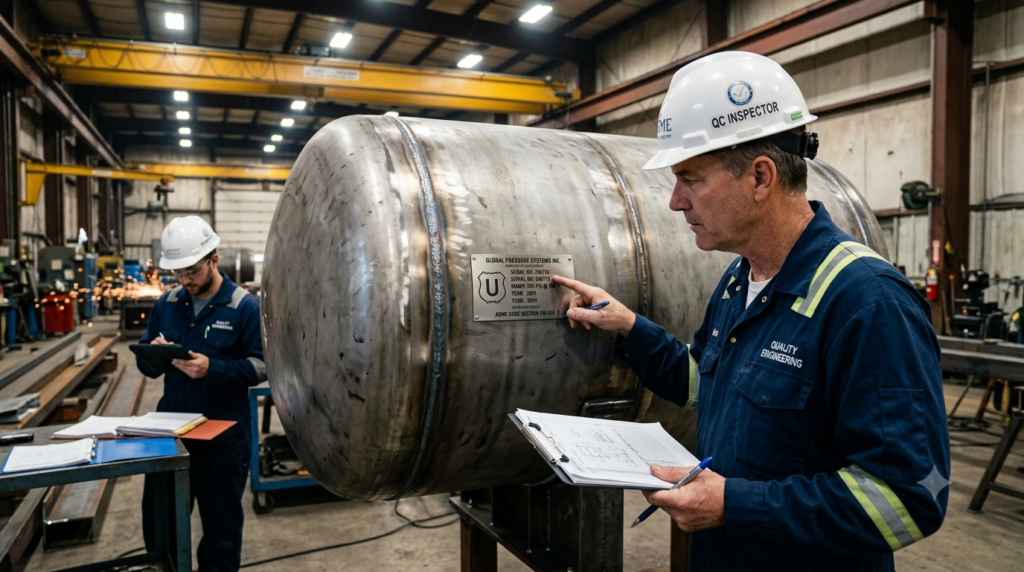
The Hard Reality: Certification Comes Before the Contract
Walk into any procurement office in the oil and gas industry in Saudi Arabia, the Gulf, or anywhere in the world, and hand them your company brochure. They will look at your equipment list, your welder certifications, your project portfolio. Then they will ask one question:
“Do you have the ASME U Stamp?”
If the answer is no, the conversation ends there. It does not matter that your welders have passed their qualifications. It does not matter that you have modern CNC equipment. It does not matter that you have delivered 50 vessels without a single failure.
Without the U Stamp, you are not on the approved vendor list. You will not be invited to tender. You are invisible to the biggest clients in the industry.
What Is the ASME U Stamp?
The ASME U Stamp is an official Certificate of Authorization issued by the American Society of Mechanical Engineers (ASME). It authorizes your workshop to fabricate pressure vessels in accordance with the ASME Boiler and Pressure Vessel Code — specifically Section VIII, Division 1.
When your workshop holds the U Stamp, it means:
- Your Quality Control system has been reviewed and approved by ASME.
- Your documentation — QC Manual, WPS, PQR, traveler records — meets the Code requirements.
- An Authorized Inspection Agency (AIA) such as Bureau Veritas, TUV, or Lloyd’s has agreed to provide third-party inspection for all stamped vessels.
- Your workshop has passed an on-site survey conducted by ASME representatives.
- Every pressure vessel you produce carrying the U Stamp has been built, tested, and documented to an internationally recognized standard.
The U Stamp is not a one-time inspection. It is not a quality award. It is a living certification that requires you to maintain your quality system every single day and to renew your Certificate of Authorization every three years through a repeat survey.
The ASME BPVC: The Standard Behind the Stamp
The ASME Boiler and Pressure Vessel Code (BPVC) is one of the oldest and most respected engineering standards in the world. It was first published in 1914 after a series of catastrophic boiler explosions that killed hundreds of people. Since then, it has evolved into a comprehensive framework that governs the design, fabrication, inspection, and testing of pressure-retaining equipment.
Section VIII, Division 1 is the section that governs unfired pressure vessels — the vessels your workshop fabricates for storage, processing, and separation in oil and gas facilities.
The Code specifies:
- How vessels must be designed (allowable stress, wall thickness calculations, nozzle reinforcement)
- Which materials are permitted and how they must be documented
- How welding must be performed and qualified (WPS and PQR requirements)
- Which Non-Destructive Examination (NDE) methods are required
- How hydrostatic or pneumatic pressure testing must be performed
- What documentation must accompany every vessel (the U-1 Data Report)
Why Oil and Gas Clients Require the U Stamp
Pressure vessels operate under extreme conditions. They contain hazardous fluids — hydrocarbons, chemicals, steam — at high pressures and high temperatures. A failure is not a minor incident. A vessel rupture can destroy an entire processing unit, kill workers, and trigger fires or explosions that shut down a facility for months.
Oil and gas operators cannot afford to rely on a vendor’s self-assessment. They need proof — verified by a third party — that every vessel was designed, fabricated, inspected, and tested to a recognized international standard.
The U Stamp provides that proof. It tells the client:
- This vessel was fabricated by a workshop whose quality system was independently verified.
- Every weld was performed under a qualified Welding Procedure Specification.
- Every weld was performed by a qualified welder.
- The vessel was inspected at mandatory hold points by an Authorized Inspector.
- The vessel passed a hydrostatic or pneumatic pressure test.
- All documentation has been reviewed and signed by the Authorized Inspector.
- The vessel carries a U-1 Data Report that records everything, permanently.
No other certification replaces this. ISO 9001 does not replace it. Local quality certifications do not replace it. It is the U Stamp or nothing.
What the U Stamp Does NOT Mean
There is a common misunderstanding among workshop owners who are preparing to apply. They assume that getting the U Stamp is primarily about improving their welding quality.
Welding quality matters. But it is only one element. Workshops fail their ASME surveys not because their welders cannot weld, but because their quality system cannot demonstrate control.
The most common reasons workshops fail or receive major non-conformances:
- QC Manual does not accurately describe actual shop practice
- WPS and PQR documents are incomplete, missing essential variables, or not properly qualified
- Material documentation cannot be traced from the mill certificate to the specific vessel
- Hold points for Authorized Inspector sign-off are not clearly defined or followed
- Pressure test records are incomplete or missing
- Personnel performing NDE do not hold current certifications
The U Stamp certifies your entire quality management system, not just your welding capability. This is the insight that separates workshops that pass on the first attempt from those that fail and spend months correcting deficiencies.
The Commercial Reality: What the U Stamp Unlocks
Beyond compliance, the U Stamp transforms your commercial position. Here is what changes when your workshop is certified:
- Access to oil and gas tenders: You become eligible to bid on pressure vessel contracts for refineries, petrochemical plants, LNG facilities, gas processing plants, and upstream production facilities.
- Preferred vendor status: Major operators and EPC contractors maintain Approved Vendor Lists (AVLs). The U Stamp is a prerequisite for AVL inclusion with most serious clients.
- Higher contract values: Stamped vessels command significantly higher prices than non-stamped fabrications. The certification justifies the premium and clients expect to pay it.
- Reduced client audit burden: The U Stamp reduces the need for clients to conduct their own detailed shop audits. Your certification is the assurance they need.
- Export opportunities: The ASME U Stamp is recognized internationally. It opens markets beyond your home country.
What Comes Next in This Series
Over the next six weeks, we will walk through every element of obtaining and maintaining your ASME U Stamp. Here is the full series:
- Post 2 — How to Apply for the ASME U Stamp: Step by step from application to Certificate of Authorization.
- Post 3 — The ASME U Stamp QC Manual: What it must contain and why most workshops get it wrong.
- Post 4 — WPS, PQR, and Welder Qualification for ASME: The documentation requirements explained.
- Post 5 — The Role of the Authorized Inspector and Authorized Inspection Agency.
- Post 6 — The ASME Survey: What happens during the assessment and how to prepare.
- Post 7 — Maintaining Your U Stamp: Renewal, surveillance, and keeping your QC system live.
Final Word
The ASME U Stamp is not a bureaucratic formality. It is the foundation of your workshop’s credibility in the pressure vessel industry. Every major project, every serious client, every high-value contract in oil and gas traces back to this certification.
If your workshop does not yet hold the U Stamp, now is the time to understand what it takes. If you already hold it, this series will help you ensure your system is solid enough to survive the next renewal survey without surprises.
Next week: How to apply for the ASME U Stamp — step by step from the initial application through to receiving your Certificate of Authorization