
Understanding what is ASME U Stamp certification is the first step
for any fabrication workshop that wants to supply pressure vessels
to oil and gas clients.
Your fabrication workshop can produce clean welds, certified materials, and immaculate documentation. But if you walk into a procurement office at Saudi Aramco, SABIC, ADNOC, Shell, or TotalEnergies without an ASME U Stamp on your wall — you will not get past the vendor qualification stage.
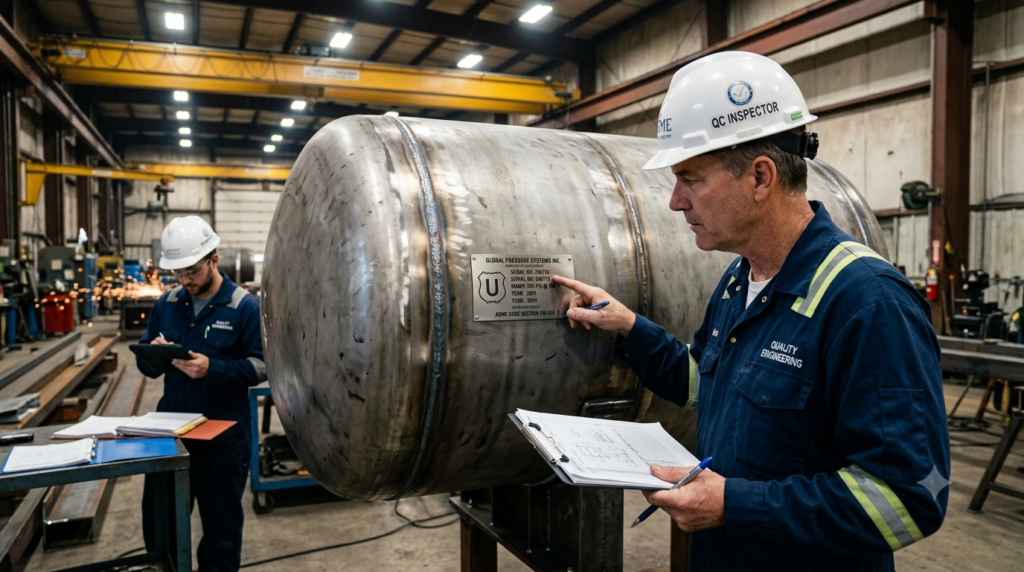
The ASME U Stamp is not a nice-to-have. It is not an optional quality award. For pressure vessel fabrication in the oil and gas, petrochemical, and power generation industries, it is the entry ticket. Without it, the biggest contracts in the world are simply not available to you.
This article explains exactly what the ASME U Stamp is, what it proves, who requires it, and why it matters so much. If you are a workshop owner, QC Manager, or Quality Engineer thinking about what your facility needs to compete at the highest level — this is where the conversation starts.
What Is ASME U Stamp?
ASME stands for the American Society of Mechanical Engineers. It is one of the world’s oldest and most respected engineering standards organisations, founded in 1880. ASME publishes the Boiler and Pressure Vessel Code — commonly called the BPVC — which is the global standard for the design, fabrication, inspection, and testing of pressure-containing equipment.
The U Stamp is a Certificate of Authorization issued by ASME to fabrication workshops that have demonstrated they can manufacture pressure vessels in full compliance with ASME Section VIII Division 1. When a workshop earns the U Stamp, it is authorised to physically stamp the nameplate of every qualifying vessel it produces with the ASME U symbol.
That small stamped letter on a nameplate tells the client, the regulator, and the insurance company one thing: this vessel was designed, fabricated, inspected, and tested to the most rigorous internationally recognised standard in the world. The official ASME Boiler and Pressure Vessel Code (BPVC) is
published and maintained by the American Society of Mechanical
Engineers at asme.org. https://www.asme.org/codes-standards/find-codes-standards/bpvc-boiler-pressure-vessel-code
| What the U Stamp Mark Actually Means When you see the ASME U symbol on a pressure vessel nameplate, it means: • The vessel was designed by a qualified engineer to ASME Section VIII Div.1. • All materials used carry full mill certifications and traceability. • All welding was performed by ASME Section IX qualified welders with approved WPS and PQR. • Full NDE (non-destructive examination) was completed per code requirements. • The vessel passed a hydrostatic test at 1.5 times the Maximum Allowable Working Pressure (MAWP). • An ASME Authorised Inspector (AI) independently witnessed and approved the entire process. • A complete Manufacturer’s Data Report (Form U-1) has been filed and is on record. |
The Difference Between U Stamp and U2 Stamp
ASME Section VIII has two divisions that are relevant to most fabrication workshops. Understanding the difference is important because they serve different market segments.
ASME Section VIII Division 1 — The U Stamp
Division 1 is the standard applied to the vast majority of pressure vessels in industrial service. It uses a design approach based on allowable stress values with built-in safety factors. The rules are well-established, widely understood, and accepted globally by clients, regulators, and insurance companies.
Division 1 covers vessels operating at pressures above 15 PSI (approximately 1 bar). The maximum pressure and temperature range is very broad, making this the go-to standard for separators, drums, heat exchangers, accumulators, and most process vessels in oil and gas and petrochemical service.
If your workshop is targeting the fabrication of standard process vessels for oil and gas clients, the U Stamp under Division 1 is the certification you need first.
ASME Section VIII Division 2 — The U2 Stamp
Division 2 is the advanced standard. It uses a more rigorous analytical approach — including detailed fatigue analysis — and allows for thinner wall thicknesses because the design method is more precise. Division 2 vessels are typically used in high-pressure, high-cycle, or critical service applications where weight saving is important or where the operating conditions are particularly demanding.
Achieving the U2 Stamp requires a higher level of engineering capability and documentation. It is generally pursued by workshops that have held the U Stamp for several years and are moving into more technically advanced work.
| U Stamp — Division 1 | U2 Stamp — Division 2 | |
| Design Method | Allowable stress with safety factor | Analytical / fatigue-based design |
| Typical Use | Standard process vessels, separators, drums | High-pressure, high-cycle, critical service |
| Wall Thickness | Standard — conservative safety factors | Thinner — optimised for weight saving |
| Market | Oil & gas, petrochemical, power — mainstream | Advanced / specialised industrial projects |
| Get This First | YES — starting point for most workshops | After U Stamp — typically 3–5 years later |
Who Actually Requires the ASME U Stamp?
The short answer: almost every major oil and gas, petrochemical, and power generation operator in the world. The U Stamp is not just a preference — for most large clients, it is written into their vendor qualification requirements as a mandatory condition of approval.
Here are the types of clients and industries where the U Stamp is typically required or strongly expected:
| # | Client / Sector | Why They Require It |
| 1 | Saudi Aramco | Mandatory in vendor registration. Pressure vessels for all Aramco facilities must carry ASME U Stamp. Non-negotiable. |
| 2 | SABIC (Saudi Arabia) | Required for all pressure-containing fabricated equipment across SABIC facilities and affiliates. |
| 3 | ADNOC (UAE) | Mandatory vendor qualification requirement for all pressure vessel fabricators supplying to Abu Dhabi operations. |
| 4 | Shell International | Shell DEP (Design Engineering Practice) specifies ASME BPVC compliance. U Stamp is the accepted proof of compliance. |
| 5 | TotalEnergies | Required for all pressure vessels in LNG, refining, and upstream projects worldwide. |
| 6 | BP | BP technical standards specify ASME compliance for pressure vessels on all major capital projects. |
| 7 | EPC Contractors (Technip, Saipem, Bechtel, Wood) | Large EPC firms include ASME certification in their approved fabricator requirements. Without it, workshops cannot bid sub-vendor packages. |
| 8 | Power Generation Operators | Boilers, heat exchangers, and pressure vessels in power plants require ASME code compliance in most jurisdictions. |
| 9 | Insurance & Risk Assessors | Underwriters for industrial facilities require ASME-stamped vessels as a condition of coverage for pressure equipment. |
| 10 | National Regulators (US, GCC, Europe) | Many national and regional regulations either reference or mandate ASME BPVC compliance for pressure vessels above defined parameters. |
What Type of Vessels Require the U Stamp?
ASME Section VIII Division 1 applies to pressure vessels operating at internal or external pressures exceeding 15 PSI (approximately 1 bar). The following vessel types — all common in oil and gas and petrochemical service — typically require U Stamp certification when supplied to major clients:
- Gas-Liquid Separators — Two-phase and three-phase separators on wellheads, production platforms, and processing plants.
- Flash Drums & Knock-Out Drums — Vessels used to separate entrained liquids from gas streams in processing facilities.
- Pressure Vessels in Columns & Towers — Distillation columns, absorber towers, and stripping columns used in refining and petrochemical processing.
- Storage Vessels Under Pressure — Bullets and spheres for LPG, propane, and compressed gas storage.
- Heat Exchangers — Shell-and-tube heat exchangers where the shell side is a pressure vessel under ASME jurisdiction.
- Accumulators & Surge Drums — Buffer vessels used in pump and compressor systems to manage pressure fluctuations.
- Fired Heater Components — Headers, manifolds, and pressure-containing components in process heaters.
- Filter Vessels & Coalescer Vessels — Pressure vessels used in filtration and liquid-gas separation applications.
| Important: When Is ASME NOT Required? Not every fabricated vessel requires ASME certification. Vessels that may be exempt include: • Vessels operating at pressures below 15 PSI with no exposure to lethal substances. • Vessels with internal diameter less than 6 inches (per Section VIII scope limitations). • Vessels in specific categories such as pressure vessels for human occupancy. • Vessels where a client specifically exempts ASME and specifies an alternative accepted standard. However, in the oil and gas and petrochemical sectors, clients almost always specify ASME compliance — even for vessels that may technically fall outside mandatory scope. This is because ASME is the recognised global standard, and clients do not want to manage multiple standards on a single facility. |
Why Workshops Lose Contracts Without the U Stamp
This is the most important section of this article. The U Stamp is not just about technical compliance. It is about commercial access. Here is what happens in the real procurement world when a workshop does not have the U Stamp:
| 1 | Automatically disqualified from vendor lists Major clients like Saudi Aramco, SABIC, and ADNOC use automated vendor registration systems that filter by certification. If ASME U Stamp is a mandatory field and you cannot fill it in — your application does not proceed. No human ever reviews it. |
| 2 | Cannot win EPC sub-vendor packages EPC contractors managing large oil and gas projects are required by their clients to use only ASME-certified fabricators for pressure vessels. The sub-vendor list is approved before procurement begins. Workshops without U Stamp are not on it. |
| 3 | Excluded from tendering on government projects In many GCC countries, government-owned energy companies require ASME certification as a statutory condition. This is not a preference — it is a regulatory requirement in the project specification. |
| 4 | Cannot supply to international projects The ASME U Stamp is recognised globally. For a workshop in Saudi Arabia, UAE, Kuwait, Pakistan, India, or anywhere else to supply vessels to a project in Europe, the Americas, or Southeast Asia — the U Stamp is what makes cross-border supply possible. |
| 5 | Insurance and liability exposure without it Pressure vessels without ASME certification create liability risks for the client and the operator. Insurance underwriters for industrial facilities expect ASME compliance. A non-stamped vessel can become an insurability issue. |
How Long Does It Take to Get the U Stamp?
This is the question most workshop owners ask first — and the honest answer is: faster than you think, if you are properly prepared.
The ASME U Stamp process typically takes between 3 and 6 months from the date of application to the date the certificate arrives. The actual ASME survey itself — when the ASME team visits your workshop — usually takes 1 to 2 days. The time before the survey is what most workshops spend the longest on: getting the QC Manual right, qualifying the welders, and building the quality management system.
| Timeline | Key Activity |
| Month 1 | Prepare and submit application on asme.org. Pay application fee. ASME assigns your Authorized Inspection Agency (AIA). |
| Month 1–2 | AIA assigns your Authorized Inspector (AI). Initial meeting with AI to review your QC Manual and quality system. AI identifies gaps and issues advisory comments. |
| Month 2–3 | Address AI comments. Finalise QC Manual. Complete or verify WPS, PQR, and welder qualifications. Ensure calibration records are current. |
| Month 3–4 | AI confirms readiness. ASME schedules the survey visit. Survey team reviews documents, walks the shop floor, witnesses demonstration activities. |
| Month 4–5 | Survey report issued. Any minor findings addressed. Certificate of Authorization and U Stamp die issued by ASME. |
| Month 5–6 | Certificate arrives. Workshop is now authorised to stamp vessels. First stamped vessel can be fabricated and delivered. |
The most important message here is this: the timeline is determined almost entirely by how prepared your workshop is before you apply. Workshops that arrive at the ASME process with a strong QC Manual, qualified welders, and calibrated equipment move through the process quickly. Those that start from scratch after submitting the application spend months playing catch-up.
The Role of the Authorised Inspector (AI)
One of the unique features of the ASME certification system is the Authorised Inspector. The AI is not an ASME employee — they are employed by an ASME-accredited Authorized Inspection Agency (AIA) such as Bureau Veritas, Lloyd’s Register, TÜV, SGS, or Intertek.
The AI plays two distinct roles in your U Stamp programme. Before certification, the AI works with your workshop to verify readiness for the ASME survey. They review your QC Manual, check your welding qualifications, inspect your equipment, and advise on gaps. After certification, the AI is your ongoing compliance partner — they are present at defined inspection hold points during the fabrication of every stamped vessel your workshop produces.
Building a good working relationship with your AI is not just advisable — it is essential. A workshop that communicates clearly with its AI, maintains accurate records, and runs its quality system properly will have a straightforward certification and renewal process. A workshop that treats the AI as an obstacle will struggle.
Where to Start
Now that you understand what is ASME U Stamp and what it proves,
the next step is the application process.
If your workshop is fabricating or planning to fabricate pressure vessels for oil and gas, petrochemical, or power generation clients — the ASME U Stamp is the foundation that everything else is built on. Before the big contracts, before the Aramco vendor list, before the EPC approved fabricator packages — you need the stamp.
The next article in this series walks through the complete ASME U Stamp application process step by step — from submitting your application on asme.org to the moment the certificate arrives. If you want to get ahead before you read it, the single most important thing you can do right now is start your QC Manual.
| The Most Important First Step The ASME QC Manual is the document that the Authorised Inspector reviews first. It is the document that defines your quality system. It is what the ASME survey team reads before they walk your shop floor. Most workshops that delay or fail their ASME survey do so because of the QC Manual — not because of poor welding or inadequate equipment. The manual either does not contain all required sections, or it describes a quality system that does not match what actually happens in the workshop. Getting the QC Manual right is where the U Stamp journey truly begins. |
| Download the Complete ASME U Stamp QC Manual Template All 18 required sections. 35+ ready-to-use forms. Fully editable Word document. Used by fabrication workshops in KSA, UAE, and internationally. $49 USD → freedocumentshub.com | Gumroad: iftakhar.gumroad.com/l/srpjrw |
Continue Reading — ASME Workshop Series
This article is Part 1 of the ASME Workshop Series on FreeDocumentsHub.com. The full series covers every stage of the U Stamp journey:
- Part 1: What Is ASME U Stamp
- Part 2: How to Apply for the ASME U Stamp — Step by Step (Publishing 17 June 2026)
- Part 3: The ASME QC Manual — What It Must Contain (Publishing 24 June 2026)
- Part 4: WPS, PQR, and Welder Qualification for ASME (Publishing 1 July 2026)
| About the Author Iftakhar Ahmad has 19+ years of experience in industrial engineering, quality control, and fabrication management across oil and gas and petrochemical projects in Saudi Arabia, UAE, and the wider Gulf region. He has worked directly on ASME-certified pressure vessel projects for clients including Saudi Aramco, SABIC, and SADARA. FreeDocumentsHub.com | contact@freedocumentshub.com |
If you are still asking what is ASME U Stamp and whether your
workshop needs it — the answer is yes, if you are targeting
any major oil and gas or petrochemical
| Get the Complete ASME U Stamp & U2 Stamp QC Manual Microsoft Word (.docx) — Fully Editable — 18 Sections — 35+ Forms — Instant Download | $49 USD → freedocumentshub.com | Gumroad: iftakhar.gumroad.com/l/srp |