
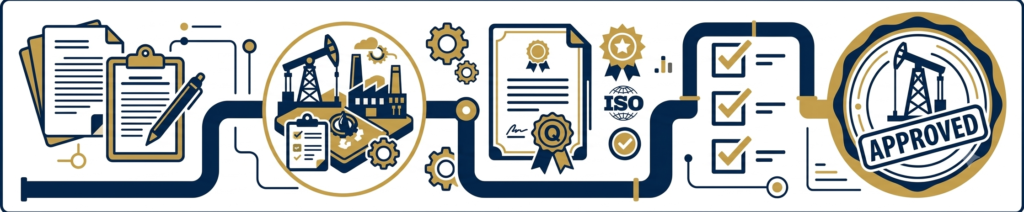
If your company supplies equipment, materials, or services to the oil and gas industry, getting on Saudi Aramco’s Approved Vendor List (AVL) is one of the most valuable things you can do. Saudi Aramco is not just a major oil company — it is the single largest oil producer in the world, and its procurement network spans thousands of vendors across dozens of categories.
📋 Need Help Getting Vendor-Approved?
At FreeDocumentsHub.com, we provide a complete documentation service for companies applying to Saudi Aramco and other major oil and gas operators. From pre-qualification document packages to gap analysis, checklist preparation, and audit-ready QMS templates — we help fabricators and manufacturers get approved faster. Visit freedocumentshub.com to explore our full-package vendor registration support.
But the registration process is structured, document-heavy, and unforgiving of shortcuts. Vendors who go in unprepared waste months, sometimes years, trying to get qualified. Those who understand the process from the start move through it efficiently and start winning business far sooner.
This guide gives you a complete, step-by-step walkthrough of how Saudi Aramco vendor registration works, what documents you need, how the qualification process unfolds, and what pitfalls to avoid along the way.
Why Becoming a Saudi Aramco Approved Vendor Matters
Saudi Aramco’s Approved Vendor List is not just a preferred-supplier database. It is a mandatory gatekeeping mechanism. If your company is not on the AVL for a specific commodity or service category, you cannot bid on Aramco projects in that category — period.
Being AVL-approved signals to the market that your company has:
- Passed a documented financial and technical evaluation
- Demonstrated capability to meet Aramco’s stringent quality and HSE standards
- Committed to compliance with Saudi Aramco’s supplier code of conduct
- Undergone facility assessment (for manufacturing vendors)
The rewards are significant. Saudi Aramco’s annual procurement spend runs into tens of billions of dollars. Approved vendors gain access to a procurement ecosystem that includes direct contracts, EPC contractor supply chains, and long-term frame agreements. For many international and regional manufacturers, it is the single most valuable qualification on their client list.
Understanding the Saudi Aramco Vendor Registration Framework
Saudi Aramco manages vendor registration through its Supplier Management function, which operates under the Supply Chain Management (SCM) organization. All vendor interactions, including registration, qualification, and performance management, are handled through the IKTVA (In-Kingdom Total Value Add) programme framework and the digital Supplier Management Portal (SMP).
There are two main registration pathways:
1. Direct Vendor Registration (Manufacturing / Supply)
This pathway is for companies that manufacture or supply physical products — pressure vessels, valves, pipes, flanges, electrical equipment, instrumentation, and similar materials. Registration here typically involves a facility audit and product qualification test.
2. Service Vendor Registration
This pathway covers engineering services, construction contractors, inspection bodies, IT service providers, logistics companies, and other service-based businesses. Documentation and assessment criteria differ from the manufacturing pathway.
Both pathways run through the Supplier Management Portal (SMP), which is the central digital platform for submission, communication, and status tracking. Understanding this portal is essential before you begin.
Step 1 — Determine Your Commodity Code Category
Before you touch any forms or prepare any documents, you need to identify the correct commodity code category that describes your products or services. Saudi Aramco classifies all vendors by commodity codes aligned with the United Nations Standard Products and Services Code (UNSPSC) framework.
Why this matters:
- Your commodity code determines which technical department reviews your application
- It dictates the specific documentation requirements for qualification
- Misclassification causes delays and rejection — even if your company is otherwise qualified
Common commodity categories for fabrication and manufacturing vendors include: pressure vessels and heat exchangers, structural steel and storage tanks, rotating equipment (pumps, compressors), valves and actuators, piping and fittings, electrical equipment, and instrumentation and control systems.
Review the Saudi Aramco Supplier Management Portal to browse the commodity classification list before proceeding. If your products span multiple categories, you will need to register under each relevant code separately.
Step 2 — Check Eligibility Requirements
Saudi Aramco does not qualify all applicants. Before submitting, ensure your company meets the baseline eligibility criteria. These are not formalities — failing them results in immediate rejection.
Minimum eligibility requirements typically include:
- Legal registration: Your company must be legally registered in its country of operation with valid commercial registration documents.
- Minimum operating history: Generally a minimum of 3–5 years in operation, depending on the commodity category.
- Financial health: Audited financial statements showing solvency and adequate working capital.
- Quality management system: An active ISO 9001 certification or equivalent is required for most categories.
- HSE compliance: A documented Health, Safety, and Environment management system aligned to recognized standards (ISO 45001 or OHSAS 18001 for safety, ISO 14001 for environment).
- No sanctions or debarment: Your company must not be listed on international sanctions lists or debarred from major international procurement bodies.
For In-Kingdom vendors (companies operating inside Saudi Arabia), IKTVA programme compliance and Saudization requirements also apply.
Step 3 — Create Your Supplier Management Portal (SMP) Account
All Saudi Aramco vendor registration and qualification processes run through the Supplier Management Portal (SMP). This is a web-based platform where you submit applications, upload documents, track status, receive communications, and manage your vendor profile.
To create your SMP account:
- Navigate to the Saudi Aramco Supplier Management Portal via the official Aramco website.
- Select “New Supplier Registration.”
- Enter your company’s legal name, country, and primary contact information.
- Create login credentials for your primary account administrator.
- Verify your email and activate the account.
Important: Designate a dedicated SMP account administrator within your organization. This person will be the primary point of contact for all Aramco interactions. Use a company domain email address, not a personal or generic email. Portal communications about document requests, audit scheduling, and approval status come through this channel.
Step 4 — Prepare and Submit Your Pre-Qualification Documents
Document preparation is where most vendors stumble. The list of required documents is extensive, and Aramco’s reviewers will reject incomplete submissions. Having everything ready before you start uploading saves significant time.
Core pre-qualification document package:
Company Legal and Commercial Documents
- Certificate of incorporation / commercial registration certificate
- Articles of association or memorandum of association
- Trade license (if applicable)
- Tax registration certificate (VAT, commercial tax, as applicable)
- Company profile and capability statement
Financial Documents
- Audited financial statements for the last 3 years (balance sheet, P&L, cash flow)
- Bank reference letter confirming credit standing
- Letter from external auditor confirming audit validity
Quality and HSE Certifications
- ISO 9001 certificate (valid, issued by accredited certification body)
- ISO 14001 certificate (for most manufacturing categories)
- ISO 45001 / OHSAS 18001 certificate
- Quality manual / Quality Management System documentation
- HSE policy and statistics (TRIR, LTIR for last 3–5 years)
Technical and Manufacturing Capability Documents
- List of manufacturing equipment and test facilities
- Production capacity statement
- Certifications and approvals specific to your product (e.g., ASME U Stamp for pressure vessels, API licenses for valves)
- List of completed projects / reference list (especially for oil and gas clients)
- CV of key technical personnel (quality managers, welding engineers, inspectors)
Compliance and Ethics Documents
- Signed Supplier Code of Conduct declaration
- Anti-bribery and anti-corruption policy
- Conflict of interest declaration
All documents must be in English or accompanied by certified English translations. Certifications must be valid at the time of submission and must remain valid through the entire qualification process.
Step 5 — Undergo the Technical Pre-Qualification Review
After you submit your documents, Saudi Aramco’s technical procurement team reviews them against the specific requirements of your commodity category. This is not a rubber-stamp process.
What happens during review:
- Aramco reviewers verify legal and commercial standing
- Financial documents are evaluated against minimum thresholds
- Quality and HSE certifications are checked for accreditation validity
- Technical capability is assessed against commodity-specific criteria
- Reference projects are checked for relevance and credibility
During this stage, Aramco may issue a Request for Additional Information (RAI) asking for clarification or supplementary documents. Respond promptly and completely. Slow or incomplete responses stall the process and can result in the file being deprioritized.
Review timelines vary significantly depending on the commodity category, the completeness of your submission, and current workload in the relevant technical department. Simple service categories can be reviewed in weeks; complex manufacturing categories can take several months.
Step 6 — Facility Survey and Product Qualification Testing
For manufacturing vendors, passing the document review is only the first hurdle. Saudi Aramco conducts physical facility surveys — essentially on-site audits — to verify that your manufacturing capabilities match what you have claimed on paper.
What the facility survey covers:
- Physical inspection of manufacturing equipment and test facilities
- Review of quality control systems (incoming inspection, in-process controls, final inspection)
- Assessment of calibration systems for measuring and test equipment
- Welder qualification records and welding procedure specifications (for pressure equipment manufacturers)
- NDE (non-destructive examination) capability: RT, UT, MT, PT
- Review of HSE conditions on the shop floor
- Interviews with key technical and quality personnel
Product qualification testing:
For certain categories — especially pressure vessels, heat exchangers, valves, and piping components — Saudi Aramco may require you to manufacture and submit a qualification sample for independent laboratory testing. The sample is tested against Saudi Aramco Materials System (SAMS) specifications. Passing this test is mandatory for approval in those categories.
The facility survey is typically conducted by Saudi Aramco inspection personnel or by a designated third-party inspection agency on Aramco’s behalf. You will receive advance notice. Prepare your facility thoroughly, ensure all records are organized and accessible, and brief your quality and engineering teams on the process.
Step 7 — Address Survey Findings and Corrective Actions
Following the facility survey, Aramco (or the third-party surveyor) issues a survey report that may contain non-conformances or observations. These must be addressed before your approval can be granted.
Non-conformances are categorized typically as:
- Major non-conformances: Significant gaps that must be fully resolved before approval can proceed.
- Minor non-conformances: Issues that must be corrected within a defined timeframe after initial approval.
- Observations: Advisory notes that are not mandatory but represent best-practice recommendations.
For each non-conformance, submit a Corrective Action Report (CAR) that describes the root cause, the corrective action taken, and the evidence of implementation. Aramco reviewers verify the corrective actions before moving your application to the approval stage.
Do not treat non-conformances as obstacles. They are a normal and expected part of the qualification process. The vendors who handle them professionally — with clear documentation, genuine root cause analysis, and verifiable corrective actions — move through this stage quickly.
Step 8 — Receive AVL Approval and Complete IKTVA Registration
Once all non-conformances are resolved and all qualification criteria are satisfied, Saudi Aramco issues formal approval and adds your company to the Approved Vendor List (AVL) for the relevant commodity codes. You will receive an official notification via the SMP.
IKTVA Compliance (for In-Kingdom Vendors):
If your company operates in Saudi Arabia, you will also need to complete your In-Kingdom Total Value Add (IKTVA) disclosure. IKTVA is a programme that measures the proportion of value added within the Kingdom — local content, Saudi workforce, local procurement, and so on. Saudi Aramco requires all in-Kingdom vendors to report IKTVA scores, and higher scores improve your competitive position when bidding for Aramco work.
International vendors without in-Kingdom operations are not subject to IKTVA reporting but may face commercial advantages being given to locally compliant competitors when bids are evaluated.
Step 9 — Maintain Your AVL Status Through Ongoing Compliance
Getting onto the AVL is not a one-time event. Maintaining your approved status requires ongoing action. Aramco conducts periodic re-evaluations, and vendor status can be downgraded or suspended for a range of reasons including expired certifications, poor performance on projects, HSE incidents, or failure to respond to requalification requests.
Ongoing compliance actions include:
- Renew ISO certifications before expiry and upload updated certificates to the SMP immediately
- Submit updated audited financial statements annually
- Respond to any re-survey or re-qualification notifications within stated deadlines
- Maintain IKTVA reporting (if in-Kingdom)
- Update your SMP profile whenever key personnel, addresses, or capabilities change
- Ensure that project performance data reflects positively on your company
Many vendors lose their AVL status not because of major failures but through administrative neglect — letting certificates lapse, failing to respond to portal notifications, or not submitting required updates. Build a compliance calendar around your key certification renewal dates and SMP reporting obligations.
Common Mistakes That Derail Vendor Registration
Based on patterns seen across the qualification landscape, these are the most common reasons vendor registrations stall or fail:
- Incorrect commodity code selection: Submitting under the wrong category means your application is reviewed by the wrong team. It will either be rejected or transferred, adding months to the process.
- Expired or unaccredited certifications: ISO certificates issued by non-IAF-accredited bodies are not accepted. Certificates within 3–6 months of expiry may also trigger concerns.
- Incomplete financial documents: Unaudited accounts or accounts that do not cover the required number of years are rejected.
- Overstating capabilities: Claiming equipment, certifications, or personnel you do not have will be exposed during the facility survey and results in disqualification.
- Slow response to additional information requests: RAIs that sit unanswered for weeks signal poor organizational responsiveness and delay approval.
- Facility not audit-ready: Shops that are disorganized, have calibration gaps, or cannot produce WPS/PQR records on demand perform poorly in surveys.
- Neglecting post-approval maintenance: Failing to upload renewed certifications or respond to re-qualification notices causes AVL status to lapse.
How Long Does Saudi Aramco Vendor Registration Take?
There is no single answer. The timeline depends on the complexity of your commodity category, the completeness of your initial submission, how quickly you respond to information requests, and current processing volumes at Aramco’s supplier management department.
Typical ranges:
- Simple service categories with a clean submission: 2–4 months
- Manufacturing categories with facility survey: 6– 12 months
- Complex categories with product qualification testing: 12–18 months or more
The best thing you can do to accelerate the process is to submit a complete, accurate application from the start and respond to any queries within 48–72 hours. Vendors who treat the SMP portal as a priority communication channel consistently experience faster approvals.
Documents Your Workshop Should Already Have Before Applying
If you are a fabrication workshop or manufacturer looking to enter the Saudi Aramco supply chain, these are the foundational documents and certifications you should have in place before you begin the registration process:
| Document / Certification | Purpose in Aramco Qualification |
| ISO 9001 Certificate | Mandatory quality management proof |
| ISO 14001 Certificate | Environmental management compliance |
| ISO 45001 / OHSAS 18001 | Occupational health & safety compliance |
| ASME U Stamp (for pressure vessels) | Mandatory for pressure vessel supply to O&G |
| API Licenses (as applicable) | Required for valves, flanges, pipes |
| Audited Financials (3 years) | Financial solvency assessment |
| Bank Reference Letter | Credit standing verification |
| WPS / PQR Records | Welding capability for metal fabricators |
| NDT Personnel Certifications | In-house inspection capability |
| HSE Statistics (3–5 years) | Safety culture and track record |
| Calibration Records | Measurement system reliability |
| Client Reference List | Demonstrated delivery experience |
A Special Note on the ASME U Stamp for Pressure Vessel Manufacturers
If your workshop manufactures pressure vessels, heat exchangers, or pressure-retaining equipment, the ASME U Stamp is not optional for Saudi Aramco qualification — it is a mandatory prerequisite.
Saudi Aramco’s engineering standards require pressure-retaining equipment to be manufactured under a recognized quality certification program. The ASME U Stamp, issued under ASME Section VIII Division 1 (or Division 2 for high-pressure designs), is the globally accepted benchmark for this requirement.
Workshops without the ASME U Stamp cannot be approved as direct suppliers of pressure vessels to Aramco, regardless of their other qualifications. If you are building toward Aramco qualification and do not yet hold the U Stamp, obtaining it must be a parallel or prior objective.
Conclusion: Treat Saudi Aramco Vendor Registration as a Strategic Programme
Saudi Aramco vendor registration is not a form-filling exercise. It is a structured, multi-stage qualification programme that evaluates your company’s legal standing, financial health, technical capability, quality management, and HSE performance.
The companies that succeed approach it like a project — with a dedicated owner, a preparation checklist, milestone tracking, and a professional response to every information request and audit finding. The reward, access to one of the world’s largest procurement ecosystems, is worth every hour invested in getting the process right. Start with your document readiness. Ensure your certifications are current. Get your facility in audit-ready condition. Then submit a complete application and manage the portal as a priority communication channel. That formula, applied consistently, is how workshops and manufacturers around the world break into the Saudi Aramco supply chain.
💡 Struggling with the documentation side of Aramco vendor registration?
FreeDocumentsHub.com offers a complete vendor registration document package for Saudi Aramco and other major operators. We cover pre-qualification checklists, QMS templates, HSE documentation, gap analysis reports, and more. Whether you are starting from scratch or fixing gaps before a re-survey, our full-package service is built specifically for oil and gas fabricators and manufacturers. Visit freedocumentshub.com to get started.