
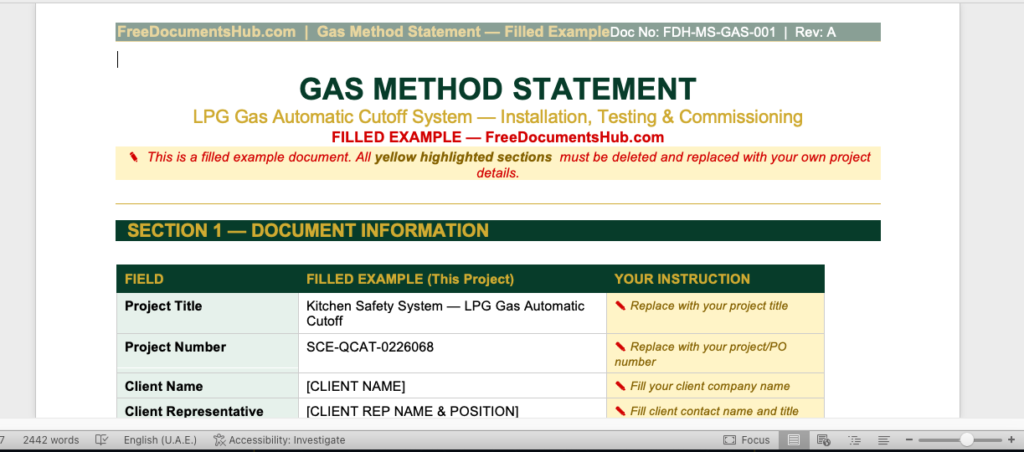
Most engineers know they need a gas method statement before work begins.
The problem is not knowing what one looks like when it is properly filled.
You can find blank templates easily. You can find guidance documents that list the sections. But a complete, filled example — with real equipment, real steps, real standards, and real test procedures — that is almost impossible to find for free.
This post gives you exactly that.
Below is a complete walkthrough of every section in our filled gas method statement example, based on a real LPG Gas Automatic Cutoff System project. The free download at the bottom contains the full document — 12 sections, fully completed, with guidance notes in every cell telling you exactly what to delete and replace with your own project information.
What Project Is This Based On?
The filled example is based on a real kitchen safety system installation — an LPG Gas Automatic Cutoff System for a commercial kitchen in a labour camp facility in Saudi Arabia.
The system covers: — One LPG gas detector installed at floor level in the kitchen — One normally-closed gas solenoid valve on the LPG supply line — One control panel with 24VDC power supply and relay output — One manual reset pushbutton at the kitchen entrance — Full field wiring, testing, and commissioning
This is a real scope of work that engineers and contractors encounter every day in commercial kitchens, labour camps, hotels, hospitals, and industrial facilities. The method statement structure applies to any gas system project — change the equipment details and the steps remain the same.
Section by Section Walkthrough
Section 1 — Document Information
Every method statement begins with a document control block. This is not optional.
The filled example shows:
— Project title and number — Client name field — left blank intentionally — fill with your client — Contractor name — your company — Document number, revision, and issue date — Site location — Approval status
Why this matters: Without document control, there is no traceability. If something goes wrong on site, the first question asked is — which version of the method statement was approved? If you cannot answer that, you have no legal protection.
The approval status must show APPROVED FOR EXECUTION before any work begins. A method statement marked DRAFT is not an approved document.
Section 2 — Scope of Work
The scope section in the filled example lists every piece of work in specific terms:
— Supply, install, wire and commission the LPG gas detection and cutoff panel — Install gas detector at correct height for LPG — 300mm from floor level — Install normally-closed solenoid valve on LPG supply line — Install manual reset pushbutton at kitchen entrance — Complete all field wiring and terminations — Perform insulation resistance and continuity tests — Perform full functional test and integrated system test — Obtain client sign-off on commissioning records
The scope also clearly states what is NOT included — LPG cylinder supply, kitchen exhaust system, and the electrical cutoff panel which is a separate system under a separate method statement.
Why this matters: The scope defines the boundary of your responsibility. If it is not in the scope, you are not responsible for it. If it is in the scope and you did not do it — you are liable. Be specific. Be complete.
Section 3 — Reference Documents and Standards
The filled example references:
— NFPA 96 — Commercial cooking ventilation and fire protection — EN 50194 — Gas detection for combustible gases — EN 13611 — Safety and control devices for gas burners — IEC 60079-29 — Performance requirements for flammable gas detectors — IEC 61010 — Safety requirements for electrical measurement and control equipment — Project P&ID drawing — Client HSE requirements document
Every standard listed tells the client which rules you are working to. It gives your team technical authority for every decision made on site. It tells the third-party inspector which compliance requirements to check against.
Why this matters: A method statement without standard references is not a professional document. Any experienced HSE inspector will reject it immediately.
Section 4 — Personnel and Competency
The filled example lists five roles:
— Project Manager — with qualification and years of experience — Site Supervisor — certification number field to fill — Gas Technician — gas safe registration number field to fill — HSE Officer — NEBOSH or equivalent certification field to fill — Client Representative — name and position field to fill
Every person working on a gas system must be competent. Competency is not self-declared. It is documented. The certification number proves it. The client HSE representative will check every name on this list before issuing the work permit.
Critical point: Client and supervisor names are left blank in the example intentionally. Never submit a method statement with blank names. Fill every name before submission. A blank name means an unknown person with unknown qualifications is performing gas work — no professional client will approve this.
Section 5 — Tools, Equipment and Materials
The filled example covers every item needed:
— LPG gas detector — EN 50194 certified, specific make and model — Gas solenoid valve — normally closed, 24VDC coil, EN 13611 certified — Control panel — fabricated unit with 24VDC PSU and relay output — Manual reset pushbutton — IP65 rated, illuminated — Field cables — 2-core 1.5mm² to detector, 2-core 2.5mm² to solenoid — Portable gas detector — with calibration certificate number and expiry date — Multimeter — calibrated, certificate number required — Insulation tester — 500V/1000V, calibrated
The guidance note on the solenoid valve highlights a critical point: confirm the coil voltage — 24VDC or 230VAC — before ordering. A solenoid valve ordered with the wrong coil voltage is useless on site and delays the project.
Why this matters: All test equipment must have current calibration certificates. An expired calibration certificate makes your test results invalid. The client can reject your entire commissioning pack on this point alone.
Section 6 — Isolation and Permit to Work
This section describes exactly how the gas system is made safe before work begins.
The filled example covers:
General Work Permit — obtain signed permit from client HSE before mobilising.
Electrical Isolation — isolate at the specific distribution board, apply personal padlock, verify zero voltage with calibrated meter.
Gas Isolation — close LPG main isolation valve at cylinder manifold, lock with chain and padlock, display isolation tag, verify zero pressure on downstream gauge.
Gas-Free Verification — check with portable gas detector, must read 0% LEL before work begins, recheck every 30 minutes throughout the work.
Isolation Ownership — the site supervisor holds all isolation keys. Only the supervisor removes the isolation after work is complete and records are signed.
Why this matters: Gas work without proper isolation is one of the leading causes of industrial fatalities. This section is checked first by every client HSE inspector. If the isolation procedure is vague or incomplete — the method statement will not be approved.
Section 7 — Step-by-Step Work Sequence
This is the most important section. The filled example contains 21 steps — from obtaining the work permit to final client sign-off.
Key steps from the filled example:
Step 4 — Check with portable gas detector before touching anything. 0% LEL confirmed and recorded.
Step 8 — Gas detector installed at 300mm from floor. This is correct for LPG — which is heavier than air and accumulates at low level. Natural gas detectors go high — near the ceiling. Wrong installation height means the detector never activates in a real gas leak. This is a life safety failure.
Step 9 — Solenoid valve installed with flow direction arrow correct. Normally closed confirmed. This is critical — a normally open valve stays open during a power failure. In an emergency, the power may fail. The gas must stop flowing when power is lost — not continue. NC type only.
Step 17 — Functional test using test gas applied to detector. Not a simulated signal — actual test gas to the detector head. This proves the full detection chain works.
Step 19 — Full integrated test in the presence of the client representative. This is the step that proves the system works as a complete system — not individual components in isolation.
Step 20 — Manual reset test. The system must stay in alarm after gas clears until a human manually resets it. This prevents automatic restart of gas supply after an alarm event without a human confirming the area is safe.
Why this matters: Each step must be specific enough for any qualified technician to follow without verbal instruction. If your site supervisor is replaced on day two, the replacement must be able to read the method statement and continue the work correctly.
Section 8 — Hazard Identification and Controls
Six hazards covered in the filled example:
— Gas leak — fire or explosion — Electrical shock — Asphyxiation from LPG accumulation — Falls from height during cable installation — Struck by falling tools or materials — Heat stress in hot environment
Each hazard has a specific control measure — not a generic statement. The gas leak control specifies that portable gas detector is present at all times, all ignition sources are removed before gas isolation is lifted, and spark-proof tools are used. This is actionable. A technician on site knows exactly what to do.
Why this matters: Generic controls like “wear PPE” or “be careful” tell an inspector that the person who wrote the method statement has never been on a gas site. Specific controls demonstrate real operational knowledge and get your document approved faster.
Section 9 — Emergency Procedures
Three emergency scenarios covered with specific actions:
Gas leak — stop work, evacuate, close LPG isolation, do not re-enter until gas-free confirmed, call site emergency number.
Fire — activate alarm, evacuate to muster point, do not fight gas-fed fire, call Civil Defence.
Injury — call first aider, call emergency services, do not move injured person.
Critical point in the filled example: Every emergency contact field is marked for filling — site emergency number, first aider name and number, nearest hospital name and address, muster point location.
Why this matters: Generic emergency procedures that say “call emergency services” without a real phone number are useless in an actual emergency. Real numbers. Real names. Real locations. This is what saves lives.
Section 10 — Environmental Controls
Simple and practical:
— All cable waste collected and removed from site daily — No gas venting into enclosed spaces — Ventilation confirmed operational before gas isolation removed — Materials not stored on site overnight without client permission
Section 11 — Inspection and Test Plan Reference
Six inspection activities listed with hold points and record references:
— Cable IR test — contractor witness — FDH-SI-004 record — Cable continuity test — contractor witness — FDH-SI-002 record — Panel energisation — contractor witness — commissioning sheet — Gas detector functional test — client witness required — Solenoid valve cutoff test — client witness required — Integrated system test — client sign-off required
The difference between contractor witness and client witness matters. A contractor-witnessed test means your own supervisor signs off. A client-witnessed test means the client representative must be present before you can proceed. Schedule these activities in advance. A client who is not on site when you are ready to test delays your project by days.
Section 12 — Sign-Off and Approval
Three signatures required:
— Prepared by — contractor engineer — Site Supervisor — confirms practical execution plan is correct — Client HSE Approved By — the only signature that makes the document valid for execution
The rule is simple: no signatures, no work.
A method statement with two out of three signatures is not an approved method statement. Work begins after all three signatures are on the document and dated.
The Guidance Notes in the Document
Every section in the filled example contains guidance notes in yellow — marked with a red pencil symbol.
These notes tell you: — What the filled content represents — What you must delete — What you must replace it with — What the critical technical decisions are — like solenoid valve voltage and gas detector installation height
This makes the document usable by any engineer anywhere in the world — whether you are working in Saudi Arabia, the UK, Ireland, New Zealand, India, or anywhere else. The structure is universal. The technical principles are universal. Only the project-specific details change.
Download the Filled Example
The complete 12-section filled Gas Method Statement is available for free download below.
What you get: — Fully filled document based on a real LPG gas cutoff system project — All 12 mandatory sections completed — Yellow guidance notes in every section — delete and replace with your details — Correct standards referenced — NFPA 96, EN 50194, EN 13611, IEC 60079 — Real 21-step work sequence you can adapt immediately — Professional FreeDocumentsHub branded format — dark green and gold
Enter your email below to download. You will receive the document immediately.
Need a custom method statement written for your specific project?
Free Download
Gas Method Statement — Filled Example
12 Sections Completed · Real LPG Project · NFPA 96 · EN 13611 · IEC 60079
⬇ Download Free NowNo sign-up required · Instant download · DOCX format
We provide professional technical documentation for gas systems, instrumentation, electrical, mechanical, and fire and safety projects — delivered remotely to any location in the world.
📄 Paid service — custom documentation, professional quality, project-specific content. 🆓 Free — general guidance and template examples always available here.
📩 contact@freedocumentshub.com 🌐 FreeDocumentsHub.com — Available 24 hours, 7 days a week.