
If you are designing, specifying, or commissioning mechanical systems for a commercial building in the USA — ASHRAE 90.1 is the most important standard you must know.
It is not optional. It is not just a guideline. In most US states it is adopted into law through the International Energy Conservation Code (IECC) or state energy codes.
This guide covers everything you need — what ASHRAE 90.1 is, what it requires, how it affects your HVAC design, and how to ensure your project complies.
What is ASHRAE 90.1?
ASHRAE 90.1 is the Energy Standard for Buildings Except Low-Rise Residential Buildings published by the American Society of Heating, Refrigerating and Air-Conditioning Engineers.
It sets minimum energy efficiency requirements for:
- Building envelope — walls, roof, windows, insulation
- HVAC systems — heating, cooling, ventilation, controls
- Service water heating
- Lighting — interior and exterior
- Other equipment — motors, elevators, escalators
The current edition is ASHRAE 90.1-2022. Previous widely adopted editions include 2019, 2016, and 2013. Always check which edition your state has adopted.
Who Must Comply?
ASHRAE 90.1 applies to:
- All new commercial buildings
- Major renovations of existing commercial buildings
- Additions to existing buildings
It does not apply to:
- Single family houses
- Low-rise residential buildings up to 3 stories
- Buildings that use no electricity or fossil fuels
- Historic buildings in some jurisdictions
Climate Zones — The Foundation of Everything
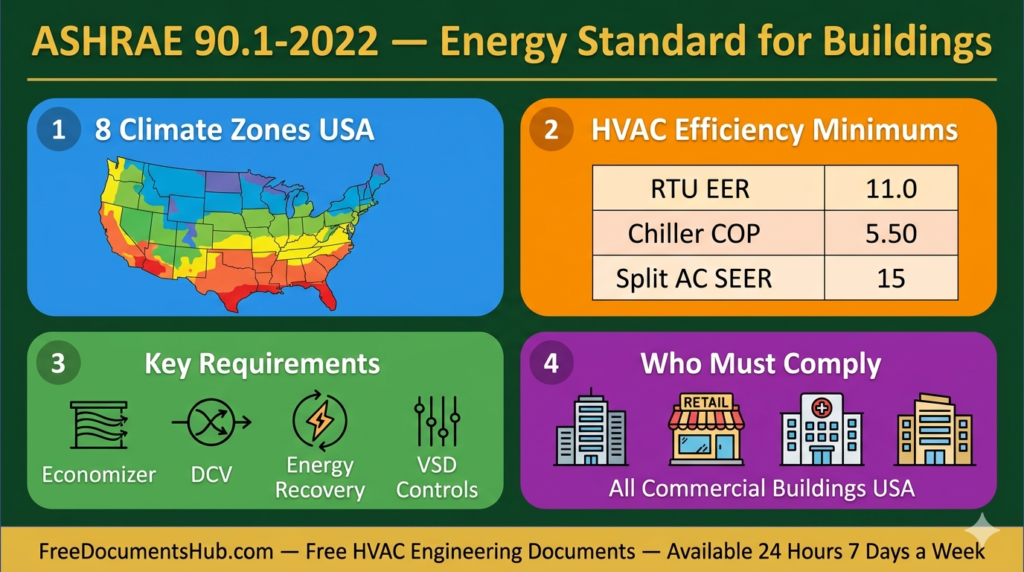
ASHRAE 90.1 divides the USA into 8 climate zones. Your climate zone determines the minimum insulation levels, fenestration requirements, and HVAC efficiency requirements for your project.
| Climate Zone | Description | Example Cities |
|---|---|---|
| Zone 1 | Very Hot — Humid | Miami, FL; Honolulu, HI |
| Zone 2 | Hot — Humid | Houston, TX; Phoenix, AZ |
| Zone 3 | Warm — Humid/Dry | Atlanta, GA; Las Vegas, NV |
| Zone 4 | Mixed — Humid/Dry | Baltimore, MD; Seattle, WA |
| Zone 5 | Cool — Humid/Dry | Chicago, IL; Denver, CO |
| Zone 6 | Cold | Minneapolis, MN; Burlington, VT |
| Zone 7 | Very Cold | Duluth, MN; Anchorage, AK |
| Zone 8 | Subarctic | Fairbanks, AK |
Always identify your climate zone first — before selecting any equipment or insulation.
Section 6 — HVAC Requirements (Most Critical for MEP Engineers)
Section 6 of ASHRAE 90.1 covers all mechanical HVAC requirements. This is where most MEP engineers spend their compliance effort.
6.1 — Minimum Equipment Efficiency
All HVAC equipment must meet minimum efficiency ratings. These are non-negotiable.
Cooling Equipment — Minimum Efficiency (ASHRAE 90.1-2022):
| Equipment Type | Capacity | Minimum Efficiency |
|---|---|---|
| Split system AC — residential type | < 65,000 BTU/hr | SEER 15, EER 11.2 |
| Packaged AC unit | 65,000–135,000 BTU/hr | EER 11.0 |
| Packaged AC unit | 135,000–240,000 BTU/hr | EER 11.0 |
| Packaged AC unit | > 240,000 BTU/hr | EER 10.0 |
| Water-cooled chiller | 150–300 tons | COP 5.45, IPLV 6.17 |
| Water-cooled chiller | > 300 tons | COP 5.50, IPLV 7.19 |
| Air-cooled chiller | All sizes | COP 2.80, IPLV 3.05 |
Heating Equipment — Minimum Efficiency:
| Equipment Type | Minimum Efficiency |
|---|---|
| Gas furnace — residential type | AFUE 80% |
| Gas furnace — commercial | Et 80% |
| Gas boiler — hot water | Et 80% |
| Electric resistance heating | 100% (no minimum — all energy converts to heat) |
| Heat pump — cooling mode | See cooling table above |
| Heat pump — heating mode | HSPF 8.8 |
6.2 — Economizers
An economizer brings in outside air to cool the building when outdoor conditions are favorable — saving energy by reducing compressor operation.
ASHRAE 90.1 Section 6.5.1 requires an air-side economizer when:
- Cooling capacity is ≥ 54,000 BTU/hr (4.5 tons) AND
- The climate zone and building type require it
Exceptions include:
- Systems with 100% outdoor air already
- Systems serving spaces requiring special humidity control
- Data centers and some process applications
Economizer types:
- Fixed dry-bulb — opens when outdoor temp is below setpoint (typically 55°F)
- Differential dry-bulb — opens when outdoor temp is below return air temp
- Fixed enthalpy — opens when outdoor enthalpy is below setpoint
- Differential enthalpy — most accurate — compares outdoor and return air enthalpy
6.3 — Demand Controlled Ventilation (DCV)
ASHRAE 90.1 Section 6.4.3 requires DCV when:
- Design occupancy exceeds 25 persons per 1,000 sq ft AND
- The system has design outdoor airflow > 3,000 CFM
DCV uses CO2 sensors to modulate outside air based on actual occupancy. When the room is empty — outside air reduces to minimum. When fully occupied — outside air increases to design level.
Result: Typically 20–30% reduction in HVAC energy in variable occupancy spaces like conference rooms, auditoriums, and retail stores.
6.4 — Energy Recovery Ventilation (ERV)
ASHRAE 90.1 Section 6.5.6 requires energy recovery when:
- Design supply airflow is ≥ 70% outside air AND
- Total system airflow exceeds specific thresholds by climate zone
Energy recovery transfers heat (and sometimes moisture) between exhaust air and incoming outside air — reducing the energy needed to condition outside air.
Minimum effectiveness requirements:
- Sensible heat recovery: 50% minimum
- For total energy recovery: 50% sensible AND 50% latent
6.5 — Variable Speed Drives (VSD)
ASHRAE 90.1 Section 6.5.3 requires VSD (Variable Frequency Drive) on:
- Fan motors > 5 HP serving variable air volume (VAV) systems
- Pump motors > 5 HP serving variable flow hydronic systems
- Cooling tower fan motors > 7.5 HP
VSD reduces motor speed at part load — since power varies with the cube of speed, reducing speed by 20% reduces power consumption by nearly 50%.
6.6 — Controls Requirements
ASHRAE 90.1 requires:
- Setback controls — thermostats must be capable of setback to at least 55°F heating and 85°F cooling during unoccupied hours
- Optimum start — system must automatically determine latest start time to achieve comfort by occupancy
- Automatic shutdown — HVAC must shut down during unoccupied periods
- Zone isolation — large buildings must be able to isolate and shut down zones independently
- Hot gas bypass limitation — limited to 25% of total cooling capacity
Section 5 — Building Envelope Requirements
The building envelope — walls, roof, windows, floors — must meet minimum insulation and fenestration requirements based on climate zone.
Example requirements for Climate Zone 4 (Baltimore, MD):
| Element | Maximum U-Value or Minimum R-Value |
|---|---|
| Roof — insulation above deck | U-0.048 (R-20 minimum) |
| Roof — attic and other | U-0.027 (R-38 minimum) |
| Exterior wall — metal framing | U-0.064 |
| Exterior wall — mass | U-0.104 |
| Below grade wall | U-0.119 |
| Slab on grade | R-10 for 2 ft below grade |
| Windows — vertical glazing | U-0.36, SHGC-0.40 |
| Skylights | U-0.50, SHGC-0.40 |
Section 9 — Lighting Requirements
Lighting is a major energy consumer and ASHRAE 90.1 sets strict limits.
Interior Lighting Power Density (LPD) — Watts per sq ft:
| Space Type | Maximum LPD (W/sq ft) |
|---|---|
| Office — open plan | 0.98 |
| Office — enclosed | 0.98 |
| Retail | 1.26 |
| Corridor | 0.66 |
| Lobby | 0.90 |
| Conference room | 1.23 |
| Manufacturing | 1.17 |
| Warehouse | 0.66 |
| Hospital — patient room | 0.62 |
| Kitchen | 1.21 |
Controls required:
- Automatic shutoff — all spaces must have automatic shutoff controls
- Daylight controls — spaces with skylights or windows must reduce artificial lighting when daylight is sufficient
- Occupancy sensors — required in most space types
Compliance Paths
ASHRAE 90.1 offers three ways to demonstrate compliance:
1. Prescriptive Path Meet every individual requirement in the standard — equipment efficiency, insulation levels, LPD, controls. Straightforward but least flexible.
2. Energy Cost Budget Method Demonstrate that the proposed design uses no more energy than a reference building meeting prescriptive requirements. Allows trade-offs — better envelope offsets less efficient equipment.
3. Performance Rating Method (Appendix G) Used for LEED certification and above-code compliance. Compare proposed design against a modeled baseline building. Requires energy modeling software.
Common Compliance Mistakes
Mistake 1 — Wrong climate zone Using the wrong climate zone gives wrong insulation and efficiency requirements. Always verify using ASHRAE 90.1 Figure B-1 or the DOE climate zone map.
Mistake 2 — Missing economizer Forgetting to include an economizer on qualifying systems is one of the most common ASHRAE 90.1 violations found during commissioning.
Mistake 3 — No DCV on qualifying spaces Conference rooms and retail spaces with > 25 persons per 1,000 sq ft almost always require DCV. Missing this fails both ASHRAE 90.1 and energy code.
Mistake 4 — Oversized equipment Equipment sized at 150% of calculated load is less efficient at part load and may not meet IPLV requirements. Size at 100–115% of calculated load.
Mistake 5 — Missing VSD on large fans and pumps VAV systems with fans over 5 HP must have VSD. This is frequently missed on submittal review.
Mistake 6 — Lighting controls not commissioned Daylight sensors and occupancy sensors installed but not properly calibrated fail compliance even if the hardware is present.
ASHRAE 90.1 Compliance Checklist — Quick Reference
| Requirement | Section | Check |
|---|---|---|
| Climate zone identified | Fig. B-1 | ☐ |
| Equipment efficiency meets minimum | Table 6.8.1A-C | ☐ |
| Economizer provided where required | 6.5.1 | ☐ |
| DCV provided where required | 6.4.3 | ☐ |
| Energy recovery provided where required | 6.5.6 | ☐ |
| VSD on fans > 5 HP in VAV systems | 6.5.3 | ☐ |
| Setback controls provided | 6.4.3 | ☐ |
| Optimum start controls | 6.4.3 | ☐ |
| Building envelope U-values met | Table 5.5 | ☐ |
| Window SHGC met | Table 5.5 | ☐ |
| Interior LPD within limits | Table 9.5.1 | ☐ |
| Automatic lighting shutoff | 9.4.1 | ☐ |
| Daylight controls where required | 9.4.1 | ☐ |
Free Download — ASHRAE 90.1 Compliance Documents
We have prepared professional HVAC design and compliance documents referencing ASHRAE 90.1-2022 — including system selection checklists, equipment schedules, commissioning checklists and design basis report templates.
All documents are ready to use on your next USA commercial project.
👉 Download free at FreeDocumentsHub.com — available 24 hours, 7 days a week.
Summary
ASHRAE 90.1-2022 sets the minimum energy efficiency floor for commercial buildings in the USA. For MEP engineers the most important requirements are:
- Equipment must meet minimum SEER, EER, COP and IPLV ratings
- Economizers are required on most systems above 4.5 tons
- DCV is required in high occupancy variable spaces
- Energy recovery is required on high outside air systems
- VSD is required on large fans and pumps in variable flow systems
- Controls must include setback, optimum start and automatic shutoff
The standard changes with every edition. Always confirm which edition your state has adopted before starting design.
For professional ASHRAE 90.1 compliant design documents — visit FreeDocumentsHub.com.
Iftakhar Ahmad is a systems integration engineer with 19 years of Gulf industrial experience. FreeDocumentsHub.com provides professional HVAC, Electrical and MEP engineering documents for projects worldwide — available 24 hours, 7 days a week.