
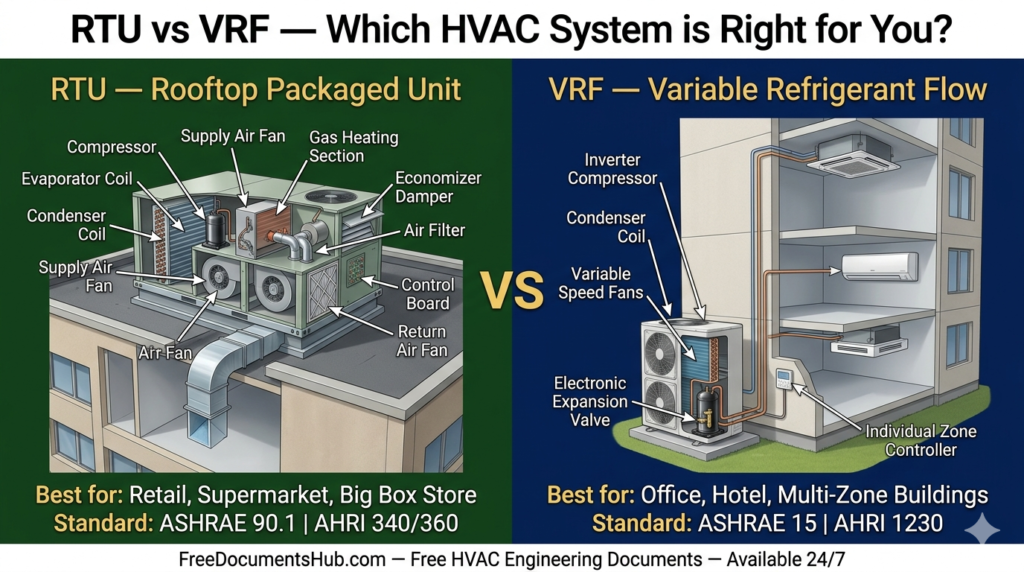
If you are an MEP engineer, mechanical contractor, or facility manager working on a commercial project in the USA — at some point you will face this decision:
Rooftop Packaged Unit (RTU) or Variable Refrigerant Flow (VRF)?
Both systems cool and heat buildings effectively. Both are widely used across the USA. Both comply with ASHRAE 90.1 efficiency requirements.
But they are fundamentally different in how they work, what they cost, how they are maintained, and which buildings they suit best.
This guide gives you the complete comparison — so you can make the right selection for your specific project.
What is an RTU?
A Rooftop Packaged Unit is a self-contained HVAC system where all components — compressor, evaporator coil, condenser coil, supply fan, return fan, heating section, and controls — are assembled in a single factory-built cabinet installed on the roof of the building.
Conditioned air is distributed through sheet metal ductwork to the occupied space below.
How it works in simple terms: Return air comes up from the building → passes through the filter → gets cooled or heated → supply fan pushes it back down through ducts → repeats continuously.
Typical capacity range: 3 tons to 130+ tons Fuel options: Electric cooling + gas heating (most common), electric heat pump, or electric resistance heating Refrigerant: R-410A (current) or R-454B (new low-GWP replacing R-410A per AIM Act)
What is a VRF System?
A Variable Refrigerant Flow system uses refrigerant — not air — as the primary medium to carry cooling or heating energy from a central outdoor unit to multiple indoor units throughout the building.
The outdoor unit contains the compressor and condenser. Refrigerant pipes connect to individual indoor fan coil units in each zone. Each zone controls its own temperature independently.
How it works in simple terms: Outdoor unit compresses refrigerant → refrigerant flows through pipes to each indoor unit → each indoor unit absorbs or rejects heat independently → compressor speed varies to match the exact load at any moment.
Types of VRF:
- 2-pipe heat pump — entire system either cools or heats at one time
- 3-pipe heat recovery — simultaneous cooling in some zones and heating in others from the same outdoor unit
Typical capacity range: 4 tons to 100+ tons Refrigerant: R-410A or R-32 (lower GWP)
Head to Head — Complete Comparison
1. System Efficiency
RTU: Efficiency is measured by SEER (Seasonal Energy Efficiency Ratio) and EER (Energy Efficiency Ratio).
Per ASHRAE 90.1-2022:
- Units below 65,000 BTU/hr: minimum SEER 15, EER 11.2
- Units 65,000 to 135,000 BTU/hr: minimum EER 11.0
- Units above 240,000 BTU/hr: minimum EER 10.0
RTUs run at fixed compressor speeds. At part load — when the building is not fully occupied or the weather is mild — the compressor cycles on and off. This reduces efficiency significantly.
VRF: Efficiency is measured by EER and IEER (Integrated Energy Efficiency Ratio).
VRF inverter compressors modulate speed continuously from 10% to 100% of capacity. At part load — which is most of the operating year in commercial buildings — VRF maintains high efficiency because it never fully cycles off.
Typical VRF IEER: 18–25+ (compared to RTU IEER of 12–16)
Winner for efficiency: VRF — especially in climates with moderate temperatures for most of the year.
2. First Cost (Installation Cost)
RTU: RTUs are factory-assembled and arrive on site ready to install. A single crane lift places the unit on the roof curb. Ductwork is the main installation cost.
Approximate installed cost for a 20-ton RTU in USA:
- Equipment: $18,000–$25,000
- Ductwork and installation: $15,000–$30,000
- Total: $33,000–$55,000
VRF: VRF requires one outdoor unit plus multiple indoor units plus refrigerant piping plus commissioning by a manufacturer-trained technician. More components mean more installation time.
Approximate installed cost for equivalent 20-ton VRF system:
- Equipment: $25,000–$40,000
- Piping, installation, commissioning: $20,000–$35,000
- Total: $45,000–$75,000
Winner for first cost: RTU — typically 20–35% lower installed cost than VRF for equivalent capacity.
3. Operating Cost (Energy Cost)
RTU: Higher energy consumption — especially at part load. A 20-ton RTU running at 40% load cycles inefficiently.
Annual energy cost for 20-ton RTU (Dallas, TX — 2,500 cooling hours): Approximately $6,000–$9,000/year depending on utility rates and usage patterns.
VRF: Lower energy consumption — inverter compressor matches load precisely. Studies show 20–40% energy savings compared to RTU in typical commercial applications.
Annual energy cost for equivalent VRF system: Approximately $4,000–$6,500/year.
Winner for operating cost: VRF — saves $1,500–$3,000 per year in energy costs for a 20-ton system.
4. Zoning and Comfort Control
RTU: A single RTU serves one zone — or at best several zones through a VAV (Variable Air Volume) system. All zones receive the same supply air temperature. Individual room temperature control requires additional VAV boxes, reheat coils, and controls — adding cost and complexity.
VRF: Each indoor unit is an independent zone. The conference room, the CEO office, the server room, and the open plan floor all control their own temperature simultaneously — from a single outdoor unit.
3-pipe heat recovery VRF can cool the server room while simultaneously heating the perimeter offices — recovering the heat from one zone and using it in another.
Winner for zoning: VRF — no comparison. This is VRF’s greatest strength.
5. Maintenance
RTU: All mechanical components are in one location on the roof. One technician with a ladder accesses everything — compressor, coils, filters, fan motors, controls. No need to enter the building or access ceiling spaces.
Maintenance schedule:
- Monthly: filter inspection
- Quarterly: coil cleaning, refrigerant check
- Annual: full service per ASHRAE 180
VRF: Outdoor unit maintenance is straightforward. But indoor units are distributed throughout the building — in ceiling spaces, on walls, above raised floors. Accessing every indoor unit for filter cleaning, coil service, and drain pan inspection requires working in occupied spaces — sometimes above tenants.
A 20-indoor-unit VRF system requires 20 separate filter cleanings per service visit.
Winner for maintenance: RTU — single location, simpler access, lower maintenance labor cost.
6. Installation Speed
RTU: Fast installation. Roof curb is prepared, RTU arrives pre-assembled, crane lifts it into position, electrical and gas connections are made, ductwork is connected. A single 20-ton RTU can be installed and commissioned in 3–5 days.
VRF: Longer installation. Outdoor unit, refrigerant pipe routing, multiple indoor unit installations, leak testing with nitrogen, refrigerant charging, controls wiring, and manufacturer commissioning all add time. A 10-indoor-unit VRF system typically takes 2–3 weeks.
Winner for installation speed: RTU — significantly faster, especially for retail and construction projects with tight schedules.
7. Noise Level
RTU: The entire mechanical system is on the roof — away from occupants. Noise inside the building comes only from supply air through diffusers. RTUs themselves can be loud on the roof — important consideration for outdoor terraces or rooftop amenities.
VRF: Indoor units operate very quietly — cassette units as low as 22 dB(A). This makes VRF the preferred choice for hotels, executive offices, hospitals, and any space where noise is a critical comfort factor.
Winner for noise: VRF — significantly quieter in the occupied space.
8. Code Compliance — USA Standards
Both systems must comply with:
| Requirement | Standard | RTU | VRF |
|---|---|---|---|
| Minimum efficiency | ASHRAE 90.1-2022 | ✅ | ✅ |
| Ventilation rates | ASHRAE 62.1-2022 | Requires DOAS or economizer | Requires separate DOAS |
| Refrigerant safety | ASHRAE 15-2022 | ✅ | Occupied space limits apply |
| Equipment installation | IMC 2021 | ✅ | ✅ |
| Mechanical code | IBC 2021 | ✅ | ✅ |
| Refrigerant transition | AIM Act | R-454B replacing R-410A | R-32 or R-454B |
Important note on VRF and ASHRAE 15: VRF systems use large quantities of refrigerant in occupied spaces. ASHRAE 15-2022 sets limits on refrigerant concentration in occupied areas. For large VRF systems in small rooms, a leak detection system may be required. Always verify compliance during design.
Decision Guide — Which System for Which Project?
| Project Type | Recommended System | Reason |
|---|---|---|
| Supermarket / Hypermarket | RTU | High open load, simple zoning, easy maintenance |
| Big box retail store | RTU | Large open area, fast installation |
| Restaurant | RTU | High latent load, kitchen exhaust coordination |
| School / University | RTU with VAV | Single system serving large areas |
| Open plan office | VRF | Multiple zones, energy saving, quiet |
| Hotel | VRF | Individual room control, quiet, guest comfort |
| Multi-tenant office building | VRF | Tenant sub-metering, individual control |
| Hospital / Medical clinic | VRF | Precise temperature control, quiet |
| Server room / Data center | Dedicated precision cooling | Neither RTU nor standard VRF |
| Mixed use — retail + office | RTU for retail floor + VRF for office | Best of both systems |
The 5 Questions to Ask Before You Specify
1. What is the space type? Open plan retail → RTU. Multiple private offices → VRF.
2. What is the budget? Tight first cost budget → RTU. Lifecycle cost focus → VRF.
3. What is the zoning requirement? One or two zones → RTU. Five or more zones → VRF.
4. Who will maintain the system? In-house maintenance team with limited access → RTU. Professional FM company → either.
5. What are the noise requirements? Standard commercial space → RTU acceptable. Hotel, hospital, executive office → VRF preferred.
Free Download — HVAC System Selection Checklist
We have prepared a complete HVAC System Selection Checklist (FDH-HVAC-02) covering RTU vs VRF comparison with all evaluation criteria, code compliance checklist, and decision matrix — ready to use on your next project.
Standards referenced: ASHRAE 62.1, ASHRAE 90.1, ASHRAE 15, AHRI 340/360, AHRI 1230, IMC 2021.
👉 Download free at FreeDocumentsHub.com — available 24 hours, 7 days a week.
Summary
RTU and VRF are both excellent HVAC systems for USA commercial projects. The choice comes down to five factors — space type, zoning, budget, maintenance, and noise.
Choose RTU when: Large open space, simple zoning, tight budget, fast installation, easy maintenance.
Choose VRF when: Multiple zones, comfort control, energy efficiency, quiet operation, long-term cost savings.
For most commercial projects the answer becomes clear once you answer the five questions above.
If you need help with HVAC system selection, load calculation, equipment schedules, or commissioning documentation for your USA project — our engineering team is available 24 hours, 7 days a week at FreeDocumentsHub.com.
Iftakhar Ahmad is a systems integration engineer with 19 years of Gulf industrial experience. FreeDocumentsHub.com provides professional HVAC, Electrical, and MEP engineering documents for projects worldwide.