
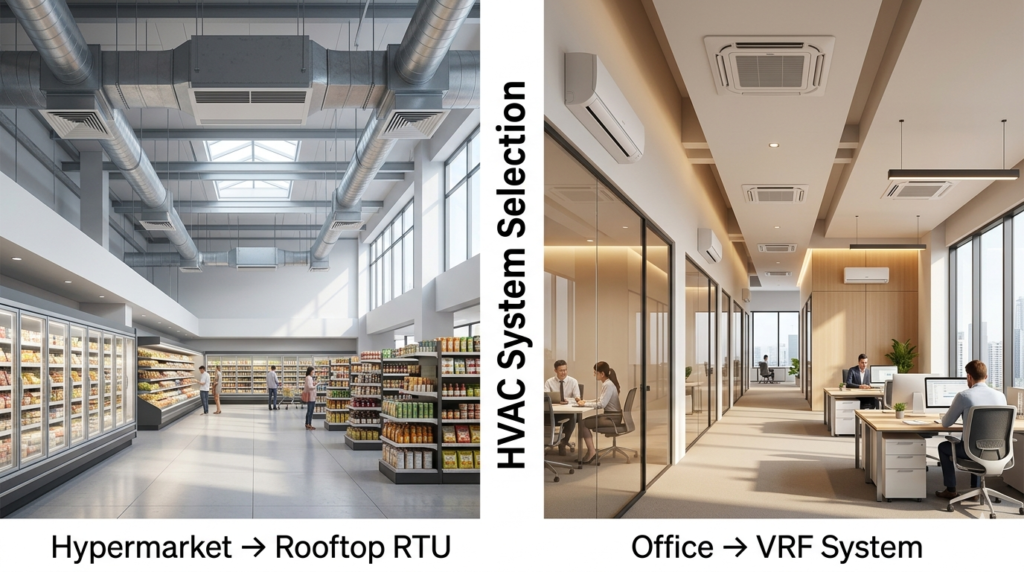
If you are designing or specifying an HVAC system for a 12,000 square foot commercial building in the USA — the first question you must answer is:
How much cooling and heating does this building actually need?
Get this wrong and you will either oversize the equipment — wasting energy and money every month — or undersize it — leaving the building uncomfortable and the client unhappy.
This guide walks you through the complete HVAC load calculation process using the ASHRAE method, step by step. We will use a 12,000 sq ft commercial building as our working example throughout.
Why Accurate Load Calculation Matters
Many engineers make the mistake of using a simple rule of thumb — “one ton per 400 square feet” — and calling it a day.
For a small residential project that may be acceptable. For a 12,000 sq ft commercial building it is not.
A hypermarket has refrigeration cases generating heat. An office has 50 computers running all day. A restaurant has commercial cooking equipment. Each of these changes the load calculation significantly.
The only correct method is a full load calculation per ASHRAE 183 or ACCA Manual N — the two standards recognized across the USA for commercial HVAC load calculation.
The Two Loads You Must Calculate
Every HVAC load calculation has two parts:
1. Cooling Load — how much heat must be removed in summer to keep the building at 75°F / 50% RH 2. Heating Load — how much heat must be added in winter to keep the building at 70°F
Both must be calculated. Both determine equipment size.
Step 1 — Establish Design Conditions
Before any calculation begins you need two sets of temperatures — outdoor and indoor.
Indoor Design Conditions (USA Standard):
| Parameter | Cooling | Heating |
|---|---|---|
| Indoor Dry Bulb | 75°F | 70°F |
| Indoor Relative Humidity | 50% | 30–40% |
Outdoor Design Conditions: These vary by location. Use ASHRAE Fundamentals Handbook climate data tables or ACCA Manual N Appendix.
Example — Dallas, Texas:
- Summer: 100°F dry bulb / 75°F wet bulb
- Winter: 22°F dry bulb
Example — Chicago, Illinois:
- Summer: 91°F dry bulb / 74°F wet bulb
- Winter: -4°F dry bulb
Always use your specific city data — never use generic national averages.
Step 2 — Calculate Envelope Loads
The building envelope — walls, roof, windows, and floor — gains or loses heat based on the temperature difference between inside and outside.
Wall and Roof Conduction Load
Formula: Q = U × A × CLTD
Where:
- Q = Heat gain (BTU/hr)
- U = Overall heat transfer coefficient (BTU/hr·ft²·°F)
- A = Surface area (sq ft)
- CLTD = Cooling Load Temperature Difference (°F) — from ASHRAE tables
Example — South Wall of our 12,000 sq ft building:
- Wall area: 800 sq ft
- U-value: 0.08 BTU/hr·ft²·°F (insulated metal panel)
- CLTD: 35°F (from ASHRAE table — August, 2 PM, south facing)
- Q = 0.08 × 800 × 35 = 2,240 BTU/hr
Repeat this calculation for every wall face and the roof.
Roof Load Example:
- Roof area: 12,000 sq ft (flat roof with R-20 insulation)
- U-value: 0.05
- CLTD: 50°F
- Q = 0.05 × 12,000 × 50 = 30,000 BTU/hr
Solar Gain Through Glass
Formula: Q = A × SC × SHGF × CLF
Where:
- A = Glass area (sq ft)
- SC = Shading Coefficient (0.4–0.9 depending on glass type)
- SHGF = Solar Heat Gain Factor (BTU/hr·ft²) — from ASHRAE tables by orientation
- CLF = Cooling Load Factor
Example — West-facing glass:
- Glass area: 400 sq ft
- SC: 0.65 (double glazed, low-e coating)
- SHGF: 150 BTU/hr·ft² (west, August, 4 PM)
- CLF: 0.85
- Q = 400 × 0.65 × 150 × 0.85 = 33,150 BTU/hr
West-facing glass in afternoon sun is one of the highest loads in any commercial building. This is why building orientation matters at the design stage.
Step 3 — Calculate Internal Loads
Internal loads are heat generated inside the building by people, lights, and equipment. In a commercial building these are often larger than the envelope loads.
Lighting Load
Formula: Q = Watts × 3.413 × CLF
- 3.413 = BTU/hr per Watt
- CLF accounts for thermal lag of the building structure
Example — 12,000 sq ft office at 1.5 W/sq ft:
- Total watts = 12,000 × 1.5 = 18,000 W
- Q = 18,000 × 3.413 × 0.9 = 55,291 BTU/hr
For LED lighting use 0.8–1.2 W/sq ft. For older fluorescent use 1.5–2.0 W/sq ft.
Occupant Load
People generate both sensible heat (dry heat) and latent heat (moisture from breathing and perspiration).
Formula:
- Sensible: Q = Number of people × qs
- Latent: Q = Number of people × ql
ASHRAE Occupant Heat Values:
| Activity | Sensible (BTU/hr) | Latent (BTU/hr) |
|---|---|---|
| Seated — office work | 250 | 200 |
| Standing — retail | 300 | 250 |
| Light work | 350 | 300 |
Example — 12,000 sq ft hypermarket with 80 occupants:
- Sensible: 80 × 300 = 24,000 BTU/hr
- Latent: 80 × 250 = 20,000 BTU/hr
Equipment Load
Formula: Q = Watts × 3.413
Example — 12,000 sq ft office with computers and equipment:
- Computers: 60 × 150W = 9,000W
- Servers and misc: 3,000W
- Total: 12,000W
- Q = 12,000 × 3.413 = 40,956 BTU/hr
For a hypermarket add refrigeration case heat rejection — typically 25–40 BTU/hr per linear foot of display case.
Step 4 — Calculate Ventilation Load
Per ASHRAE 62.1-2022, commercial buildings must bring in a minimum amount of fresh outside air. This outside air must be conditioned — it adds to your cooling and heating load.
Ventilation Rate Procedure:
Vbz = (Rp × Pz) + (Ra × Az)
Where:
- Rp = People outdoor air rate (CFM/person) — from ASHRAE 62.1 Table 6-1
- Pz = Number of occupants
- Ra = Area outdoor air rate (CFM/sq ft)
- Az = Zone floor area
Example — 12,000 sq ft retail space:
- Rp = 7.5 CFM/person (retail per ASHRAE 62.1)
- Pz = 80 people
- Ra = 0.06 CFM/sq ft
- Az = 12,000 sq ft
- Vbz = (7.5 × 80) + (0.06 × 12,000) = 600 + 720 = 1,320 CFM outside air
Outside Air Cooling Load:
- Sensible: Q = 1.1 × CFM × ΔT = 1.1 × 1,320 × (100–75) = 36,300 BTU/hr
- Latent: Q = 0.68 × CFM × ΔW = 0.68 × 1,320 × 40 = 35,904 BTU/hr
Outside air load is significant — especially in hot humid climates. This is why Energy Recovery Ventilators (ERV) are required by ASHRAE 90.1 on larger systems.
Step 5 — Total Load Summary
Now add everything together:
| Load Category | Sensible (BTU/hr) | Latent (BTU/hr) |
|---|---|---|
| Walls — all faces | 18,500 | — |
| Roof | 30,000 | — |
| Glass solar gain | 45,000 | — |
| Lighting | 55,291 | — |
| Occupants | 24,000 | 20,000 |
| Equipment | 40,956 | — |
| Outside air ventilation | 36,300 | 35,904 |
| Subtotal | 250,047 | 55,904 |
| Safety factor 10% | 25,005 | 5,590 |
| DESIGN TOTAL | 275,052 | 61,494 |
| GRAND TOTAL | 336,546 BTU/hr |
Convert to Tons: 336,546 ÷ 12,000 = 28 Tons of cooling
This is our equipment sizing target for a 12,000 sq ft hypermarket in Dallas, Texas.
Step 6 — Heating Load
Heating load is simpler — no solar gain, no internal credits required for safety.
Formula: Q = U × A × ΔT
ΔT = Indoor temp – Outdoor design temp = 70°F – 22°F = 48°F (Dallas winter)
| Element | U-Value | Area (sq ft) | ΔT | Load (BTU/hr) |
|---|---|---|---|---|
| Walls | 0.08 | 3,200 | 48 | 12,288 |
| Roof | 0.05 | 12,000 | 48 | 28,800 |
| Glass | 0.35 | 800 | 48 | 13,440 |
| Infiltration | — | — | — | 15,000 |
| Ventilation OA | — | 1,320 CFM | 48 | 69,696 |
| TOTAL HEATING | 139,224 BTU/hr |
Step 7 — Equipment Selection
Based on our calculation:
| Parameter | Value |
|---|---|
| Total cooling load | 336,546 BTU/hr |
| Cooling load in tons | 28 tons |
| Selected RTU capacity | 30 tons (next standard size up) |
| Heating capacity required | 139,224 BTU/hr |
| Minimum SEER (ASHRAE 90.1) | 14 EER for this size |
For a 12,000 sq ft hypermarket in Dallas a 30-ton Rooftop Packaged Unit (RTU) from Carrier, Trane, York or Lennox would be the typical selection.
Common Mistakes to Avoid
1. Using rule of thumb only “One ton per 400 sq ft” gives 30 tons for 12,000 sq ft — which happens to be close in this example. But for a server room or restaurant it would be completely wrong. Always do the full calculation.
2. Ignoring latent load In humid climates latent load can be 20–30% of total load. Ignoring it leads to equipment that cannot control humidity — causing mold and comfort complaints.
3. Not accounting for orientation West-facing glass in afternoon sun can add 5–10 tons to a building load. A building facing the wrong way costs the owner more in energy bills every year.
4. Oversizing equipment Equipment sized at 150% of calculated load short-cycles — turns on and off too frequently — reducing efficiency and lifespan. Size at 100–115% of calculated load only.
5. Ignoring ASHRAE 62.1 ventilation Outside air is not optional — it is a code requirement. Missing it means the building will have poor indoor air quality and potentially fail inspection.
Free Download — HVAC Load Calculation Worksheet
We have prepared a complete HVAC Load Calculation Worksheet (FDH-HVAC-01) in Excel format — ready to use on your next project.
The worksheet covers:
- All envelope load calculations with CLTD method
- Internal loads — lighting, occupants, equipment
- Ventilation loads per ASHRAE 62.1
- Total load summary and equipment sizing
- References: ASHRAE 183, ACCA Manual N, ASHRAE Fundamentals
👉 Download free at FreeDocumentsHub.com — available 24 hours, 7 days a week.
Summary
Calculating HVAC load for a 12,000 sq ft commercial building involves seven steps:
- Establish indoor and outdoor design conditions
- Calculate envelope loads — walls, roof, glass
- Calculate internal loads — lighting, people, equipment
- Calculate ventilation load per ASHRAE 62.1
- Add all loads with safety factor
- Calculate heating load separately
- Select equipment at 100–115% of calculated load
For a 12,000 sq ft hypermarket in Dallas, Texas — our example gives approximately 28–30 tons of cooling and 140,000 BTU/hr of heating.
Every building is different. Every climate is different. The ASHRAE method accounts for all variables — which is why it is the standard across the USA.
Iftakhar Ahmad is a systems integration engineer with 19 years of Gulf industrial experience. FreeDocumentsHub.com provides professional HVAC, Electrical, and MEP engineering documents for projects worldwide — available 24 hours, 7 days a week.