
By the FreeDocumentsHub Editorial Team | Industrial Technology Briefing
| Need Your Inspection Documentation Audit-Ready? If your workshop is preparing for Saudi Aramco AVL approval or ASME certification, your NDT reports, MTRs, and data books need to match the standard your inspector expects — wireless or not. FreeDocumentsHub helps fabrication workshops prepare complete, audit-ready vendor registration packages. → Explore our documentation services at FreeDocumentsHub.com |
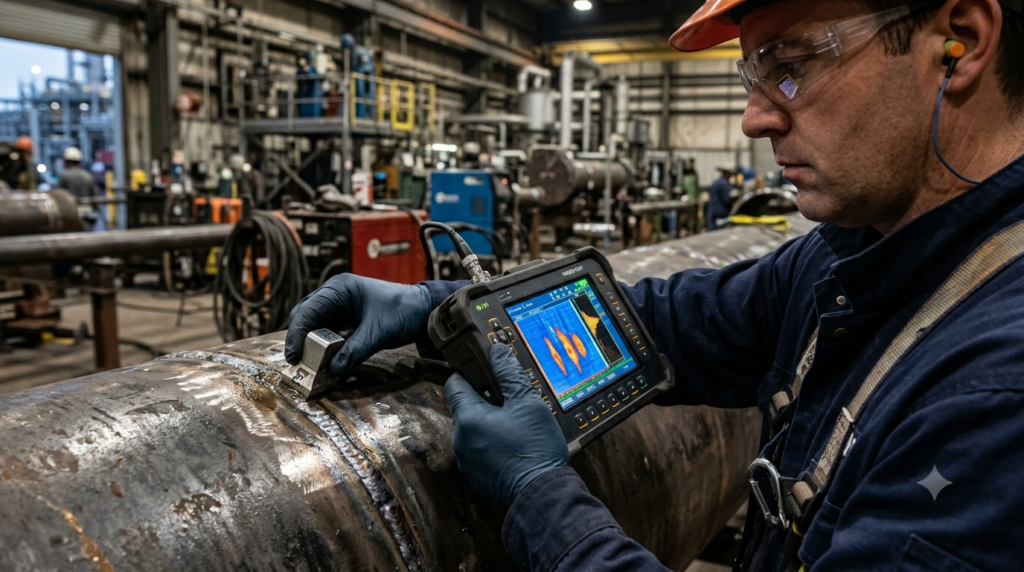
For decades, phased array ultrasonic testing (PAUT) has meant one inspector, one cable-tethered probe, and a flaw detector strapped to a harness or perched on scaffolding. That picture started changing in 2025. Across the non-destructive testing (NDT) industry, instrument makers spent the year cutting cords — literally and digitally — and the result is the most significant shift in portable PAUT hardware in close to a decade.
This is not a single product launch. It is a pattern across multiple manufacturers, all pointing in the same direction: lighter, untethered, cloud-connected inspection equipment built for inspectors who move between confined spaces, scaffolding, offshore platforms, and refinery turnarounds without the luxury of a fixed workstation. Here is what actually happened in 2025, what “wireless” really means in phased array UT today, and why it matters if you run a fabrication workshop preparing documentation for vendor approval.
Why “Wireless” Became the Word Everyone in NDT Used This Year
Industrial NDT equipment has historically lagged consumer and medical ultrasound by years when it comes to connectivity. Phased array probes were hard-wired to flaw detectors through multi-pin connectors, data was pulled off via USB stick or SD card, and getting an inspection report from the field to the office often meant physically carrying the instrument back to a laptop.
Market research tracking the PAUT equipment sector found that wireless probe connectivity was available in roughly 29% of new phased array models brought to market between 2023 and 2025 — up sharply from a market where wireless was effectively a novelty feature just a few years earlier. Combine that with cloud-based data analytics, which industry analysts now flag as one of the dominant innovation trends shaping the sector, and 2025 looks less like an incremental year and more like an inflection point.
From Eddyfi to Olympus — The 2025 Launches That Moved the Needle
Three developments in particular defined the year for portable ultrasonic inspection:
1. Eddyfi Technologies Launches Cypher (June 2025)
Eddyfi Technologies released Cypher, a portable PAUT platform built around total focusing method (TFM) imaging alongside standard phased array, time-of-flight diffraction, and plane wave imaging modes. The headline features were less about raw beam physics and more about how the instrument is used in the field: a glove-ready, sunlight-readable touchscreen, automatic probe and scanner detection that removes manual setup steps, hot-swappable batteries so inspections do not stop for a recharge, and cloud-enabled data synchronization that lets reports move from the field to the office without a physical handoff. The unit also carries IP65 environmental sealing and military-grade drop resistance, aimed squarely at offshore platforms and refinery shutdown work.
2. Olympus Adds AI-Assisted Interpretation (August 2025)
Olympus Corporation followed with a phased array ultrasonic testing device built around artificial intelligence for data analysis and interpretation — part of a broader industry move toward automated flaw recognition. Independent market analysis on AI-powered ultrasonic systems has reported flaw-detection accuracy exceeding 95% in controlled testing, and a roughly 40% reduction in on-site inspection time where wireless, portable units replaced older bench-style equipment.
3. Wabtec Acquires Olympus’s Former NDT Division (July 2025)
Perhaps the clearest signal of how seriously the industry now treats inspection technology: Wabtec Corporation acquired Evident’s Inspection Technologies division — the business that used to operate as Olympus NDT — in a deal valued at approximately $1.78 billion. The acquisition folds advanced PAUT and broader NDT capability into Wabtec’s data-and-analytics portfolio, reinforcing a trend that runs through every launch this year: inspection hardware is increasingly being built and bought as a data platform, not just a measurement tool.
What “Going Wireless” Actually Means in Phased Array UT
“Wireless phased array” is a useful headline, but the reality on the inspection floor is layered. There are three distinct things manufacturers are cutting loose, and it is worth knowing the difference:
- Wireless probe-to-instrument connectivity — removing the fixed cable between the phased array probe and the flaw detector. This is the most literal sense of “wireless” and the one with the least industry-wide adoption so far — useful in confined-space and overhead work where cable drag or snagging is a real hazard, but still a minority feature across new models.
- Cloud-enabled data sync — the instrument transmits inspection data, images, and reports directly to a cloud platform rather than requiring a USB transfer back at the office. This is the feature seeing the fastest adoption in 2025, and it is the one with the most direct impact on documentation turnaround for vendor approval and ASME data book preparation.
- Untethered, battery-swappable field operation — hot-swappable batteries and ruggedized, all-in-one housings that remove the need for a generator, inverter, or fixed power source. Combined with cloud sync, this is what lets an inspector run a full shift on a platform or in a plant shutdown without returning to a base station.
Put together, these three layers are what the industry means when it says phased array is “going wireless” — not necessarily a probe with no cable at all, but an inspection workflow with no fixed point. The inspector, the probe, and the data all move independently of any anchored workstation.
| Layer | What It Removes | Where It Matters Most |
| Wireless probe link | Fixed cable between probe and detector | Confined spaces, overhead and underwater work |
| Cloud data sync | USB/manual transfer of inspection files | Multi-site teams, fast-turnaround documentation |
| Battery-swappable design | Dependence on fixed power source | Offshore platforms, plant shutdowns, remote sites |
Why This Matters for Workshops Pursuing Vendor Approval
If your workshop is preparing NDT records for a Saudi Aramco AVL submission, an ASME data book, or a client’s quality assurance package, the equipment your inspector uses rarely makes it into the paperwork conversation — but it shapes the paperwork all the same.
- Faster TFM and PAUT scanning speeds directly shorten the inspection window during a plant shutdown or fabrication hold point — fewer delays between weld completion and sign-off.
- Cloud-synced inspection data reduces the lag between field testing and the final report landing in your data book or ITP file, which matters when a client or Authorized Inspector is waiting on records before releasing the next stage.
- AI-assisted flaw classification does not replace a qualified Level II or Level III NDT technician’s sign-off, but it is increasingly used as a second check during weld inspection — something documentation reviewers may start asking about during vendor audits.
None of this changes the documentation requirements themselves — Form U-1, MTRs, WPS/PQR, and NDE reports are still governed by the same ASME and client specifications. What changes is how quickly and reliably that data reaches the file that gets submitted for approval.
Where Phased Array UT Is Headed Next
A few directions are already visible in how manufacturers are positioning their 2025 launches and near-term roadmaps:
- Matrix array transducers with higher element density, improving volumetric coverage on complex geometries like nozzle welds and branch connections.
- Tighter integration between PAUT systems and drone-based or robotic crawler platforms for remote and elevated asset inspection.
- Expanded use of full matrix capture and real-time imaging techniques to improve defect sizing accuracy beyond what conventional PAUT delivers.
- Continued build-out of high-temperature and corrosive-environment PAUT protocols for refinery and petrochemical service without requiring a full shutdown.
This piece is intended as an industry briefing, not a product recommendation — FreeDocumentsHub does not sell, distribute, or receive compensation for any NDT equipment mentioned here. If your workshop is evaluating new inspection hardware, that decision should run through your own Level III NDT personnel and procurement process.
The Takeaway
Phased array ultrasonic testing did not become wireless overnight in 2025 — but it took its biggest step yet toward an inspection workflow with no fixed anchor point. Cloud sync, battery-swappable rugged housings, and early wireless probe connectivity are converging into a single shift: inspection data that moves as fast as the inspector carrying it. For workshops chasing vendor approval timelines, that shift is worth watching — even if the documentation requirements on your desk look exactly the same as they did last year.
| Preparing for Saudi Aramco AVL or ASME Vendor Approval? Whatever inspection technology your workshop uses, the final data book still has to meet the documentation standard your client and Authorized Inspector expect. FreeDocumentsHub helps fabrication workshops compile complete, audit-ready vendor registration and certification packages. → Get in touch through FreeDocumentsHub.com |