
A practical breakdown of the qualification chain behind every code-compliant weld, and where fabricators most often get PQR-to-WPS traceability wrong.
| Need Your WPS/PQR Package Reviewed or Built Before an Aramco Inspection? freedocumentshub.com prepares and audits WPS/PQR documentation packages for fabricators and workshops pursuing Aramco AVL registration and ASME code compliance. Message us on WhatsApp for a documentation review: +966-XX-XXX-XXXX (update with live number). |
An inspector rejects a WPS during a shop audit — not because the weld looks wrong, but because the Procedure Qualification Record behind it doesn’t actually support the ranges written on the specification. This happens more often than it should, and it’s rarely a welding problem. It’s a documentation problem. Understanding exactly what a PQR is, what it must contain, and how it legally supports a WPS is one of the most valuable things a QC engineer, welding engineer, or workshop owner can get right before a code inspection ever happens.
What Is a Procedure Qualification Record?
A Procedure Qualification Record, or PQR, is the documented evidence that a specific combination of welding variables — process, base metal, filler metal, joint design, preheat, heat treatment, and position — produces a weld that meets the mechanical property requirements of the applicable code. Under ASME Section IX, the suggested format is Form QW-483.
A PQR is not a set of instructions. It is a record of what was actually done on a test coupon, and what the tests on that coupon actually showed. The values entered on a PQR are as-run values — the real numbers recorded during the qualification weld — not target values or a range. That distinction matters enormously, because the PQR is the only document in the whole system that carries legal weight as proof of capability.
The Qualification Chain: Coupon to Production Weld
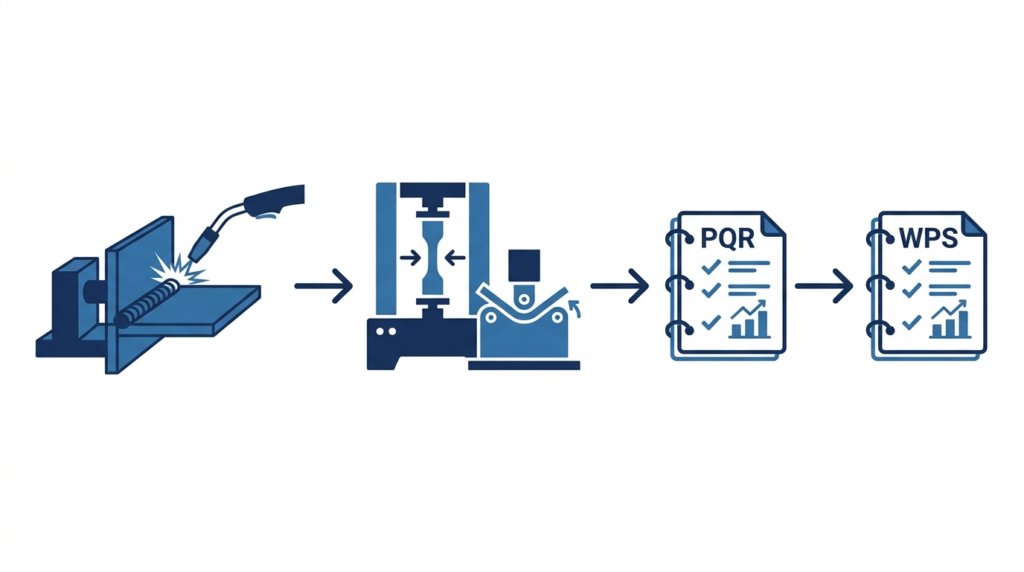
The relationship between a PQR and a Welding Procedure Specification (WPS) is best understood as a chain of custody for technical proof:
- A test coupon is welded under witnessed, controlled conditions using a specific set of variables.
- The actual parameters used — amperage, voltage, travel speed, preheat, interpass temperature, filler metal, gas — are recorded exactly as they occurred.
- The coupon is sent for mechanical testing (tensile, guided bend) and, when required, impact testing and hardness testing.
- If the coupon passes, those actual variables and test results are documented on the PQR.
- The PQR becomes the supporting evidence for one or more WPS documents, which translate the as-run PQR values into an acceptable range for production welding.
- Welders are then qualified separately, within the range the WPS allows, and every production weld is traceable back through the welder, the WPS, and ultimately the PQR.
The WPS is permission to weld within a range. The PQR is proof that the range is real. A WPS can only be as wide as the PQR data actually supports — writing a WPS range beyond what the PQR proves is a non-conformance, even if the production welds themselves are sound.
What a Complete PQR Must Contain
A properly completed PQR carries two categories of information that must both be present and internally consistent:
1. Actual Essential Variables
- Welding process(es) used
- Base metal P-Number and Group Number (or specification/type/grade for the actual materials welded)
- Filler metal F-Number and, where applicable, A-Number
- Test coupon thickness and, for groove welds, deposited weld metal thickness
- Preheat and interpass temperature actually used
- Post-weld heat treatment (PWHT), if performed, including time and temperature
- Shielding and backing gas composition, where applicable
- Welding position of the test coupon
2. Test Results
- Tensile test results (strength values and location of failure)
- Guided bend test results (face, root, or side bends, with acceptance criteria)
- Impact test results, where the base metal, thickness, or design code triggers a toughness requirement — recorded as a supplementary essential variable
- Hardness test results, where required by the base metal or governing code
Every one of these fields must be filled with what actually happened during the qualification test, verified by the testing laboratory’s report, and signed by the organization’s authorized representative. A PQR with blank or estimated fields is not a qualification record — it’s a liability.
Essential vs. Supplementary Essential Variables
Essential variables are those that, if changed beyond the qualified range, are considered to affect the mechanical properties of the weld and require requalification. Supplementary essential variables apply specifically when the design requires notch-toughness (impact) testing, and they control additional factors that influence the heat-affected zone and grain structure — such as heat input, interpass temperature limits, and certain process-specific parameters.
This distinction is where many PQR packages fail during audit. A PQR qualified without accounting for supplementary essential variables cannot support a WPS used on equipment where impact testing is required by the design code, even if the base essential variables are otherwise identical.
| Where PQR Documentation Most Often Breaks WPS range written wider than the actual PQR test data supports. Supplementary essential variables omitted when the design requires impact testing. Deposited weld metal thickness qualification miscalculated against the applicable thickness tables and restrictions. Field-recorded production parameters that don’t match any qualified PQR when checked during an audit. |
The 2025 Edition of ASME Section IX: What Changed for PQR Documentation
ASME Section IX moved to its 2025 edition, and fabricators holding ASME certification are expected to have reviewed and, where needed, updated their WPS and PQR documentation against the new edition. Some of the most relevant changes for PQR preparation include refinements to how tolerances are treated when a dimension or parameter is not explicitly given as a maximum, minimum, or range — these are now to be treated as nominal, with deviations judged by engineering practice. The edition also extends explicit qualification coverage to additive manufacturing processes, and reinforces the handling of supplementary essential variables tied to toughness requirements, thermal control, and post-weld heat treatment.
None of this changes the basic function of a PQR — it remains the recorded proof behind a WPS — but it does mean that PQRs qualified under earlier editions should be reviewed for continued adequacy, particularly for equipment where toughness, thermal control, or PWHT are governing factors. Existing qualifications generally remain valid, but new qualification work should be planned against the current edition rather than an older one held over from habit.
| Document | What It Proves | Who Uses It |
| PQR (Form QW-483) | That a specific set of variables actually produced a weld meeting code mechanical requirements | Welding engineer, QC, code inspector |
| WPS (Form QW-482) | The acceptable range of variables for production welding, supported by one or more PQRs | Welders, production supervisors, inspectors |
| WPQ | That an individual welder can produce sound welds within a qualified range | Welders, QC, client auditors |
The Practical Takeaway
A PQR is not paperwork to fill in after the fact — it’s the technical foundation the entire welding qualification system is built on. Getting it right the first time, with as-run values that are complete, consistent, and traceable, is far cheaper than discovering a gap during an Aramco AVL audit or a third-party inspection, when the only fix is requalification.
| Need Your WPS/PQR Package Reviewed or Built Before an Aramco Inspection? freedocumentshub.com prepares and audits WPS/PQR documentation packages for fabricators and workshops pursuing Aramco AVL registration and ASME code compliance. Message us on WhatsApp for a documentation review: +966-XX-XXX-XXXX (update with live number). |
| Free Download: Sample WPS and Matching PQR To make this easier to apply, we’ve put together a free sample WPS and matching PQR you can download and use as a reference. They’re filled out with realistic values for a common SMAW carbon steel procedure, showing exactly how a Welding Procedure Specification and its supporting Procedure Qualification Record should be structured and cross-referenced. These are for training and reference only — not a substitute for your own witnessed qualification testing — but they’re a solid starting point for building or auditing your own documentation. Download the free sample WPS and PQR below. |