
Aramco Trade
Certification Hub
Free exam preparation guides for every Saudi Aramco trade certification — WPR, Scaffolder, Rigger, QC Inspector, QAQC, Safety Officer, Welding Supervisor, and 50+ more trades. Study chapters, practice questions, mock exams — all completely free.
Work Permit Receiver (WPR)
Complete Exam Preparation Bundle
The most comprehensive WPR exam preparation resource available in English for Saudi Aramco trade certification. 12 full study chapters covering every topic in the WPR examination — including the Work Permit System, Hazard Identification, Hot Work, Confined Space Entry, Electrical Safety, Fire Protection, Gas Testing, PPE, Emergency Response, and Pressure Systems. Plus 200 practice questions and 4 full mock exams.
Based on GI-2.100 and all relevant Saudi Aramco Safety Standards. Written by engineers with 19+ years of Gulf industrial project experience across Saudi Aramco, SABIC, and major EPC projects.
The Saudi Aramco Work Permit System
GI-2.100 — Permit types, roles, the full permit cycle
Hazard Identification & Risk Assessment
JSA, risk matrix, hierarchy of controls
Hot Work Safety
Welding, grinding, fire watch, 30-foot rule
Cold Work Safety
Permit conditions, isolation, safe verification
Confined Space Entry
CSE permit, atmospheric testing, standby man
Electrical Safety & LOTO
Lockout/tagout, isolation, live work prohibition
Fire Protection & Detection Systems
Fire alarm types, gas detection, SAES-B-067
Gas Testing & Atmosphere Monitoring
LEL, O2, H2S, CO — acceptable limits
PPE Requirements
Selection, inspection, Aramco PPE matrix
Emergency Response & Evacuation
Muster points, emergency signals, spill response
Pressure Systems & Pipework Isolation
Blinding, spectacle blinds, double block and bleed
Mock Examinations
4 × 50 questions — exam conditions, full answer keys
12
Full study chapters covering every WPR exam topic
200+
Practice questions — 3 options each — answers on last page
4
Full mock exams — 50 questions each — timed exam format
Free
100% free — zero cost — no registration — no email
📥 Download Now — WPR Complete Bundle
Chapter 1 — Work Permit System — available now. Full 12-chapter bundle releasing chapter by chapter. All free. All available immediately.
Every Aramco Trade — One Hub
The Aramco Trade Certification Hub is expanding continuously. Every trade certification will have its own complete preparation bundle — study chapters, practice questions, and mock exams — all completely free. New bundles are added regularly. Check back or follow FreeDocumentsHub.com on LinkedIn for updates.
Safety Permits
Permit management, hazard control, safety systems for authorised permit receivers and safety officers.
Quality & Inspection
Inspection techniques, QC procedures, documentation, welding quality, and non-destructive testing.
Construction Trades
Scaffolding systems, rigging operations, lifting equipment, load calculations, and safety protocols.
Mechanical Trades
Welding procedures, pipework, mechanical inspection, pressure systems, and equipment maintenance.
Electrical Trades
Electrical safety, isolation procedures, panel work, instrument systems, and LOTO requirements.
Fire Protection
Fire detection systems, suppression, fire watch duties, emergency response, and SAES-B-067.
Simple. Free. Effective.
Choose Your Trade
Select the Aramco certification you are preparing for from the trade list above.
Download Free
Download the study chapters and question bank instantly. No registration. No email. No payment.
Study & Practice
Read each chapter. Answer the practice questions without looking at answers. Score yourself honestly.
Pass Your Exam
Score 180+ on the 200-question bank before sitting the real exam. You are ready.
Start Your WPR Preparation
Today — Free
Download Chapter 1 — The Saudi Aramco Work Permit System — and begin your exam preparation right now. No registration. No cost. No conditions. Available 24 hours, 7 days a week.
Download Free — Chapter 1FreeDocumentsHub.com — Available 24 Hours, 7 Days a Week
Pass Your Aramco Approval.
Free Exam Prep. Zero Cost.
Complete exam preparation guides for Saudi Aramco trade and professional approvals — Safety Officer, Work Permit Receiver, and Mechanical Engineer & Supervisor. Built from 19+ years of real Gulf industrial project experience.
All guides are free to download directly — no registration, no payment, no waiting. Click any guide below to open the PDF immediately.
Choose Your Certification
Each guide covers the full technical syllabus tested in the Aramco approval exam for that role — with practice questions and a complete answer key.
Safety Officer Aramco Approval
Complete preparation guide for the Saudi Aramco Safety Officer approval examination — covering all seven core duties, key standards, 200 practice questions, and a full answer key.
- HSE Awareness & Safety Officer Responsibilities
- Stop Work Authority — Non-Negotiable Rules
- Work Permit System (GI-2.100) — All 7 Types
- Gas Testing — LEL, H₂S, O₂, CO Levels
- Fire Protection — SAES-B-067 Requirements
- Electrical Safety — GI-6.012, LOTO, Arc Flash
- Incident Investigation — 5-Why Root Cause
- Saudi Labour Law — Employer & Worker Rights
Work Permit Receiver WPR Certification
Chapter 1 of the 12-chapter WPR series — the Saudi Aramco Work Permit System in full detail. Every WPR exam draws 25–30% of questions from this chapter alone.
- What Is a Work Permit & Why It Exists
- The 7 Types of Work Permit — Full Detail
- WPR Duties, Authority & Boundaries
- Permit Cycle — Application to Closure
- Validity, Extensions, Suspensions, Cancellations
- Common WPR Exam Questions Explained
- Real Incident Case Study with Lessons Learned
- 20 Chapter Practice Questions with Answers
Mechanical Engineer & Supervisor Aramco Approval
Complete preparation guide covering six core mechanical engineering disciplines tested in the Aramco Mechanical Engineer and Supervisor approval examination.
- Pressure Vessels — ASME VIII, API 510, API 579
- Piping Systems — ASME B31.3, API 570
- Rotating Equipment — Pumps, Compressors, API 686
- Welding & NDT — ASME IX, WPS/PQR, Defect Criteria
- Lifting & Rigging — Crane Ops, Rigging Hardware
- Maintenance Systems — PM, PDM, RBI, CMMS
- Corrosion Rate & Remaining Life Calculations
- 200 Exam Questions with Full Answer Key
The Right Way to Use These Guides
Follow this four-step method for every guide. Aim for 180+/200 (90%) before sitting the real Aramco exam.
Read Part 1
Read the HSE Awareness or technical knowledge section in full before touching the questions.
Study Standards
Master the key standards — GI-2.100, SAES-B-067, GI-6.012, ASME VIII, API 510. Know the reference, not just the rule.
Attempt All Questions
Answer all questions without looking at the answer key. Time yourself — 1.5 minutes per question.
Score & Re-Study
Check answers on the last page only. Any topic below 70% — re-read that section before sitting the real exam.
Standards Covered Across All Three Guides
Every question is anchored to a specific standard. Know the standard, know the answer.
Need More Industrial Documents?
The Documents page has free professional templates for method statements, ITPs, NCRs, risk assessments, commissioning checklists, and more — built from 19 years of real Gulf project experience.
Browse All Documents →Available 24 hours, 7 days a week · contact@freedocumentshub.com
QA/QC Inspector Aramco Approval
Complete exam preparation guide for the Saudi Aramco QA/QC Inspector approval examination — covering inspection roles, ITP, NCR, welding quality, NDT methods, key formulas, and 200 practice questions with a full answer key.
- QA vs QC — Roles, Authority and Responsibilities
- Inspection and Test Plans — Hold, Witness, Review Points
- Non-Conformance Reports (NCR) and CAPA Process
- Welding Quality — WPS, PQR, WQT, AWS D1.1, ASME IX
- NDT Methods — VT, PT, MT, RT, UT, HT
- Dimensional Inspection and Measurement Tools
- 10 QC Formulas — Corrosion Rate, Remaining Life, Cpk
- Key Standards — ISO 9001, API 510/570, SAES, NACE
Piping QC Inspector — Aramco Approval Exam Preparation Guide
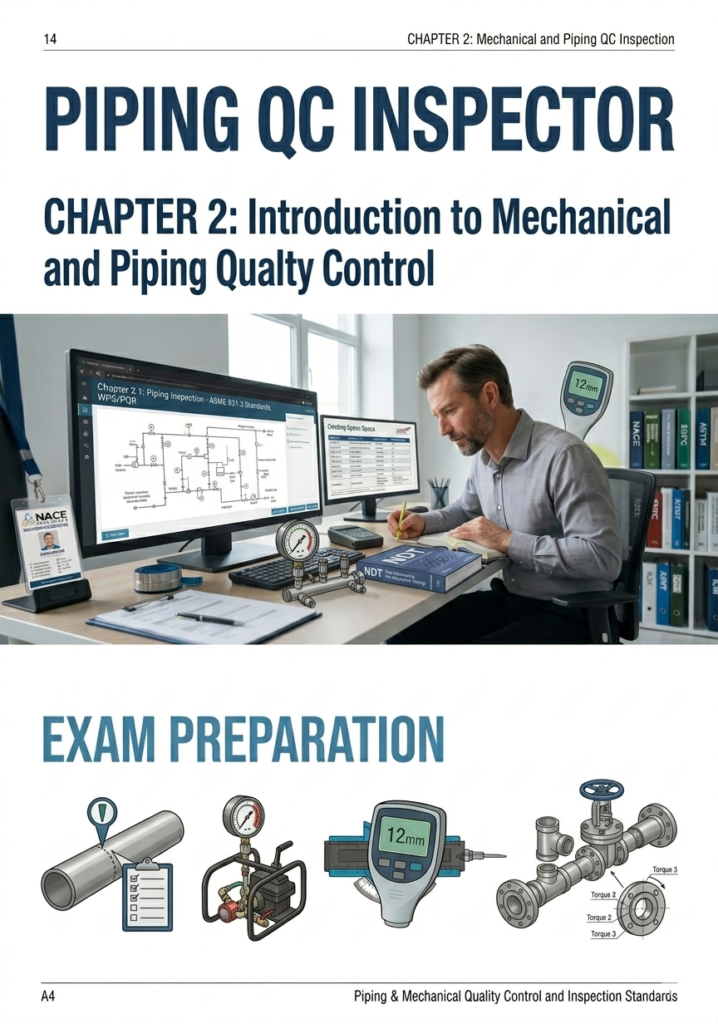
50 questions covering piping materials, dimensional inspection, pressure testing, API 570 in-service inspection, piping fabrication, and all ASME B31.3 formulas with worked examples. Reference standards: ASME B31.3, ASME B16.5, API 570, SAES-L-350. Target 180+/200 before sitting the real exam.
7 parts. Everything a Piping QCI needs to pass the Saudi Aramco approval exam.
✅ Part 1 — Piping Materials and Components (A106, A312, A335, Duplex SS, flange ratings) ✅ Part 2 — Dimensional Inspection (tolerances, fit-up, flange face, bolt torque) ✅ Part 3 — Pressure Testing (hydrostatic, pneumatic, leak test — ASME B31.3) ✅ Part 4 — In-Service Inspection — API 570 (corrosion rate, remaining life, inspection intervals) ✅ Part 5 — Piping Fabrication and Construction (spooling, supports, SAES-L-350) ✅ Part 6 — Standards, Formulas and Key Rules (all ASME B31.3 and API 570 formulas with worked examples) ✅ Part 7 — 50 Exam Questions (A/B/C format, answer key last page only)
Reference Standards: ASME B31.3 | ASME B16.5 | ASME B16.9 | API 570 | SAES-L-350
Target: 180+ out of 200 before sitting the real exam.
100% free. No signup. Download instantly.
E&I Instruments QC Inspector — Aramco Approval Exam Preparation Guide
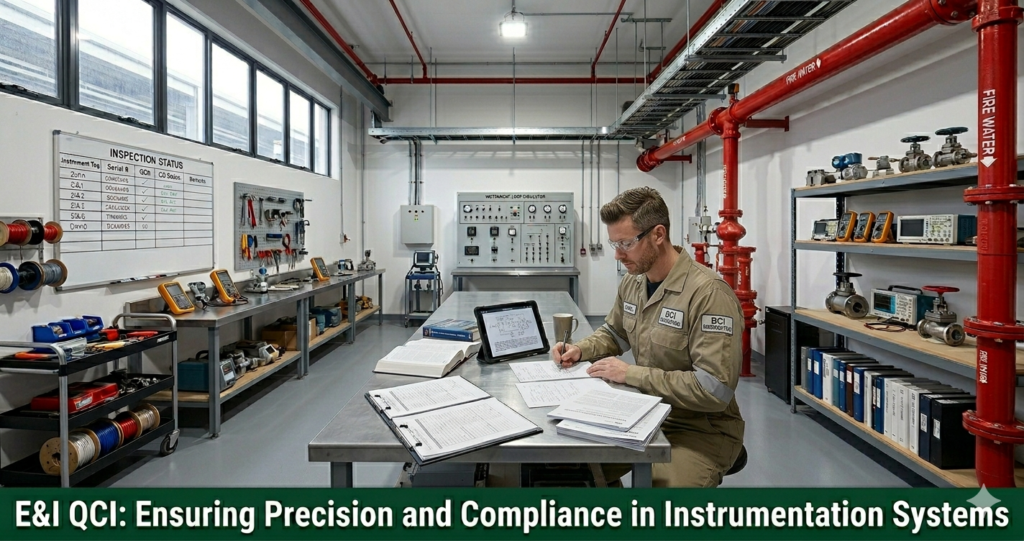
Complete exam preparation guide for engineers and inspectors preparing for the Saudi Aramco E&I Instruments QC Inspector approval examination. Covers all core topics tested in the Aramco QCI exam — instrumentation principles, calibration, loop testing, SAES standards, instrument installation, and documentation.
What is covered:
- Instrument types — pressure, temperature, level, flow — principles and selection
- Calibration procedures and acceptance criteria
- Loop testing and pre-commissioning inspection
- Saudi Aramco instrument standards — SAES-J-002, SAES-J-100, SAES-J-902
- Hazardous area classification — ATEX, IECEx, NEC
- Control valves — sizing, testing, inspection
- Safety instrumented systems — SIL, SIS, ESD
- 50 exam questions — A/B/C format — answer key last page only
Aramco Welding QC Inspector Exam Preparation Guide — Free PDF
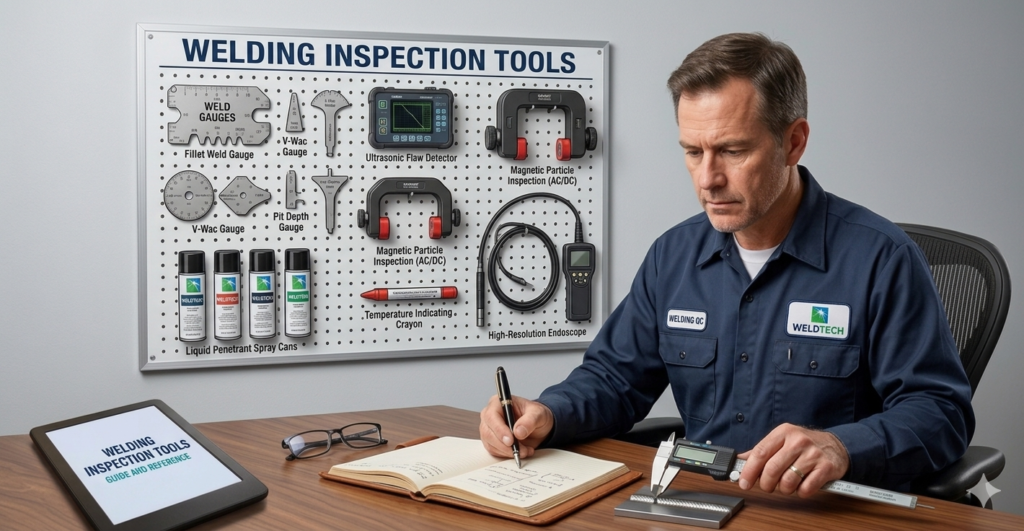
Preparing for your Saudi Aramco Welding QC Inspector approval exam? This free PDF study guide gives you everything you need in one document — written specifically for inspectors and engineers working to Aramco standards.
This guide covers all major topics tested in the Aramco Welding QCI approval exam, including welding processes and positions, WPS and PQR qualification sequence, welder selection by qualification, visual inspection acceptance criteria, NDT method selection, PWHT and preheat requirements, carbon equivalent formulas, NCR avoidance, NCR closure procedure, first two hours on duty discipline, and a complete welding QC abbreviations reference.
What is inside this guide:
— Welding processes — SMAW, GTAW, GMAW, FCAW, SAW — shielding methods and Aramco applications — Welding positions 1G to 6G — qualification scope for each position — WPS vs PQR — difference explained clearly, creation sequence step by step — WPS essential variables — what changes require a new PQR — PQR mechanical tests — tensile, bend, impact — quantities and acceptance criteria — How to read a Welder ID Card — F-Number, P-Number, position, thickness range, expiry, Aramco stamp — all 8 checks — Visual inspection acceptance criteria — AWS D1.1 — undercut, porosity, cracks, overlap, arc strike — NDT methods — VT, PT, MT, RT, UT, PAUT, TOFD — detection capability and limitations — RT requirements on Aramco projects — IQI, film density, Level II, exclusion zone — Carbon equivalent formula — IIW and AWS D1.1 simplified — preheat table — PWHT inspection requirements — heating rate, soak temperature, cooling rate, hardness limits — Key welding formulas — CE, fillet throat, heat input, NDE quantity, repair rate, acceptance rate — 12 critical points to never ignore to avoid NCR on Aramco projects — Step by step NCR closure procedure — 7 steps from red tag to formal closure — First 2 hours on duty — complete welding QCI morning discipline from 7:00 AM to 9:00 AM — Complete abbreviations reference — all short forms used in welding QC organized by category — 200 exam questions with full answer key — 3 options per question, A/B/C format
Reference Standards covered:
ASME IX — AWS D1.1 — AWS D1.5 — ASME B31.3 — API 1104 — SAES-W-011 — NACE MR0175 — ASME V
Who this is for:
This guide is written for welding QC inspectors preparing for Saudi Aramco approval, CWI and CSWIP holders working on Aramco projects, welding supervisors who want their team examination-ready, and engineers new to Aramco welding QC requirements.
No sign-up required. No payment. Click the button below and download immediately.
Painting & Coating QC Inspector Aramco Exam Preparation Guide

Free Download — Painting & Coating QC Inspector Aramco Exam Preparation Guide
Most coating inspectors on Aramco projects know how to paint.
Very few know how to answer the exam questions that get them the badge to do it.
The Saudi Aramco Painting & Coating QC Inspector CBT is one of the most technical approval exams on the Aramco designation list. It covers surface preparation standards, DFT measurement rules, holiday testing procedures, ambient condition requirements, defect identification, and a full range of coating formulas — all referenced against Aramco’s own SAES-H-001, SSPC-PA2, NACE SP0188, and ISO standards.
This free guide covers everything. 200 questions. 6 parts. Answer key on the last page only.
Who This Guide Is For
- Painting QC Inspectors preparing for Saudi Aramco CBT approval
- Coating Inspectors sitting NACE Level 1 or BGAS Grade 2 exams
- QC engineers responsible for coating inspection on Aramco projects
- Site engineers and supervisors who need to understand coating QC requirements
- Anyone working under SAES-H-001, SSPC-PA2, or NACE SP0188 on Aramco projects
What the Aramco Painting QCI Exam Actually Tests
The exam does not ask you to mix paint. It asks you to prove you understand the inspection standards well enough to catch non-conformances before they become NCRs.
These are the six areas that appear in the exam — and in the guide:
Part 1 — Surface Preparation
Surface preparation questions make up 25 to 30 percent of all Painting QCI exam questions. This is the highest weighted topic in the exam.
You must know:
ISO blast cleaning grades and their SSPC and NACE equivalents:
| ISO Grade | SSPC | NACE | Description |
|---|---|---|---|
| Sa 1 | SSPC-SP 7 | NACE 4 | Light blast — loosely adhering material removed |
| Sa 2 | SSPC-SP 6 | NACE 3 | Commercial — two-thirds of mill scale removed |
| Sa 2½ | SSPC-SP 10 | NACE 2 | Near-white metal — 95% or more contaminant-free |
| Sa 3 | SSPC-SP 5 | NACE 1 | White metal — 100% clean |
The Aramco standard is Sa 2½ (SSPC-SP 10) per SAES-H-001. Sa 3 is required for buried and submerged service only.
Surface profile requirements are equally important. Aramco requires 40 to 75 μm Rz for most epoxy primer systems. Inorganic zinc silicate requires 25 to 50 μm Rz. Profile is measured using Testex replica tape and read with a micrometer.
Cleanliness verification before coating must cover three contaminants:
- Salt and chlorides — Bresle patch test — maximum 30 mg/m² per SAES-H-001
- Dust — tape test per ISO 8502-3 — Grade 1 or 2 maximum
- Oil and grease — UV lamp or solvent wipe — zero visible contamination acceptable
Critical rule: A blasted surface must be coated within 4 hours — 2 hours in humid conditions per SAES-H-001. Flash rust after this period means the surface must be reassessed before coating.
Part 2 — Coating Application Inspection
The QCI’s job during coating application is not to apply paint. It is to verify that the contractor is following the approved coating system exactly — coat by coat.
The step-by-step application inspection covers:
- Blast grade confirmed and profile on file before primer application
- Ambient conditions checked — steel temperature minimum 3°C above dew point — RH maximum 85%
- Paint batch number verified — mixing ratio per Technical Data Sheet — within pot life
- Stripe coat applied on all edges, welds, and bolt heads before full coat
- Wet Film Thickness (WFT) checked during application to predict final DFT
- Dry Film Thickness (DFT) measured after cure per SSPC-PA2
Stripe coat is heavily tested in the exam. Edges, welds, and bolts are the thinnest areas in any coating system. They fail first. A stripe coat — brush applied using the same primer — provides extra protection on these areas before the full coat is applied.
Part 3 — DFT Measurement — SSPC-PA2
This is the single most examined topic in the Painting QCI exam. 30 to 35 percent of questions come from SSPC-PA2 DFT rules.
The two rules that must be memorised together:
Rule 1: 90% or more of all DFT readings must meet the minimum specified DFT.
Rule 2: No single reading is permitted below 80% of the minimum specified DFT.
Both conditions must be satisfied simultaneously. This is the most common exam trap.
Example: Minimum DFT is 250 μm. No single reading may be below 200 μm (80% of 250). And 90% or more of all readings must be at 250 μm or above.
SSPC-PA2 measurement frequency: 5 gauge readings per 10 m² (per 100 sq ft). The gauge must be calibrated daily using certified shims on a representative uncoated substrate.
WFT to DFT formula:
- WFT = DFT ÷ Volume Solids
- Example: DFT required 200 μm, Volume Solids 60% → WFT = 200 ÷ 0.6 = 333 μm
DFT to WFT formula:
- DFT = WFT × Volume Solids
- Example: WFT applied 300 μm, Volume Solids 65% → DFT = 300 × 0.65 = 195 μm
Part 4 — Holiday Detection — NACE SP0188
A holiday is a discontinuity — a pinhole or break — in a coating that exposes the steel substrate. Holiday testing is mandatory for all buried, submerged, and immersed coatings per SAES-H-001.
Two test methods:
Low Voltage Wet Sponge — Used for coatings below 500 μm above grade. Test voltage 67.5V DC. Wet sponge electrode is passed across the coating. No spark means the coating is intact.
DC High Voltage Spark Test — Used for all thicknesses on critical service. Test voltage calculated by formula:
Test Voltage (V) = 3294 × √DFT in mils
To convert DFT from microns to mils: divide by 25.4.
Example: DFT = 400 μm = 15.75 mils → Voltage = 3294 × √15.75 = 3294 × 3.97 = 13,077 V
When a holiday is found:
- Mark the location
- Allow the repair coat to fully cure
- Re-test the repaired area plus 150 mm of the surrounding area
- Document all holidays and repairs on the coating record
Part 5 — Ambient Conditions and Defect Identification
Ambient limits for coating application:
| Condition | Limit | Tool |
|---|---|---|
| Relative Humidity | Maximum 85% | Digital hygrometer |
| Steel surface temperature | Minimum 3°C above dew point | Contact thermometer |
| Air temperature | 5°C to 40°C for most epoxies | Calibrated thermometer |
| Wind speed | Below 15 m/s typically | Anemometer |
Ambient conditions must be checked and recorded before and during every application session — not once per day.
Six coating defects every QCI must recognise:
Pinholing — Small holes through the coating film. Caused by solvent entrapment when coating applied too thick. Action: sand, clean, re-coat.
Blistering — Raised bubbles in the coating. Caused by moisture trapped under the coating. Action: blast back to bare metal and re-coat.
Runs and sags — Thick drips down the coated surface. Caused by applying too thick or holding the spray gun too close. Action: sand down and re-apply.
Mud cracking — Map cracking pattern across the coating. Caused by excessive thickness — especially in zinc silicate primers. Action: blast back to bare metal and re-coat.
Fish eyes — Circular craters in the coating surface. Caused by oil or silicone contamination on the steel before application. Action: clean the surface and re-coat.
Delamination — Layers separating from each other. Caused by intercoat interval exceeded or inadequate cure of the previous coat. Action: blast back to bare metal and re-coat.
Part 6 — Standards Reference and Key Formulas
Standards every Painting QCI must know:
| Standard | Coverage |
|---|---|
| SAES-H-001 | Aramco coating requirements — process equipment — on-plot |
| SAES-H-002 | Aramco coating — above-grade piping and equipment |
| SSPC-PA2 | DFT measurement — frequency, area averages, acceptance |
| ISO 8501-1 | Surface cleanliness grades — Sa 1 to Sa 3 |
| ISO 8502-3 | Dust assessment — tape test |
| ISO 8502-9 | Bresle salt test — soluble salt measurement |
| ISO 8503 | Surface profile measurement — Ra and Rz |
| NACE SP0188 | Holiday testing — DC and AC methods |
The 200 Exam Questions
The guide contains 200 multiple choice questions across 8 sections — A, B, and C options — with the answer key on the last page only.
How to use it: Answer all 200 questions before checking the answer key. Write your answers on a separate sheet. Score yourself only after all 200 are complete.
Passing target: 180 or above out of 200 (90%) before sitting the real Aramco CBT exam.
Download Free — No Email Required
The complete Painting & Coating QC Inspector Aramco Exam Preparation Guide is available free on FreeDocumentsHub.com.
No email address required. No registration. No payment.
www.freedocumentshub.com contact@freedocumentshub.com
Available 24 hours, 7 days a week.
Coming Next in the Aramco CBT Series
- Safety Officer CBT Guide —coming soon
- Welding QC Inspector CBT Guide — available now
- Painting & Coating QCI CBT Guide — this guide
- Mechanical Inspector CBT Guide — coming soon
- Electrical Inspector CBT Guide — coming soon
- Instrumentation Technician CBT Guide — coming soon
Follow FreeDocumentsHub.com for every new release.
FreeDocumentsHub.com — Free Industrial Documents and Training for Engineers and QC Professionals Worldwide.
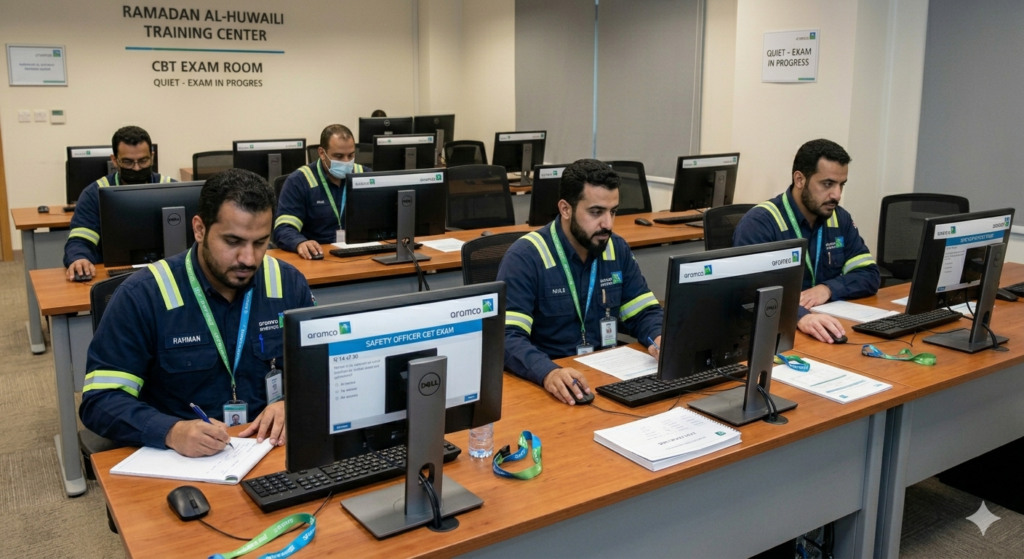
Saudi Aramco CBT Safety Officer Exam Preparation Guide — 100 Questions with Complete Answer Key
Introduction
Many experienced Safety Officers with 10, 15, even 20 years of site experience fail the Saudi Aramco CBT — not because they lack knowledge, but because they walk into the exam without understanding what Aramco specifically tests, how the questions are structured, and what standards are referenced.
This guide was written to close that gap.
The Saudi Aramco CBT Safety Officer Exam Preparation Guide published by FreeDocumentsHub.com covers all 10 subject areas tested in the actual Aramco Computer Based Test. It contains 100 practice questions across 10 parts, a complete answer key on the last page, a full abbreviation reference, and structured teaching sections before each question set so you understand the concept — not just memorise an answer.
What Is the Saudi Aramco CBT?
The CBT (Computer Based Test) is the mandatory exam that every contractor and vendor employee must pass before receiving an Aramco gate pass. It is conducted at approved Aramco testing centres and is based on Aramco’s own General Instructions (GIs), SAES standards, and international references including ISO 45001, OSHA, and Saudi Labour Law. The passing score is typically 70% or above. Fail, and you wait 30 days before you can retake.
For a Safety Officer, passing this exam is the legal requirement before stepping onto any Aramco project site. There are no exceptions.
What the Guide Covers — 10 Parts, 10 Questions Each
The guide is structured into 10 focused parts that mirror the subject areas of the actual exam:
Part 1 — CBT Exam Process: Registration through TAMS, exam day procedure, pass/fail process, badge issuance, and cooling-off period rules.
Part 2 — Safety Standards and Regulations: Aramco Life Saving Rules (GI-0002.102), hierarchy of controls, OSHA alignment, and GI cross-references.
Part 3 — Quality Management: ITP Hold Points and Witness Points, NCR process, ISO 9001:2015 principles, and quality audit expectations.
Part 4 — Communication and Reporting: Toolbox talk requirements, incident reporting timelines, Aramco PSR communication, and the legal status of safety records.
Part 5 — Safety Management Systems: JSA, HIRARC, Permit to Work types, Emergency Response Plan requirements, and emergency drill frequency.
Part 6 — Engineering and Technical Knowledge: LOTO, high voltage definitions, working at height thresholds, fall protection anchor requirements, crane lifts, and scaffolding tag colours.
Part 7 — Production and Operations Safety: HAZOP, SIMOPS planning and approval, maintenance PTW, turnaround (TAR) safety management, and permit expiry rules.
Part 8 — Data Recording and Documentation: TRIR and LTIFR calculations, calibration record requirements, document control rules, and the 24-hour record retrieval obligation.
Part 9 — Analysis and Problem Solving: Incident investigation sequence, 5 Why root cause analysis, Bow Tie analysis, and Behaviour Based Safety (BBS) observation programmes.
Part 10 — Management Systems and Compliance: ISO 45001:2018 PDCA cycle, Saudi Labour Law heat stress regulations, MOC process, contractor obligations, and Safety Officer to worker ratios.
How to Use the Guide
The guide follows the same discipline as the real exam — answer all 100 questions across all 10 parts before checking the answer key on the last page. This trains your exam mindset, not just your knowledge. If you score below 7 out of 10 on any part, go back, re-read the teaching section, and retake that part before sitting the real CBT.
The scoring guide is simple: 90–100 means you are ready. 75–89 means review your weak areas. 60–74 means re-study required. Below 60 means full restart before attempting the exam.
Who Should Use This Guide
This guide is for any contractor employee preparing for the Saudi Aramco CBT Safety Officer designation. It is equally useful for HSE professionals reviewing their knowledge of Aramco standards, project managers who need to understand what their Safety Officers are tested on, and training coordinators building CBT preparation programmes for their site teams.
Download the Guide
The Saudi Aramco CBT Safety Officer Exam Preparation Guide is available now on FreeDocumentsHub.com. Visit the website, browse the industrial documents library, and download your copy.
📎 www.freedocumentshub.com 📧 Custom documents and training requirements: contact@freedocumentshub.com
FreeDocumentsHub.com — Free Industrial Documents and Training. Available 24 hours, 7 days a week.
Sprinkler Systems Standard: Complete Reference Guide for Fire Protection Engineers and Inspectors
Introduction
A sprinkler system that activates correctly can contain a fire to the room of origin. A sprinkler system that was designed incorrectly — wrong occupancy class, wrong head spacing, inadequate water supply, missed obstructions — can fail when it matters most.
On industrial projects across the Gulf, sprinkler system drawings are rejected, installations fail inspection, and commissioning is delayed every week. Almost always the root cause is the same — the engineer or contractor did not have a working knowledge of what NFPA 13 actually requires.
This guide was written to fix that.
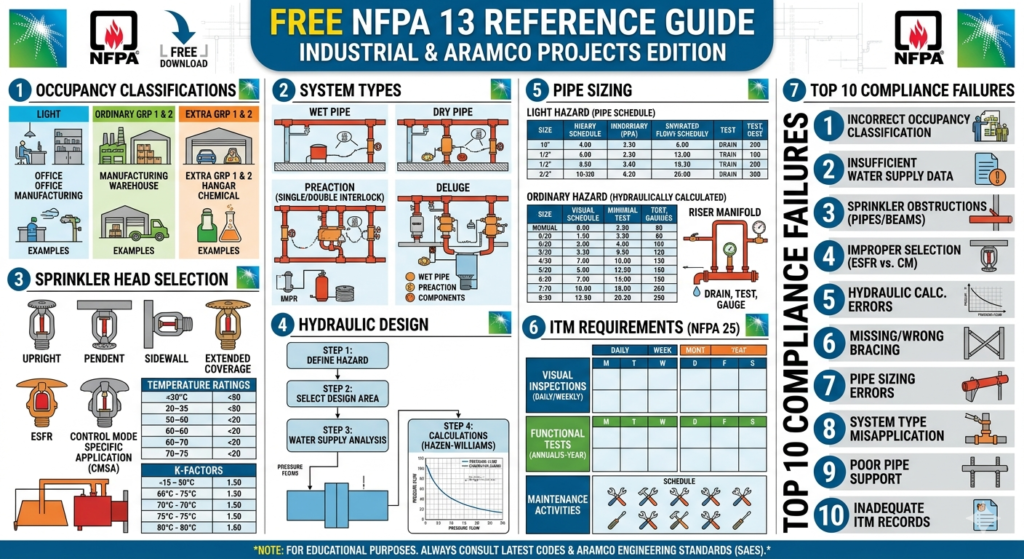
The NFPA 13 Complete Reference Guide from FreeDocumentsHub.com covers everything a working fire protection engineer, inspector, or safety officer needs — occupancy classifications and design densities, all five system types, sprinkler head selection, spacing and positioning rules, hydraulic design principles, pipe materials and supports, valves and alarm devices, inspection and testing requirements, and the ten most common compliance failures found on Aramco and industrial projects.
Download it free. Use it on every project.
What is NFPA 13?
NFPA 13, the Standard for the Installation of Sprinkler Systems, is published by the National Fire Protection Association and is the primary standard governing automatic sprinkler system design and installation worldwide. The 2022 edition is the current version.
On Saudi Aramco projects, NFPA 13 is the mandatory design reference for all sprinkler systems in buildings, warehouses, process facilities, and utility structures. Engineers submitting fire protection drawings for Aramco approval must demonstrate full compliance with NFPA 13. Inspectors and safety officers are regularly tested on its requirements. NFPA 13 does not stand alone — it works together with NFPA 25 for maintenance, NFPA 72 for fire alarm interfaces, NFPA 14 for standpipe systems, and NFPA 20 for fire pumps.
What the Guide Covers — 11 Sections
Section 1 — What is NFPA 13 establishes the purpose and scope of the standard, explains why it is critical on Aramco and Gulf industrial projects, and lists the full range of systems and applications it governs.
Section 2 — Occupancy Classifications is one of the most important sections in the guide. It covers all six occupancy classifications from Light Hazard through Extra Hazard Group 2 and Special Occupancies, with examples for each. It includes the design density and area of operation table — showing the exact water demand figures in both metric and imperial units for every occupancy class. Misclassifying the occupancy is the single most consequential design error in NFPA 13.
Section 3 — System Types covers all five system types in full — wet pipe, dry pipe, pre-action (single interlock, double interlock, and non-interlock variants), deluge, and foam-water systems — with the operating principle, correct application, and limitations of each. It covers the critical differences between pre-action and deluge systems that many engineers confuse, and explains where each system type is required on Aramco projects.
Section 4 — Sprinkler Head Types and Selection covers the complete temperature rating table with colour codes and maximum ceiling temperatures, the eight standard head types from upright and pendent through ESFR and CMSA storage heads, and the response type classification — standard response versus quick response — with their RTI values and required applications.
Section 5 — Spacing and Positioning Rules covers the maximum coverage area per head for every occupancy, the critical 1.8-metre minimum spacing rule that prevents cold soaking between adjacent heads, wall distance requirements, deflector clearance requirements, and the obstruction analysis rules for beams, ducts, cable trays, and columns that are the leading cause of drawing rejections on industrial projects.
Section 6 — Hydraulic Design covers when hydraulic calculations are mandatory, the seven key design parameters from design density through friction loss, the Hazen-Williams formula and C-factor values for different pipe materials, water supply analysis including fire flow testing, safety margin requirements, fire pump selection criteria, and the rule that system demand must never exceed 90% of available water supply.
Section 7 — Pipe Materials, Sizing and Supports covers all approved pipe materials including black steel Schedule 40 and 10, galvanised steel, CPVC, copper, and stainless steel with the correct application for each, hanger spacing requirements by pipe diameter, seismic bracing requirements, and flexible connection requirements at expansion joints.
Section 8 — Valves, Alarms and System Components covers the four types of indicating control valves, OS&Y versus butterfly versus PIV, alarm check valve operation, waterflow switches and their required retard settings, tamper switch supervision requirements, pressure switch applications, and the Inspector’s Test Connection requirement and testing procedure.
Section 9 — Inspection, Testing and Maintenance covers the complete NFPA 25 inspection frequency table from weekly control valve checks through 5-year internal pipe inspection, the 10-step acceptance testing procedure for new systems, and the hydrostatic test requirement — 200 psi for 2 hours with zero pressure drop.
Section 10 — Common Deficiencies lists the ten most common NFPA 13 compliance failures found on industrial and Aramco projects — wrong occupancy classification, heads closer than 1.8 metres, missing obstruction analysis, wrong temperature rating, unsupervised control valves, missing hydraulic calculations, unconfirmed water supply, missing Inspector’s Test Connection, hanger spacing exceeded, and no hydrostatic test record. Each deficiency shows exactly what goes wrong and what the correct requirement is.
Section 11 — Abbreviation Reference covers all 20 key NFPA 13 abbreviations.
Who Should Download This Guide
This guide is for fire protection engineers designing sprinkler systems for AHJ or Aramco approval. It is for mechanical engineers reviewing contractor sprinkler submittals. It is for site inspectors conducting sprinkler system acceptance testing. It is for safety officers preparing for the Aramco CBT where NFPA 13 requirements are tested. It is for project managers who need to understand why sprinkler drawings are rejected and what is needed to close the comments.
If you work on any industrial, commercial, or process plant project where an automatic sprinkler system is installed — this guide belongs in your technical library.
Download
The NFPA 13 Sprinkler Systems Complete Reference Guide is available now as a free Word document download from FreeDocumentsHub.com.
👉 www.freedocumentshub.com 📧 Custom fire protection documentation for your project: contact@freedocumentshub.com
All content is for exam preparation and educational purposes. Always verify current Aramco standards and revisions before applying on live projects.